
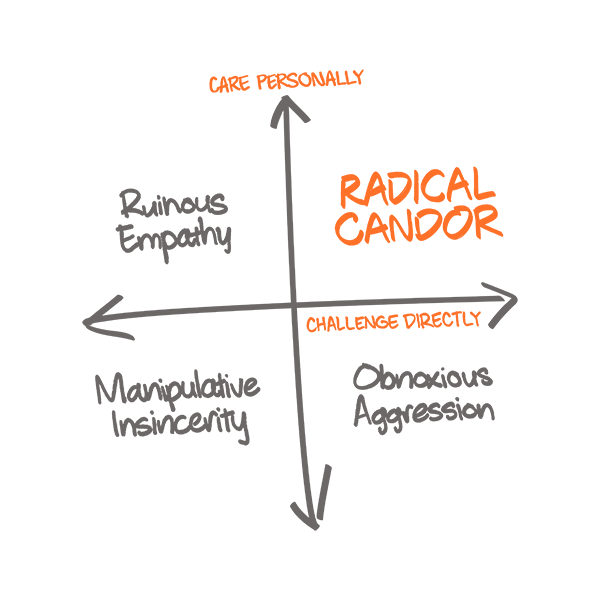
What Is Performance Development Anyways?
It is a manager’s job to help each person on their team both develop and grow their careers, as well as manage each person’s performance. Balancing the intrinsic desire to improve and grow and the extrinsic desire for rewards like bonuses, equity, and promotion is one of the most difficult things about being a manager.
It’s important to note that performance management is different than performance development. Yet, the two are often conflated. Giving a person a performance rating that translates to a bonus is very different from having a series of weekly impromptu guidance conversations that help a person develop the skills they need to succeed, help them know what to do more of, and what to do less of.
And yet people often talk about feedback as if the impromptu conversation and the performance review conversations are one and the same. They are two very different things. Impromptu conversations should be happening multiple times a week and should be focused on coaching a person to do more of what’s good and less of what’s not. Giving guidance that’s kind, clear, specific, and sincere is the cornerstone of performance development.
A performance review process without regular development conversations is like capping a rotten tooth. It will just rot faster and more painfully. Performance reviews should happen once or twice a year and should help the person understand their compensation, and their promotion prospects or termination risks, if any. Most companies expend so much energy on performance management that they don’t focus as much on development.
Because of this, employees are often blindsided during performance reviews because they haven’t received any guidance or feedback about their performance prior to their formal review. If a company is actively committed to performance development, there shouldn’t be any surprises when performance review time rolls around.
Have Regular Impromptu Development Conversations
The atomic building block of Radical Candor is the two-minute impromptu development conversation. You don’t want to try to operationalize impromptu chats. The motivations of both the feedback giver and the feedback receiver need to be intrinsic.
The motivation to solicit guidance and to act on it is the desire to improve, to grow, to do good work and then make it better, to build strong relationships and then make them stronger.
“I’m listening to you because I want to develop the skills and the team I’ll need to succeed.”
The motivation to give guidance is mostly altruistic—to help another person and the team as a collective flourish.
“I’m telling you this because I want to help you develop the skills you need to succeed and because it’s not fair to your peers if I don’t tell you.”
If you tie each two-minute conversation too explicitly to extrinsic motivators like bonus, promotion, or termination, you can ruin the motivation for them. If an employee thinks each two-minute impromptu conversation is going to impact their compensation or future career prospects, they will be less open to hearing what was said and more prone to fight it.
Radically Candid Performance Development is HIP
An easy way to remember how to succeed at Radically Candid performance development is by thinking of it like this: Radical Candor is HIP. Keep this top of mind when you’re having your impromptu conversations.
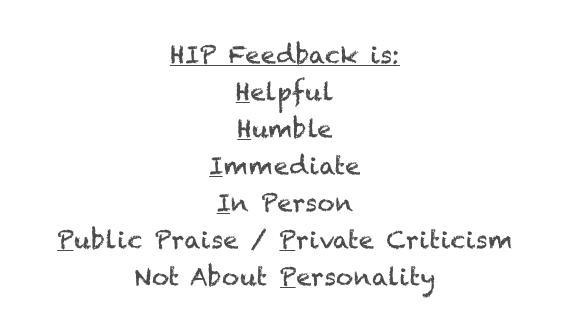
Humble: Don’t be arrogant. Be curious. Deliver your feedback firmly and with supporting rationale, but be open to push-back. Listen with true intent to understand so that you get a full command of both perspectives before agreeing or disagreeing.
Helpful: You don’t have to have all the answers. Simply exposing your intent to be helpful offers clarity to the other person about your intentions. Most people will want to hear whatever it is you’re going to say.
Immediate: Feedback has a short half life. When you give feedback while the details are all fresh in your mind, you are able to be much more specific. You also give the person a better chance to improve immediately.
In person: The clarity of your feedback gets measured not at your mouth, but at the other person’s ear. The majority of communication is non-verbal, and you won’t really know if the other person understood what you were saying if you can’t see the reaction. When talking in person, you can make adjustments based on their body language and emotions. If you work with a remote team, opt for a video call so you can still communicate face to face.
Private criticism / Public praise: A good rule for feedback is praise in public, criticize in private. Public criticism tends to trigger a defensive reaction and make it much harder for a person to accept they’ve made a mistake and learn from it. Public praise tends to make the recipient feel great, and it encourages others to emulate whatever they did that was great.
Not about Personality: Make your feedback about the work the person has done, rather than about the person. “I think that’s wrong” is more effective than “You’re wrong.” And “That was a great presentation because X, Y, Z” is more beneficial than “You’re great at presentations!”
Why It’s Worth It
While there’s no doubt that it’s a challenge, aligning performance development with performance management is such a key part of succeeding as a boss that I’ve devoted a bonus chapter to it in the second edition of the book Radical Candor: Be a Kick-Ass Boss Without Losing Your Humanity. (This new chapter discusses performance development and offers an in-depth guide for how to create a performance management strategy.)
By balancing the two, you can create a culture where people can grow in their careers or discover that perhaps the role they’re in isn’t a great fit for them. But if you fail to have regular development conversations, someone might get labeled as a B player when they’re simply just not suited for the position.
Everyone can be excellent at something. That’s very different from saying anyone can be good at anything—definitely not true. Sadly, lots of people never find work they are truly excellent at because they stay in the wrong job too long.
Bosses keep this kind of employee on for several reasons: they’re not sure they can find someone better; it takes time and effort to train new people; and they like the person and feel it would be unfair to encourage them to find a job they are better suited for.
This lack of courage and energy leads to a tremendous loss of human potential—to lives of quiet desperation. Assuming that people who are not thriving are therefore mediocre and can’t do any better is both unjust and unkind. Allowing them to continue down that path may be the worst case of Ruinous Empathy that managers regularly display and a great contribution to wasted possibility. It’s what I did with Bob.
The truth is that everyone can be exceptional somewhere and it is a boss’s job to help them find that role. But you can’t do this if you skip performance development conversations. The bottom line? You’re going to have to get HIP in order to create a talent-retaining culture where people actually like coming to work. Download the performance development guide >>
*This post was updated June 1, 2022
————————————————————————————————————————————————————————————–
Download our free learning guides to start putting Radical Candor into practice.
Sign up for our Radical Candor email newsletter >>
Shop the Radial Candor store >>
Book a keynote or workshop >>
Share your perspective
This site is protected by reCAPTCHA and the Google Privacy Policy and Terms of Service apply.