 Kim Scott

A Story
People often focus on feedback they get from their bosses. But the best feedback comes from the people who work for you. It can be difficult to get it—unless you create a culture where you solicit it regularly. I made a habit of it with my team in Dublin, when I worked at Google, and it paid off.
Once, I delayed the start of a meeting with the Dublin team because I didn't want to cut short my morning hour with my newborn twins. Deep in the fog of new parenthood, I thought everyone on the call would understand. A young father fired back, "Ya know, Kim, we have children, too!" I'd pushed the meeting into his dinner hour without thinking. At first I felt deeply ashamed, but I’d learned over the years that I generally respond badly when in shame brain. I kept my mouth shut and just breathed for a beat. Once I'd gotten over feeling defensive, I changed the meeting to a time that allowed me breakfast with my kids and him dinner with his. I was grateful to him for pointing it out. I would not have been aware of the impact that my new-parent fog was having on the rest of the team if he hadn’t pointed it out.
He didn’t speak up because I was open to criticism in some vague way. He spoke up because I had, at the advice of a mentor years before, made a habit of soliciting feedback in my 1:1’s and then, even though the silence was profoundly uncomfortable, keeping my mouth shut until they told me something. I’d often felt defensive, but I had learned over time to manage that natural feeling rather than lashing out. Most importantly, I’d rewarded the candor. I’d proven over time that folks wouldn't be punished for telling me what they thought; they’d also be rewarded by my fixing the problem or explaining why I couldn’t. As the leader of the team, I’d also made myself the exception to the “criticize in private rule,” so that people could point things out in team meetings rather than waiting to get a private meeting on my calendar, which could be difficult given how over-scheduled I was. It was fast, free, and helped us get along better while preventing me from making big mistakes.
The Idea
The Radical Candor® Order of Operations is simple: Get It, Give It, Gauge It. This post focuses on the first step: Get it. Where and how.
When should you ask for feedback?
The last five minutes of your 1:1
One-on-Ones are too often used to give feedback. I used to save up all my criticism for 1:1s with my team. I’d try to keep it casual by having them over coffee. Then I overheard someone calling them “the cappuccino of doom.” Don’t make that mistake!
Your main agenda item in a 1:1 meeting is to have a conversation–in other words, to let go of your agenda and get to know the other person. If you’re going to work well with people, you have to build real, human relationships. The best way to do that is to talk with them. On the one hand, this is common sense. On the other hand, this has come to feel like a radical act. When was the last time you put your phone away, closed your computer, and gave someone at work your full attention?
I recommend having real human conversations in your 1:1s with your boss, your closest peers, and with each of your employees. It’s their time, and they should drive the overall agenda.
But do save the last five minutes of every 1:1 to solicit feedback. Baking “get it” into a meeting you already have ensures you’ll actually do it. It’s your opportunity to get a fresh read on how you're doing, what mistakes you’re making, how you might be inadvertently annoying them or making life harder than it needs to be. Ideally, you’ll also hear about what you’re doing right, and be encouraged to do more of it.
When it’s time to give feedback, don’t save it up for your 1:1s (even with a cappuccino). Instead, do it right after the thing happens, in an impromptu two-minute conversation.
How do you ask for feedback—and act on it?
Four steps to getting actionable feedback and what to do next:
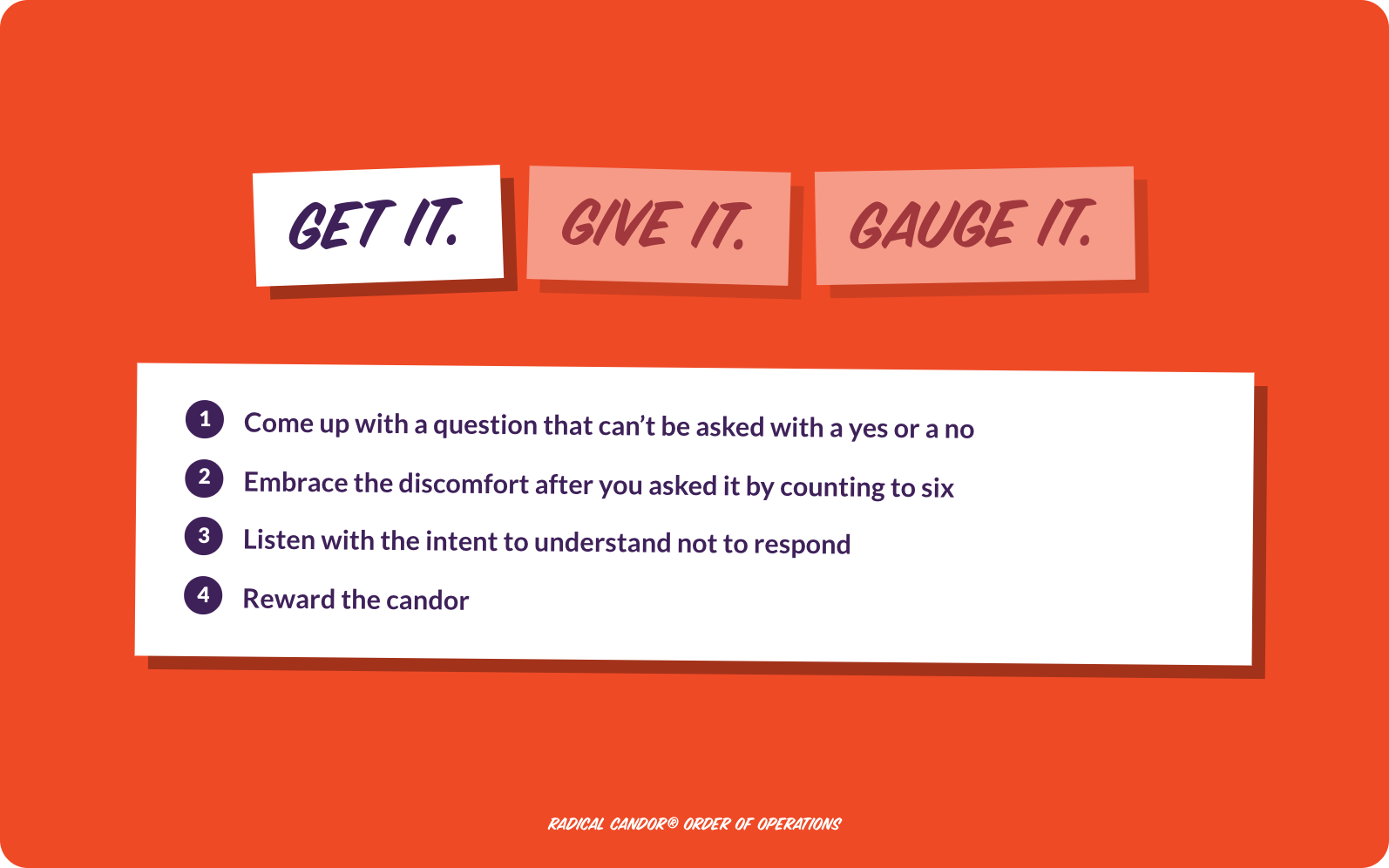
Step 1: Have a go-to question.
If you ask, "Do you have any feedback for me?" I can already tell you the answer: "No, everything's fine." Nobody wants to give you feedback, especially when they have to work hard to think of a specific answer to a generic question (Teenage kids are the exception. This is a service they are happy to offer—ask me how I know 🙂).
A question that can be answered quickly with a simple yes or a no offers the other person an easy out. So ask a question that demands a specific answer, and that sounds like you (e.g., not like a canned line you’re reading from a script). The one I often use is, "What could I do or stop doing that would make it easier to work with me?" If those words don't roll off your tongue, find words that do. And not everyone loves this question…after my cofounder Jason Rosoff and I had worked together for about a month, he confessed he hated being on the receiving end of such a broad question, so I changed it for my meetings with him.
You can brainstorm your own go-to question right now with our tool, Compass. It’ll help you find one that’s specific to you and that you’re actually excited to try with your team, boss, or peers.
Step 2: Count to six and embrace the discomfort.
Once you've asked, the other person is on the spot. Your instinct will likely be to rescue them from the awkward silence by rushing in to fill it. Don't do this. The only way to make them comfortable is to let them off the hook, and then you've failed to solicit feedback.
The simplest technique I know is to shut your mouth and count to six.
Six seconds is a long time. It feels like forever. Almost nobody can endure that much silence. If counting to six doesn't do it, ask the question again. If that doesn't work either, ask again differently. For example, if you ask “What could I change to make it easier for us to work together?” and they don’t answer, ask them “This might help: Think about our most recent project check-in. Was there anything I could have done differently to make it easier to work with me?”
Step 3: Listen with the intent to understand, not to respond.
I’m paraphrasing a habit espoused in The 7 Habits of Highly Effective People. It’s sold over 40 million copies, so safe to assume they’re onto something. Here’s what’s going to happen: You've finally gotten some criticism. Even though you asked for the feedback, you're likely to feel defensive when you actually get it. That is OK. It doesn't mean you're shut down to feedback. It means you're human, and your humanity is an asset, not a liability, to Radical Candor. You just have to manage your feelings rather than letting them manage you.
Whatever you do, don't critique the criticism. Instead, repeat back what you heard: "So what I hear you saying is..." Or ask a follow-up question. What you assume they mean may not be what they are trying to tell you. The most common communication problem is the illusion that it has happened…
Step 4: Reward the candor.
If all you say is "thanks for the feedback," the other person is likely to feel you’re brushing them off. You have got to make your listening tangible. To get more candor, you have to reward it: Fix the problem, or explain why you’re not going to fix it.
If you agree with the feedback, fix the problem. If you agree with the feedback but it will take time to fix, take the first step and explain what will happen from there.
If you disagree, explain why, respectfully. But before you launch into your disagreement, find the five or ten percent you do agree with and say so. Repeat back what you heard. If you feel defensive, ask to talk more in the next day or so. But don’t let it drop. When you come back to the topic, give a full, respectful explanation of why you're not going to act on it. A good disagreement can improve a relationship. Unresolved disagreement has a way of blowing up like a dirty bomb and contaminating a relationship.
What to do this week
Make “getting it” a routine part of every 1:1.
Open the agenda for your 1:1s and add an item: "Last five minutes: feedback for me"
Then look at who is missing from your calendar. If you don't have a regular 1:1 with your boss, ask for one. If you don't have one with the two or three peers you work with most, set one up. If you're a manager and any employee has fallen off your calendar, put them back on. You can't solicit feedback in a meeting you don't have.
If you want a place to practice your go-to question before you ask it for real, try Compass. But remember, what counts is a real, human conversation, not a practice session with an AI.
Up Next
A deeper dive on how to come up with your go-to question.
And if you want a real person to help your team put this into practice, reach out to our team.
Related reading: How Do You Build a Culture of Feedback? Get It, Give It, Gauge It, How to Receive Feedback, Responding to Negative Feedback
Share your perspective
Leave a comment below.