

Don’t let fears of tears (or some other emotional response) silence your feedback
In our workshops, we get a regular drumbeat of questions: “What if the person gets defensive? Starts to yell? Threatens to sue? Bursts into tears? What if they refuse to understand the criticism? What if they can’t figure out how to fix the problem? Why don’t they already know it’s a problem? Do I actually have to say it? Am I too nice? Am I too mean?”
All of it looms so large that people often give up before they even start.
That’s a mistake—not only at work, but also in your personal life. If I hadn’t gotten over my dread of a possible emotional response to my feedback, I might not be married today.
When I was first dating my husband Andy, he was over at my house when I went into my living room to do my daily yoga practice. He followed me in, sat down on the couch, and started reading the paper. I found this incredibly intrusive. I don’t want him watching me; it’s so awkward to tell him to leave; what if he gets upset? I’ll just say nothing, and then I’ll never ever go out with him again. Who does he think he is, sitting there on the couch reading the paper while I’m doing yoga?
Then I realized I could use what I’d learned at work and simply try to give Andy some feedback. “When you’re in the room while I’m doing yoga, I feel self-conscious. Do you mind reading the paper in the other room?”
“Oh, sure, of course.” He folded the paper and went into the other room. Yes, it was a little awkward for both of us. But it was also a moment of triumph. He was open to my feedback, and I learned that I didn’t have to be terrified about how it would land. Most of the time, it lands just fine.
You can’t predict or control a person’s emotional response to your feedback, and that’s okay
In the story above, I was so caught up in imagining how Andy might respond to my feedback that I almost said nothing. When I did speak up, I could gauge his actual response. As is usually the case with most people, it was no big deal. What a relief! But even if Andy had been sad or mad or brushed me off, it would’ve been OK because I had learned how to respond to those reactions. Your job is to just say what’s on your mind and be present for the person’s response. Don’t be silenced by your imagination of how they might react. We all tend to imagine the worst, but the worst isn’t what usually happens.
Noticing the other person’s reaction and responding effectively is the third step in the order of operations, “Gauge it.” To do this well, keep these three things in mind:
- Feedback is measured at the listener’s ear, not the speaker’s mouth.
- Nine times out of 10, giving feedback goes better than you think.
- Sometimes people will be mad, sad, or dismissive. There’s a playbook to use in each case.
1. Feedback is measured at the listener’s ear, not the speaker’s mouth.
When you first give them the feedback, start gently. You don’t need to start all the way out at the edge of Challenge Directly®. Make sure you’re clearly above the line on Care Personally®, and JUST SAY IT.
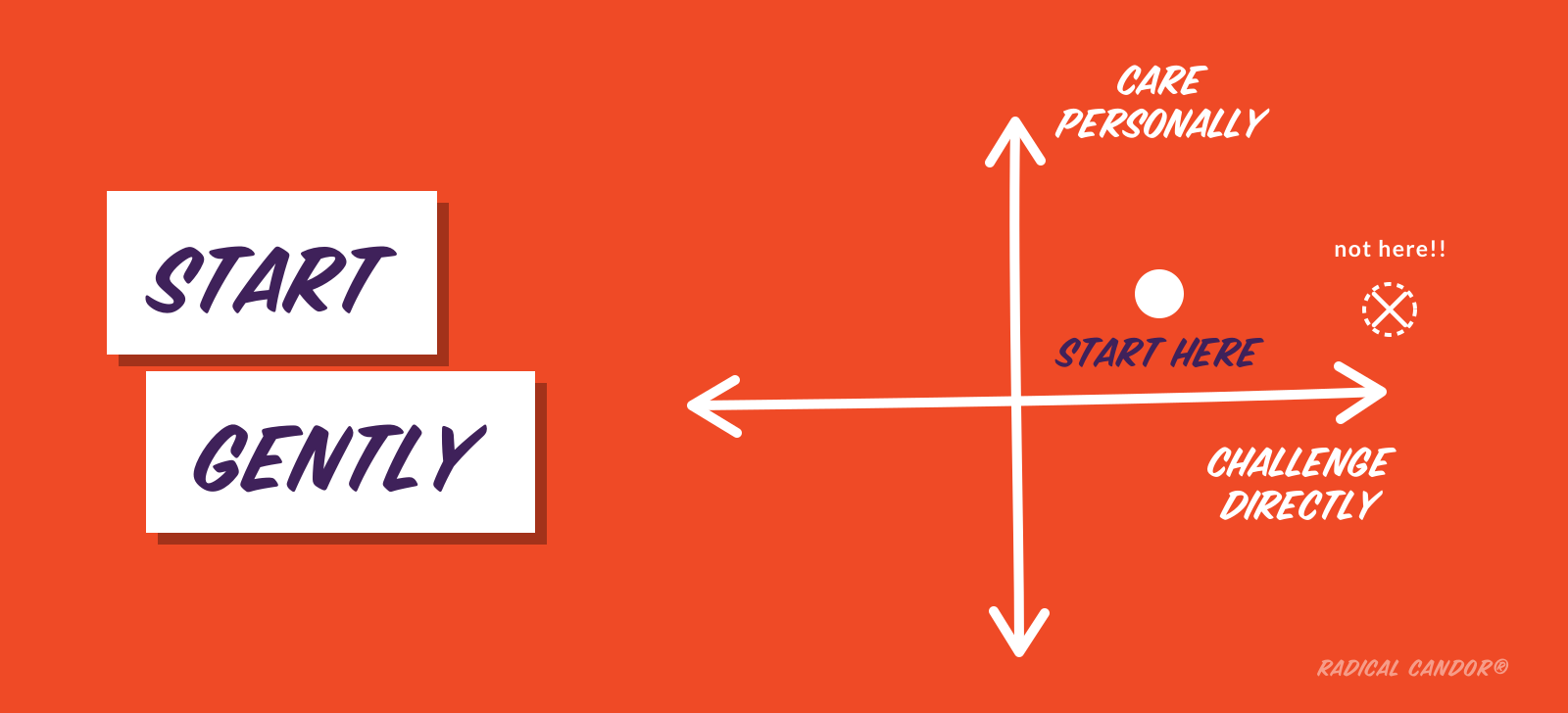
Then pay attention to how they respond. What do they say? Pay attention to their emotions, body language, facial expressions, and tone. Don’t get so focused on what you’re saying and how you’re saying it that you stop noticing the person you’re saying it to. Feedback is a conversation, not a monologue.
Remember, we communicate on an intellectual and an emotional plane at the same time. If you ignore the emotional signals coming at you, you simply won’t communicate very well. Yes, emotions are uncomfortable and messy. But we learn in discomfort.
You should also keep in mind that the same feedback, said the same way, can land differently for a multitude of reasons. That’s because Radical Candor is universally human, but culturally and interpersonally relative. Radical Candor is about love and truth at the same time—universal human values that anyone, anywhere, can understand. However, the way we express love and truth varies from culture to culture, from person to person, and from moment to moment. I know I respond differently before I’ve had my morning coffee vs. after, and I’m not alone. Because of this diversity and variance, there isn’t one right way to give feedback. This is what makes gauging Radical Candor so important, and so difficult.
What feels Radically Candid to one person can feel obnoxious, or too touchy-feely, to another. The gap widens when you move from one company to another, and widens even more when you move from one country to another. Or even just from New York to California. When I made that move, someone sent me a cartoon. It was a map of the United States with someone in New York saying “f— you” but thinking “have a nice day”; and someone in California saying “have a nice day,” but thinking “f— you!” When I moved from New York to California, I had to learn how to tone down my feedback. Sometimes people thought I was being incredibly rude when I thought I was just being clear.
With all those factors—culture, company, caffeine, and a million others—you’ll never know how someone will react to feedback. That’s why you have to stay present and gauge it in the moment.
2. Nine times out of 10, giving feedback goes better than you think it will.
The good news is, feedback usually goes well. But we all have a negativity bias, especially in interpersonal dynamics. For most of our evolution, we were dead if we got excluded from the tribe. We’re wired to remember the communication train wrecks as a survival mechanism.
Knowing that you have this bias—we all do, it’s primordial—is the first step to avoid acting on it. Now you can take a moment when you’re feeling scared or anxious and remember that it’ll likely go well and is worth doing.
The more you do it, the easier it’ll get, too. Radical Candor is designed to feel more like brushing and flossing than a root canal. It’s a quick, two-minute conversation that leaves both of you better off and can prevent harder and more uncomfortable conversations.
3. After feedback, people can sometimes be mad, sad, or dismissive. Don’t panic.
What do you do that one time out of 10, when it doesn’t go smoothly? You gauge it—recognize the emotion. Welcome the emotion, because that’s what will help you know what to do to get things back on track.
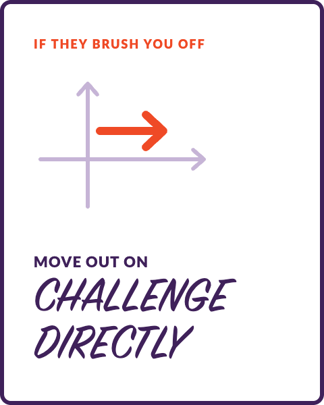
Here’s the short version—if the person seems sad or mad, move up on Care Personally; if the person brushes you off, move over on Challenge Directly.
If they’re sad, move up on Care Personally. If you’re like me, your instinct is to go the wrong way on Challenge Directly and to say something like: “Oh, don’t worry about it, it’s no big deal.” But it is a big deal. That’s why you said it. Backing off lands you in Ruinous Empathy® and leaves the person not only sad, but confused.
If they’re mad, you also move up on the Care Personally dimension of Radical Candor. Pay attention to the human need behind the anger. If you’re like me, your instinct when someone is mad is either to get mad back and perhaps start yelling, which lands you in Obnoxious Aggression®, or to feel afraid and clam up like a turtle in its shell, which lands you in a self-protective Manipulative Insincerity® situation. Neither one helps. Instead, stay curious and ask questions to understand the root of their anger.
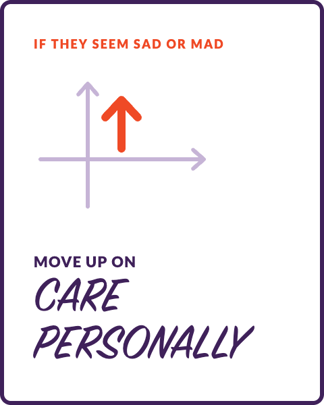
If they brush you off, you need to challenge even more directly. This is hard. It was probably hard to work up the courage to say the thing in the first place, and now you have to say it AGAIN, even more directly. It can feel like you’re hitting someone over the head, but that’s not what you’re doing. You’re simply being clear. Remember, “It’s not mean; it’s clear!” Finding the words that make it clear is part of gauging your feedback. Saying it once and then telling yourself “Well, I tried” doesn’t count. Your job is to get through to them, not to give up prematurely.
Your tip of the week
The next time you give someone feedback, notice how it lands. If they seem sad or mad, take a beat to show you care. Ask a follow-up question. Offer to help. If they brush you off or don’t seem to have heard you, say it again even more clearly.
Over the next few weeks, we’ll go much deeper on how to really show you care personally when someone is sad and mad, and how to challenge more directly.
If all you do after reading this is remember that Radical Candor gets measured at the listener’s ear, not your mouth, this was time well spent.
Up next
Next week: more about what, exactly, to do when someone is sad after you give them feedback.
Make sure you don’t miss it by signing up for our newsletter.
Related reading:
- The Radical Candor Order of Operations: get it, give it, gauge it
- How to Use the Radical Candor Framework to Gauge Your Feedback
- Navigating Radical Candor and Cultural Differences
Want to bring this to your whole team? Our workshops make it stick.
Share your perspective
This site is protected by reCAPTCHA and the Google Privacy Policy and Terms of Service apply.