 Kim Scott
A story
I’ll never forget my first meeting with the AdSense team in Tokyo. Everywhere else I’d worked, if I asked, “What could I do or stop doing that would make it easier to work with me?” and then counted to six in my head, somebody would say something.
I counted to six. Silence. Then I kept going to ten. Crickets. I asked a different way. Still, nothing.
My palms got sweaty. Embracing the discomfort is one thing; shvitzing in front of the team, quite another. Then, I had an idea. I told them a story about Toyota. To fight the cultural taboo against criticizing management, Toyota’s leaders painted a big red square on the assembly line floor. New employees had to stand in it at the end of their first week, and they could not leave until they had criticized at least three things. I asked my team: Did I need to go buy some red paint?
They laughed, but it worked: somebody opened up. It wasn’t much—just a complaint about the tea in the office—but I rewarded that candor handsomely. I thanked the person publicly. I sent a handwritten note. I approved funds for better tea, and I made sure everyone knew they’d enjoy their tea breaks that much more because somebody had spoken up in that meeting. It sparked a shift, and soon people started raising more substantive issues.
The idea
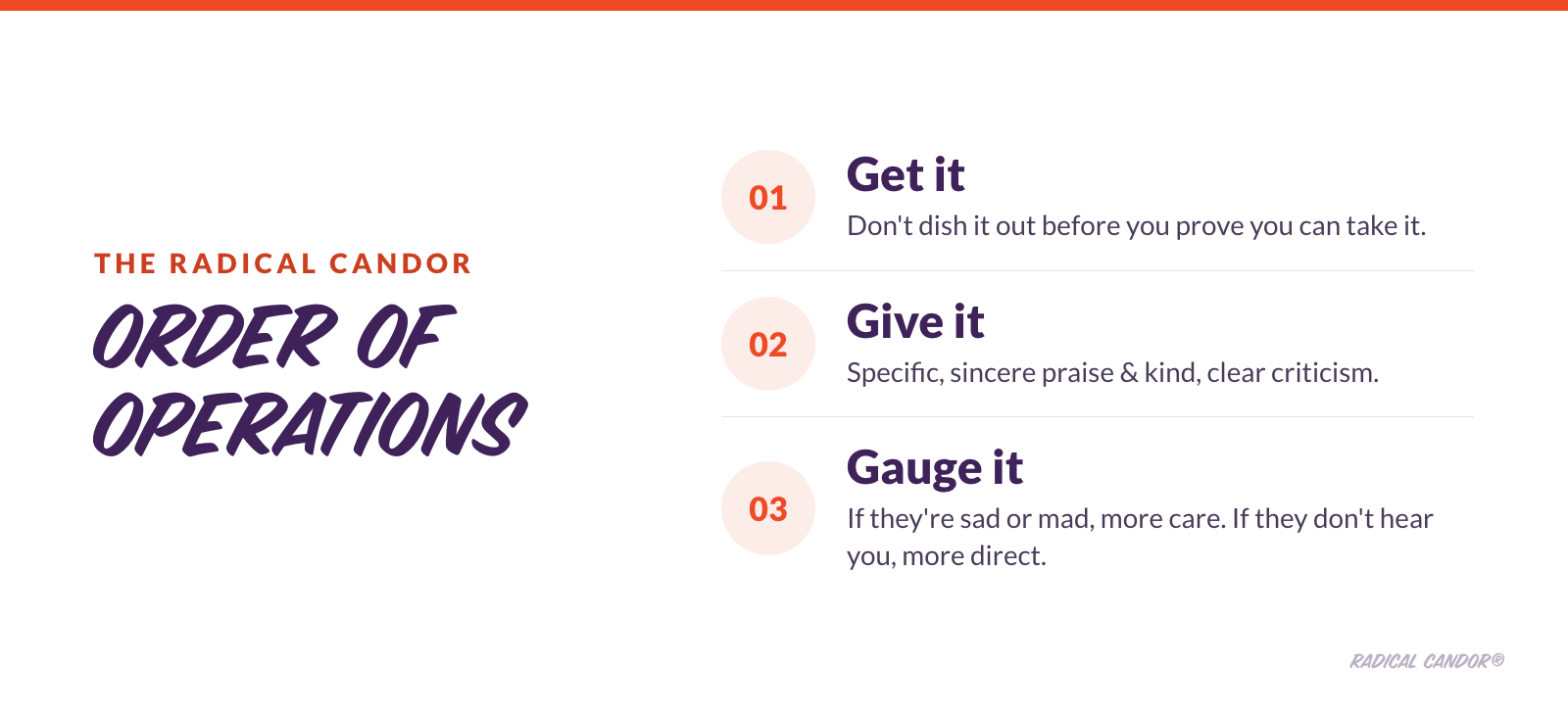
That meeting is an example of the first step in the Radical Candor Order of Operations: Get It. Often, when I talk to people about developing a culture of Radical Candor, they agree with the idea but feel nervous about putting it into practice. I always break it into three steps—the Order of Operations. Get it. Give it. Gauge it.
Get it.
Why start by asking for criticism instead of giving it?
First, asking for criticism is the best way to show you know you are often wrong and want to hear about it. Second, you’ll learn a lot, especially if you’re the boss. Few people scrutinize you as closely as the people who report to you. Third, the more firsthand experience you have of what it feels like to receive criticism, the better idea you’ll have of how your own feedback lands with others. Fourth, asking for criticism builds trust. It strengthens the relationship. Last but certainly not least, when you solicit feedback and then respond well when you get it, you’re leading by example. You’re showing others that their feedback helps improve your performance and your relationship with them. That makes them more receptive to your feedback.
If you’re not sure when to ask for feedback, the last five minutes of a 1:1 is the best slot. Make this something you do routinely, once every week or two. So bake it into a meeting you already have. Your main goal in a 1:1 is to listen, and soliciting feedback is a form of listening. Also, counterintuitively, a great moment to hear what people really think is when they are angry with you. If someone is mad at you and you are not too angry yourself, go talk to them. My instinct is to avoid people who are mad at me. I bet yours is too. It’s a lost opportunity.
Don’t discount public feedback, either. If you are the boss, you are the exception to the “criticize in private” rule. Once I figured out who on my team was most comfortable criticizing me, I’d ask that person to do it in front of others at a staff meeting. Reacting well to criticism in public shows the whole team you genuinely want it. Michelle Peluso, then CEO of Gilt Groupe, shared her own 360 review with her executive team and told the whole company, “Here is where I want your help.” That makes it safer for everyone else to do the same. That’s why we call this building a culture—not just an individual practice.
Finally, when you’re soliciting feedback, focus more on criticism than on praise. Accept praise graciously, but don’t go fishing for compliments. Analyze the feedback you get. If it’s all praise and no criticism, beware. Someone’s blowing smoke up your rear end.
Jim Morgan, when he was CEO of Applied Materials, often said, “No news is bad news. Good news is no news. And bad news is good news.” Words to live by!
If somebody is bold enough to criticize you, do not critique their criticism. Your job is to listen with the intent to understand, and then to reward the candor. That is how the tea complaint in Tokyo turned into bigger, more useful complaints later.
There’s a lot more to learn about soliciting feedback. We will get into more details next week. If you want the skinny delivered to your inbox, sign up for the newsletter.
Give it.
How do you give both praise and criticism without serving up a shit sandwich?
Once you’ve shown you can take it, you can start giving it. Give more praise than criticism. Praise should be specific and sincere. Criticism should be kind and clear.
It is just as important to tell people what to do more of as what to do less of—praise guides people in the right direction. A CEO I spoke with told me he realized it was time to get better at praise when somebody put a laminated plaque reading “say something nice!” in his cubicle.
But don’t turn this into a ratio. Some professionals say you need 3:1, or 5:1, or even 7:1 praise to criticism. Others advocate the kiss me, kick me, kiss me approach to feedback. Often called the “shit sandwich.” A forced ratio leads you to say things that are unnatural, insincere, or just plain ridiculous. If you say to me, “I love your glasses, your book kind of sucks, but wow I love your shoes,” it’s just annoying. Patronizing praise erodes trust just as fast as harsh criticism.
Karen Sipprell, a colleague at Apple, asked two questions I still use: “How long do you spend making sure you have all the facts right before you criticize somebody? How long do you spend making sure you have all the facts right before you praise somebody?” Ideally, it should be the same amount of time. The details matter.
Gauge it.
How do you know how your feedback landed?
Radical Candor gets measured at the listener’s ear, not at the speaker’s mouth. Impact matters, not intentions.
Shortly after I joined Google, my boss walked me back to her office after a presentation. She told me what had gone well, and then she said, “You said ‘um’ a lot in there. Were you aware of it?” I made a brush-off gesture with my hand. “It’s a verbal tic, no big deal.” She offered me a speech coach. I brushed that off too. Then she stopped, looked me in the eye, and said, “I can tell when you do that thing with your hand that I’m going to have to be a lot more direct with you. When you say ‘um’ every third word, it makes you sound stupid.” Now she had my full attention. But she had to try three times to get to clarity. And she had to know me well enough to know that it wouldn’t crush me if she said that I sounded stupid.
That is gauging. She watched how her words landed, saw that they hadn’t, and challenged me even more directly. If, on the other hand, I had gotten upset, she would have taken a beat to show me that she cared, and to reassure me that she was there to help me solve the problem. She wouldn't have backed off on the challenge, but she would have moved up on the Care Personally dimension of Radical Candor.
Your Order of Operations checklist
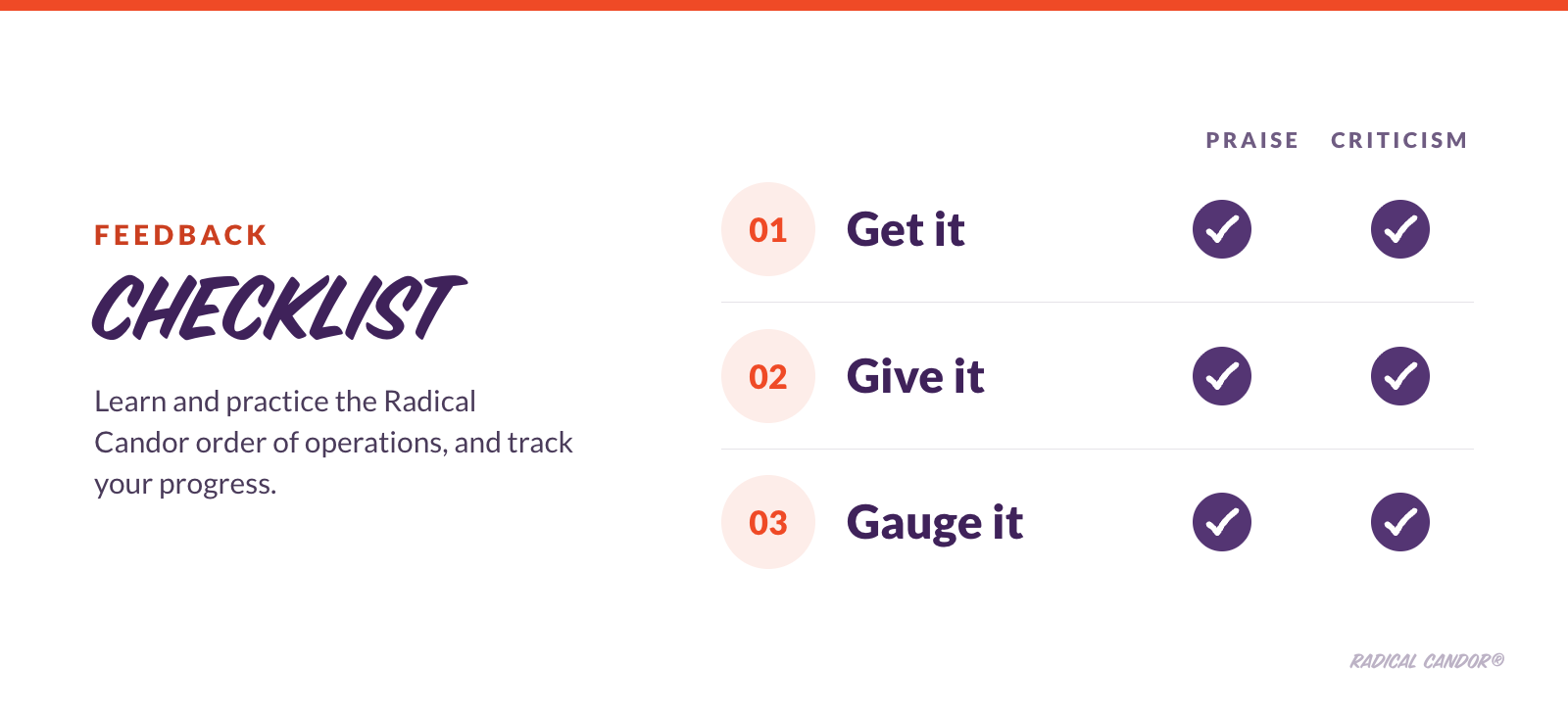
Here is a checklist you can use to make sure you’re staying oriented in the Radical Candor Order of Operations.
Is this just about managers giving and getting feedback?
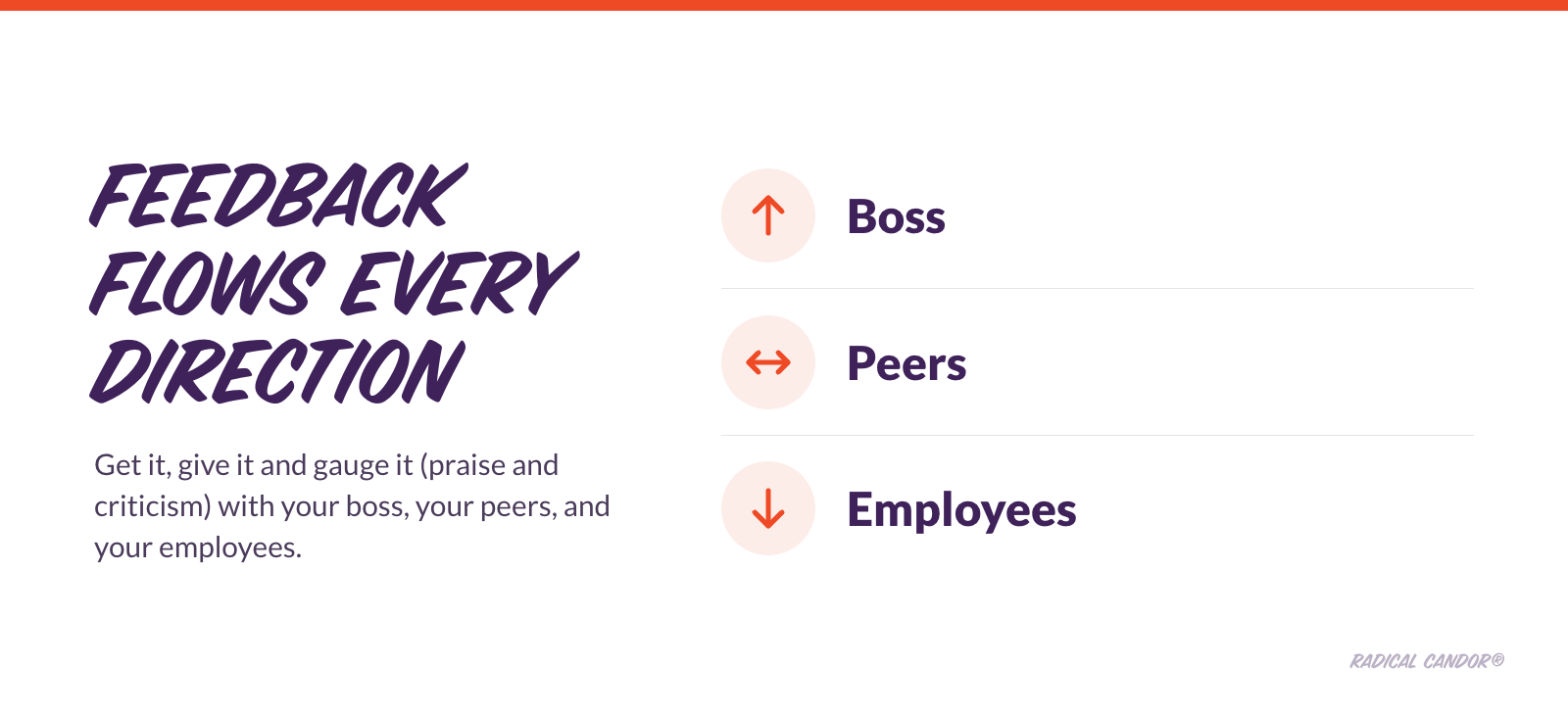
Absolutely not. The Order of Operations works the same up, down, and sideways, even though it feels very different. Before you tell your boss what they’re doing wrong, find out what your boss thinks you’re doing wrong. Same with your peers: you have to know what they think you’re getting wrong so you can fix it. Then they’ll be far more open when it’s your turn to point something out. Most people believe it’s easier to be Radically Candid if you’re the boss. But often managers are just as afraid to give employees feedback as employees are to give managers feedback.
Speaking up feels risky to everyone. But silence is the bigger risk. As the song goes, “silence like a cancer grows.” Radical Candor is the antidote, and it must happen “up,” “down,” and “sideways.”
Try this today, not tomorrow
Get it. Give it. Gauge it. It’s simple, but it shouldn’t be formulaic. You don’t have to do all three in every conversation. If you try to do that, your conversations will start to feel false and robotic, like the shit sandwich, only a triple decker.
Radical Candor should feel like brushing and flossing, not a root canal. The idea is to be conscious, on a regular basis, of getting criticism, giving praise and criticism, and gauging how what you say lands. These are short chats, not long, drawn-out conversations.
So start where the order starts. Get it. Pick one person. In the last five minutes of your next 1:1, ask them one question that can’t be answered with yes or no. Then shut your mouth and count to six. Six seconds is a long time. They will say something.
If all you do as a result of reading this is decide who you’re going to ask, come up with a specific question to ask that can’t be answered with a “yes” or “no,” and ask it today, this was time well spent.
Next week I’ll go deeper on the four steps for soliciting feedback: have a go-to question, embrace the discomfort, listen with the intent to understand, and reward the candor. If you want us to deliver that to your inbox, sign up for the newsletter.
In the meantime, if you want a place to practice the question before you ask it for real, try Compass. And if you want a real person to help your team put this into practice, reach out to our team.
Related reading: How to Receive Feedback, Debate in Public, Criticize in Private, What Is Radical Candor?
Share your perspective
Leave a comment below.