

What Does Good Feedback Sound Like in the Moment?
During a class at business school, “Jane” passed a note about “John” that John intercepted. Here’s what it said: “Check out John picking his nose—I think he just nicked his brain.”
I’d been assigned to a group project with both John and Jane. Needless to say, John was furious, and the note derailed our ability to work together. Half the people on the project dismissed Jane as an asshole; the other half dismissed John as oversensitive. Now, in addition to John and Jane being angry at each other, there was a broader fight on the team: the asshole vs. the oversensitive contingent.
How were we going to help us get the project back on track?
If I had known then what I know now, I would’ve given some feedback to Jane: “When you passed a note about John’s nose-picking, he wound up seeing it. It pissed him off unnecessarily, made it harder for us to work together, and it’s going to cause us all to get a bad grade on this project. Please go apologize to John.”
Here’s how to give specific, sincere praise and kind, clear criticism.
The Idea
The best feedback happens in real, human, two-minute conversations. They’re impromptu and happen right after the moment you’re commenting on—you’re not saving them up for a 1:1 meeting or an annual performance review. More about the where and when in this post.
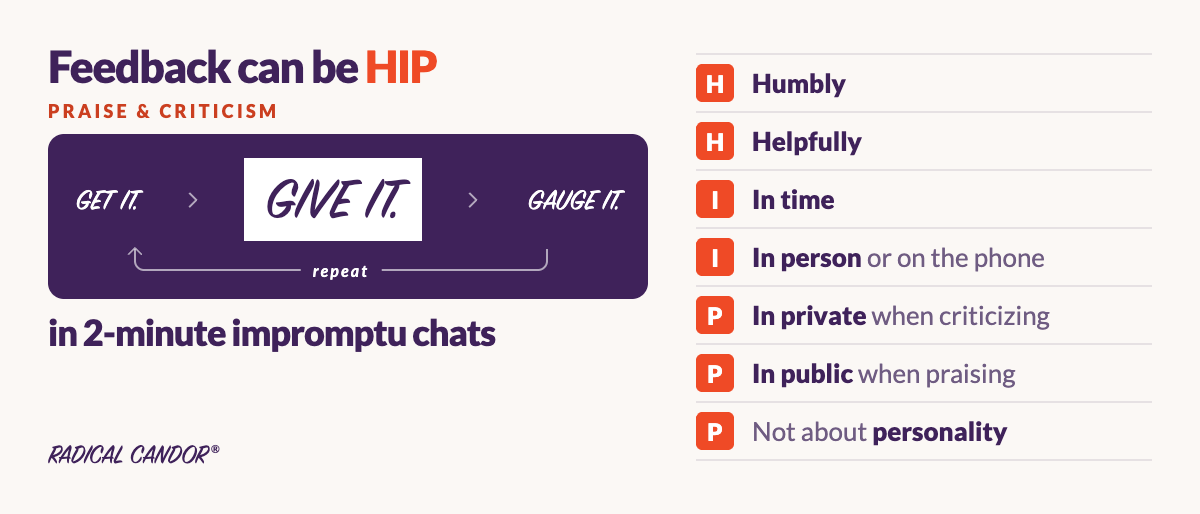
But short and impromptu ≠ careless. There are seven things you can do to help your feedback (praise and criticism) have the intended impact:
1. Be Humble
You are not the sole arbiter of what’s good and bad. That’s why I call it candor, not truth. If you walk up to someone and say, “I’m going to tell them the truth,” you’re implying that you are all-knowing and they don’t know anything. Not a great way to start a conversation. Not sure you’re right about your feedback? That’s an asset, not a liability. When you’re sure you’re right, you’re prone to arrogance.
Unlike “truth,” candor implies: “Here’s how I understand this situation. I also want to know what you think.”
Right or wrong, what you’re offering is a gift. If you’re right, you’ve given the person a chance to fix the problem, or to do more of what’s great. If you’re wrong, saying what you think is the only way they can correct your thinking. These are conversations, not monologues.
2. Be Helpful
State your intention: you’re trying to help. That alone goes a long way towards lowering someone’s defenses. In your own words, try something like: “I’m going to describe a problem I notice. If I’m wrong, I hope you’ll tell me. If I’m not, I hope I can help you fix it.” Or, “I admire what you did there, and I want to give you an opportunity to do more of it because that will help you succeed.”
Being helpful doesn’t mean you need to have the solution for the other person. You’re not omniscient, and you don’t have to do everyone’s work for them. The only help you may have to offer is the conversation itself and a commitment to work with them to find a way to do more of what’s good if it’s praise, less of what’s bad if it’s criticism. You don’t have to know the answer, but you do have to show you’ll help them find the answer. You’re not a seagull who swoops in, craps all over everything, and flies off.
3. Give Feedback Live, in Person or on the Phone
Whenever possible, give feedback in person. Ideally, take a walk. There’s something helpful about walking and looking in the same direction.
It’s tempting to just fire off a quick text. But Radical Candor gets measured at the listener’s ear, not the speaker’s mouth. If you can’t tell how it landed, you don’t know if you were clear enough, or if the person is upset and you need to take a beat to show you care.
I’ve told the story of my boss telling me I said “um” a lot. If she’d done it over text or email, she wouldn’t have seen me literally wave off the feedback with my hand. That would’ve been a silent communication fail over text.
Sometimes a text sets off fireworks of miscommunication. We’ve all had experiences when it seemed faster to text, but our text got misinterpreted and we spent hours or days trying to recover from the damage. Think of a time that happened to you, give the story a name, and think of it next time you’re tempted to fire off a text rather than picking up the phone or walking down that hall. (The same applies to giving feedback by email, by the way!)
If you’re not physically in the same place, try a phone call. Put your earbuds in and your phone in your pocket. That way you’re less likely to be distracted by notifications and you can both walk around. Many people find they listen better that way. One study, called It’s Surprisingly Nice to Hear from You, even suggests that phone calls support better collaboration than video because there is more noise than signal in facial expressions over a video call.
4. Give Feedback Right Away
Feedback has a short half-life. If the purpose of praise is to tell people what to do more of, and the purpose of criticism is to tell people what to do less of, why wait? If you notice something good or bad, say something as soon as possible.
If you wait, everything gets harder. You forget to write it down, the details get fuzzy, and you can’t be clear or helpful when you finally sit down. Or, more likely: you don’t say anything and a small problem gets much bigger.
Two important exceptions, though. You can delay if:
- You are hungry, angry, or tired. Wait until you’re in a better frame of mind.
- It’s not important. Radical Candor should not feel like nitpicking, so if something isn’t really important, you don’t need to say it right away (or maybe ever).
5. Praise in Public
Public praise is a great way to express gratitude and appreciation, which is crucial for any relationship. It also shows everyone else what great looks like, so they can learn from it and improve the whole team’s work.
Of course, some people don’t like public praise. The goal is to let them know what they did well in a way that they’ll be able to hear and appreciate, not the way that will help you the most. As you get to know the people you work with, you’ll understand which approach to use with whom.
6. Criticize in Private
Public criticism tends to trigger a defensive fight-or-flight response. When that happens, the person physically cannot hear what you’re saying, so you’re wasting your breath. You also may be creating fear in others, making it hard for them to do their best work.
Remember, debate must happen in public, while criticism should happen in private.
There’s one big exception: when you’re the boss. A boss needs to invite criticism in public. This shows everyone that they don’t need to be scared to give you feedback, and you can model how to receive it well, without defensiveness, and how you reward the candor. Plus, it scales. Several people probably have the same criticism, and this is the best way to address it once, not 20 times.
7. What is the CORE Feedback Framework? Don’t Make Feedback About Their Personality
“You’re a genius” is bad praise, for the same reason that “you’re stupid” is bad criticism. It’s hard for the person to know how to do more “genius-ing.”
This is hard because, when something goes wrong, it’s tempting to apply a personality attribute: the person is lazy, sloppy, or a jerk. Not only is that usually inaccurate, but it also isn’t fixable.
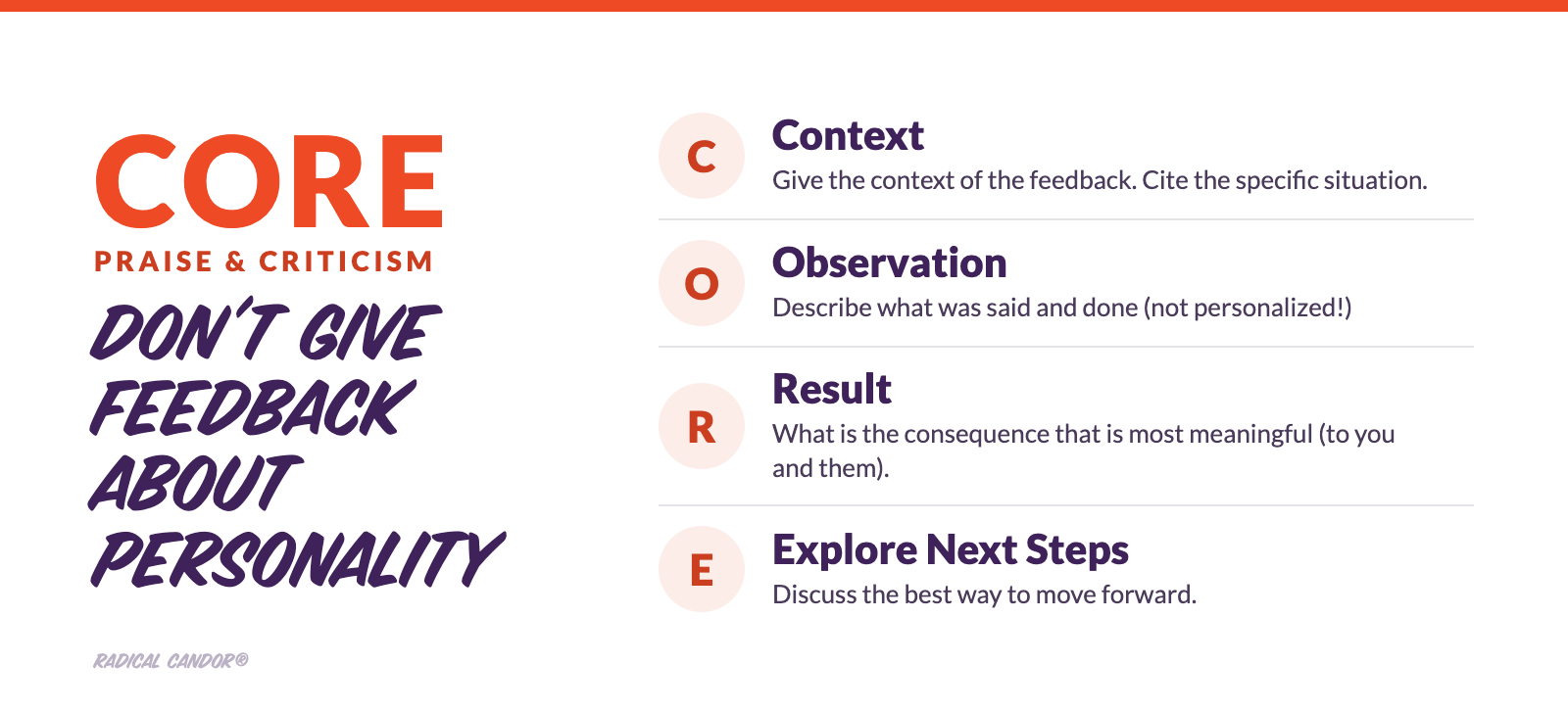
A framework called CORE is how you keep bringing everything back to things the person can fix, not personality attributes. Let’s go back to what I wish I’d said to Jane from my business school class.
Context. Where and when did the thing happen? “When we were in class today…”
Observation. What exactly was said or done? “…you passed a note about John’s nose-picking, and he saw it.” It can be awkward to state exactly what happened, especially if it’s as ridiculous as this. Don’t mince words!
Result. What was the most meaningful consequence, to you and to them? “It pissed him off unnecessarily, made it harder for us to work together, and it’s going to cause us all to get a bad grade on this project.” You might check in that they agree on the result. “Do you see it the same way?” Agreeing on the problem counts as progress.
Explore next steps. Where do you go from here? “Please go apologize to John.” You don’t have to have the answer. The next step might just be a question: “Do you think it would help if you went to apologize to John?”
CORE works for praise, too. For example: “In this morning’s budget review (context), you answered every one of the CFO’s questions in a sentence or two (observation). We got a decision in the meeting instead of a follow-up (result). Please do more of that, and help the team to do so as well. Would you walk the team through how you prepped (next step)?”
Your Tip of the Week
Practice CORE praise. Write down the C, O, R, and E on a sticky note. Then, within a day, find the person and have a live, two-minute conversation.
Up Next
Next week: how to give more praise than criticism without serving up a “shit sandwich.”
If you want tips delivered to your inbox, sign up for our newsletter. Want to practice CORE? Try Compass, Radical Candor’s AI feedback coach that will get you really comfortable with the framework.
Things move much quicker when everyone knows it, too. If you’d like help teaching this to your whole team, Radical Candor, the company behind Kim Scott’s book, runs feedback workshops where teams practice these conversations.
Share your perspective
This site is protected by reCAPTCHA and the Google Privacy Policy and Terms of Service apply.