

A Story
A banker who led a high-stakes tech IPO ran an important meeting with the COO of the company that was going public. The meeting had been a home run. So he was surprised when the COO asked, “What could I have done better?”
He couldn't think of anything, but she wouldn't let him off the hook. "I know there was something I could have done better in there." He was still drawing a blank, and now he was getting nervous. "You have a reputation for being great at giving feedback," she encouraged him. "I bet if you think about it, you can come up with something." He was sweating now, but she just smiled and stayed silent.
He finally thought of something: a metaphor she’d used hadn’t really landed. She listened and, after a beat, said, “Well, what I was trying to say was….” she explained, then asked, “Would it be better if I said this instead?”
See what she did there? Here are your 2 takeaways:
1. She embraced the discomfort. She sat through the silence without rescuing him from the awkward moment.
2. She listened to understand, not to respond. When he finally said something, she didn't argue with him. She also didn’t ask him to do the work to fix it. She offered her own suggestion and asked for his feedback on it, too.
He walked away knowing she valued his point of view, and that he had a memorable example he could mirror if she ever gave him feedback. She walked away with actionable feedback that she could use immediately. The relationship was strengthened, not weakened, by just a few moments of uncomfortable tension.
The Idea
You create an uncomfortable moment when you ask for feedback. The only way out is through. Embrace the discomfort! Discomfort signals you are learning, growing, and deepening your relationship. (See Adam Grant’s research if you don’t believe me.)
No matter how good your go-to question is, it won’t make the moment of soliciting feedback comfortable. You’ve put the other person on the spot. Then, when they finally do give you some criticism, the discomfort might get worse, not better, because you’re likely to feel defensive. Here’s how to manage the moment.
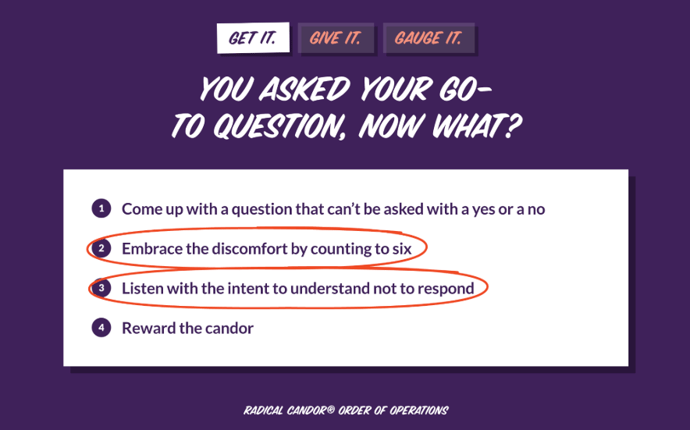
How do you embrace the discomfort?
After you ask your go-to question, the person doesn’t know quite what to say, and they’d really like to say nothing. They’re hoping you’ll jump in and rescue them. Don’t!
The simplest technique is to close your mouth and count to six, slowly.
One-Mississippi-two-Mississippi-three-Mississippi-four-Mississippi-five-Mississippi-six-Mississippi…
Almost nobody can endure six full seconds of silence. They will tell you something.
The question is, can you endure the six full seconds? It will feel like forever. That’s the point. It’ll push the person to tell you what they’re really thinking—because the alternative is that awkward silence.
If six seconds doesn't do it, you can pipe in, but not to say “oh, it’s okay” and move on. Instead, try asking the question again differently. If they truly can't come up with anything on the spot, don’t let them off the hook. Set a time to come back to it, as the COO in the story above did.
Another way to embrace the discomfort is to inquire about a person’s body language. Imagine you've just shared a big, possibly impractical idea with a colleague. He says, "Oh! Great idea," but then he hunches over and crosses his arms. Ignoring that is a lost opportunity. Without being obnoxious, ask something like: "Then why are you folding your arms and hunching down in your seat? Come on, tell me what you're really thinking!"
How do you listen with the intent to understand, not to respond?
Now you’ve asked your question and gotten an answer. You’ve dragged this poor soul out on a conversational limb they never wanted to go on. But here’s the problem. Even though you just asked for criticism, when you get it, you’ll probably feel defensive. That is OK. It doesn’t mean you’re shut down to feedback. It just means you’re human.
It’s OK to feel defensive! But it’s not OK to get defensive. If you criticize the criticism, you’re pretty much guaranteeing that person will not be candid with you next time.
The simplest technique is to ask a follow-up question to make sure you actually understood what they meant. An old line, often credited to George Bernard Shaw, says the biggest problem with communication is the illusion that it has happened.
My daughter once said to me at breakfast, "Mom, I wish you weren't the Radical Candor lady." A wave of parental guilt washed over me. Too much travel, too much work. Then I started to feel defensive. How did she think I'd make a living? But, thankfully, it occurred to me that I should take my own advice. I asked a follow-up question: "Well, who do you wish I were?" She fired back, "I wish you were the lady who minded her own business." Good thing I asked!
Another thing you can do is to repeat back what you think you heard: "So what I hear you saying is..." A word of caution, though: be sure that you are doing this with genuine curiosity. Sometimes a note of sarcasm or a belittling tone can creep in when you repeat back what you heard, especially if you’re feeling defensive. If that happens, you’re not managing your feelings; you’re spewing them onto the other person.
What to do this week
Practice two things:
- Ask a question and then be silent for six seconds so you get comfortable with how very long that is.
- Next time you feel defensive, think of follow-up questions so that you can check for understanding.
Up Next
How to reward the candor.
And if you want a real person to help your team put this into practice, reach out to our team.
Related reading: How Do You Get Feedback? The Four Steps to Solicit Radical Candor, How Do You Ask for Feedback? The Three Tests of a Good Go-To Question, How to Receive Feedback, 11 Tips for Getting Feedback From Your Employees
More from Radical Candor
How Do You Ask for Feedback? The Three Tests of a Good Go-To Question
The idea Get it. Don’t just be open to it.
How Do You Get Feedback? The Four Steps to Solicit Radical Candor®
A Story People often focus on feedback they get from their bosses. But the best feedback comes from the people who work for you. It can be difficult to get it—unless you create a …
Fixing the Employee Experience (with Tiffani Bova) 8 | 26
While the podcast team is on a Radical Sabbatical, Kim Scott is spending the season talking to authors of the books that have shaped her thinking. This week: Tiffani Bova, whose …
Share your perspective
This site is protected by reCAPTCHA and the Google Privacy Policy and Terms of Service apply.