

What does rewarding the candor look like?
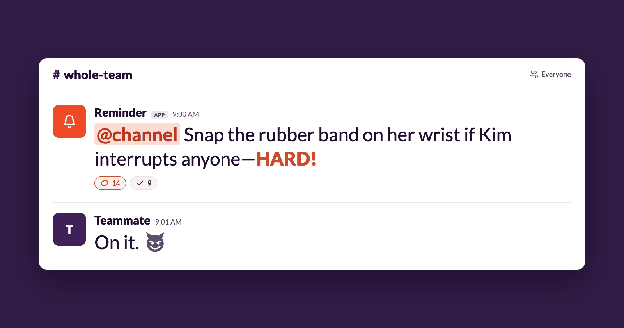
This story always comes up in our workshops: When we worked together at Google, my colleague Russ Laraway once complained that I interrupted him. It was true; I am an inveterate interrupter. I knew I couldn’t eradicate this bad habit just because he’d mentioned it. If all I’d done was to say, “Thank you for the feedback,” Russ would have thought I didn’t care. I needed to make my listening tangible.
At my next team meeting, I shared the feedback publicly. “Russ told me that I interrupt him often. I know it’s true, and that it’s a problem. I also know I probably do this to all of you. It’s my responsibility to change. But may I ask you to help me?”
I held up my wrist, where I’d put a fat, blue rubber band that I’d taken from some stalks of broccoli I’d cooked the night before. I asked everyone on the team to snap the band if they were sitting next to me and I interrupted someone in a meeting. The team thought this was funny, and had no problem agreeing to “snap me.”
I wore my “radical bandor” for the next few months. Sure enough, people snapped it. It was excellent Pavlovian training, and it did help me interrupt less. It also sent a strong signal to Russ—and everyone—that I had heard the criticism, was taking action, and wanted to hear more.
Why isn’t ‘thanks for the feedback’ enough?
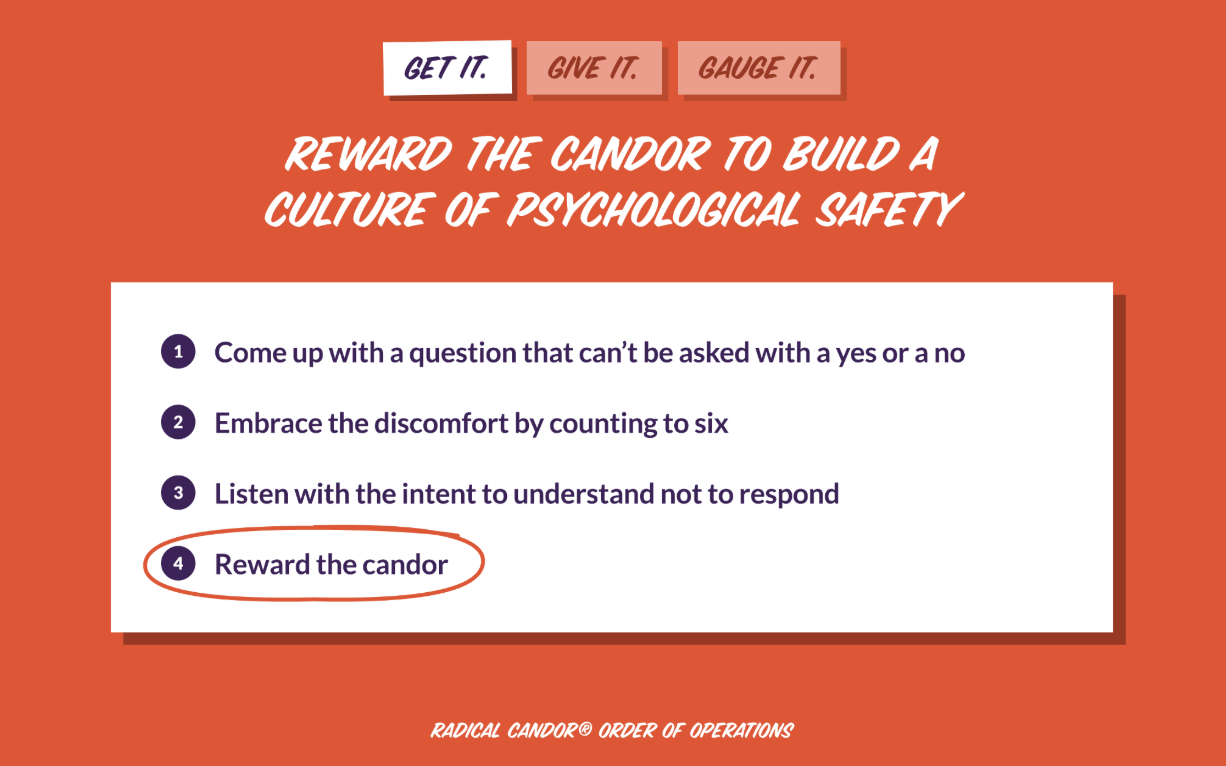
By the time someone gives you feedback, you’ve already done quite a bit of work. You asked your go-to question. You sat through the discomfort. You listened with the intent to understand, not to reply. Instead of defending yourself, you managed your feelings of defensiveness by asking a follow-up question.
Your work won’t pay off if, after all that, all you do is say “thanks.” Worse, you may even alienate the other person.
You need to make your listening tangible, and show the other person their feedback mattered. Reward their candor so they keep giving you feedback.
What happens when a company collects feedback and does nothing with it?
Leaders solicit feedback but fail to reward the candor all the time. In a podcast episode with Tiffani Bova, I learned that 87% of executives don’t know what to do with the employee feedback they collect. Companies run the survey, collect the data, and then do nothing. Employees who give feedback and get no response draw an obvious conclusion: their leaders don’t listen, don’t care—or both. What a colossal waste of time, effort, and money.
How can you act on the feedback you receive? It depends on whether you agree and how big the problem is. Here’s what to do in each scenario.
What do you do if you agree with the feedback and can easily fix it?
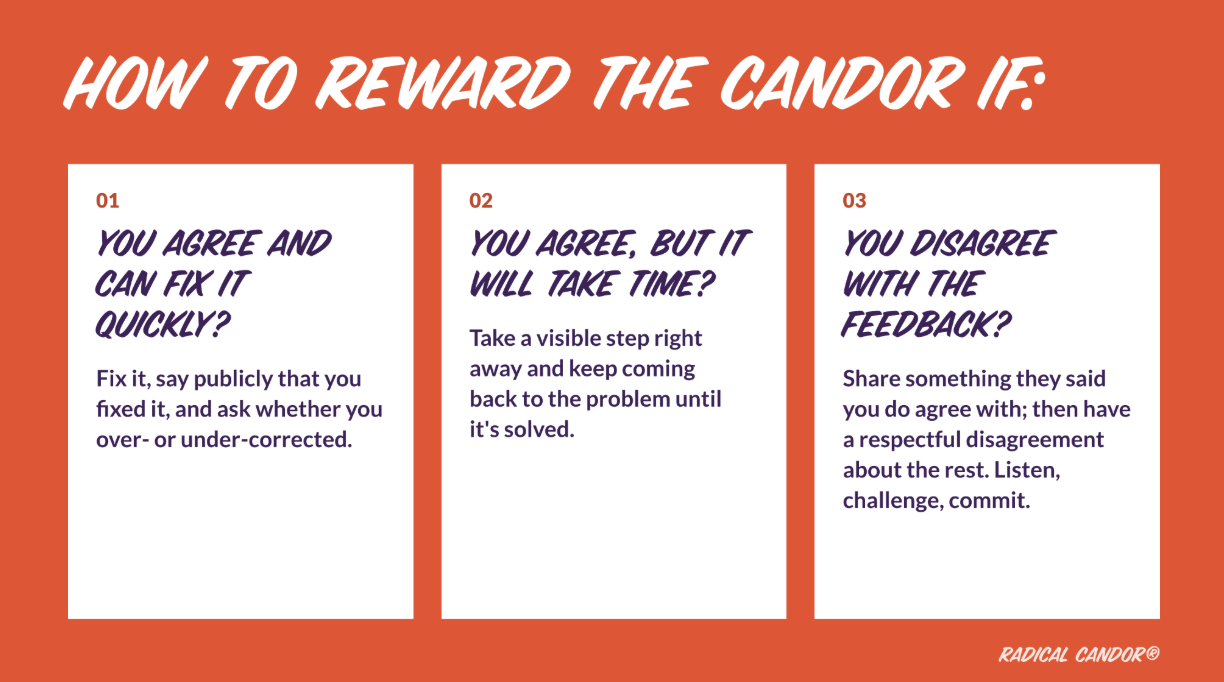
Fix the problem. Right away. Then ask the person whether your fix went far enough or if you overcorrected. You’re asking for feedback on the fix, which is valuable, but it also ensures that the fix makes it back to the person. You’ve made your listening tangible.
What if you agree with the feedback, but can’t fix it right away?
Show the steps you are taking to fix the problem, and keep coming back to it until it’s resolved. Some visible props might even be in order—remember my “radical bandor.”
It might feel frustrating for both of you that you can’t fix a problem right away. But this is your chance to show some vulnerability. If the problem is that you’re trying and failing to fix it (like my bad habit of interrupting), acknowledge that fact. Show what you are doing to try to get better and express your determination to keep trying. It’s irritating to keep bringing up the same thing, so you need to keep pushing check-ins and showing them you are still working on the issue.
What if you disagree with the feedback?
This is the hardest scenario of the three. It’s also the most likely to go wrong, in one of three ways.
First, you might pretend to agree when you don’t. Unless you’re a fantastic actor, if you say, “Thank you for the feedback” when you disagree, there’s a strong chance they’ll feel completely brushed off. Especially when you take no steps to address their feedback.
Or you might try to quietly dismiss the feedback and hope they’ll forget. Newsflash: they won’t.
The third misstep is acknowledging their feelings but doing nothing about the problem that caused them. Saying “I’m sorry you feel that way” without any action to understand or fix it just sounds passive-aggressive.
Here’s what to do instead. First, listen for anything you do agree with. It might just be 5% of what comes out of their mouth, but that’s enough. Tell them you agree with that part. Then add, “As for the rest of your feedback, I want to think it over and get back to you.”
And then actually get back to them. You owe them a full, respectful explanation of why you disagree. Encourage them to challenge your explanation. “Listen-challenge-commit” is the right approach, and it helps you find a shared path forward together. Sometimes they’ll come around. Sometimes they’ll point out a hole in your reasoning that changes your mind. But in either case, you’re showing a willingness to engage with them and understand their point of view (not acting defensively).
Disagreeing with someone might not feel like “rewarding their candor.” Remember: the only disagreements that hurt relationships are the ones that go unspoken and fester. A disagreement handled respectfully can actually deepen and strengthen a relationship. That’s the reward, for them and you.
How do you hold yourself to it this week?
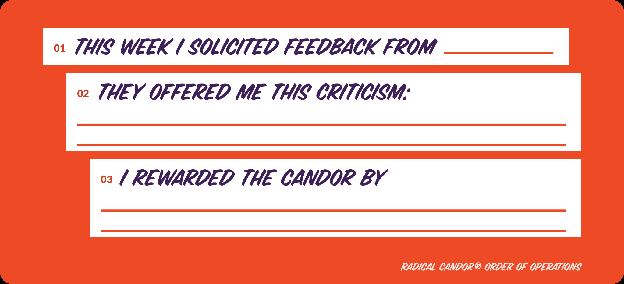
Hold yourself accountable by writing down the sentence below and filling in the blanks. Putting it on paper helps pressure-test your planned actions: Are they visible enough? Are you prepared to keep acting if the problem is persistent? If you disagree, how are you going to explain why in a follow-up conversation with the other person?
This week I solicited feedback from ________. They offered me this criticism: ________. I rewarded the candor by ________.
The Radical Candor Order of Operations is “get it, give it, gauge it.” Rewarding the candor is the most important part of “get it”—you can review all four parts of “get it” in this post.
Next week we will post about how to give feedback–more praise than criticism, but no shit sandwiches, please! Sign up for our newsletter if you want this delivered to your inbox.
And remember, Radical Candor works best when your entire team is on board. Our workshops can help.
More from Radical Candor
What Do You Do After You Ask for Feedback? The Only Way Out Is Through
A Story A banker who led a high-stakes tech IPO ran an important meeting with the COO of the company that was going public. The meeting had been a home run. So he was surprised …
How Do You Ask for Feedback? The Three Tests of a Good Go-To Question
The idea Get it. Don’t just be open to it.
Fixing the Employee Experience (with Tiffani Bova) 8 | 26
While the podcast team is on a Radical Sabbatical, Kim Scott is spending the season talking to authors of the books that have shaped her thinking. This week: Tiffani Bova, whose …
Share your perspective
This site is protected by reCAPTCHA and the Google Privacy Policy and Terms of Service apply.