

Why Does Praise Matter at Work?
Early in his career, Jason Rosoff, Radical Candor’s co-founder, had a job helping clients understand fairly complex technical things. Often, what was obvious to him was mysterious to others.
On one call, as the client got confused, Jason’s frustration grew. Luckily, he wasn’t alone on the call. His colleague Dave noticed and jumped in to redirect the conversation. He clearly laid out what Jason had been struggling to explain. The temperature was lowered, and then Dave did something Jason didn’t expect: when the client asked a question, he said, “Jason’s the best person to answer that.” Jason was surprised that Dave trusted him to lead the call, but he stepped up and finished everything smoothly.
After the call, Jason thanked Dave. Expressing gratitude and appreciation is a powerful form of praise. He said, “Dave, on the call we just had, I think the client would have been really pissed if the conversation kept going the way it started. I was totally floundering, feeling completely incapable. When you jumped in, you saved me. And when you passed the ball back to me, it gave me the confidence to try again. Please jump in again in the future!”
Dave was puzzled. He had no idea that what he did had been so helpful. He said he was actually worried that Jason would feel he’d overstepped.
That is why praise matters. It not only makes people feel good; it tells them what to do more of. If Jason hadn’t told Dave that his jump-in was helpful, Dave might have kept worrying he’d crossed a line and hesitated to rescue Jason if it happened again.
What Makes Praise Specific and Sincere?
When we talk about feedback, people often focus on criticism. But a big part of your job as a manager is to paint a picture of what’s possible and to show what good looks like. Praise, not criticism, is what will help you do that. Yes, you need to let people know when they make a mistake, but it’s even more important to “catch” them doing things right. To help keep your team moving in the right direction and strengthen your relationships, offer specific, sincere praise and kind, clear criticism.
Here’s why you should focus on the good stuff, how to ensure you’re not serving up a shit sandwich, and why it’s important to get the details right for both praise and criticism. Hint: if it is something you’d say to a dog, it’s not good praise.
1. Give more praise than criticism
When you’re leading a team, criticism is your brake and praise is your accelerator. If you want to actually get somewhere, you have to use your accelerator more than your brake.
Praise is practical. It’s not just about making people feel good (though that’s a great side effect). It tells people what to do more of. Dave reacted instinctively to rescue Jason in the call; he didn’t realize it was something he should turn into a practice until Jason thanked him for doing it.
Praise can also have ripple effects, which is why it’s a good idea to praise in public when you can. If someone is doing something well, the rest of the team can learn from their example. Praise shows everyone what good looks like. Of course, there are some people for whom public praise is cruel and unusual punishment. It’s important to get to know people well enough to understand how what you’re saying is likely to land for them. But don’t stay silent until after you get to know them, or you’ll never get to know them. There’s a bit of a Catch-22 here, and that is part of what makes giving praise and criticism feel awkward. Embrace the discomfort! That’s where the learning happens.
2. If it’s something you’d say to a dog, it’s not helpful praise
If all you do is say, “Good job!” you’re likely to sound patronizing or Manipulatively Insincere.
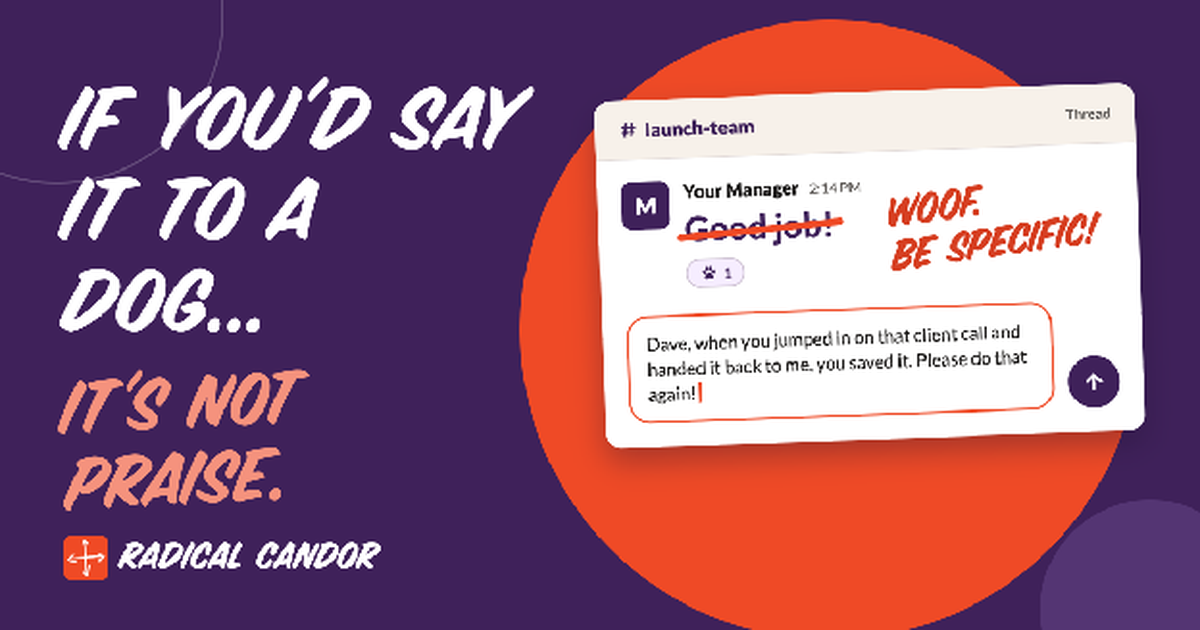
I learned this the hard way when my colleague Russ Laraway and I filmed a video tip on giving Radically Candid praise. Russ talked about why giving really specific praise matters, and he gave an example from coaching Little League.
“You’re a great Little League coach,” I said offhandedly. It was not specific, but rather the kind of “good job” that is really not helpful praise. He said, “Thank you.”
Usually, that would’ve been that. But I later realized my compliment hadn’t been specific. I hadn’t told Russ why I admired him for being a coach. He has a technique called “the book” where he publicly praises 3 things each player did in the game. The players LOVED this. Also, his willingness to leave work early to coach inspired me to deal with my own struggles to leave work early for my kids’ events.
The next day, I mentioned the irony to Russ. He replied, “Well, the real problem is that I don’t think you meant it—you hate sports.”
Now I realized it was even worse than I’d thought. It wasn’t just that I’d been vague and unhelpful. Russ thought my praise was insincere.
There we were, giving people advice on how to give good praise, and here I was totally screwing it up! Embarrassing!
Now that I knew how Russ felt, I tried again. “The other day I gave you a hard time about leaving work early for practice, and I then felt bad about it,” I began. “Because in fact I really admire that you’re a Little League coach. I love the way you give those kids praise. The things you’ve learned from the Positive Coaching Alliance have been enormously helpful in our work. And you do as good a job integrating your work and your life as anyone I know. I always wonder if I’m spending enough time with my kids, and the example you set by coaching helps me do better.”
This time, Russ said, “Now that was Radically Candid praise!”
3. Don’t use praise to wrap criticism up in a “feedback sandwich”
The feedback sandwich, often called the “shit sandwich,” sounds like this: “I love your glasses, your book kind of sucks, but I love your shoes.”
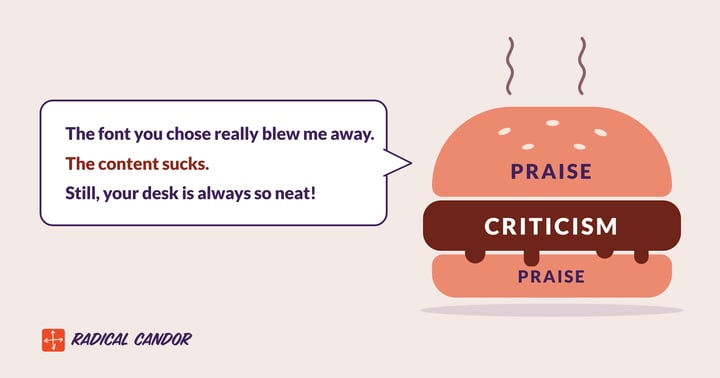
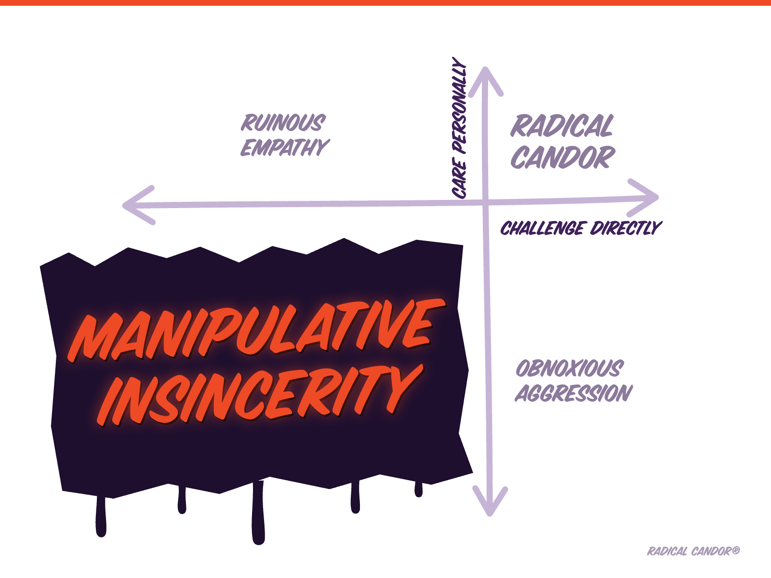
We describe the feedback sandwich more here, and there are several reasons why it doesn’t work. The main problem is that it risks diluting the impact of your praise. If you are trying to find things to compliment so you have the right ratio of praise to criticism, your praise winds up in the Manipulative Insincerity® quadrant.
4. Get the details right for both praise and criticism
Karen Sipprell, my colleague at Apple, asked two questions that stuck with me: “How long do you spend making sure you have all the facts right before you criticize somebody? How long do you spend making sure you have all the facts right before you praise somebody?” Ideally, the answer is the same.
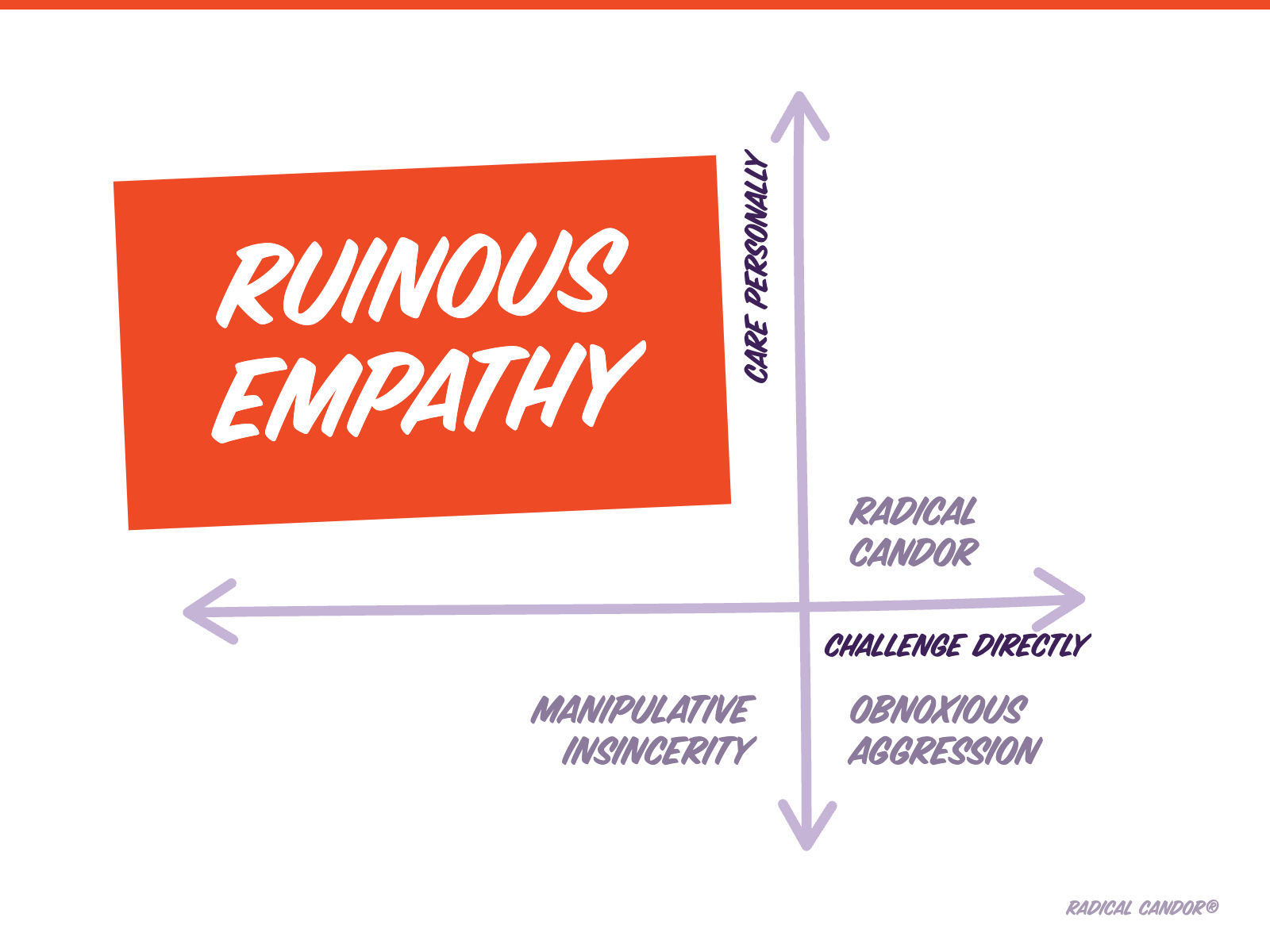
And if you get the facts wrong, praise can do real damage. That’s Ruinous Empathy®: being “nice” instead of accurate.
A friend of mine told a cautionary tale about “just trying to say something nice” as a leader. Wandering around at 2 a.m. the night before a launch, he bumped into an engineer, Anatoly, and asked him about a particular feature. Anatoly answered his question and told him about several important aspects of the feature. A couple of days later, when celebrating the launch, my friend congratulated Anatoly on his excellent work in front of the whole company.
The problem was that Anatoly was only one of a handful of strong engineers on the project. All the other engineers who worked on it now thought that Anatoly had claimed credit for the entire feature himself. Embarrassed, he emailed the whole company, listing everyone who had worked on the project with him.
My friend realized he had been Ruinously Empathetic. He was just trying to make Anatoly happy by praising him, but he’d accidentally thrown him under the bus. When giving praise, you need to investigate until you really understand who did what and why it was so great. You need to go deep into the details.
5. Use CORE to make sure you’re not praising someone’s personality
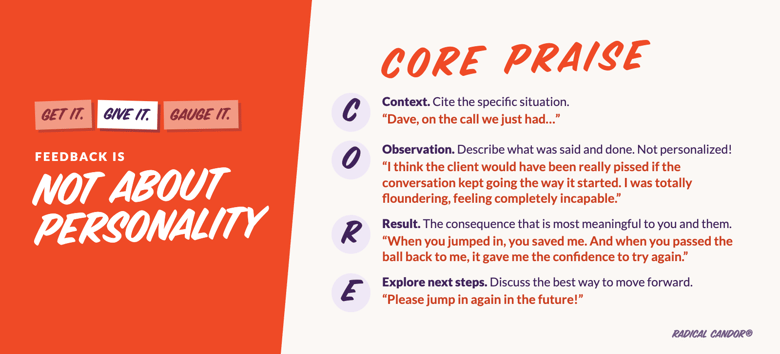
The CORE framework (Context, Observation, Result, and Explore next steps) is as important for praise as for criticism, and for the same reason: it’s not helpful to comment on someone’s personality. “You’re a genius” is bad praise, for the same reason that “you’re stupid” is bad criticism. It’s hard for the person to know how to do more “genius-ing.”
Go back to what Jason said to Dave. The context for the praise was their client call. The observation was that Dave jumped in, then passed the ball back to Jason. The result was that the client wasn’t pissed off, and Jason had the confidence to wrap things up. And for next steps, Dave knew exactly what to do again to set Jason up for success.
When I explained why it’s best to give feedback in impromptu two-minute conversations, I told a brief story about some praise and some criticism my boss gave me on the way back to her office. Because she gave me specific, sincere praise and kind, clear criticism, what she said didn’t feel like a feedback sandwich.
What to Do This Week
Pick one person you work closely with who did something recently you admired. Before you say anything, take time to get the facts right: what exactly they did, and what difference it made. What was the context? What was your observation? What exactly did they do right? What do you want them to do next? Express your gratitude and appreciation, live. In person is best. A public meeting you’re already in together works great too. But if you’re not in the same place, pick up the phone and call!
Up Next
Next in the series: We’re moving onto the third step in the Radical Candor Order of Operations, Gauge It. —How to notice the way your feedback lands. Coming soon.
If you’d like help teaching this to your whole team, that’s what the Radical Candor workshops are for.
Related reading:
Share your perspective
This site is protected by reCAPTCHA and the Google Privacy Policy and Terms of Service apply.