Does anyone actually want to be a manager of managers? And if so, what do these people actually do? On this episode of the Radical Candor podcast Kim, Jason and Amy discuss strategies for being an effective manager of managers. If you're managing people who manage other people, then you're managing managers. Whereas if you're managing individual contributors, you're managing a team. The most significant difference when you become a manager of managers is that now you have to become a thought partner, not just on the functional expertise and the business your direct reports are running or the product that they're building, but you also have to be a thought partner to them on how they're managing their team.
Listen to the episode:
Radical Candor Podcast Episode At a Glance

When you are a manager of managers, it’s your job to make sure not only that the authority you have doesn’t go to your head, but that authority doesn’t go to the heads of the people who work for you. In other words, you want to make sure that nobody on your team, including you, has unilateral decision-making power over who gets hired, who gets promoted, and who gets fired. You want to make these decisions as a team.
As you switch from direct management of individual contributors to managing managers, you’re going to face new challenges. When you become a manager, you can’t be in the details of every decision; when you become a manager of managers you don’t even know all the decisions that are being made.
When you become a manager you can’t solve every problem, when you become a manager of managers you may not even know about the problems that are getting solved and you have to let go of control.
You can’t have a personal relationship with every person your direct reports manage — and at some point, you won’t even be able to know everyone’s name. And, people may start to see you differently — perhaps as the big intimidating boss they have to perform for versus the nice person they used to say hi to in the coffee line.
Listen to the full episode to hear the team share their experiences of navigating these changing dynamics, including how Kim used to "crank call" members of her team.
Radical Candor Podcast Checklist
1. For managers of managers, here are the conditions that you need to create so those good relationships can happen on your team. You need to make explicit to the people you're managing, that management is part of their job. You need to make sure that none of your managers have unilateral decision-making power over who gets promoted, who gets hired, and who gets fired.2. As a manager of managers, you want to create a culture of guidance. In fact, all managers do, but specifically, as a manager, managers, remember, it's not enough to just solicit feedback. You also have to make yourself open to public criticism. You also want to design systems that are going to enable people to speak truth to power. If you want more information on how to set those up, check out season 4, episode 14.
3. Managers of managers need to build effective teams. That starts with hiring the right people and making sure that when you're hiring people, it is clear to them what management skills are going to be required. And don't forget to not only put that in the job description but to make that part of the interview process as well as the reference check process. The best tip that we can give you is to call people who have reported to that person in the past and find out what they really think of them as a manager.
4. As a manager of managers, you need to make sure that everybody's on the same page about what the goals are. And the best way to do that is with what we call a bottoms-up OKR process or a bottoms-up goal-setting process.
5. Remember, you are not the Hotel California of management — people can (and will) leave if you're not managing effectively.
How Google sets goals: OKRs / Startup Lab Workshop
Radical Candor Podcast Resources
- Radical Candor Podcast: 3 Tips For Small-Team Managers
- Are You a Manager of Managers? Here’s How Speak-Truth-To-Power Meetings Can Make Your Workplace More Equitable
- Radical Candor Podcast | Quiet Quitting Calls Out Bad Bosses
- The Manager of Managers | Gallup
- 5 things I learned the hard way as a manager of managers | by Rich Archbold | Medium
- How to Manage Managers | HBR
- As Your Team Gets Bigger, Your Leadership Style Has to Adapt | HBR
- Superbosses: How Exceptional Leaders Master the Flow of Talent: Finkelstein, Sydney: 9781591847830: Amazon.com
- From Manager to Director: Guide to Managing Managers
- How to Manage Managers
- One-On-One Meetings: 7 Things To Know Right Now
- Podcast Season 2, Episode 9: Meet Like A Boss — The 411 On 1:1s
- Power Is the Great Motivator | HBR
- The Manager: Master and Servant of Power | HBR
- 6 Steps for Setting Measurable Goals to Avoid “Productivity Paranoia”
- Enduring Love: A Novel - McEwan, Ian: Books
- Measure What Matters: OKRs: The Simple Idea that Drives 10x Growth: 9780241348482: Doerr, John
- How Google sets goals: OKRs / Startup Lab Workshop
Have questions about Radical Candor? Let's talk >>
————————————————————————————————————————————————————————————–
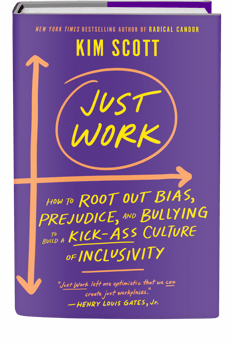
Just Work is Available Everywhere Books are Sold!
Episodes are written and produced by Brandi Neal with script editing by Amy Sandler. The show features Radical Candor co-founders Kim Scott and Jason Rosoff and is hosted by Amy Sandler.
The Radical Candor Podcast theme music was composed by Cliff Goldmacher. Order his book: The Reason For The Rhymes: Mastering the Seven Essential Skills of Innovation by Learning to Write Songs.
Sound editing by PodcastBuffs.
More from Radical Candor
Fixing the Employee Experience (with Tiffani Bova) 8 | 26
While the podcast team is on a Radical Sabbatical, Kim Scott is spending the season talking to authors of the books that have shaped her thinking. This week: Tiffani Bova, whose …
Unlocking Leadership Intelligence (with Caroline Webb) 8 | 24
What separates a leader who makes wise calls under pressure from one who gets stuck in their own point of view? Caroline Webb has spent decades studying the answer — first as an …
Get Situated for Success (with Angela Duckworth) 8 | 23
While the Radical Candor podcast team is on a Radical Sabbatical, Kim Scott is spending the season interviewing authors of the books that have shaped her thinking over the past …
Share your perspective
This site is protected by reCAPTCHA and the Google Privacy Policy and Terms of Service apply.