 Kim Scott
A HIP Approach to Feedback: 6 Tips to Help You Practice Radical Candor
We’re all about helping people become more Radically Candid with their feedback. By feedback, we mean praise and criticism. Being Radically Candid...
Table of Contents
Corrections, factual observations, disagreements, and debates are different from criticism. It’s vital to be able to correct somebody’s work, to make a factual observation, or to have a debate in public. But criticism should be offered in private.
It’s easy to say, “criticize in private, disagree in public.” But where, exactly, is the line between criticism and disagreement?
Let’s imagine you and I are in a meeting to decide whether or not we should enter the market in Slovenia. If I think your assessment of the market size or the fit of our product for that market, that’s a conversation we need to have with the whole group assembled to make this decision. I need to share the numbers I am using to form my opinion. I need to show you my work so that you can either explain why I’m wrong or persuade me that I’m right. However, if I think you have an ulterior motive for entering the market, that is a criticism I need to share with you privately. If I know that you have family in Slovenia and I think that you just want the company to pay for your travel there a couple of times a year, the worst thing I could do is to shout that out publicly. I need to pull you aside and share my concerns. If I am not satisfied with your answer, we need to escalate the matter together.
Here are some more examples.
|
Corrections/disagreement that need to be said publicly during the meeting |
Criticism that needs to happen in private after the meeting |
|
“There’s a typo on slide six–it needs to say 1.9, not 19.” |
“You’ve given several important presentations that are riddled with typos that a simple spell-checker would catch. This is starting to hurt your credibility–and it’s not like you. I wonder what’s going on. Is everything OK?” |
|
“I disagree with what you just said. I’m prepared to listen-challenge-commit, but I want to have the opportunity to challenge what you said before I commit.” |
“In the meeting when you breezed past what I said, you were ignoring the point I was making. This has happened in the last five meetings we were in together. If we don’t have a debate as a team, people won’t be bought in and we won’t execute well. Can you give a little more space for conversation and even disagreement next time?” |
|
“I wonder if John could repeat what he just said–we seem to have moved off his point too fast.” |
“In the meeting, when John said he disagreed with you, you did not seem open to what he was saying. That made you seem defensive, which didn’t help you make your case. You have great ideas, and I want to make sure others hear them. How can I help?” |
When you criticize someone publicly, their brain is likely to go into fight or flight mode, meaning they can’t hear a word coming out of your mouth. So not only have you hurt them and made yourself look like a jerk, you’re wasting your breath. Not a great outcome.
So criticize in private, and when you do, don’t be an asshole about it. An ad hominem attack about their personality is not fair game. Be humble, state your intention to be helpful, have a real two-way conversation in person or on the phone (no text, email, slack, etc), offer it right away rather than hanging on to resentment. To make sure you’re not merely insulting their personality, share the context, make your observation about what they did or said, explain the result, and explore with them what the next step they can take to make things better might be.
You’ll make better decisions faster if everyone feels safe enough to disagree openly with one another. Research ranging from Project Aristotle at Google to a Collective Intelligence study by researchers at Carnegie Mellon, MIT, and Union College shows that when everyone on a team has the opportunity to contribute, the team is more successful. Plus, it’s more efficient to air opinions in the meeting. You don’t want to waste time in a meeting after the meeting.
One of the most frustrating ways to shut down a productive disagreement is to tell the person who disagrees with you that they are “being defensive.”
Steve Jobs offered a metaphor that explains the value of open disagreement, discussion, and debate on a team. When Steve Jobs was a kid, his neighbor showed him a rock tumbler— a can that spun on a motor. The neighbor asked Steve to gather up some ordinary rocks from the yard. He took the stones, threw them into the can, added some grit, turned on the motor, and, over the racket, asked Steve to come back two days later. When Steve returned to the noisy clatter of the garage, the neighbor turned off the contraption and Steve was astounded to see how the ordinary rocks had become beautiful polished stones. Steve would later say that when a team debated, both the ideas and the people came out more beautiful— results well worth all the friction and noise.*
Your job as a boss is to turn on that “rock tumbler.” Too many bosses think their role is to turn it off —to avoid all the friction by simply making a decision and sparing the team the pain of debate. It’s not. Debates/discussions/disagreements take time and require emotional energy. But a lack of debate saps a team of more time and emotional energy in the long run.
Of course, it’s also possible to leave the rock tumbler on too long, leaving nothing in the can but some dust. Here are some ideas that can help you keep the debate going without grinding everyone down too much.
Make sure that individual egos and self-interest don’t get in the way of an objective quest for the best answer. Nothing is a bigger time-sucker or blocker to getting it right than ego. On a broad level, this means intervening when you start to sense that people are thinking, “I’m going to win this argument,” or “my idea versus your idea,” or “my recommendation versus your recommendation,” or “my team feels . . .”
Redirect them to focus on the facts; don’t allow people to attribute ownership to ideas, and don’t get hijacked by how others who aren’t in the room might (or might not) feel. Remind people what the goal is: to get to the best answer, as a team. You’re creating a collaboration of great minds, not monitoring a high school debate competition or running a presidential election. If you have to, set ground rules at the beginning of the meeting, or—if your team would find it amusing and useful rather than ridiculous— put a prop like an “ego coat check” outside the door.
Another way to help people search for the best answer instead of seeking ego validation is to encourage them to switch roles--also called a Rogerian Argument. If a person has been arguing for A, ask them to start arguing for B. If a debate is likely to go on for some time, warn people in advance that you’re going to ask them to switch roles. When people know that they will be asked to argue another person’s point, they will naturally listen more attentively.
I once interned at McKinsey for a summer, and what impressed me most about the company was its ability to spur productive debate. How’d they do it? McKinsey had very consciously created an “obligation to dissent.”
If everyone around the table agreed, that was a red flag. Somebody had to take up the dissenting voice. McKinsey alums often brought this with them into the companies they later worked for. One ex- McKinsey executive at Apple struggled to foster a culture of debate on a team he inherited in Japan. He had a bunch of gavels made up with “duty to dissent” written in Japanese on them. If there wasn’t a robust enough argument in a meeting, he’d slide the gavel across the table to someone, as a sign to take up the opposite point of view. This simple prop was surprisingly effective.
There are times when people are just too tired, burnt out, or emotionally charged up to engage in productive debate. It’s crucial to be aware of these moments because they rarely lead to good outcomes. Your job is to intervene and call a time- out. If you don’t, people will make a decision so that they can go home; or worse, a huge fight stemming from raw emotions will break out. If you’ve gotten to know each person on your team well enough, you’ll be sufficiently aware of everyone’s emotions and energies so that you’ll know when it’s necessary to step in and defer the debate till people are in a better frame of mind.
The spirit with which a debate is launched often determines the tenor of what follows. I have found that people on a team I lead key off my mood to an almost alarming extent; when I find a way to have fun with a debate, others often follow suit. In some cases, it might be simple humor or opening the meeting with a good self-effacing story. What you say is less important than the tone it conveys, and the mood it sets for what follows.
Finally, it’s important to be aware that not everyone enjoys debate. Some people find the very act of debate aggressive and/or threatening. I recall a time when we were developing a class at Apple on communication, and I described my ideas on creating positive space for debate. Suddenly, a colleague next to me smiled and burst out, “Oh! You have been debating me all this time just to make the class better. I thought you were just trying to drive me crazy.” What to me had been an exciting opportunity to push each other to hone and develop ideas had been to him an excruciating exercise in one-upmanship. This drove home the importance of providing a clear explanation up front about the purpose of debate and creating a positive space in which it can occur, not to mention the importance of knowing the people I was debating with well enough to recognize when I was driving them nuts without meaning to!
One of the reasons that people find debate stressful or annoying is that often half the room expects a decision at the end of the meeting and the other half wants to keep arguing in a follow-up meeting. One way to avoid this tension is to separate debate meetings and decision meetings. Another way to ease the anxiety of the people who want to know when the decision will get made is to have a “decide by” date next to each item being debated. Then at least they know when the debate will end and the decision will be made.
It’s tempting to end debates and make a decision too soon when a debate becomes too painful. You might be creeping up on a topic that’s been a subject of great contention. At times like this, people often look to the boss to end the suffering and make a decision. My instinct is to be a peacemaker or to get to a decision quickly. But a boss’s job is often to keep the debate going until all the facts are out on the table, rather than to resolve it with a premature decision. It’s the debates at work that help individuals grow and help the team work better collectively to come up with the best answer.
I once made a preemptive decision about what seemed like a small thing— a seating chart— that ended badly. We didn’t even have cubes, just tables. As the team grew from ten to sixty- five people, we eventually had to rearrange the space and move everyone’s desk. Everybody had an opinion about what the layout should be, and a young project manager volunteered to herd the cats. They were hard to herd. The angst about who sat next to whom and how far they were from a window went on for the better part of a week. Frustrated, I came in on a Sunday and moved everyone’s desks myself.
The result was near mutiny on Monday morning. “We were this close to a decision!” exclaimed the project manager. “And you just set us back a week.” He was an unusually levelheaded person, but there were tears of real frustration in his eyes.
The right thing to do would have been to set a “decide by” date, so everybody would know that they couldn’t lobby the project manager endlessly. If the debate seemed too rancorous, I could have asked him how I could help. For example, I could have suggested the people whose differences he was having a hard time reconciling try to wrap it up over a meal or a walk, or that they switch roles and argue for each other’s positions. But grabbing the decision away from him and making it myself was not only overbearing; it simply didn’t work.
A disagreement is about the work — differing assessments of market size, a typo on a slide, a challenge to an idea. Criticism is about the person — their motives, behavior patterns, or how they’re showing up. Disagreements need to happen in public so the team has all the facts. Criticism should happen in private so the person can hear it without going into fight-or-flight mode.
When you criticize someone publicly, their brain goes into fight-or-flight mode and they can’t hear a word you’re saying. You’ve hurt them, made yourself look bad, and wasted your breath. In private, use the CORE method: share the context, make your observation about what they did or said, explain the result, and explore next steps together.
Research from Google’s Project Aristotle and studies at Carnegie Mellon, MIT, and Union College shows that teams where everyone can contribute openly are more successful. Airing opinions in the meeting is also more efficient — you avoid the dreaded “meeting after the meeting.”
Steve Jobs compared team debate to a rock tumbler — ordinary rocks go in, and the friction of tumbling against each other with some grit produces beautiful polished stones. When a team debates, both the ideas and the people come out stronger. A boss’s job is to turn on the rock tumbler, not turn it off to avoid friction.
Keep the conversation focused on ideas, not egos. Create an obligation to dissent. Pause when people are too tired or emotional. Use humor to set the right tone. Set “decide by” dates so everyone knows when the debate will end. And don’t grab a decision just because the debate has gotten painful — that’s how you get the seating-chart mutiny.
Three ways to put this into practice.
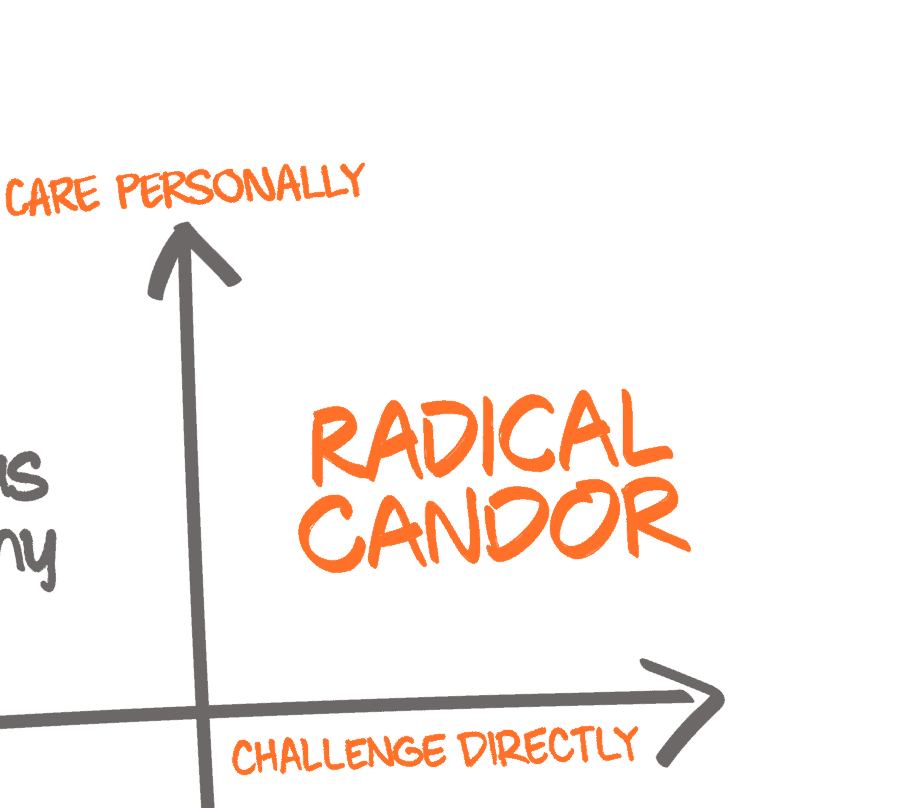
We’re all about helping people become more Radically Candid with their feedback. By feedback, we mean praise and criticism. Being Radically Candid...
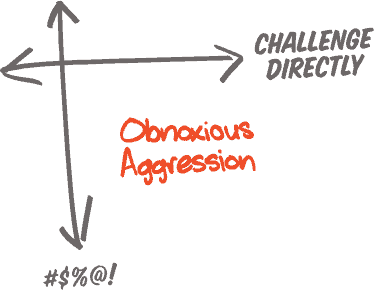
Obnoxiously Aggressive criticism is often referred to as “front-stabbing”. It’s when you criticize without Caring Personally.

A good rule of thumb for guidance is praise in public, criticize in private.
Share your perspective
Leave a comment below.