 Kim Scott
Relationships Transcend Hierarchy
This week I’m focused on how you can build a more Radically Candid relationship with your boss. Radical Candor is about strengthening relationships “up,” “down,” and “sideways” – not reinforcing hierarchy. It works in your personal life, too.
For many people, Radical Candor with their boss sounds risky. I get why. Once I gave a Radical Candor talk and someone tweeted at me, “Tried Radical Candor with my boss. Got fired.” I immediately DM’d the person and offered to make introductions, but they said that they’d actually already found another job…
The story illustrates why people are wary of upward Radical Candor–after all, your boss has some power. Your boss could get mad and fire you, or put you on a graveyard shift, or prevent you from getting a promotion, a bonus, or a raise. However, pushing through this discomfort is key to your success. That is all true–but it probably won’t happen.
Furthermore, your boss is probably just as afraid of giving you feedback as you are of giving your boss feedback. Since I wrote this book, hundreds of managers have written to me, “But what if I give my employees feedback and they quit?” or “What if I give my employees feedback and they get discouraged and quiet quit?”
When I was a kid I was really afraid of snakes. When we went for walks in areas where I was likely to see one, my mom used to say, “That snake is more afraid of you than you are of it.” It was reassuring, somehow. I’m not saying you should think of your boss as a snake, but it may help to realize your boss may feel afraid of you, too.
The people I know who have been most successful in their careers figured out how to speak truth to power without blowing up their careers. How did they do it?
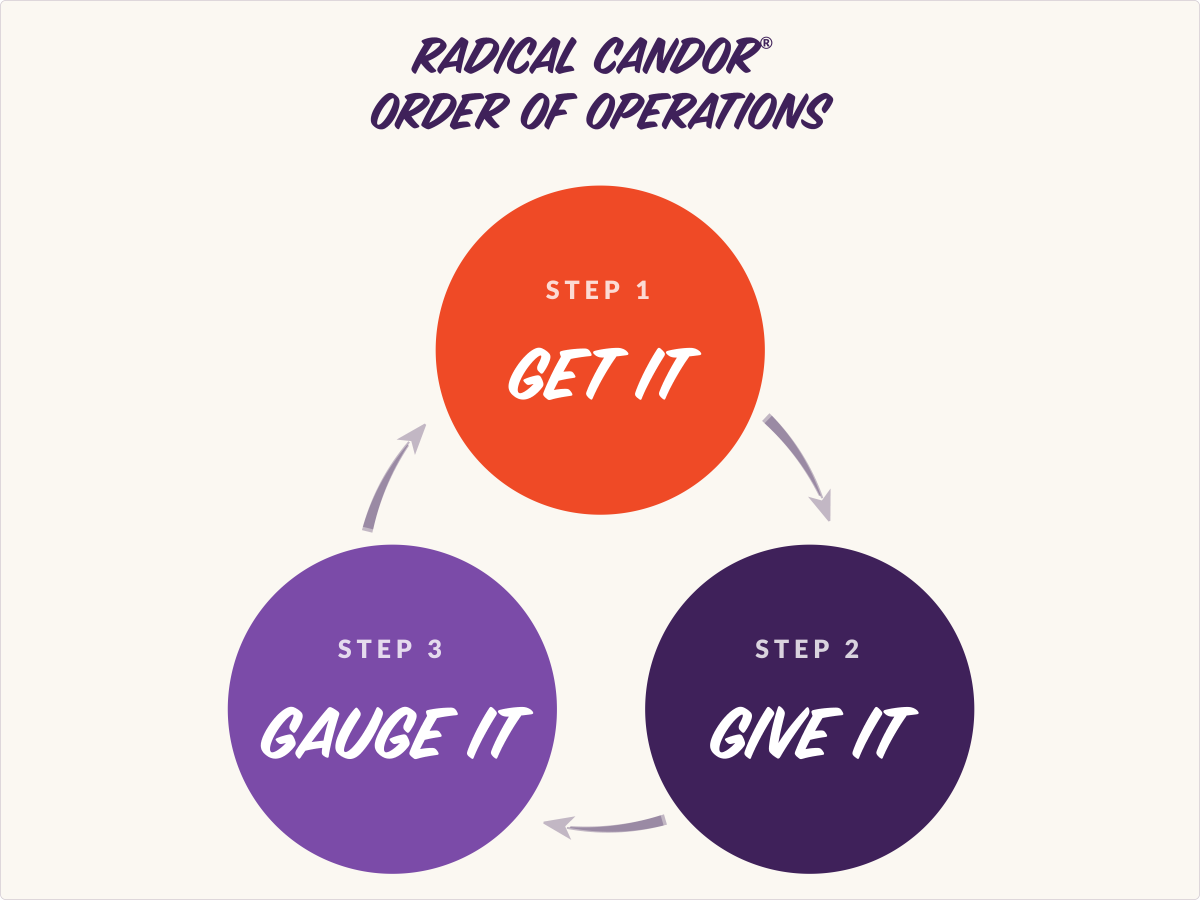
The same Radical Candor Order of Operations (Get it, Give it, Gauge it) that makes Radical Candor possible with your peers and direct reports will help you communicate with your boss. It may feel different, though, so here are some tips.
How to Practice Radical Candor with Your Boss: Get it, Give it, Gauge it
Get It: How Do You Ask Your Boss for Feedback?
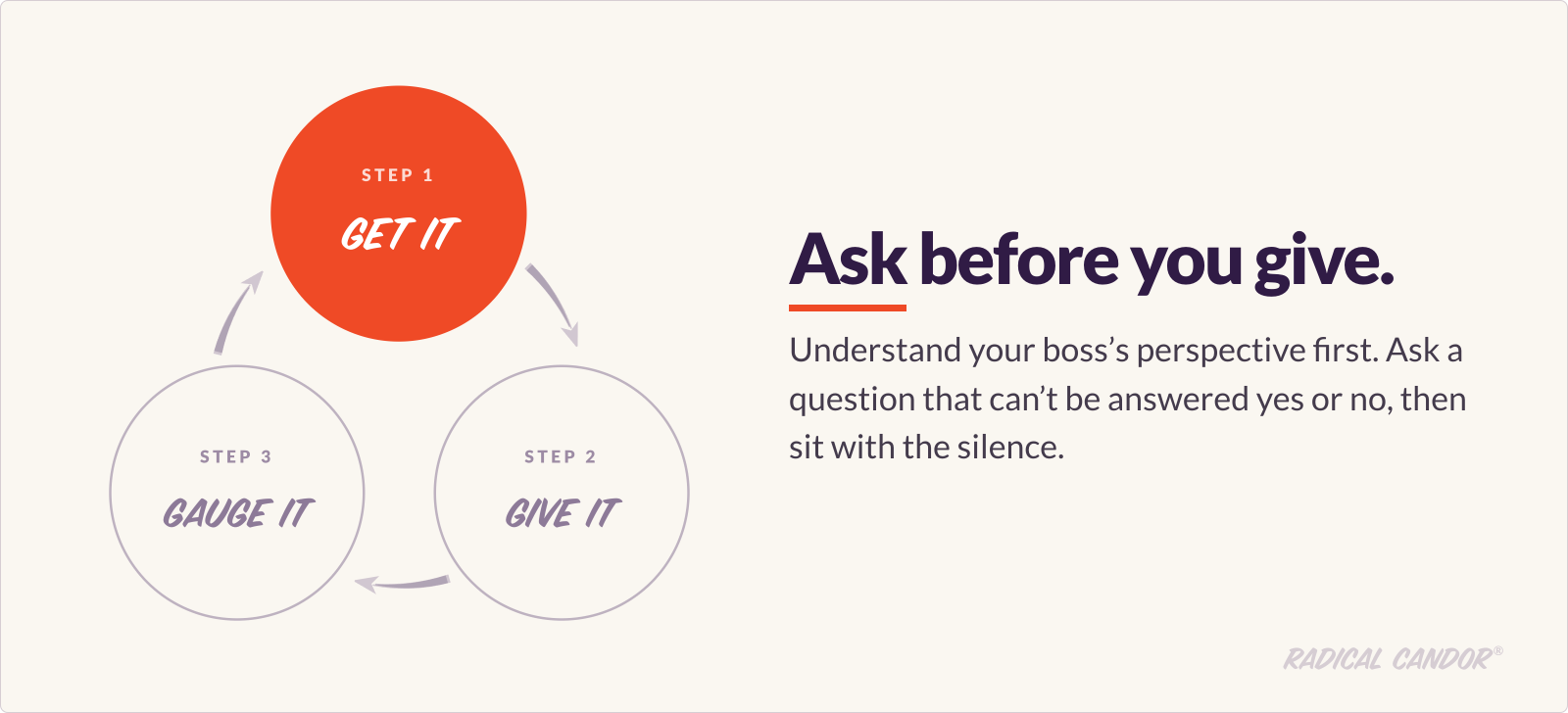
Start by asking for feedback before you give it. Make sure you understand your boss’s perspective before you start dishing out praise or criticism. It’s particularly important to know what your boss thinks of your work. It’s also important to understand their priorities and how your work fits into them. You may know your work much more deeply than your boss does, but remember that your boss has a broader perspective on the organization (and how your work serves it) than you do. Asking for feedback will help you understand that perspective.
Here are four things to keep in mind when asking your boss for feedback. (These may sound familiar because they are the same four things to keep in mind when soliciting feedback from anyone):
- Have a go-to question. Ask a question that can’t be answered with a yes or a no.
- Embrace the discomfort. Your boss probably won’t answer right away. It will be awkward. Take a breath, stay calm, and don’t rush in to fill the silence.
- Listen with the intent to understand, not to respond. When you get the feedback, don't critique the criticism or get defensive. Ask a follow-up question.
- Reward the candor. Don’t just say thanks. Act on the feedback, or disagree, but be willing to “listen-challenge-commit.”
How to Give Feedback to Your Boss
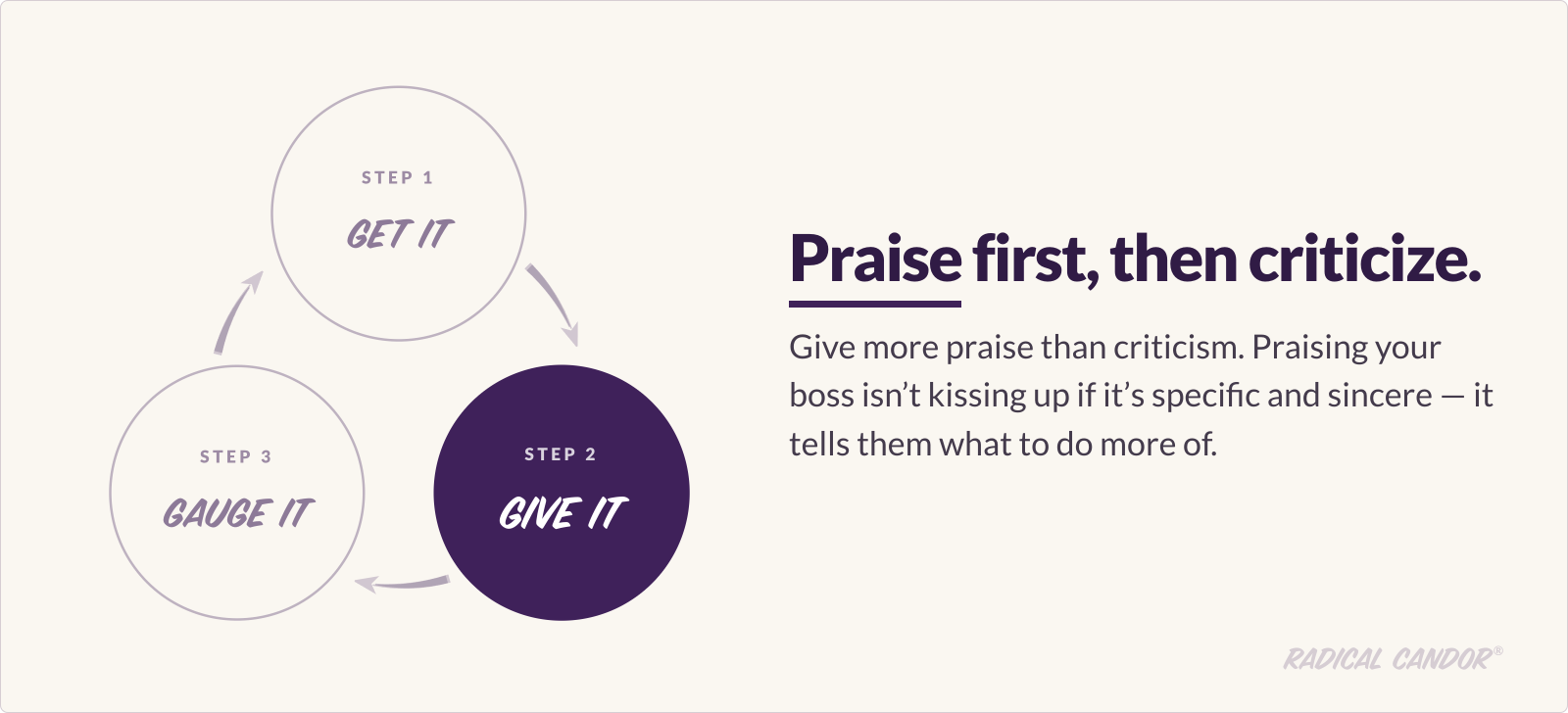
Next — give praise and criticism. Give more praise than criticism. Praising your boss is not “kissing up” if you are specific and sincere; it’s letting them know what to do more of.
When it comes to giving your boss criticism, start gently. Say something like, “Would it be helpful if I told you what I thought of X?” If your boss says “no,” or “that's not your job,” let it drop and polish up your résumé! If your boss says yes, start with something pretty small and benign and move on to step 3: gauge how they react.
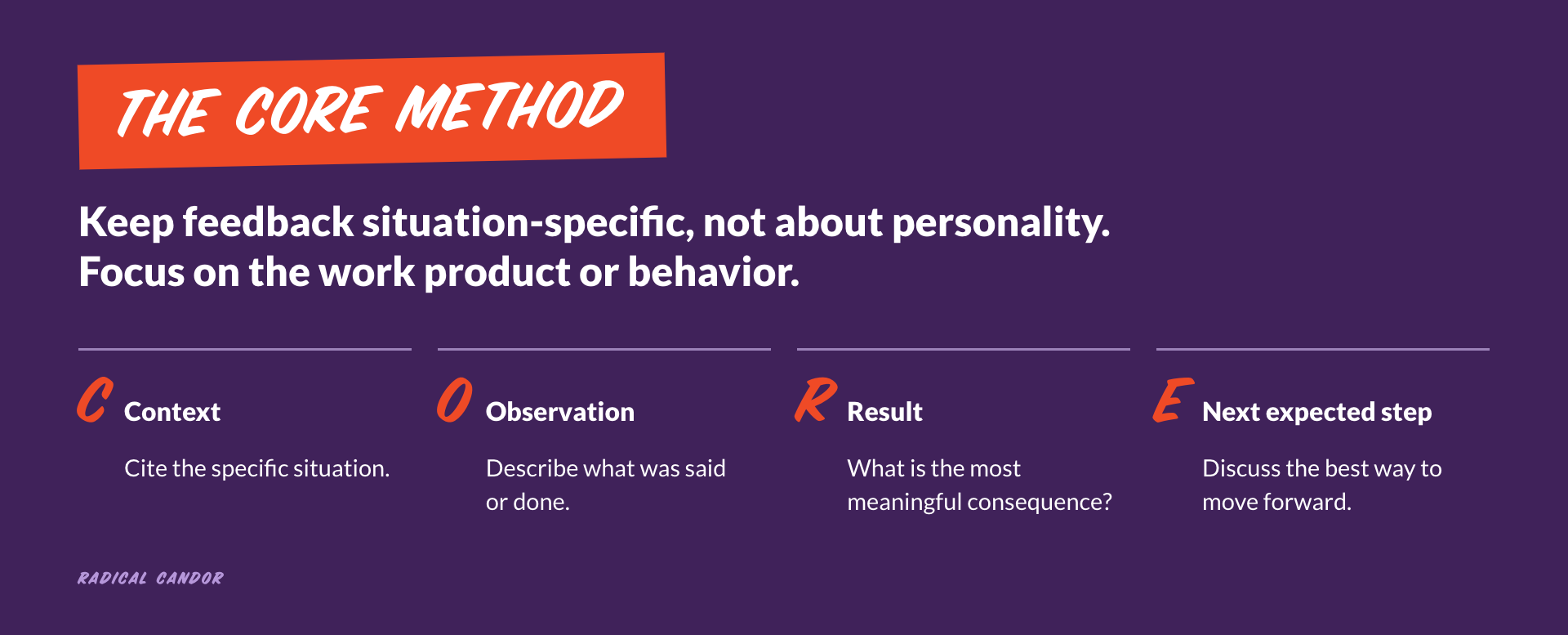
When offering guidance to your boss, use the same tips as you would with anyone else: be helpful, humble, do it immediately and in person, praise in public (if it doesn't look like kissing up), criticize in private, and don't judge personality. To avoid judging personality, use the CORE method (context- observation- result- explore next steps).
Being Radically Candid with your boss is crucial to your success. If you can tell your boss you disagree with a decision, they may reverse it. But even if they don’t, you can have conversations that will allow you to better understand the rationale behind it. And once you understand the rationale more deeply, you can explain it to others — even if you don't agree with it. When your team asks, “Why are we doing this? It makes no sense to us; didn’t you explain our point of view? Why are we being ignored?” you can reply, “I understand your perspective. Yes, I did have an opportunity to share your perspective. Here’s what I said and what I learned about why we are doing what we are doing.” If they insist on knowing whether you agree, you can tell them honestly that your boss listened to your point of view, that you were given an opportunity to challenge the decisions, and that now it's time to commit to a different course of action than the one you were arguing for.
A key to productive disagreement is this: Listen, Challenge, Commit. The most successful employees and leaders have the humility to listen, the confidence to challenge, and the wisdom to know when to quit arguing and to get on board. In fact, a sign of a healthy team is being able to align on a decision, even when some teammates don’t agree. Radical Candor makes that possible.
How to Gauge Your Boss’s Reaction, and What to Do if it’s Bad
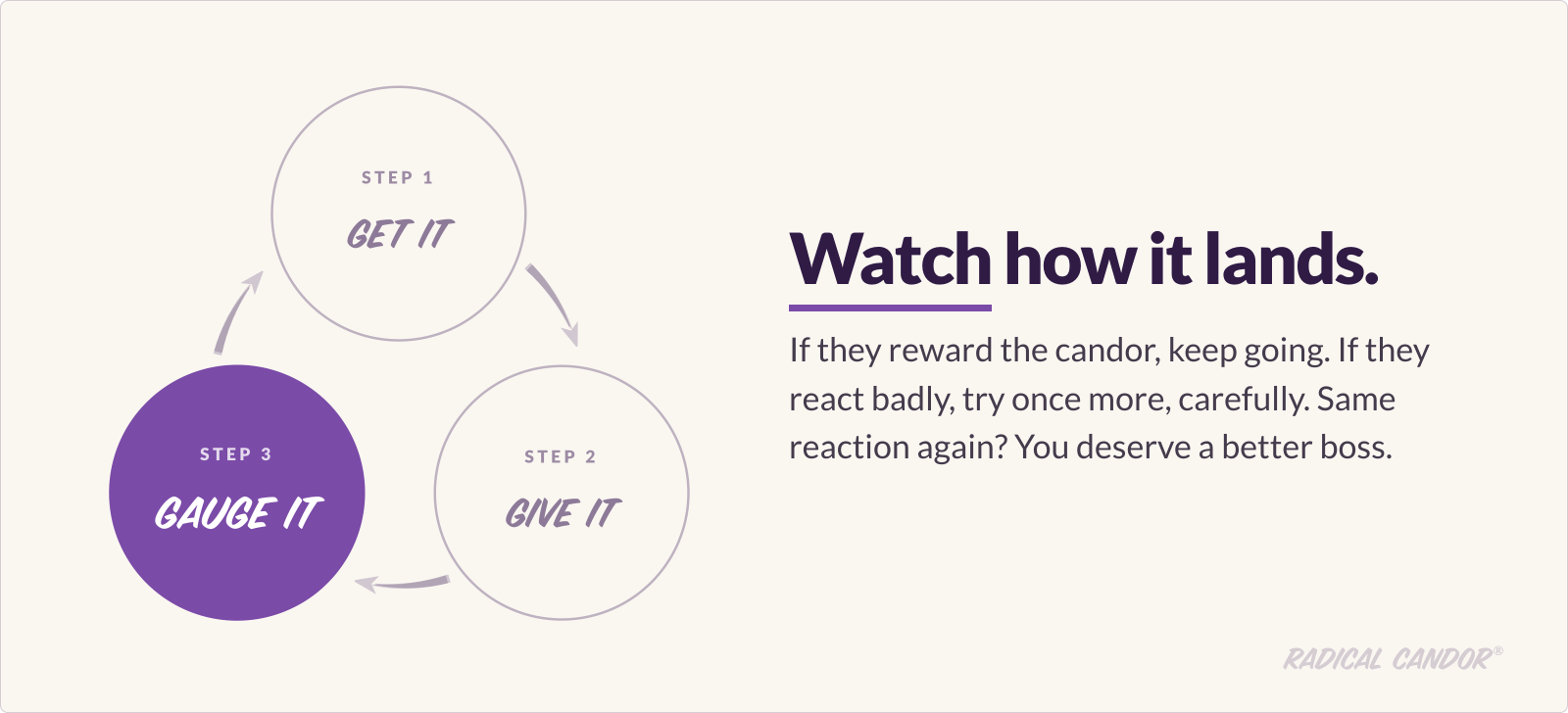
Finally, you’ve got to gauge your boss’s reaction. If they react well and reward the candor, keep going. If they react poorly, don’t give up immediately or assume ill intent. Try again, carefully, but if you get the same reaction the next time, it may be time to move on. You deserve a better boss.
Remember, bosses have feelings too. If your boss is having an emotional reaction, try to move up on the Care Personally dimension. If you ignore the emotional signals you’re getting from your boss, you will have a hard time communicating. If you struggle to interpret their emotions, feel free to ask them. “I think what I just said frustrated you – did I? If so, I’m sorry.”
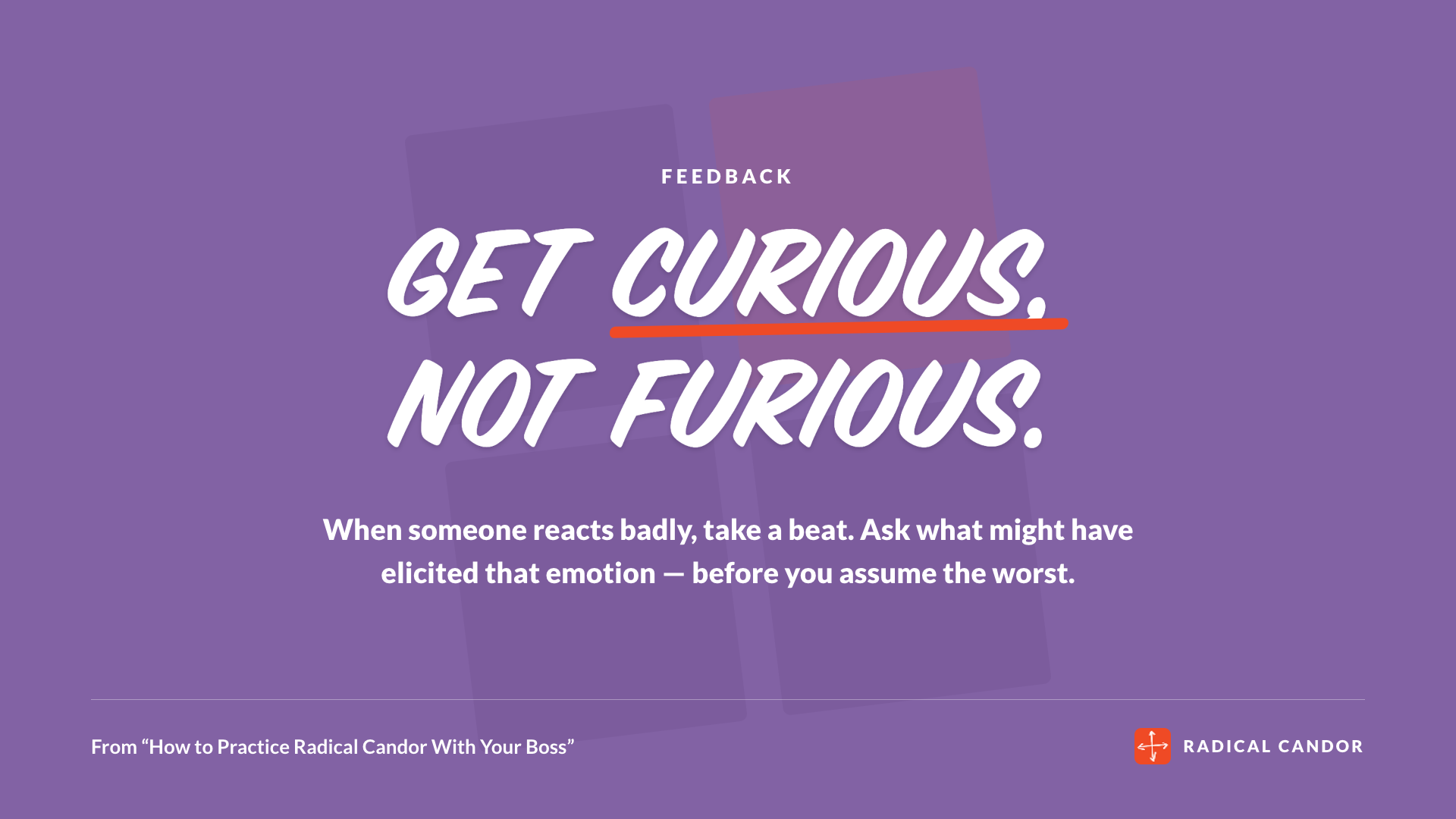
But what if your boss starts yelling at you? It’s pretty hard to Care Personally about someone who is communicating that way, especially when that someone has the power to fire you or block your next promotion. Try this: “Get curious, not furious.” Take a beat and reflect on what might have elicited such emotion. Did you say something that landed poorly with your boss? Is there something else going on in their life that is causing them stress?
That doesn’t excuse yelling, and you have the right to give your boss that feedback. But maybe not right now. Someone who is yelling is emotionally flooded, which means they probably can’t hear anything you say anyway. Rather than wasting your breath, consider taking the advice that my therapist gave me for dealing with my toddlers having a tantrum in the grocery store: just don’t add fuel to the fire. Almost nobody, not a toddler and not your boss, can stay at that pitch of emotion for too long. Try to breathe deeply and not react.
Sometimes a boss reacts at the other end of the emotional spectrum: they don’t seem to hear you at all. Or they brush off every bit of feedback you’re sharing. In these cases, it’s your signal to restate the feedback as clearly as you can. You can even add, “I’m not sure I’m getting through right now. This feels really important, and I want to make sure I’m being clear.” But remember, it’s not mean or disrespectful. In fact, if you stay grounded in Radical Candor – being clear while coming from a place of care and a sincere desire to be helpful to your boss – you might find it actually deepens your relationship.
One More Thing
If you feel your boss is bullying you, that is another matter. I wrote about what to do in this situation in my book Radical Respect. You can read more about that here.
Just Ask!
Get it! Make a plan to ask your boss for feedback today. If you want help with your “go-to” question, the words that will actually come out of your mouth when you ask, we’ve got you. Check out Compass, our Radical Candor AI tool that can coach you through your next high-stakes feedback conversation: compass.radicalcandor.com
Share your perspective
Leave a comment below.