 Kim Scott
Radical Respect: How to Work Together Better
Radical Candor author and co-founder Kim Scott announced the launch of her new book, Radical Respect: How to Work Together Better (St. Martin’s...
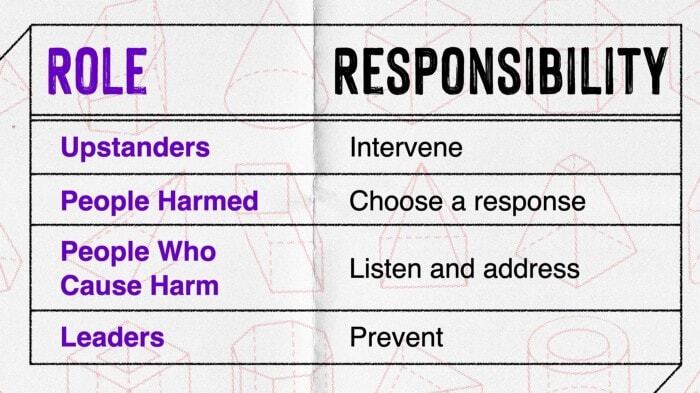
Whenever injustice at work happens, you will play at least one of four different roles: person harmed, upstander, person who caused harm, or leader. You may at different moments play all the roles. And sometimes, confusingly, you may even find yourself in two or more roles at once.
Each of these roles has its own responsibilities. The key is to be clear about what your role is, and when you find yourself in multiple roles, the role with the greatest responsibility is the guide to your action.
When we can both acknowledge our own role and understand the perspectives of people in the other roles, we can come up with better strategies for responding in a way that creates real change.
We can take a broader view of ourselves and others as people who can always learn and improve.
Most importantly, we can build compassion for ourselves in each of these roles and develop strategies for responding more effectively to workplace injustice, no matter what role we find ourselves in. We can practice Radical Respect.
Need help putting these ideas into practice? Let's talk!
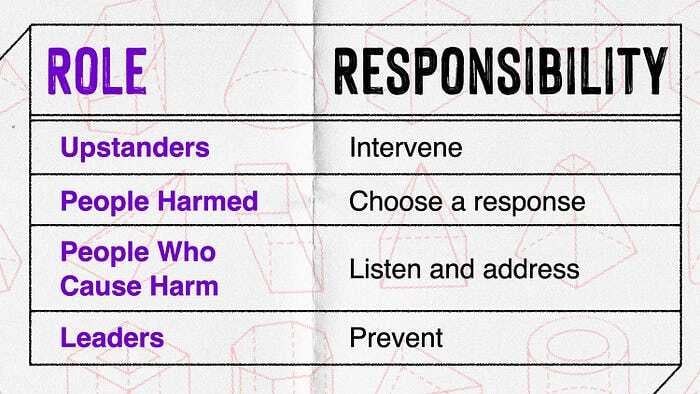
If you’re on the receiving end of workplace injustice, your responsibility is first and foremost to yourself. This means remembering that you get to choose your response, even when your choices are hard or limited.
Recognizing those choices, evaluating their costs and benefits, and choosing one of them can help to restore your sense of agency. Even when you have been victimized, you have a choice in how you respond.
When you make that choice, put yourself first. You have a right to act in self-defense.
In my experience, no one who has been on the receiving end of bias, prejudice, or bullying wants to keep quiet about it. One’s initial instinct is to speak out. Yet that instinct then gets repressed in a thousand different ways. And that repression, that loss of ability to speak out, is debilitating — sometimes even more harmful than the original experience.
How can we learn to recognize injustice so that we can respond in a way that restores our sense of freedom and agency?
I am all about choices, not additional pressure. Too often, there is a lot of pressure on a victim to come forward — even when the risks are both obvious and considerable. I do not want to encourage people harmed to make any choices that will harm them further.
Having said that, it’s worth noting that confronting bias, prejudice or bullying has obvious costs and hidden benefits; silence has hidden costs and obvious benefits. The more aware you are of both the obvious costs and the hidden benefits, the better your decision will be.
If you weigh the consequences and decide to confront the injustice, Radical Respect, which this post is excerpted from, offers specific suggestions for how to do so in a way that doesn’t destroy your career.
I also acknowledge there’s wisdom in choosing your battles.
Choosing not to respond is a legitimate choice, and nobody, least of all me, should judge you for making it. Either way, making a conscious choice enables you to reclaim your sense of agency.
Finally, if you later regret whatever decision you did make, cut yourself some slack. Beating yourself up for not responding the “right” way just adds insult to injury; don’t forget that you were the wronged party in the first place! Self-forgiveness doesn’t mean ignoring our regrets.
It means acknowledging how hard it is to confront these things, forgiving ourselves for missed opportunities, and doing our best to learn and do better next time.

If you witness injustice and want to help fight it, you need to be an upstander who proactively finds a way to support people harmed, not a passive bystander who simply watches harm being done, perhaps feeling bad about it but not doing anything about it.
When you notice bias, prejudice or bullying, you have a responsibility to take action. Also, you have an obligation to notice it: being unaware does not give you absolution.
Admittedly, you can’t always solve the problem. But you can always show solidarity with the person who is being harmed, and that acknowledgment — that “something is wrong here” — is invaluable.
Maybe you didn’t mean to cause harm, or maybe you were unaware of the effect what you said or did had on another person. Or maybe you actually meant to inflict harm, but you didn’t expect anyone to notice.
Maybe you were just angry on that particular day or felt threatened. Maybe you later regretted what you had done.
The fact remains, you harmed another person, and now someone’s pointing it out to you. How are you going to react? Are you going to explode in a defensive/aggressive rage? Are you going to be coldly dismissive?
Or are you going to take the complaint to heart?
It doesn’t feel good when someone tells you you’ve harmed them, particularly when that wasn’t your intention.
But as with critical feedback of any kind, consider it a gift. Feedback can help you learn to be more considerate, avoid harming other people, and (at minimum) correct your behavior before it escalates and causes greater harm and/or gets you into serious trouble.
Listen to what you’re being told and address it.

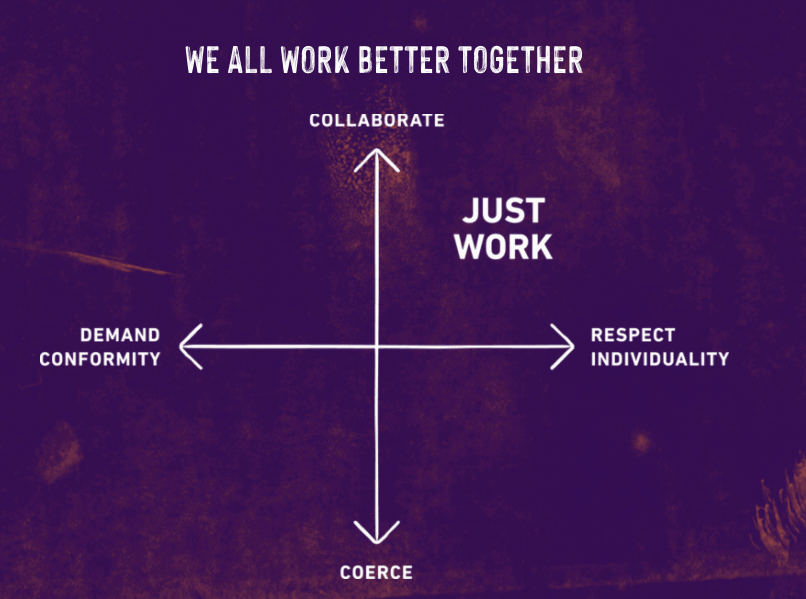
One of the great joys of leadership is the opportunity to create a collaborative, respectful working environment. A healthy organization is not merely an absence of unpleasant symptoms.
Creating a just working environment is about eliminating bad behavior and reinforcing collaborative, respectful behavior.
That means teaching people not to allow bias to cloud judgment, not to allow people to impose their prejudices on others; it means creating consequences for bullying and preventing discrimination, harassment, and physical violations from occurring on your team.
Workplace injustice is not inevitable. There are specific actions you can take so that you and your team can love the work and love working together so that you can all get sh*t done, fast and fair.
And once you start taking these actions, you set in place a virtuous cycle.
————————————————————————————————————————————————————————————–
Radical Candor author and co-founder Kim Scott announced the launch of her new book, Radical Respect: How to Work Together Better (St. Martin’s...
Kim Scott is the author of Radical Candor: Be a Kick-Ass Boss Without Losing Your Humanity and Radical Respect: How to Work Together Better and...
By Kim Scott & Trier Bryant We―all of us―consistently exclude, underestimate, and underutilize huge numbers of people in the workforce even as...
Share your perspective
Leave a comment below.