2 min read

Praise & Obnoxious Aggression

Table of Contents

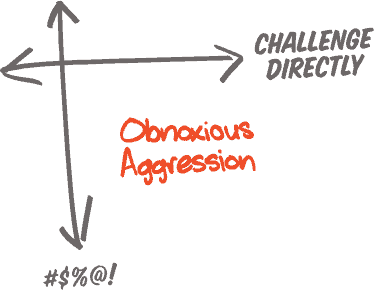
Praise can be Obnoxiously Aggressive when it is given without any care for the recipient. Belittling compliments are one of the best examples of this.

Below is a perfect example: an email that a boss at a legendary Silicon Valley company sent out to his team of about 600 people, 76 of whom had just gotten bonuses. It sort of screams, “I’ll praise you if it gets more work out of you but I really couldn’t care less how you feel.” The names & email addresses have been changed, but the text, grammar errors and all, is word for word what was actually sent out.

From: John Doe
Date: Tue, Oct 27 at 9:53 AM
Subject: Spot Bonus Winners!
To: giantteam@corpx.com

Dear Giant Team,

In Q3 there was a number of you that really excelled and went above and beyond the rest of us to deliver significant impact to Corpx. These team members and their accomplishments have been recognized with the Q3 spot bonus attributed by the Management Team. I want to take this opportunity to share who these extraordinary people are and provide you an overview of their accomplishments in the list below.

John Doe
Vice President, Giant Team
Worldwide

  • 33rd Name: Level 5 seller, he drove the highest QTD revenue of any seller: $7.5M in Q3. His comp at $70k base and OTE of $116k is 50% below market; retention risk.
  • 39th Name: she has done all of the dirty work in getting XYZ off the ground with endless spreadsheets, updates, legal calls, security calls, financial modeling, fallback matrices and has done a great job (well above her level 3 status)
  • 72nd Name: Exceptional effort in the past 4+ months. Additional responsibility covering John Doe.

Imagine how Person 33 felt when he saw his salary had been sent out to 600 people, along with the fact he was being paid half of what he should have been and was probably looking for other jobs! Just think how motivating it must have been for Person 39 to learn that she did all the “dirty work.” It probably wasn’t any consolation to learn she did such a great job that she was considered to be “well above her level 3 status.” At least there was some comedy in the fact that Person 72 had to be given a bonus for “covering John.” In other words, John Doe was such a jerk the company had to pay people a bonus if they worked closely with him.

This was Obnoxiously Aggressive. John Doe was plenty specific about what had gone well, but he had clearly gathered this information by asking all the managers who worked for him to send him a justification for the bonus. He cared so little about the people he was praising that he didn’t even bother to edit (or ask an assistant or an HR partner to edit) the justifications. He just copy-pasted them and fired off this email.

---

More about this story and others is included in “Radical Candor: Be a Kickass Boss Without Losing Your Humanity,” published by St. Martin’s Press. Learn more

Key Questions Covered

What is Obnoxious Aggression in the context of praise?

Obnoxious Aggression is one of the four quadrants in the Radical Candor framework. When it shows up in praise, it means recognizing someone's work without genuinely caring about them as a person. The result is compliments that feel belittling or tone-deaf — like publicly sharing an employee's salary or describing their work as "dirty work" — praise that serves the manager's agenda rather than the recipient's growth or well-being.

How can praise be harmful or demoralizing even when it's specific?

Specificity alone doesn't make praise effective. If a manager copies and pastes justifications written by others, broadcasts private compensation details to 600 colleagues, or frames contributions as "dirty work," the praise signals that the manager doesn't care about the recipient's feelings or dignity. Good praise requires both specificity and genuine care for the person — that's the "Care Personally" dimension of Radical Candor.

What should a manager do differently when recognizing employees publicly?

Before sending a public recognition email, ask yourself: How will each person feel when they read this? A few practical steps: edit ruthlessly for tone, never include private compensation data, avoid language that demeans contributions (like "dirty work"), and write the recognition yourself rather than copy-pasting managerial justifications. Taking five extra minutes to consider the recipient's perspective is the difference between Radical Candor and Obnoxious Aggression.

Why does the Radical Candor framework emphasize "Care Personally" alongside "Challenge Directly"?

Radical Candor sits at the intersection of caring personally and challenging directly. Without genuine care, even well-intentioned directness — or praise — becomes Obnoxiously Aggressive. Managers who skip the care component treat people as instruments for output rather than as human beings. The story in this post illustrates what happens when a leader focuses entirely on performance metrics while ignoring the emotional impact of his communication on his team.

Is Obnoxious Aggression always intentional?

Not necessarily. John Doe may not have intended to humiliate his team members — he was likely just careless and rushed. But intent doesn't erase impact. Obnoxious Aggression can stem from indifference as much as malice. That's why Radical Candor encourages managers to pause and think about how their words will land, especially in written communications that go out to large groups and can't be taken back.

Keep going.

Three ways to put this into practice.

Apply what you've learned Get personalized coaching with Compass
Your AI-powered Radical Candor coach. Free to try.
Used by managers at Apple, Dropbox, and Twitter Try Compass free
Stay sharp More like this, every week
Practical leadership tips in your inbox.
Join 25,000+ leaders Subscribe free
For your whole team Bring Radical Candor to your organization
Workshops, keynotes, and rollouts for teams of 50+.
Trusted by 100+ Fortune 500 leadership teams Talk to our team

EXPLORE MORE FROM RADICAL CANDOR

Criticism & Obnoxious Aggression

Criticism & Obnoxious Aggression

Obnoxiously Aggressive criticism is often referred to as “front-stabbing”. It’s when you criticize without Caring Personally.
Read More
Tips to Avoid Obnoxiously Aggressive Praise

Tips to Avoid Obnoxiously Aggressive Praise

If you think you've given praise that was Obnoxiously Aggressive, check out these tips for moving towards Radical Candor!

Read More
Tips to Avoid Obnoxiously Aggressive Criticism

Tips to Avoid Obnoxiously Aggressive Criticism

If you think you've given criticism that was Obnoxiously Aggressive, check out these tips for moving towards Radical Candor!

Read More