 Kim Scott
How to Get and Give Feedback Using the Radical Candor Order of Operations
There are four simple steps for how to give and receive feedback you need to excel at work. You might call it the solution to your feedback wipeouts....

Esther Bintliff recently interviewed me for the Financial Times about Radical Candor — feedback that is kind, clear, specific and sincere — and some folks have asked me what I think about Avraham Kluger’s research, which Bintliff also referenced in the article.
In 1996 Kluger and his research partner Angelo DeNisi published an analysis that found giving feedback is inherently flawed and one-third of feedback interventions actually decreased performance. He says people should instead prioritize active listening.
First of all, I 100% agree good feedback (praise and criticism) ALWAYS begins with soliciting feedback, aka listening, not giving it.
There is an order of operations to Radical Candor (which includes both praise and criticism with an emphasis on praise): get it, give it, gauge it, encourage it. Don't dish it out before you prove you can take it. I think that is why Kluger became a researcher of listening.
Experiments (like the ones Kluger studied) that look at the impact of being told whether a person got an exam question right or wrong on motivation do not give an accurate assessment of the impact that good feedback from a caring colleague has on motivation.
An automated "You're wrong!" is not good feedback in my book. Good feedback happens when the person offering cares personally and challenges directly. There is zero care personally in an automated you're wrong...
There is no formula for how one person can tell another when they think they're wrong. I have to do it in a way that works for me, and also that works for the other person. What works for me may not work for you.
I have to adjust what works for me enough so that it will also work for you. What works for me with you won't work for me with someone else. I'm not sure it's possible to design an experiment when the variables change with every diad.
Kluger describes a feed-forward interview very similar to the career conversation methodology Russ Laraway developed when we worked together at Google. (I describe that briefly in Radical Candor, he describes it more thoroughly in his new book When They Win, You Win.) Career conversations are an essential part of a good boss-employee relationship.
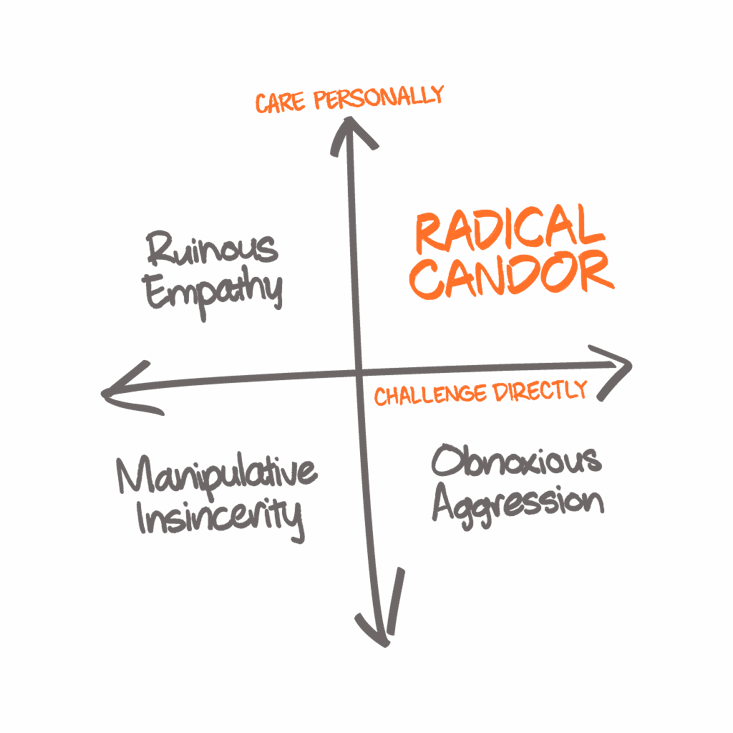
The fundamental building block of a good boss-employee relationship is guidance — the word I prefer for feedback.
I like guidance because feedback makes you want to put your hands over your ears, but guidance is something most of us long for. Also, positive and negative feedback are terms that are confusing.
What people really mean usually is praise and criticism. But sometimes negative feedback really means poorly delivered praise or criticism — patronizing praise or cruel criticism.
Effective guidance is humble, helpful, immediate, delivered in person or synchronously (no text/email/tool), praise in public, criticize in private, and not about a personality attribute.
The crucial thing to remember in all of this is that people who are in positions of authority MUST be able and willing to hear and more importantly act on criticism without getting defensive. Leaders who get stuck in the “fuck you “ or the “I suck” phases of hearing feedback are dangerous leaders.
They are especially dangerous when they are armed.
In Bintliff’s article, she explains that Kluger had been “hired to apply psychological principles to the management of police officers,” and was admonished by the chief of police when he delivered his results.
I could not disagree more vehemently with the police chief's assertion that "I am telling you, a good policeman does not need feedback. If he does need feedback he’s not a good policeman.”
As we have seen over and over again, a police officer who is shut down to criticism, a police force that refuses to hold police accountable for the way they treat people, is a police force that is dangerously unjust.
In fact, a 2019 study found police officers who interacted with and actively solicited feedback from residents were more trusted by their communities than those who didn't engage in these behaviors.
Overall, effective feedback — based on caring personally while also challenging directly — shows us what to do more of and what to do less of.

There are four simple steps for how to give and receive feedback you need to excel at work. You might call it the solution to your feedback wipeouts....
Every once in a while, if you’re lucky, you get to work on something that is so fun you can’t believe it’s work. For me, collaborating with my team...

Stop for a moment and remember the last time you gave someone feedback. How did it go? If your feedback fell flat, you’re not alone. Feedback fails...
Share your perspective
Leave a comment below.