10 Free Resources to Help You Practice Radical Candor
"Getting and giving impromptu feedback is more like brushing and flossing than getting a root canal," Radical Candor author and co-founder Kim Scott...
7 min read

There are four simple steps for how to give and receive feedback you need to excel at work. You might call it the solution to your feedback wipeouts. We call it the Radical Candor Order of Operations.
This proven feedback framework is designed to help you give, get, gauge, and encourage feedback no matter your role on a team. You can follow these steps to give feedback to peers, cross-functional team members, direct reports, and your boss.
Feedback provides valuable insights into areas where individuals can improve their skills, performance, and behaviors. It helps identify strengths and weaknesses, allowing individuals to develop and grow professionally.
Giving and getting feedback helps individuals understand expectations and align their work accordingly. It enables them to make necessary adjustments, leading to improved performance and productivity.
Feedback fosters open communication and trust among team members. It creates a culture of transparency and collaboration, strengthening relationships and promoting a positive work environment.
Feedback offers opportunities for continuous learning and development. It allows individuals to gain new perspectives, acquire new knowledge, and refine their skills.
When employees receive feedback, they feel valued and recognized for their efforts. This boosts their engagement, motivation, and job satisfaction, leading to higher levels of productivity and retention.
We get a lot of questions about how to give and receive feedback effectively, and we know that putting Radical Candor into practice is more difficult than it seems.
Don't worry — we've got your back. Getting and giving feedback takes practice. Here's how to get started.

To give and receive feedback effectively, there are a few key principles to keep in mind:
Remember, feedback is an opportunity for growth and development. By following these principles, you can create a culture of open communication and continuous improvement.
Now that you know the basics about giving and getting feedback, here's how to give and receive feedback using the Radical Candor order of operations.
When learning how to give and receive feedback, you may not know you have to get it before you give it. That's why soliciting feedback is the first step in the Radical Candor Order of Operations.
When receiving feedback using Radical Candor, start by listening actively, focusing on understanding rather than defending yourself. Ask clarifying questions to ensure you fully grasp the message. Express appreciation for the person's candor, even if the feedback is difficult to hear. Take time to reflect on the feedback before responding, considering how you can use it to improve.
Follow up by letting the person know how you've implemented their suggestions and ask for ongoing input to ensure you're on the right track. If the delivery of the feedback wasn't effective, kindly provide feedback on their approach to help improve future interactions. Finally, seek feedback regularly to foster a culture of open communication.
This approach demonstrates your commitment to growth, values the input of others, and helps create a more transparent and productive work environment.
This might be awkward at first, but there are four easy things you can do to make asking for feedback feel more natural.
Some nuances depend on whether you’re the boss soliciting feedback from your direct reports or an individual contributor soliciting feedback from your boss.
Select the link below that applies to you to learn more about how to use this process to get the feedback you need to succeed at work.
I'm a manager >> I'm an individual contributor >>
When giving feedback using Radical Candor, it's essential to balance caring personally with challenging directly. Start by building genuine relationships with colleagues, showing that you care about their growth and well-being, and demonstrating empathy and understanding.
When addressing issues, be specific and clear, tackling problems promptly without sugarcoating or downplaying concerns. Maintain humility by acknowledging that your perspective might be incomplete, and invite dialogue by asking for their point of view.
Be helpful by offering actionable suggestions for improvement and providing necessary resources or support. Don't wait for formal reviews; instead, give immediate feedback as issues arise.
This approach ensures that feedback is timely, constructive, and delivered in a context of mutual respect and genuine concern for the recipient's development.

Understanding how to give and receive feedback effectively means learn how to give and get both praise and criticism. Radically Candid praise included both caring and a challenge.
Being specific and sincere is a real relationship-building opportunity. It helps people feel seen and appreciated while also getting a new perspective on their work.
We’ve created a cheat sheet to help you practice praise using the CORE method:
C — Context (Cite the specific situation.)
O — Observation (Describe what was said or done.)
R — Result (What is the most meaningful consequence to you and to them?)
E — Expected Next Step (What is the expected next step?)
Learn how to give feedback (praise) >>

For most people, the hardest part of getting and giving feedback is grasping the concept of kind and clear criticism. Remember, Radically Candid criticism includes both caring and a challenge.
Being kind means caring about what’s best for the person long term, not just what feels easiest right now.
Being clear means leaving no room for interpretation about what you really think — while also being open to the possibility that your opinion is wrong.
We’ve created a cheat sheet to help you practice praise using the CORE and HIP methods to give criticism.
Learn how to give feedback (criticism) >>

Do you ever wonder how the feedback you give others is landing? How about your reaction to the feedback you’re receiving? This giving-and-getting feedback stuff can be tricky. When practicing how to give and receive feedback, this is an important part of the process.
We call this part of the Radical Candor order of operations gauging feedback. In other words, how does the feedback that you give land for the other person?
Remember, feedback is measured, not at the speaker’s mouth, but at the listener’s ear. And, this applies to the feedback you give as well as the feedback you get.
When delivering feedback, focus on being fully present, pay attention to how the other person is reacting, and be willing to adjust our approach.
How exactly do you do that? Don’t worry, we’ve created a cheat sheet to help you practice understanding how your praise and criticism landed.
Learn how to gauge feedback >>

It’s a lot easier to lead by example than it is to change other people’s behavior. In order to sustain a culture of getting giving feedback, you have to walk the talk.
If you want to encourage Radical Candor between the people on your team, you have to create an environment of psychological safety.
Coined by author and Harvard Business School Professor Amy Edmondson, psychological safety refers to feeling heard and acknowledged versus fearing you will be retaliated against.
Establishing psychological safety and cognitive and emotional trust allows people to give candid feedback, openly admit mistakes and actively learn from each other.
We have a resource guide with six tips for encouraging feedback on your team to help you get started.
Learn how to encourage feedback >>

Getting and giving Radically Candid feedback is more like brushing and flossing than getting a root canal. Don’t schedule it. Just ask for it and offer it consistently and immediately when it’s needed, and maybe you won’t ever have to get a root canal.
To help you strengthen your Radically Candid habit, download the Radical Candor Practice Playbook. Complete the reflection exercises for Radical Candor, Obnoxious Aggression, Ruinous Empathy and Manipulative Insincerity.
Sharing your stories and ideas with each other will help deepen your understanding of Compassionate Candor and how it applies to real-world situations.
If you feel comfortable, share your Radical Candor stories with folks outside your team like family members, friends or colleagues.
When you show a little vulnerability by telling your stories, you are doing several important things at once:
This will make it easier to solicit feedback — and the more feedback you solicit, the more self-aware you become. To keep yourself accountable, add a reminder to your calendar to share your stories.
Get the Radical Candor practice playbook >>
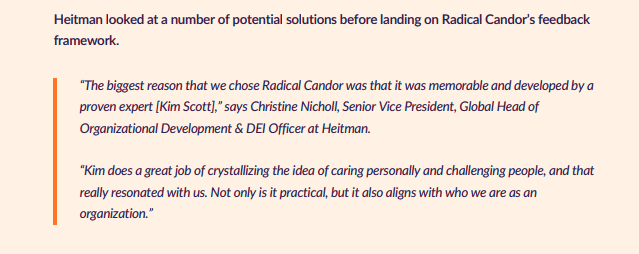
Radical Candor is one of the most effective ways to learn how to give and receive feedback effective because it:
This approach helps create a more dynamic, transparent, and productive work environment where feedback is seen as a tool for growth rather than something to fear.
Go to RadicalCandor.com/Resources to learn how to give and receive feedback like a boss. This one-page quick-start guide gives you the quick and dirty on Radical Candor complete with definitions for the quadrants and the order of operations for getting and giving feedback. Print it out and keep it by your desk!

"Getting and giving impromptu feedback is more like brushing and flossing than getting a root canal," Radical Candor author and co-founder Kim Scott...

According to Gallup's Leadership and Management Indicator, only 21% of employees in the U.S. trust the leadership in their organization. In addition,...

Every once in a while, if you’re lucky, you get to work on something that is so fun you can’t believe it’s work. For me, collaborating with my team...
Share your perspective
Leave a comment below.