

What does a two-minute feedback conversation look like?
A common question the Candor Coaches and I get during a Radical Candor® workshop is "How do I find the time to give feedback?” It doesn’t have to be an hours-long meeting to be impactful, as this story illustrates.
Shortly after I joined Google, I had to present to the founders and CEO on how the AdSense business was doing.
I was nervous, but luckily the business was thriving. When I said how many new customers we’d added, the CEO almost fell off his chair. I felt like the meeting was going pretty well. In fact, I kind of felt like a genius. But when I walked past my boss as it ended, expecting a high-five, she asked me to walk back to her office. My stomach sank. I had screwed something up.
She didn't start with what I'd done wrong. She started with what I'd done right, not in a “feedback sandwich” way. She was specific and sincere:
“In the meeting, when you offered both the pros and the cons of your recommendation, you gained real credibility. Do more of that! I learned a lot today from the way you handled those questions.”
I’d worried I wasn’t arguing my points vehemently enough, so it was good she told me that. Specific, sincere praise doesn't just make a person “feel” good. It helps them perform better. She helped me understand that something I’d worried was a weakness was actually a strength, so I’d do more of it.
“But what could I have done better?” I asked.
She laughed. “You always want to focus on what you could have done better. Which I understand. I do, too. We learn more from failure than success. But I want you to focus for a minute on what went well, because overall it really did go well. This was a success.”
“How could it have been even more successful?” I asked.
“You said, ‘um’ a lot in there. Were you aware of it?”
I breathed a huge sigh of relief. If that was all I'd done wrong, who cares? I made a brush-off gesture with my hand. "Yeah, I know I say it a lot. It's no big deal."
"I know this great speech coach. I bet Google would pay for it. Would you like an introduction?"
I waved my hand again. "No, I’m too busy–all those new customers!"
She stopped walking. She looked me right in the eye and said, "I can tell when you do that thing with your hand that I'm going to have to be a lot more direct with you. When you say 'um' every third word, it makes you sound stupid."
Now she had my full attention.
She wasn’t being mean to tell me I sounded stupid. It was the kindest thing she could have done for me at that moment in my career. An important point, though: she never would have used those words with other people on her team who listened better than I did. She knew me well enough to know that it wouldn’t upset me much for her to say that. She also knew me well enough to know that if she hadn't used just those words, I never would have visited the speech coach.
And thank goodness I did. When I met with the coach, I learned that I literally said "um" every third word. I'd been giving presentations my whole career. I'd raised money for two startups by giving presentations. I thought I was pretty good at it. Now, I felt as if I'd been walking through my whole career with a giant hunk of spinach between my teeth and no one had had the common courtesy to point it out.
This conversation made me want to solve my “um” problem immediately. It also made me appreciate my boss and inspired me to do for my team what she’d done for me: give better feedback. The way she gave praise and criticism got me thinking about how to teach other people how to adopt her style of management. All this from a two- minute encounter.
When and where should you give feedback?
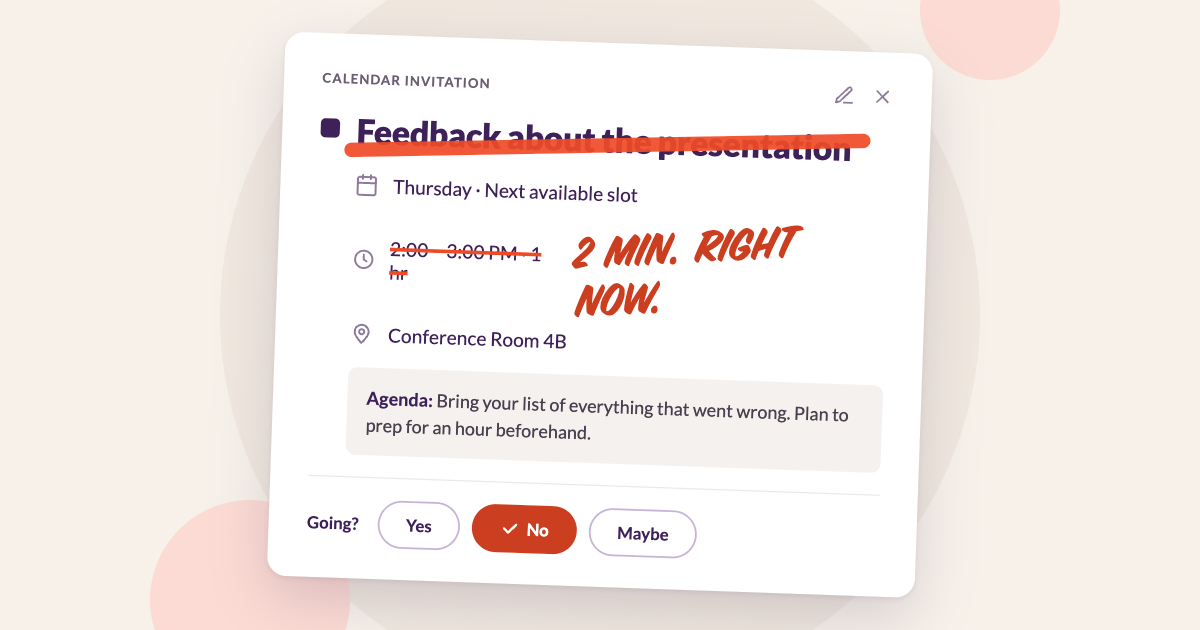
Answer: In impromptu, 2-minute chats. To give Radical Candor, put your phone in your pocket, shut your computer, look a person in the eye, and have a real human conversation.
Most people agree that feedback is important—but few believe it can be quick. They picture an hour-long conversation they have to schedule and prep for, like a root canal.
Instead, think of these conversations like brushing your teeth: basic relationship hygiene. Don't calendar them, don’t save up topics in some kind of dreaded list. Just talk, right away, kindly, and you'll deliver the feedback in less time than it would take you to schedule the meeting.
If my boss had waited until we got back to our desks and then put an hour on the calendar called “feedback about the presentation,” it would have taken more time and created more angst for both of us.
Even if you’re scheduled within an inch of your life, you can find two minutes in between meetings. Keep a little slack in your calendar by holding twenty-five and fifty-minute meetings with hard stops. Or, if you can get away with it, be willing to be a little late to your next meeting.
These conversations are the best way to build better relationships and achieve better results. They are core to your job. Building good relationships with the people you work closely with is, in my book, more important than perfect punctuality.
Now—what should you say in these conversations? Read on.
How much praise should you give compared to criticism?
Praise lets people know what to do more of. Radical Candor is about painting a picture of what's possible, and praise is a better tool for that than criticism. It shows people what to do more of and that you’re paying attention. Expressing gratitude and appreciation is vital to any strong relationship.
Praise goes wrong when you treat it as something you have to say before and after criticism. It comes off as insincere: "Great glasses. Terrible presentation. Love the shoes, though." That's the feedback sandwich. If you do this all the time, you’ll create a Pavlovian response—no one will hear your praise because they’ll be bracing for the inevitable criticism.
Some research says you need a praise-to-criticism ratio of 3:1, 5:1, or even 7:1. But scrambling to hit a ratio could also lead to insincere praise. My boss didn’t compliment me on the fonts I’d used in my presentation during that walk back to her office. She talked about something that mattered. She had been paying attention. She wanted to help me grow. I could trust her praise, and that helped me trust her criticism, too.
Think about what you most appreciate about the people you work closely with, and tell them how you feel. If you notice someone doing something great in a meeting, praise them publicly, then and there. Hint: if it’s something you’d say to a dog (“good job”), it’s not Radical Candor praise. Be specific and sincere.
How do you give criticism without sounding harsh?
Criticism is to let people know what to do less of–or at least what you think they should do less of. Sometimes you’re wrong. And you only give a person the chance to change your mind if you tell them what you think. So whether you’re right or wrong, feedback is a gift. But it usually doesn’t feel like a gift. So focus on saying what you mean without being mean.
Unspoken criticism explodes like a dirty bomb. Staying silent too long about bad work or behavior that angers or frustrates you makes the problem more likely to continue; you’ll get angrier with repetition, and eventually you will blow up in a way that makes you look irrational, harms your relationship, or both. Don’t let things fester. Nip problems in the bud.
Easy to say, hard to do.
It’s easy for me to say, “Be Radically Candid!” Harder for you to do it. In fact, I struggle with it, too. It’s hard to change your behavior just by reading. That’s why our company, Radical Candor, offers workshops.
More from Radical Candor
How Do You Act on Feedback? Reward the Candor
What does rewarding the candor look like? This story always comes up in our workshops: When we worked together at Google, my colleague Russ Laraway once complained that I …
What Do You Do After You Ask for Feedback? The Only Way Out Is Through
A Story A banker who led a high-stakes tech IPO ran an important meeting with the COO of the company that was going public. The meeting had been a home run. So he was surprised …
Manipulation vs. Persuasion: A Clear Distinction (with Jay Conger) 8 | 29
While the podcast team is on a Radical Sabbatical, Kim Scott is spending the season talking to authors of the books that have shaped her thinking. This week: Jay Conger, whose …
Share your perspective
This site is protected by reCAPTCHA and the Google Privacy Policy and Terms of Service apply.