 Kim Scott
Acting Like a Jerk by Not Caring Personally is a Radical Candor Fail
What makes Radical Candor radical is that it’s a deviation from the norm, which tends to fall somewhere between acting like a jerk and avoiding...
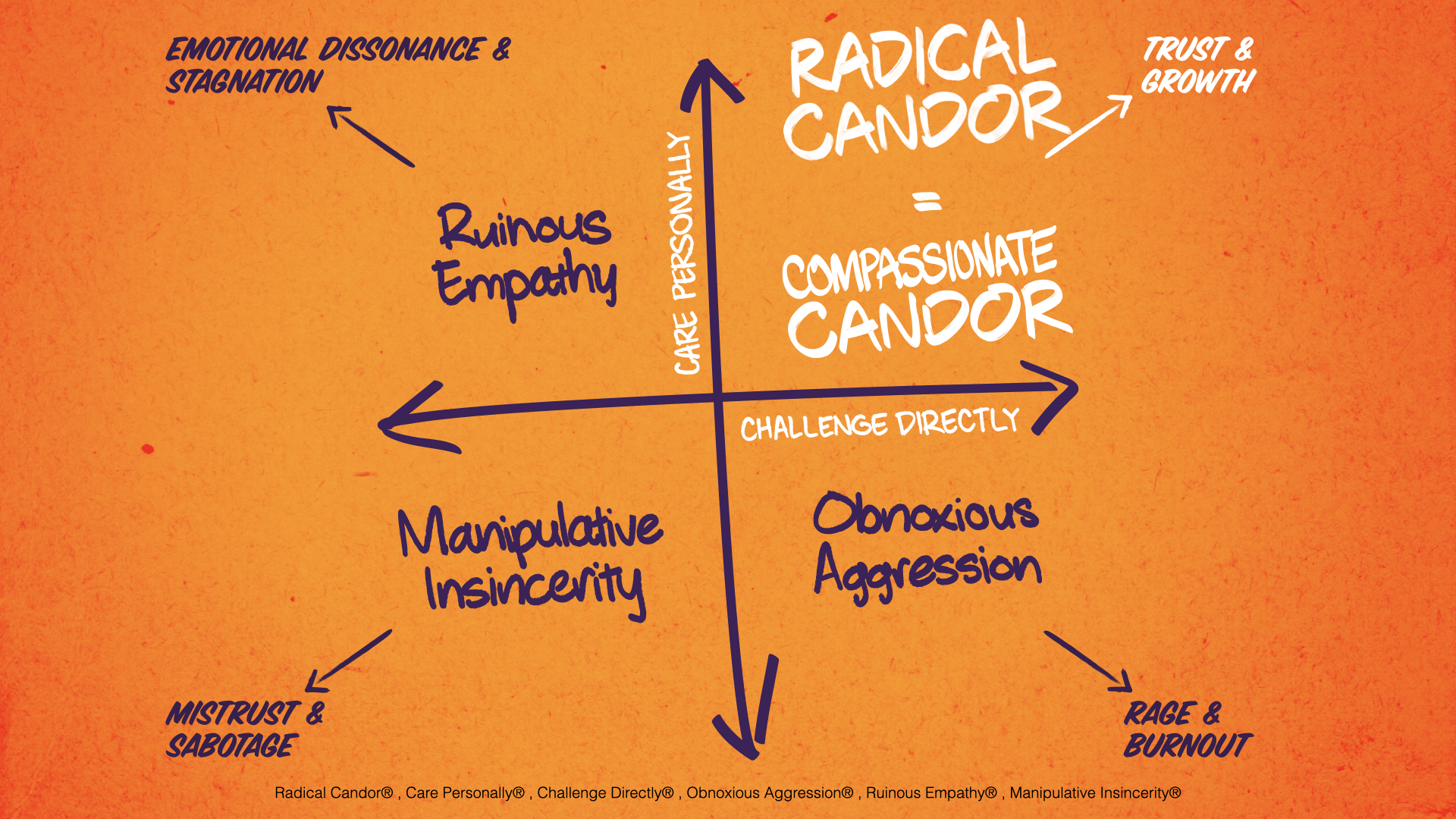
People have been asking lately if we have ‘rebranded’ Radical Candor as Compassionate Candor. Nope. These terms are synonymous. Use whichever you prefer.
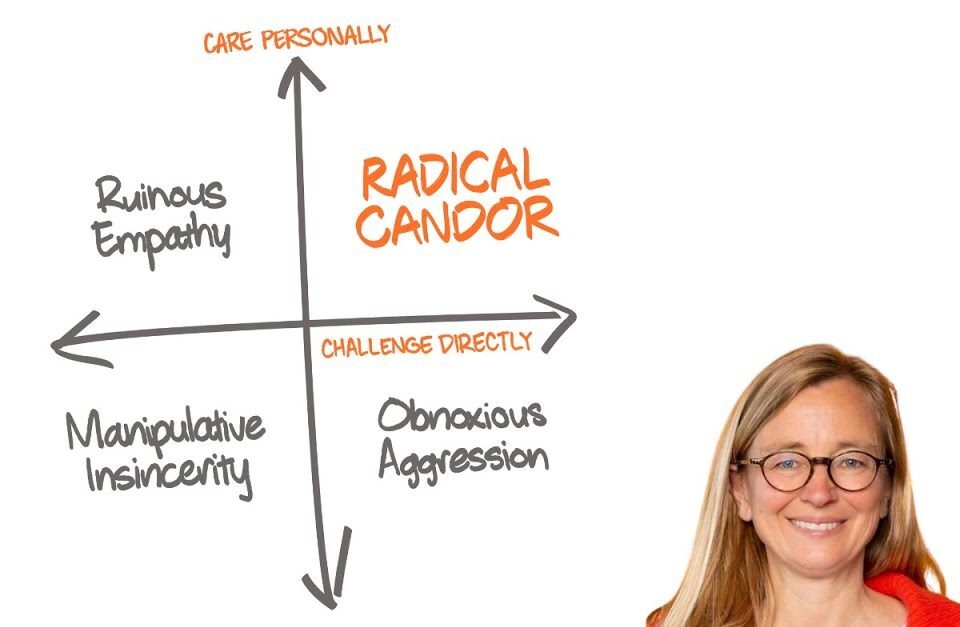
When the Candor Coaches and I do workshops at companies all over the world, people quickly build a shared vocabulary. They understand that Radical Candor means to Care Personally and to Challenge Directly at the same time. The shared framework offers a way of building trust, helping people grow, and creating a culture of psychological safety.
However, a few people who read the title but not the book twisted the words into a license to act like a jerk. That certainly was not my intention—and overall it's not been the impact of the book or the company. However, I take feedback seriously, so I pay attention to the exceptions.
The HBO Show Silicon Valley conflated Radical Candor, Manipulative Insincerity and Obnoxious Aggression. I first understood why that mattered when I got off an overnight flight to find my phone blowing up. Friends, family, people I hadn't heard from in months, all asking the same thing: had I seen the Silicon Valley episode? I hadn't. But I caught up fast.
In the episode, a character named Ben Burkhardt wants to be COO for the show's hero, Richard Hendricks. Ben advises Richard to treat an employee cruelly and calls it "Rad Can." He's a parody of Obnoxious Aggression. When his boss walks into the restaurant where Ben is meeting Richard, Ben literally runs to hide, attributing his Manipulative Insincerity to Radical Candor, too.
Ugh. The Radical Candor framework was designed to prevent this kind of conflation. But the TV show was stirring the pot and having fun with the mess.
I'd written a book and built a company that helped people to take criticism to heart. I encouraged people to pan for gold even when they disagreed with feedback. Radical Candor starts with soliciting feedback and responding well to unsolicited feedback.
Clearly, I needed to take my own advice here…I thought about why I'd decided not to call the book Compassionate Candor. The word "radical" got people's attention. That was the point. The edgy word next to the conscientious word created a jolt. It made people think. I resurfaced a long post explaining that Radical Candor and Obnoxious Aggression were two very different things. I hoped that would address the problem.
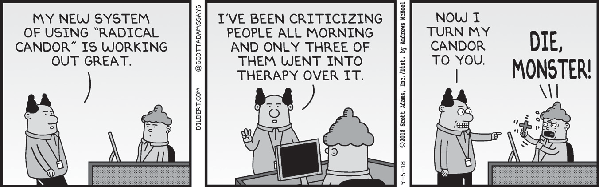
It did not—A few months later, Dilbert piled on. I won't spend much time on a cartoonist who once wrote that women are treated differently by society "for exactly the same reason that children and the mentally handicapped are treated differently." But the strip did show how some bosses twist "Radical Candor" into a cover for being obnoxious.
As I was processing that, I also had to confront the Ray Dalio problem. People confuse Radical Candor with Dalio's Radical Transparency. Dalio's philosophy is about managing people as if you're operating a machine to achieve a goal. There's not much room for Care Personally in that model. And relationships need some privacy to thrive. I'm all for transparency when it comes to business results. But Radical Transparency doesn't foster good working relationships or psychological safety. Recently, I talked about this on the Radical Candor podcast with Rob Copeland, who wrote The Fund, a book about the nightmarish culture at Dalio's firm, Bridgewater. The stories he told were grim.
So what did I mean by "radical"? Foundational, essential; basic, not extreme. And yet still rare. I mean what Antoine de Saint-Exupéry meant in The Little Prince: "One sees clearly only with the heart. What is essential is invisible to the eye."
I also wanted to convey energy and excitement. The idea that bosses should use their power to bully people is old and boring, not radical. Liz Wiseman and I talked recently on the podcast about her data that shows that command-and-control can choke innovation and damage a team's ability to improve. My experience bears out her data. Bosses get better results when they voluntarily set down unilateral power and invite their teams to hold them accountable. When they stop trying to control people and start encouraging agency. Collaboration and innovation flourish when human relationships replace bullying and bureaucracy.
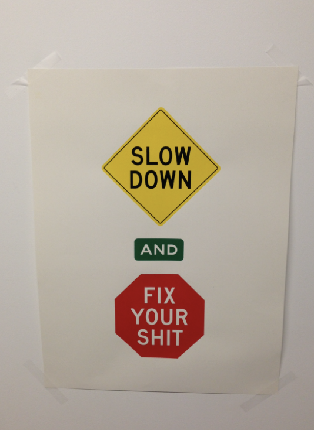
But as I thought about that Silicon Valley episode, the Dilbert Cartoon, and the confusion with Ray Dalio, I was forced to confront that for some people "radical" sounds like a cousin to "move fast and break things," the evil ethos of "disrupt now, dodge accountability later." That approach is the opposite of Radical Candor. In fact, friends who used to work at Facebook back when it was still called that sent me a photo of posters on their walls at corporate HQ that read "Slow down and fix your shit."
What could I do to fix the fact that some leaders use Radical Candor as an excuse to be a jerk? On the one hand, haters gonna hate. On the other hand, I feel a real responsibility to support people whose bosses are weaponizing Radical Candor. That's why I offer the Compassionate Candor version of the framework. If you're in a situation where the people around you are using Radical Candor as an excuse to act like a jerk, please call it Compassionate Candor instead. Feel free to use this image to defuse the weaponization of my work.
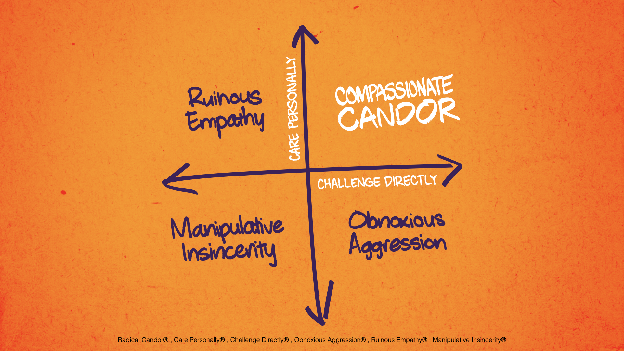
The contrast between Ruinous Empathy and Compassionate Candor is worth thinking about.
Joan Halifax, a Zen Buddhist teacher, puts it well: empathy is a component of compassion, but empathy alone doesn't lead to action. Unregulated emotional empathy can cause burnout and withdrawal. Compassion is empathy plus the will to do something about the suffering you're witnessing.
In Against Empathy, psychologist Paul Bloom explains how empathy can focus our emotions so intensely that we stop reasoning clearly. Empathy locks us into the moment, making it harder to see long-term consequences. That's what Ruinous Empathy does: you're so fixated on not hurting someone's feelings or offending them in the moment that you don't tell them something they'd be better off knowing in the long run. I'm not against empathy. Neither is Bloom. (I have both empathy and compassion for how dangerous two-word titles can be.)
Jeff Weiner, former CEO of LinkedIn, tells a story that makes this concrete. He describes coming across a person crushed by a boulder on a mountain trail. The empathetic response is to feel the same crushing suffocation, rendering you helpless. The compassionate response is to recognize that the person is in pain and do everything in your power to remove the boulder. In other words, compassion is empathy plus action.
Early in his career, Jeff had a reputation for being pretty harsh. He's living proof that self-awareness and personal growth can transform how you lead.
In short, Radical Candor and Compassionate Candor are synonyms. Some of the clients we work with choose to call it Radical Candor; others Compassionate Candor. We build to suit.
Either way, the practice of building good relationships is at the center of a leader's job. That is what I meant when I wrote these words:
"Relationships are core to your job. If you think that you can fulfill your responsibilities as a manager without strong relationships, you are kidding yourself. I'm not saying that unchecked power, control, or authority can't work. They work especially well in a baboon troop or a totalitarian regime. But if you're reading this, that's not what you're shooting for."
This week's Radical Refresher goes out with the alternative version of the 2x2 attached, free to use if someone in your world is treating Radical Candor as a license to be a jerk.
What makes Radical Candor radical is that it’s a deviation from the norm, which tends to fall somewhere between acting like a jerk and avoiding...
What is Radical Candor? People often get confused about what Radical Candor really means.
"I can see how Radical Candor works when I already have a relationship... but what about with people I barely know? Isn’t it too risky to give...
Share your perspective
Leave a comment below.