
Asking employees for feedback is a powerful tool for building trust, enhancing engagement, and driving continuous improvement throughout your organization.
Soliciting feedback from your employees helps create a psychologically safe work environment where everyone feels valued and empowered to contribute to the team's success.
While almost no one likes asking for feedback, whether or not you do it, and do it well, has an enormous impact on your success or failure as a manager.
Key Benefits of Asking Employees for Feedback
Improves Trust and Team Dynamics: By asking employees for feedback, you demonstrate that you value their opinions and are willing to make changes based on their input. This fosters trust and strengthens your relationships with your team, creating a more collaborative and supportive work environment.
Enhances Self-Awareness and Growth: Feedback from employees provides valuable insights into your strengths and areas for improvement. This self-awareness is essential for personal and professional growth, enabling you to become a more effective leader.
Boosts Employee Engagement: When employees feel their voices are heard and their feedback is acted upon, their engagement and commitment to the organization increase. Engaged employees are more motivated, productive, and likely to stay with the company, reducing turnover rates.
Encourages a Feedback Culture: Soliciting feedback from employees sets an example for your team, encouraging them to give and receive feedback openly. This creates a culture where constructive criticism is welcomed, leading to continuous improvement and higher performance across the team.
Provides a Fresh Perspective: Employees often have a unique perspective on processes, projects, and team dynamics. Asking employees for feedback can help you identify issues you may not have noticed, allowing you to address them proactively.
Aligns Goals and Expectations: Asking your employees for regular feedback helps ensure that your actions and decisions align with your team's needs and expectations. This alignment ensures that everyone is working toward common goals, enhancing overall team effectiveness.
Demonstrates Humility and Openness: By actively asking employees for feedback, you show that you are humble and open to learning and growth. This humility can inspire your team to adopt a similar attitude, fostering a culture of continuous learning and development.
Improves Decision-Making: Employee feedback can provide valuable insights and diverse perspectives that enhance your decision-making process. By considering different viewpoints, you can make more informed and effective decisions that benefit the entire team.
Now that you know why it's important to be regularly asking employees for feedback, let's talk about how to solicit feedback from employees.
Asking Employees for Feedback: How to Do It
Have a Go-To Question
@appletvProfessional development is key. ♬ The Completely Made Up Adventures - Apple TV
- Don’t ask a question that can be answered with a yes or a no, or an “Oh, no, everything is fine.” Which is exactly the answer you’ll get most of the time if you ask, “Do you have any feedback for me?” So don’t ask that. People often want me to give them the right words. The right words are the ones you’re most likely to use, not the words I give you.
- Your question must sound like you -- something you would naturally say. If you sound like Kim Scott and not yourself, people won’t believe you really want to hear what they have to say. The question I like to use is, “What I could do or stop doing that would make it easier to work with me?” However, If those words don’t fall easily off your tongue, find words that do.
- Your question must be adapted for the person you’re talking to. Jason Rosoff, who co-founded Radical Candor with me, told me he hates my question. I need to ask him a more specific question.
Of course, you’re not really just looking for one thing; that opening question is just designed to get things moving. If you don’t have time to keep reading, do this one thing: write down your go-to question, to whom you're going to ask it, and when (today not tomorrow).
Listen to the Go-To Question podcast >>
Embrace the Discomfort

No matter how good your question is when asking employees for feedback, the person you ask won’t want to answer it. The only way out of this uncomfortable moment is through it. If you try to make the person comfortable, you’ll just let them off the hook. You won’t get the Radical Candor that you need to improve and grow.
Most people will try to wriggle out of the conversation. They probably didn’t see your question coming, and so they feel immediately wary. “Really everything is fine,” they may insist. Their discomfort will make you feel uncomfortable, and you may find yourself reassuring them by nodding and offering an “I’m glad to hear that.”
Don’t do this. It’s essential that you prepare yourself for these scenarios in advance and commit to sticking with the conversation until you have a genuine response.
One technique is to count to six before saying anything else, forcing them to endure the silence. The goal is not to be a bully but to insist on a candid discussion — to make it harder for the person to say nothing than to tell you what they’re thinking. If they can’t come up with anything on the spot, you can always arrange a time to meet again. If counting to six doesn’t do the trick, ask the question again. And again if necessary.
One of the bankers who led Facebook’s IPO told me about a time Sheryl Sandberg asked him for feedback after a meeting with potential investors. “What could I have done better?” she asked him. He couldn’t think of anything. The presentation had been a home run. Sheryl wouldn’t let him off the hook, though. “I know there was something I could have done better in there.”
He still couldn’t think of anything. Now, he was getting nervous. “You have a reputation for being great at giving feedback,” Sheryl encouraged him. “I bet if you think about it you can come up with something.” Now, he was sweating. But still, she didn’t let him off the hook. She smiled expectantly and stayed silent.
That was when he finally thought of something, and told her. “Thank you!” She said, “I’ll do better next time!”
Another way to embrace the discomfort is to point out when people’s body language is at odds with what they’re saying. Imagine you’re at a meeting with a colleague with whom you’ve just shared a big, possibly impractical idea. He responds, “Oh! Great idea,” but you notice that he hunches over and crosses his arms defensively. Ignoring that sort of nonverbal cue is a lost opportunity.
Without being obnoxious, try saying something like, “Then why are you folding your arms and hunching down in your seat? Come on, tell me what you’re really thinking!”
Listen With the Intent to Understand, Not to Respond
Don’t start telling the other person they weren’t Radically Candid! Instead, try to repeat what the person said to make sure you’ve understood it, rather than defending yourself against the criticism that you’ve just heard.
Listen to and clarify the criticism — but don’t debate it. Try saying, “So what I hear you saying is . . .” If you find my language too programmatic, find another way to say it.
If you’re like most people, you’ll probably feel a strong urge to act defensively when you get criticism — or at the least to explain yourself. This is a natural response, but it pretty much kills any chance that you’ll get the person to offer you the gift of candor again. So don’t feel bad that you are having this very normal human reaction. Manage your feelings rather than letting them manage you.
Remind yourself going in that no matter how unfair the criticism, your first job is to listen with the intent to understand, not to defend yourself.
Reward Candor to Get More of It

Once you’ve asked your question and embraced the discomfort and understood the criticism, you have to follow up by showing that you really did welcome it. You have to reward the candor if you want to get more of it.
If you agree with the criticism, make a change as soon as possible. If the necessary change will take time, do something visible to show you’re trying. For example, my friend and former colleague Russ once complained that I interrupted him. It was true; I am an inveterate interrupter. I tried not to do it, but I knew I wouldn’t succeed in eradicating this bad habit just because he’d mentioned it.
Telling Russ that I couldn’t help myself was hardly a good way to reward his candor. So I said, “I know, it’s a problem. Can I ask you to help me stop interrupting?” I pulled a fat, blue rubber band out of my drawer and put it around my wrist. I asked him to snap the rubber band every time I interrupted him. Russ thought this was funny, and agreed.
I wore the rubber band, which I now think of as my “radical bander,” to my staff meeting. I asked everyone present to help me by snapping it. Sure enough, others started snapping the rubber band. Then, I mentioned it at an all-hands meeting.
Additional snapping did help me interrupt less. But equally important was that it sent a strong signal that I had heard the criticism and was taking action, and that I wanted to hear more criticism.
In some cases, of course, you may disagree with the criticism. It’s here that your Radical Candor skills become essential. It is never enough to simply acknowledge the other person’s feelings— that invariably feels passive-aggressive and insincere. Instead, first, find something in the criticism you can agree with, to signal that you’re open to criticism.
Then, check for understanding — repeat what you heard back to the person to make sure you got it. Then, let them know you want to think about what they said and schedule a time to talk about it again.
It’s essential that you do get back to it. The key then is to explain exactly why you disagree. If you disagree with the feedback, giving the person a thoughtful, respectful explanation of why is the best reward you can offer for their Radical Candor. Sometimes they’ll come around, sometimes not.
Sometimes they may even spot flaws in your reasoning that cause you to reconsider. The reward for their candor might have to be a full explanation of why you disagree, an openness that invites them to poke some more at your logic and a clear idea of when it’s time to stop arguing and commit.
Use Timely Opportunities
For instance, after leading a team through a product launch, I might ask, "How did you think I handled the unexpected delay in shipping? What could I have done differently?"
This approach yields more actionable insights than general questions about my leadership style.
Propose Your Own Criticism
Self-reflection is a powerful tool for inviting candid feedback soliciting feedback from employees. By acknowledging my own areas for improvement, I create a safe space for others to share their thoughts.
For example, I might say, "I feel I could have communicated the project timeline more clearly. Did you notice this as well? What other areas do you think I could improve on?"
This approach often leads to more candid and helpful conversations.
Use Visual Aids
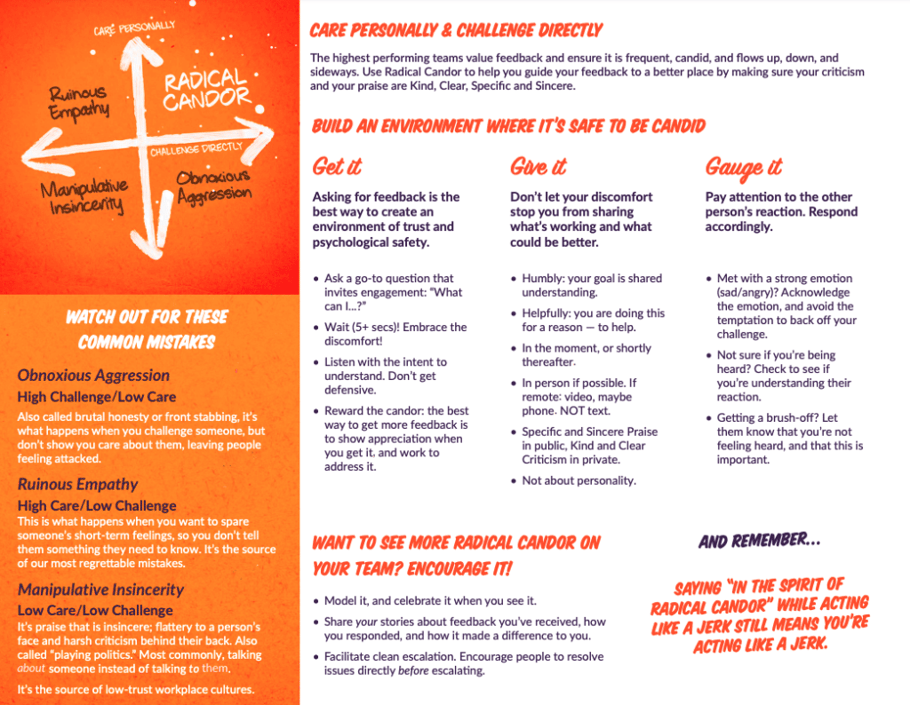
When asking employees for feedback, using visual representations can make abstract concepts more tangible. This helps gauge if your feedback is landing as intended and provides insights for improvement.
I've found that using the Radical Candor framework as a visual tool can be incredibly effective. Print out the Radical Candor framework and ask employees to mark their ratings of your feedback.
This not only helps me understand if my intentions align with my impact but also opens up discussions about specific instances where my feedback missed the mark.
Regular Check-Ins
Consistency is key in building a culture of feedback. By making asking employees for feedback a regular agenda item in one-on-one meetings, we normalize the practice and make it less daunting.
I might start these sessions with, "Before we dive into project updates, I'd like to hear your thoughts on how I've been supporting you this past week. What's working well, and where could I improve?"
This approach ensures that feedback becomes an ongoing conversation rather than a rare, anxiety-inducing event.
Keep a Tally
How many times each week do the people you work with criticize you? How often do they praise you? If it’s all praise and no criticism, beware! You’re having smoke blown up your rear end. You need to work harder to get them to criticize you. Try teaching the people on your team about the idea of Radical Candor.
Explain why you don’t want them to be ruinously empathetic or manipulatively insincere with you. Tell them you’d welcome Radical Candor, but you’d prefer Obnoxious Aggression to silence. Print out the Radical Candor framework, and when you’re having a conversation and you feel like somebody is pulling their punches, point to Radical Candor and ask them to go there.
Because, when it comes to soliciting Radical Candor, good news is no news, no news is bad news, and bad news is good news.
By implementing these strategies, I've found that employees become more comfortable providing actionable feedback. This not only helps me grow as a leader but also fosters a culture of openness and continuous improvement within the team.
Remember, the goal isn't just to receive feedback, but to create an environment where everyone feels empowered to give and receive feedback regularly.
————————————————————————————————————————————————————————————–
*This post was updated July 18, 2024.
More from Radical Candor
How Do You Ask for Feedback? The Three Tests of a Good Go-To Question
The idea Get it. Don’t just be open to it.
How Do You Get Feedback? The Four Steps to Solicit Radical Candor®
A Story People often focus on feedback they get from their bosses. But the best feedback comes from the people who work for you. It can be difficult to get it—unless you create a …
Fixing the Employee Experience (with Tiffani Bova) 8 | 26
While the podcast team is on a Radical Sabbatical, Kim Scott is spending the season talking to authors of the books that have shaped her thinking. This week: Tiffani Bova, whose …
Share your perspective
This site is protected by reCAPTCHA and the Google Privacy Policy and Terms of Service apply.