Say What? How to Measure Feedback Responses 6 | 41
We get a lot of questions about how to measure feedback. To measure your feedback effectively, it's crucial to understand that Radical Candor is...
3 min read
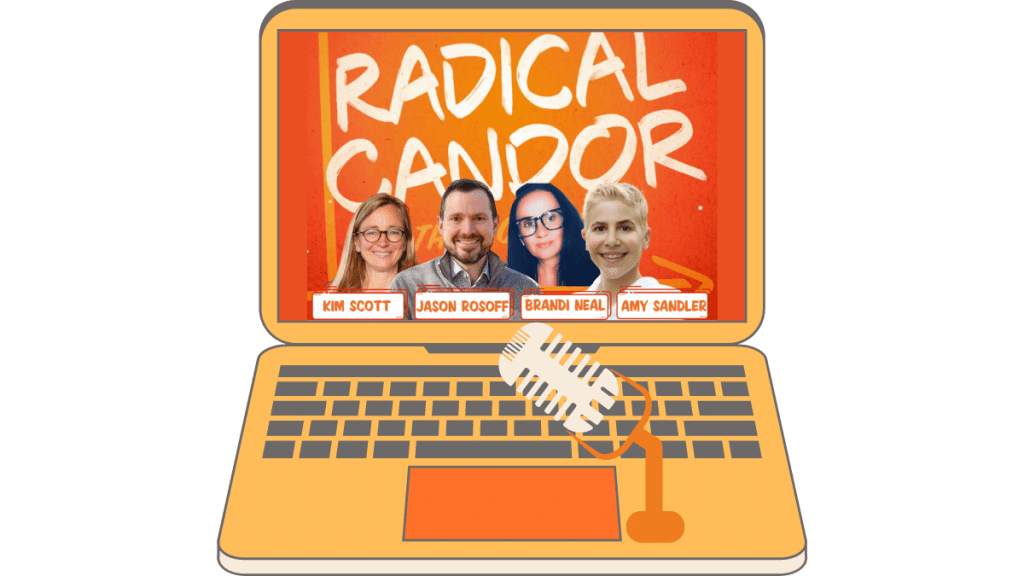
On this episode of the Radical Candor podcast, Kim, Jason and Amy discuss the trend of prioritizing future-focused feedforward over backward-looking feedback. Feedback vs. feedforward — both of these words are well-intentioned euphemisms that tend toward either Ruinous Empathy or Manipulative Insincerity. Kim has strong opinions on the words "feedforward" and "feedback." Tune in to find out why one word makes Kim want to put her hands over her ears and the other makes her want to throw up in her mouth.
Listen to the episode:

There’s been a lot of chatter lately about feedback vs. feedforward. Words matter. We don’t love the word feedback, but because it’s commonly used to show people what to do more of and what to do less of, we use it often.
Does “bad feedback” mean criticism, or does it mean criticism that is badly delivered?
Does “good feedback” mean praise, or praise that is well delivered, or criticism that is well delivered?
Who the hell knows??! Because it’s unknowable. Sloppy language.
The term feedforward is even more problematic because it pretends that we don’t have to understand past mistakes to avoid them in the future. It pretends that we can avoid necessary but uncomfortable conversations.
@wallstreetjournal Feedback too often leaves workers feeling defeated, but a new term—“feedforward”—encourages improvement and development, its proponents say. The canceling of feedback has its share of skeptics. It comes as younger generations—who can prefer a more positive, nurturing environment—are accounting for a larger share of the workforce, and companies increasingly focus on performance and efficiency following a pause on reviews during the pandemic. #feedback #performancereview #feedforward #jobs #work #careers #wsj #thewallstreetjournal #wallstreetjournal #CapCut ♬ Busy office (large enterprise building)(104530) - Killy
Join Kim's Critiquing Capitalism Book Club on Fable
Have questions about Radical Candor? Let's talk >>
————————————————————————————————————————————————————————————–
Radical Candor Podcast Listeners Get 10% Off The Feedback Loop
Watch the Radical Candor Videobook
We’re excited to announce that Radical Candor is now available as an hour-long videobook that you can now stream at LIT Videobooks. Get yours to stream now >>
Episodes are written and produced by Brandi Neal with script editing by Amy Sandler. The show features Radical Candor co-founders Kim Scott and Jason Rosoff and is hosted by Amy Sandler. Nick Carissimi is our audio engineer.
The Radical Candor Podcast theme music was composed by Cliff Goldmacher. Order his book: The Reason For The Rhymes: Mastering the Seven Essential Skills of Innovation by Learning to Write Songs.
Download our free learning guides >> Take the Radical Candor quiz >> Sign up for our Radical Candor email newsletter >> Shop the Radical Candor store >> Get Radical Candor coaching and consulting for your team >> Get Radical Candor coaching and consulting for your company >> Meet the team >>

We get a lot of questions about how to measure feedback. To measure your feedback effectively, it's crucial to understand that Radical Candor is...
It’s a lot easier to lead by example than it is to change other people’s behavior. If you want to encourage feedback between the people on your team...
Feedback helps you grow, right? So why is it so hard to take? Kim and Russ share their tips and techniques for what to do after you get feedback. ...
Share your perspective
Leave a comment below.