Showing compassion is real work, and, like all real work, it is rewarding and also taxing. In general, we undervalue the emotional labor of being the boss. But this emotional labor is not just part of the job; it’s the key to being a good boss. On this episode of the Radical Candor podcast Kim, Jason and Amy discuss emotional labor through the lens of a scenario sent to us by one of our listeners looking for guidance on how to avoid being a ShamWow for everyone on their team.
Listen to the episode:
Radical Candor Podcast Episode At a Glance
We’ve said before, if you’re the boss, you’re kind of an emotional shock absorber for your team. You’ve got to be able to deal with other people’s emotions.
When we communicate, we communicate on an emotional plane and a rational plane at the same time. If you as the boss dismiss all emotional signals as unprofessional you’re not going to communicate very well.
On this episode of the Radical Candor podcast, the team addresses a question about how to respond to crying at work.

Dear Radical Candor,
I appreciate all the concepts around Radical Candor and try hard to use them with my team, and I am a proponent for others to pick up the skills. Thanks. Now for advice...I am VP of New Product Development with a team of 450.
I am working on succession planning with two individuals, both of whom are senior directors on my staff. I can practice radical candor with one of them. This person is willing to listen and course correct and wants me to be even harder on them in order to improve.
I try to practice the same principles with the other person. In two instances when I have challenged directly—with lots of caring personally—this person has broken down and cried.
This disarms me and I back off and now really dread going back at it again, it is exhausting. I owe it to them to give them the feedback, I truly want them to improve and be in a position to move into my role but they are taking steps backward in their behaviors. How do I navigate this?
Thanks again for all the great work your team does for many.
@cbsnews This 4-year-old wowed people online by discussing his emotions with his mom. He had a tough day, but they talked it out #children #kids #momsoftiktok #inspirational #love ♬ original sound - cbsnews
Radical Candor Podcast Checklist
- Meet emotion with compassion. If somebody gets upset or angry or defensive, it doesn’t mean you’ve failed in some way. It means they care about their work. That’s a good thing. Your job is to react with compassion, not to say, “Don’t take it personally.” If someone becomes emotional at work, acknowledge the emotion and ask simple questions to move the person out of the limbic system/threat zone, such as “Tell me how you are feeling right now,” or “How would you like to proceed?” These have the effect of helping someone move out of threat response and into problem-solving.
- Acknowledging emotions is a great way to build relationships with your team, and the quality of these relationships play a vital role in your success or failure as a leader. Remember, the worst thing you can do is ignore emotional reactions. Emotions like anger, sadness and fear are part of the human condition, and people shouldn’t have to leave their humanity at home when they come to work.

- Get curious about why someone is crying. Emotion can be a shortcut to the heart of the matter. Often when somebody is frustrated or angry or upset enough about a situation at work that they start to cry, this is your cue to keep asking questions until you understand what the real issue is. Don’t avoid the emotion. React to it with kindness, but also use it to better understand what’s really going on.
- There is a lot of evidence that non-white and/or non-male folks tend to be penalized more heavily for showing emotion, so be extra careful to check your reaction for bias in those cases. We owe it to everyone to meet emotion with compassion.
Radical Candor Podcast Resources
- Emotional Reactions At Work Are Awkward: Here's How To Deal
- Podcast Season 2, Episode 16: Navigating Emotional Reactions at Work
- Emotional Labor And The Great Resignation: 2 Things To Know
- Thoughts on Gender and Radical Candor | First Round Review
- MIT Sloan Review | The Smart Way to Respond to Negative Emotions at Work
- How Leaders Can Get the Feedback They Need to Grow
- Go With Your Gut: Emotional Intelligence and Decision Making
- Follow Your Gut? Emotional Intelligence Moderates the Association Between Physiologically Measured Somatic Markers and Risk-Taking
- ShamWow (We have zero affiliation, but in case you didn't get the reference, here it is!)

Have questions about Radical Candor? Let's talk >>
————————————————————————————————————————————————————————————–
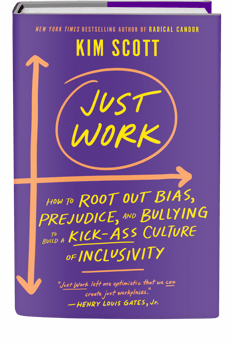
Just Work is Available Everywhere Books are Sold!
Episodes are written and produced by Brandi Neal with script editing by Amy Sandler. The show features Radical Candor co-founders Kim Scott and Jason Rosoff and is hosted by Amy Sandler.
The Radical Candor Podcast theme music was composed by Cliff Goldmacher. Order his book: The Reason For The Rhymes: Mastering the Seven Essential Skills of Innovation by Learning to Write Songs.
Sound editing by Nick Carissimi.
Download our free learning guides >>
Sign up for our Radical Candor email newsletter >>
Shop the Radical Candor store >>
Get Radical Candor coaching and consulting for your team >>
Get Radical Candor coaching and consulting for your company >>
More from Radical Candor
Fixing the Employee Experience (with Tiffani Bova) 8 | 26
While the podcast team is on a Radical Sabbatical, Kim Scott is spending the season talking to authors of the books that have shaped her thinking. This week: Tiffani Bova, whose …
Unlocking Leadership Intelligence (with Caroline Webb) 8 | 24
What separates a leader who makes wise calls under pressure from one who gets stuck in their own point of view? Caroline Webb has spent decades studying the answer — first as an …
Get Situated for Success (with Angela Duckworth) 8 | 23
While the Radical Candor podcast team is on a Radical Sabbatical, Kim Scott is spending the season interviewing authors of the books that have shaped her thinking over the past …
Share your perspective
This site is protected by reCAPTCHA and the Google Privacy Policy and Terms of Service apply.