Kim, Jason, and Amy discuss a listener's question about how to confront and disrupt bias in management at work for women working in male-dominated fields. Jason and Kim role-play a scenario where a manager is clearly biased and explain how to disrupt bias in the moment. They also discuss documenting incidents and when it's time to go to HR.
Listen to the episode:
Radical Candor Podcast: Episode at a Glance
@radicalcandorofficial New episodes Wednesdays! #radicalcandor #breakthebias #biasdisrupter #podcastclips #roleplay ♬ original sound - Radical Candor
Dear Radical Candor,
I have a daughter in the mechanical engineering field, which is very male-dominated. She often experiences bias from her new managers. In her words, “The manager is actually a very nice guy.”This leads me to believe that he isn’t intentional in his actions but just isn’t aware of what he is doing. The conventional process is to go to HR and they will covertly look for situations that support this and then get rid of him. The realism is that the next person (let’s be real, regardless of race or gender) may be just as biased, just in a different orientation So, the cycle continues.
How does she manage up (or coach up) to help her manager understand what she observes, and help them to be a better manager? There is often a changeover in management. This change, especially at a low level is often someone who has no experience or training in managing. They aren't necessarily the smartest or most experienced in the department. They may not even be the most qualified person in the group.
All in all, what I am asking is: How does an individual at a power disadvantage make timely observations or dare I say corrections to the power advantaged without it being interpreted as being hostile or undermining? How does a person present these strategies to HR and those in authority to change the culture so that it is expected to coach each other, and hold each other accountable, up, down and laterally, and that there is a safe and respectful way to do this?
Here's How AI Summed Up This Conversation
*Our robot makes some mistakes—listen to the episode for a 100% accurate account of the team's conversation.
- Double standards and prejudice exist in the workplace and can create challenges for individuals.
- Being tough in a meeting can be perceived differently based on gender and can lead to biased perceptions.
- It is important to address biased perceptions and have open conversations with managers to create a more inclusive work environment.
- Building solidarity and documenting incidents can help individuals navigate biased situations and take appropriate action.
Chapters

00:00 Confronting Bias at Work
08:26 Recognizing Bias and Growth Mindset
13:33 Going to HR or Addressing Bias Directly
19:09 Managing Up and Coaching Up
23:39 Role Play: Addressing Bias with Manager
28:15 Reflecting on the Role Play
34:59 Double Standards and Prejudice
37:11 Being Tough in the Workplace
39:03 Dealing with Biased Perceptions
41:40 Coaching Managers
43:26 Building Relationships with Managers
46:02 Addressing Bias and Prejudice
48:57 Creating Cultures of Open Communication
52:41 Building Solidarity and Documenting Incidents
54:49 Summary and Closing Remarks
Radical Candor Podcast Checklist — Tips From Kim
- To build solidarity, it's important to find someone you trust and can talk to about a situation. This person should be able to tell you when they think the other person is wrong, and also when you are wrong.
- The person you choose should be someone who can be radically candid with you, whether it's a friend or a family member. It's important to be able to say that you don't know what to do or how to handle the situation.
- When you experience bias, prejudice, or bullying, you're often being gaslighted in some way. You need someone who can help you see things clearly and turn the lights on for you.
- It's worth considering the risk of having a direct conversation with the person before going to HR. Although most people have a bias against talking directly, sometimes it's worth taking the risk for a positive ROI.
- Throughout most of my career, my default was silence in these situations. It left me feeling like I lacked agency and I wasn't able to build good relationships with managers.
- Step number one is to build solidarity by talking to people. Step number two is to weigh the cost and benefits of talking directly with your manager before going to HR.
- Step number three is to document what's happening. This can be as simple as sending an email to someone you trust or journaling what's happening.
- If you're not getting what you need from the person, then it may be time to go to HR. It's worth trying to talk to the person directly before escalating to HR.
- When trying to have a direct conversation with the person, it's important to remember that this person is not like all the other bosses you've had in the past who may have traumatized you. Try to let go of the past and move forward to the future.
Radical Candor Podcast Resources
- 3 Ways To Confront Bias, Bullying And Prejudice In Feedback | Radical Candor
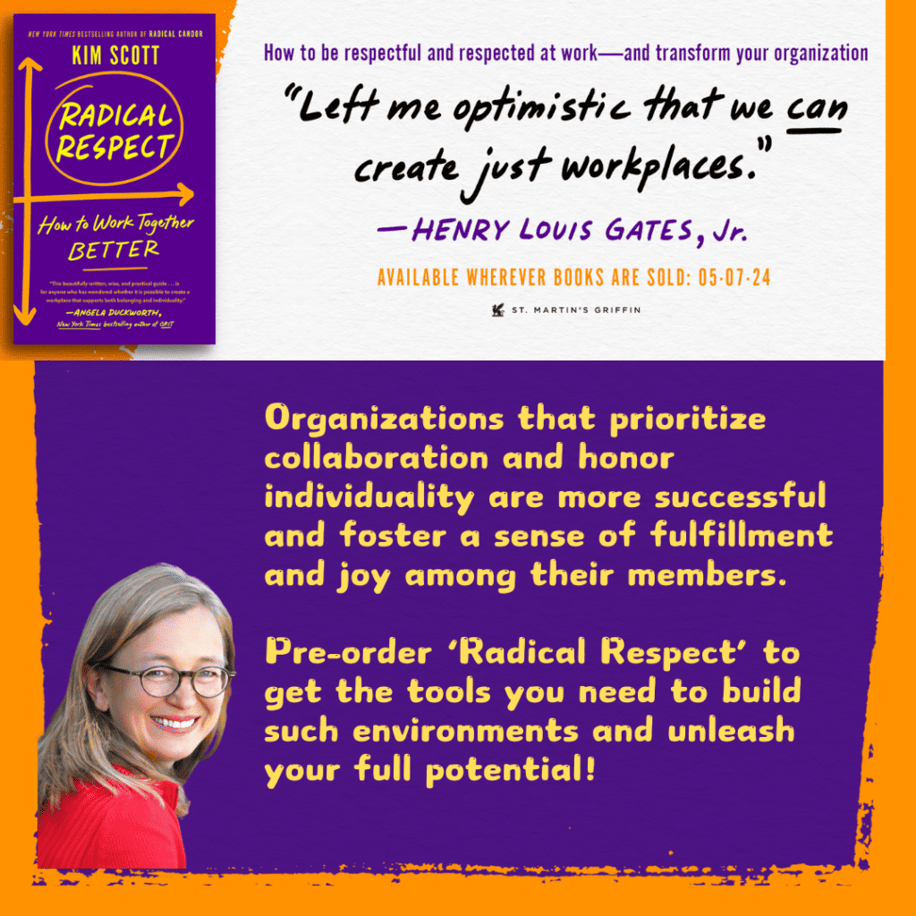
- Radical Respect: How to Work Together Better: Scott, Kim: 9781250623768: Amazon.com: Books
- How to report bias at work - PowerToFly
- Some Common Rationalizations For Silence — Radical Respect
- Why Gender Bias Makes Giving Feedback Hard For Everyone | Radical Candor
- A Republican Senator Asked This Pilot What Her Days As A "Stewardess" Are Like, And Women Everywhere Are Infuriated — BuzzFeed
Have questions about Radical Candor? Let's talk >>
————————————————————————————————————————————————————————————–
Improvising Radical Candor, a partnership between Radical Candor and Second City Works, introduces The Feedback Loop (think Groundhog Day meets The Office), a 5-episode workplace comedy series starring David Alan Grier that brings to life Radical Candor’s simple framework for navigating candid conversations.You’ll get an hour of hilarious content about a team whose feedback fails are costing them business; improv-inspired exercises to teach everyone the skills they need to work better together, and after-episode action plans you can put into practice immediately.
We’re offering Radical Candor podcast listeners 10% off the self-paced e-course. Follow this link and enter the promo code FEEDBACK at checkout.
The Radical Candor Podcast is based on the book Radical Candor: Be A Kickass Boss Without Losing Your Humanity by Kim Scott.Episodes are written and produced by Brandi Neal with script editing by Amy Sandler. The show features Radical Candor co-founders Kim Scott and Jason Rosoff and is hosted by Amy Sandler. Nick Carissimi is our audio engineer.
The Radical Candor Podcast theme music was composed by Cliff Goldmacher. Order his book: The Reason For The Rhymes: Mastering the Seven Essential Skills of Innovation by Learning to Write Songs.
More from Radical Candor
Fixing the Employee Experience (with Tiffani Bova) 8 | 26
While the podcast team is on a Radical Sabbatical, Kim Scott is spending the season talking to authors of the books that have shaped her thinking. This week: Tiffani Bova, whose …
Unlocking Leadership Intelligence (with Caroline Webb) 8 | 24
What separates a leader who makes wise calls under pressure from one who gets stuck in their own point of view? Caroline Webb has spent decades studying the answer — first as an …
Get Situated for Success (with Angela Duckworth) 8 | 23
While the Radical Candor podcast team is on a Radical Sabbatical, Kim Scott is spending the season interviewing authors of the books that have shaped her thinking over the past …
Share your perspective
This site is protected by reCAPTCHA and the Google Privacy Policy and Terms of Service apply.