Criticism & Obnoxious Aggression
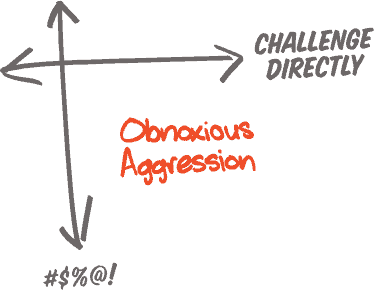
Obnoxiously Aggressive criticism is often referred to as “front-stabbing”. It’s when you criticize without Caring Personally.

Table of Contents
When bosses care too much about hurting their employees’ feelings, they will avoid giving criticism. Eventually, it becomes too late to fix this Ruinously Empathetic situation.
Here’s an example:
Bob joined Kim’s team at a software startup with glowing references, an amazing career at two of the world’s greatest technology companies, and a quirky, charming personality.
There was just one problem: Bob’s work was terrible. After a few weeks of working diligently, he finally made a presentation that was essentially a “jargon salad.” His slides were riddled with sloppy mistakes — whole sections were cut and pasted, and he hadn’t even bothered to make the fonts consistent.
Kim didn’t say a word to him after he showed it to her because she was so mad she was afraid she might say something “mean”. So she procrastinated. For ten months. It got so bad that several of her best employees said they’d quit if Kim didn’t fire Bob.
Kim scheduled a meeting, took a deep breath and told him, as gently as she could, that she was firing him. She was so gentle as to be incoherent. Bob sensed something was wrong, but mostly looked puzzled. He reassured Kim he was going to buckle down and work harder, how he would focus on making fewer sloppy mistakes.
“No, no, you don’t understand. It’s too late to fix,” Kim said.
He reassured her that he loved the company, that he had never seen a product he was more excited about, that he was committed to our collective success. Kim was trying to fire him, but there he was talking about love and commitment. She felt terrible.
To try to make things clear, Kim described not only what was wrong with Bob’s projects, but how his bad results had caused the whole team to lose faith in him. She explained that his poor work had cost the company months, and that now they would have to raise more money from VCs, diluting everyone’s stock and bringing them one big step closer to failure.
Again, he didn’t seem to understand. He was busy sketching out on a napkin an aggressive plan to address his many delayed projects.
Kim realized she was going to have to be much, much more direct. “Bob, today is your last day. I am firing you.”
He shoved his chair back from the table with a screech that made everyone look up from their steaming mugs.
“Why didn’t you tell me?” The question rolled around in my head slowly and heavily, with no good answer. “Why didn’t anyone tell me what I was doing wrong?”
He was right. Part of a boss’s job is to give guidance. Kim’s silence had hurt Bob much worse than any criticism could have. Even if Kim had been too upset at the time to phrase it artfully, if she’d told him what she really thought of his first presentation, he would have had two options. Either he could have fixed the problem and kept his job, or he could have moved on to a job that was a better fit. Instead, he’d wasted ten months of his career in a job where he was slowly failing.
Also, by letting his poor performance slide for so long, Kim had hurt company's odds of success and been unfair to everyone on the team who was doing truly amazing work. Kim thought her silence made her “nice,” but in reality her empathy made her a ruinously bad boss.
Kim realized that she always needed to Challenge Directly the people who worked for her, no matter how much it stung. It was her job, her moral obligation even.
---
More about this story and others is included in “Radical Candor: Be a Kickass Boss Without Losing Your Humanity,” published by St. Martin’s Press. Learn more
Ruinous Empathy happens when a boss cares so much about not hurting someone's feelings that they withhold honest criticism. It feels kind in the moment, but it's actually harmful: the employee never gets the feedback they need to improve, fix problems, or make an informed decision about whether the job is right for them. In Kim Scott's example, Bob wasted ten months slowly failing — all because his boss stayed silent to protect his feelings.
The sooner, the better. In the post, Kim waited ten months to address Bob's poor performance — so long that the situation became unfixable and he had to be fired. Even if you're too upset to phrase feedback perfectly in the moment, giving imperfect-but-honest feedback early is far less damaging than prolonged silence. Waiting turns a manageable problem into a crisis, and it's unfair to the employee and the rest of the team.
Silence might feel like protection, but it removes the employee's ability to choose their own path. As Kim's story shows, Bob could have fixed his work habits or moved on to a better-fit role — if only he'd known there was a problem. By staying quiet, Kim denied him both options and let him spend ten months in a job where he was failing. True kindness means giving people the honest information they need to succeed or make better decisions.
Radical Candor calls for being direct while still caring personally about the employee — what the framework calls 'Challenging Directly.' This means saying clearly and specifically what went wrong, why it matters, and what needs to change, without softening the message to the point of incoherence. In the post, Kim's overly gentle firing conversation left Bob confused and still trying to problem-solve, because she hadn't been direct enough. Clarity is a form of respect.
It's deeply demoralizing. In Kim's story, several of her best employees threatened to quit if she didn't address Bob's performance. When a manager tolerates subpar work, high performers feel their own contributions don't matter and lose faith in leadership. It also creates an uneven playing field that feels unfair to everyone doing excellent work. Addressing poor performance promptly protects team morale, fairness, and the organization's overall success.
According to Radical Candor, giving honest guidance isn't just a management tactic — it's a moral obligation. Kim reflects that her silence hurt Bob far more than any criticism would have. A manager's job is to give employees the information they need to grow or course-correct. Withholding that feedback, even out of care or discomfort, is a failure of responsibility to the individual, the team, and the organization.
Three ways to put this into practice.
Related reading
Obnoxiously Aggressive criticism is often referred to as “front-stabbing”. It’s when you criticize without Caring Personally.
When you don’t Care Personally or Challenge Directly, criticism is Manipulatively Insincere.

Praise can be Ruinously Empathetic when bosses try to be “nice” and get things wrong. Below are a few cautionary tales of how trying to make a person...