


You Don't Have to Pay the A**hole Tax: How to Avoid Working for a Bad Boss
Until about five years ago it never occurred to me to check out who my potential new boss would be when looking for a job. I had always focused on...
3 min read
Radical Candor Oct 28, 2019 7:00:57 AM
Table of Contents
Guest post about tapping the potential of each team member by Allie Cooper
From taking the time to have career conversations to delegating responsibility, a great leader is one who lifts their team members up, allowing them to grow and push their boundaries. Tapping into the potential of each team member means understanding their strengths, long-term ambitions and professional needs.
While this might seem like common sense, a lot of bosses neglect to personally invest in their team members, which can lead talented people to move on.
If you want to not only create a great team, but keep them, you need to put effort into tapping the potential of each member of your team.

In order to build a successful team, leaders need to understand the long-term ambitions of each team member. Helping your team members move toward their career goals is part of being a good boss.
However, you can only learn this through understanding your team members on a personal level. This means having regular career conversations with your employees in order to understand their dreams.
Developed by Russ Laraway, VP of people operations at Qualtrics, career conversations are designed to guide you through career planning with your direct reports so you can learn what is important to them, understand where they want to go and work collaboratively with them to build the best possible plan of action.
Yes, these kinds of conversations take time, but the return on your investment is having a team where everyone finds their jobs fulfilling and feels supported pursuing their long-term ambitions. In short, career conversations are key for tapping into each team member's potential.
Business expert and author Peter Economy wrote in Inc. that professional development is a surefire way to unlock your employees’ potential. Leadership training sessions are usually only offered to managers and supervisors, but everyone can benefit from these kinds of opportunities.
In addition, investing in professional development for your employees gets you, the boss, out of the weeds.
When Sheryl Sandberg offered to get Kim Scott a speaking coach at Google, she knew she wasn't the right person to coach Kim, but she also knew she could offer to help find someone who was. That investment benefited both Kim and Sheryl, and ultimately Google. Kim took a page from Sandberg’s playbook with her own team.
“When Scott Sheffer, who worked for me at Google, was struggling with a strategic problem, it was clear he needed a great thought partner. Scott was one of the most strategic people I knew, and understood the business better than I did. I wasn’t the right person to help him,” Kim said.
“He needed to talk to somebody who’d seen the problem a hundred times before, somebody with decades more experience than either he or I had. The person he most longed to talk to was Bill Campbell, the legendary Silicon Valley coach. I knew the thing I could do that would be most helpful was not to try to spend hours helping him think through the problem, but to spend 20 minutes getting him some time with Bill. That’s what I did.”
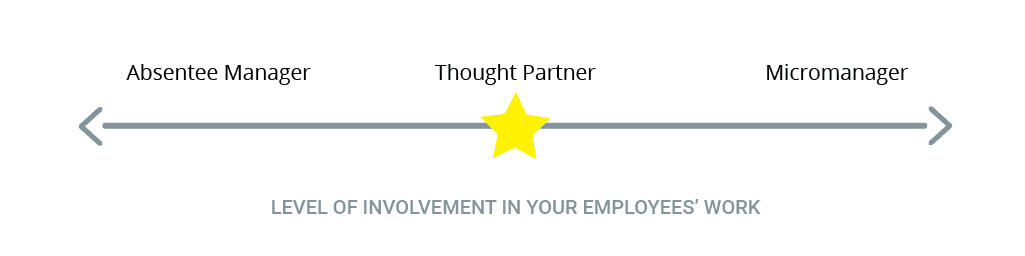
Some leaders think that being very hands-on is a good way to unlock the potential of team members. However, Kim explained that there are instances when being too hands-on leads to micromanagement, which negatively affects employee performance and morale. Micromanagers breed employees who are afraid to take initiative in solving problems.
Leaders who understand that morale facilitates company goals are the ones who understand the importance of delegating responsibility to team members. Instead of being a micromanager, be a thought partner who listens to their team members and helps them brainstorm their own solutions rather than solving problems for them.
Oftentimes we see someone on the team whom we know isn’t a good fit for their role. We might even discover that it’s not something they’re very passionate about. A Radically Candid boss should insist that if a team member has not done any exceptional work for more than two years, they should be given the opportunity to work on another project (or another job) that will make them shine.
“This policy is hard to enforce and creates a lot of stress. It forces managers to have a lot of challenging conversations with people who may or may not be in the wrong job. Of course, it’s also difficult for people who’re being pushed out of their comfort zone. But discomfort is better than being labeled permanently ‘B Players,” Kim noted.
“Everyone can be exceptional somewhere and that it is a boss’s job to help them find that role. It’s also a boss’s job to strive to have 100 percent of the team doing exceptional work.”
In general, people don’t leave bad jobs, they leave bad bosses. A kick-ass boss knows that investing in their employees as human beings means having regular performance development conversations in order to help them realize their potential. Because, happy, high-performing team members are the cornerstone of every great company.
Allie Cooper is a writer who is passionate about covering shifts in corporate culture to unlock employee potential.
Career conversations, developed by Russ Laraway, are structured discussions between a manager and their direct reports designed to uncover what each person truly values, where they want to go in their career, and how to build a collaborative plan to get there. By taking the time to understand your team members' long-term ambitions on a personal level, you signal that you're invested in their growth — not just their output. This sense of support and direction is a key reason talented people stay rather than look elsewhere.
Micromanagement erodes morale and discourages initiative. When employees feel they can't solve problems on their own, they stop trying. Instead of being hands-on to the point of controlling every decision, great leaders act as thought partners — they listen, ask good questions, and help team members brainstorm their own solutions. This approach builds confidence and capability, which are both essential for unlocking each person's full potential.
According to Radical Candor, if a team member hasn't done exceptional work in more than two years, a good boss should create an opportunity for that person to work on a different project or role where they can shine. It's a challenging conversation to have, but the alternative — leaving someone permanently labeled a low performer — is worse for everyone. The belief underlying this approach is that everyone can be exceptional somewhere, and it's a boss's job to help them find that place.
Investing in professional development — whether that's leadership training, coaching, or connecting someone with the right mentor — is one of the most effective ways to unlock an employee's potential. The post highlights how Sheryl Sandberg connected Kim Scott with a speaking coach at Google, and how Kim later arranged for a team member to meet with legendary coach Bill Campbell. The key insight: you don't have to be the one doing the developing. Finding the right resource for your team member is itself an act of great leadership.
People don't typically leave bad jobs — they leave bad bosses. When managers fail to personally invest in their team members, talented people feel unsupported and underutilized, which pushes them to look for opportunities elsewhere. By holding regular career conversations, offering growth opportunities, delegating meaningful responsibility, and helping people find roles where they can excel, leaders create an environment where employees feel fulfilled and motivated to stay.
A micromanager solves problems for their team and closely controls how work gets done, which stifles initiative and kills morale. A thought partner, by contrast, listens carefully, asks clarifying questions, and helps team members reason through challenges so they arrive at their own solutions. The thought-partner approach builds trust and capability over time, whereas micromanagement creates dependency and fear — the opposite of what you need to tap a team's full potential.
Three ways to put this into practice.
Related reading
Until about five years ago it never occurred to me to check out who my potential new boss would be when looking for a job. I had always focused on...
A few weeks ago I had the pleasure of being a guest on Jonathan Courtney’s podcast, The Product Breakfast Club to discuss my experiences as an author...

In Episode 13 of our podcast we talked about the dreaded micromanager boss and how to work towards a better relationship with them. As a part of that...