 Kim Scott
Quitting with Radical Candor
As we’ve mentioned in a couple of podcast episodes (Ep 13: Help! My Boss is a Micromanager and Ep 8: How to Give Feedback to Your Boss), sometimes no...
My friend Stacy Brown-Philpot, who just became Task Rabbit’s CEO--go, Stacy!--recently shared a great tip for establishing that you “Care Personally” in just 6 seconds. Stacy learned this tip from much-loved Silicon Valley coach Bill Campbell.
The first time Stacy ever met Bill was when he came up to her after she gave a talk she’d given and told her that she flapped her hands in front of her face when she spoke, and would have more credibility if she’d stop it. She said it was the most useful public speaking criticism she’s ever gotten.
“Were you a little mad that this man you’d never met before came up and criticized you?” I asked.
Stacy thought about it for a moment. “Well, no I wasn’t. Because before he said anything to me he gave me a great big bear hug and a kiss on the cheek. So I knew he was coming from a place of warmth. It was immediately obvious that he cared, and was just saying it to help me.”
“Were you weirded out that a strange man hugged and kissed you on the cheek?” I asked.
“No, because it seemed just so natural coming from him. I wish more people would hug like that.” When I told my husband this story he said, “I coached his son’s Little League team. He hugged all the coaches and all the parents. He just hugged everybody! More people should do that.”
Like Stacy and my husband, I wish more people gave hugs like that. Not just little one-arm side swipes, but the kind of six-second hugs that Gretchen Rubin writes about in The Happiness Project. Gretchen, who has research for EVERYTHING, explains why a longer hug is more effective than a shorter one. “Interesting fact: to be most effective at optimizing the flow of the chemicals oxytocin and serotonin – which boost mood and promote bonding – hold a hug for at least six seconds.”
Hugging can be as appropriate--and effective--at work as at home. I will never forget an off-site I attended for thousands of managers at Google in 2007. David Fischer, now a top executive at Facebook, then the VP for AdWords Online Sales and Operations at Google, gave one of the most memorable presentations on how to be a good boss I’ve ever seen. David is an extremely competent and, in the very best sense of the term, straight-laced executive. During his presentation David showed the Free Hugs video. He reminded us all that “even managers need hugs.” And he walked around during the break carrying a big FREE HUGS poster, and giving free hugs.
If you are not comfortable with a hug, it’s OK. Don’t feel bad. True confession: I felt too shy to walk up to David and give him a hug, even though I think he’s a fantastic human being and thoroughly enjoyed working with him. It wasn’t that I thought the Free Hugs thing was corny. I got a little weepy when he showed the Free Hugs video. It’s just that, even though I resist it with everything I’ve got, in my heart of hearts I’m kind of repressed...
If you, like me, are afraid you couldn’t pull off the Bill Campbell like hugs, try starting with just a little human contact, say, a quick touch on the arm. Maybe you’ll work up to bear hugs. Gretchen Rubin also has shared research about how much more positively people react to a simple touch on the arm or the hand. In this video clip, Gretchen operationalizes and gives data about why hugging and touching works. Gretchen explains why hugs are powerful with the people we love the most, and also why touch is important even with strangers. Research shows that subliminal touching (touching so subtle that it’s not consciously perceived) dramatically increases a person’s sense of well-being and positive feelings toward you, the toucher. A study showed that when restaurant servers touch their customers, they increase their tips by more than 3 percent.
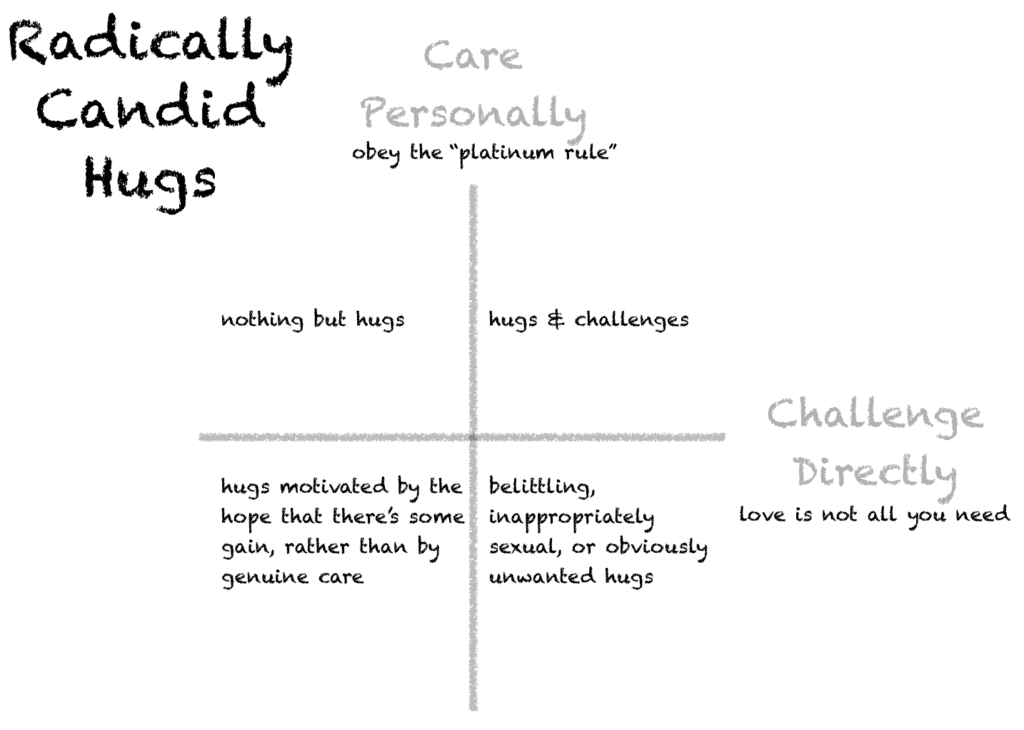
Should we really go around hugging or touching each other, even at work, even with strangers? Yes, if both you and the other person is comfortable with it!! There are two great things about a hug or a quick touch. One, it shows you care personally. It brings out a feeling of human warmth. Even if you don’t know a person well or at all, you can still care at a fundamental human level. Two, a hug is incredibly efficient. Even a “long” hug just takes six-seconds. A hug is a simple, fast, free and straightforward way to establish that you care personally about the person you’re hugging.
If the benefits of touching are so clear, why are we so afraid to do it??
I can’t help it. I am going to use the Radical Candor framework to explain how to stay out of trouble in your foray into hugging people at work.
To show you “Care Personally” with your hugs, you have to obey the “platinum rule.” The “golden rule” says do unto others as you’d have them do unto you. The platinum rule says, figure out what makes the other person comfortable, and do that; doing what makes you comfortable may drive the other person nuts. Maybe YOU like hugs; maybe they weird the other person out. Don’t force your hugs on people. When they read this article, several colleagues immediately asked me to promise not to hug them. I’m going to honor that request.
A hug or a touch CAN go wrong. If it’s sexual or belittling or obviously unwanted, it’s Obnoxiously Aggressive. If a woman is pregnant, don’t assume it’s OK to rub her belly. You may be slipping into Obnoxious Aggression.
If you don’t actually care about the person, but are doing it because you are convinced by the research that there’s some gain for you in doing it, it’s Manipulatively Insincere and will probably backfire by giving the other person the willies.
If all you ever give is hugs, and you never challenge them, then your hugs may be Ruinously Empathetic. Human warmth, however you choose to express it, is a necessary but not a sufficient condition for building good relationships. We need love, but we also need truth.
If you can do what Bill Campbell did for Stacy, and offer the kind of Radically Candid hug that opens a person’s mind and heart to learning something new or growing in some way, you’ll leave the world just a little bit happier.
Go ahead. Try it. I dare you! I’ll try it too--but only with people who want to be hugged :)
As we’ve mentioned in a couple of podcast episodes (Ep 13: Help! My Boss is a Micromanager and Ep 8: How to Give Feedback to Your Boss), sometimes no...

We have learned something really important from the way that the press sometimes describes Radical Candor as brutal honesty. And we want your advice...

When talking about Radical Candor, I often get asked about how it applies to different cultures. Can Radical Candor be used for feedback and...
Share your perspective
Leave a comment below.