————————————————————————————————————————————————————————————–
4 min read

This post about how to use Radical Candor to guide conversations to a more productive place is by Russ Laraway, author of When They Win, You Win: Being a Great Manager is Simpler Than You Think.
***
The Radical Candor framework helps create a shared context and a shared standard around feedback. However, there are some good ways and some not-so-good ways to use this vocabulary.
When used within a company, it can be tempting to label people using the four Radical Candor quadrants.
“Oh, yeah, Obnoxious Aggression — that’s totally Ted!” Or people walking around making the letter “M” with their fingers to identify certain co-workers as Manipulatively Insincere (oh, that doesn’t happen in your office?). Let’s not do that!
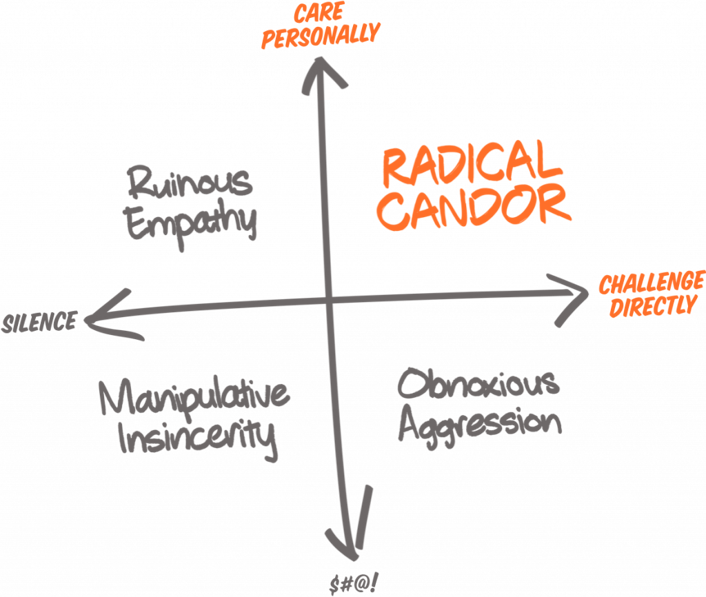
These words are meant to be used to evaluate and analyze certain interactions, and not used like Myers-Briggs or another personality test. We all behave in different ways in different interactions, and most of us probably spend time in each of the four quadrants.
We would like to encourage people that are trying to build a culture of Radical Candor not to use these terms as labels for people but to evaluate and analyze interactions.
Please don’t write people’s names in these boxes; use the framework as a compass to guide your conversations to a more productive place.
Here are some guidelines for getting the most out of the Radical Candor vocabulary in your organization and remembering not to label people.
Need help with Radical Candor? Let's talk!
Focus on the axes, not the quadrants
To analyze or evaluate an interaction, don’t focus so much on the words “Obnoxious” or “Manipulative,” but rather, evaluate an interaction based on whether there was a high level of Challenge Directly or whether there was high Care Personally.
This is important because it’s possible to act with empathy (not to be confused with Ruinous Empathy) in a certain interaction and still achieve Radical Candor. It is also possible to act aggressively in an interaction and still show up Manipulatively Insincere in that interaction.
One of my favorite examples of this is something that happens in every workplace. If you are talking about someone and not to someone, you are clearly not Challenging them Directly, and you’re not demonstrating that you Care Personally because you’re not really making any investment in that person or that relationship, you’re doing little to help them improve, etc.
This can easily be considered aggressive behavior and some might argue a bit on the obnoxious side, too. Obnoxious Aggression, right?
No — by Radical Candor standards (Radical Candards?), you are behaving with textbook Manipulative Insincerity. And this proves my point that the more meaningful way to look at the interaction is through the lens of the axes, not the quadrant names.
Read: 4 Ways To Avoid Personalizing Feedback >>
Would you label yourself?
I know this because I used to teach people how to run Radical Candor workshops and as part of the process, they'd have to come up with a story of a time in which they were Manipulatively Insincere, and this story is always an absolute struggle for people.
“I’m just not that kind of person, Russ.” Yet, whenever we make the decision — conscious or unconscious — to talk about someone and not to someone, we’re operating with textbook Manipulative Insincerity.
Many of you reading have done this and many of you reading would not consider yourselves Manipulatively Insincere, right? We wouldn’t either, because these are labels for interactions, not for people.
Most people would not call themselves Obnoxiously Aggressive (high Challenge Directly, low Care Personally) either.
But, let me run down a scenario. Imagine you’re in the passing lane on the highway during rush hour traffic, and someone in a nice sports car cuts you off, narrowly missing your vehicle with theirs. How do you react?
Correct answers include: speed up and tailgate, give them the middle finger, and yell obscenities at them.
In this interaction, we are acting Obnoxiously Aggressive toward our fellow citizens. What's more, we're committing the fundamental attribution error — using personality attributes to explain someone else’s behavior rather than considering our own behavior or situational factors that were probably the real cause of the behavior.
Saying things like “You’re a jerk” or “You’re obnoxious” is neither kind nor does it provide specifics to make the direct challenge clear.
Saying “you’re a genius” when somebody does great work also has an unspoken, dangerous corollary: if the work is bad, “you’re incompetent.”
The result of personalizing somebody’s work and calling them either incompetent or a genius is that they quit taking risks, quit learning, and quit growing.
Saying that great feedback doesn’t personalize or label people isn’t the same as saying that it isn’t personal. People care about their work, so they may react emotionally to criticism.
You can’t control another person’s emotions, but you can help make criticism easier by not personalizing and not labeling.
Just like you wouldn’t label yourself as Obnoxiously Aggressive based on one interaction, don’t jump to a label for another person either.
Listen: The Fundamental Attribution Error >>
Acknowledge the complicated set of variables

Remember that how you intend to show up on a given day may not be how you actually show up that day.
For example, imagine an interaction in which you are fresh off a big win and your co-worker is fresh off a big loss. Or what if your child kept you up last night?
What if you are hungover? What if you had a great night's sleep and got to the gym? Got breakfast? Got some bad news at home? Got some great news from home?
And now ask these same questions, rhetorically, about this theoretical interaction with a co-worker. All of these variables can manifest and make what you think is a Radically Candid interaction feel much more like an Obnoxiously Aggressive one to the other person, and of course, vice versa.
Remembering how these outside factors can affect you in a given interaction will help you be mindful that the other person is also influenced by variables that you aren’t aware of.
Being mindful of this will make you less likely to label their personality rather than the interaction.
***
Russ Laraway has had a diverse 29-year career exclusively in leadership roles. He was a Company Commander in the Marine Corps before starting his first company, Pathfinders.
From there, Russ went to the Wharton School, and then onto Google and Twitter. Post Twitter, Russ co-founded Candor, Inc. (the precursor to the company Radical Candor cofounded by Kim Scott and Jason Rosoff), along with bestselling author Kim Scott. After Candor, Russ became the Chief People Officer at Qualtrics.
Russ is now the Chief People Officer for Goodwater Capital, helping Goodwater and its portfolio companies drive impact through extraordinary employee experience. He is the author of When They Win, You Win: Being a Great Manager is Simpler Than You Think, as well as the creator of Career Conversations; which is covered in Radical Candor, and to which Russ dedicates nearly 100 pages of his new book.
Keeping it Real: Let's Keep Radical Candor From Becoming a Buzzword
The good news is that the term “Radical Candor” has entered the lexicon. The bad news is that there’s a risk it becomes a meaningless buzzword.
Navigating Radical Candor and Cultural Differences
When talking about Radical Candor, I often get asked about how it applies to different cultures. Can Radical Candor be used for feedback and...

What Is Manipulative Insincerity? Radical Candor Coaches Share Their Epic Feedback Fails
We've all been there at one time or another — too tired to care or argue. Hanging on by a thread with no craps left to give. This is how folks often...
Share your perspective
Leave a comment below.