 Kim Scott
Ruinous Empathy is a Waste of Your Time
Hi there - I'm Russ, and this is my first blog post for Candor, Incorporated. My Little League baseball players call me Coach Russ, and I'm going to...
How do you create a climate in which Radically Candid relationships can flourish? Your role as boss is far more meaningful than the usual Dilbert stereotype.
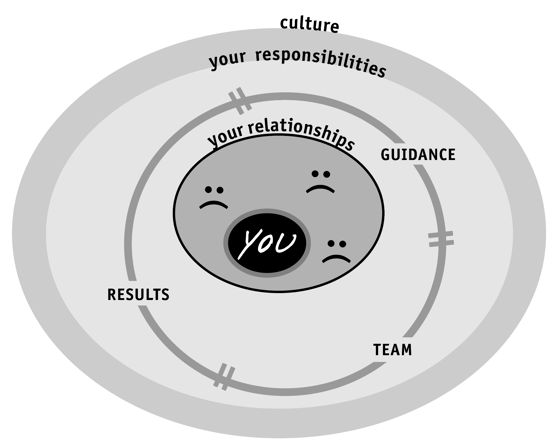
When I was at business school, I was taught that my job as a manager was to "maximize shareholder value." In life, I learned that too much emphasis on shareholder value actually destroys value, as well as morale. Instead, I learned to focus first on staying centered myself, so that I could build real relationships with each of the people who worked for me. Only when I was centered and my relationships were strong could I fulfill my responsibilities as a manager to guide my team to achieve the best results. Shareholder value is the result. It's not at the core, though.
As I've said before, there's a chicken-and-egg interaction between your relationships and your responsibilities. You can't fulfill your responsibilities without good relationships, but the way in which you fulfill your responsibilities is integral to those relationships. They're built from the outside in and the inside out. Here I'll focus on inside out, and talk about staying centered, staying on an equal footing with the people who report to you, and the art (and dangers) of socializing at work.
It may seem strange at first, but I always begin my efforts to coach CEOs in building a Radically Candid workplace by looking first at how that person has structured their life and is dealing with the pressures of their job.
What we bring to work depends on our own health and well-being. It's a measure of how far we've come as a society that this claim no longer feels overly "soft." And it's a great boon to business, because managers who create a stable foundation for themselves are invariably more effective at building teams on which people can do the best work of their lives.
Think for a moment about hard times at work. You're stressed out. You're not sleeping. Your problems at work and at home are compounding each other. Hard times are made much harder when you're not at your best. And they can make it particularly hard to "care personally" about the people you work with, not to mention those you live with. You're too busy dealing with your own suffering. But "caring personally" is integral to building the relationships that drive everything else. The essence of leadership is not getting overwhelmed by circumstances.
You can't give a damn about others if you don't take care of yourself. And when you don't care about yourself or those around you, everything else, including your results, gets out of whack. But you already know that. What am I recommending you do about it?
Be relentlessly insistent on bringing your fullest and best self to work, and taking it back home again. Don't think of it as work-life balance, some kind of zero-sum game where anything you put into your work robs your life and anything you put into your life robs your work. Instead, think of it as work-life integration. If you need to get eight hours of sleep to stay centered, those hours are not something that you do for yourself at the expense of your work or your team. Your work and your life can give each other a "double bounce." The time you spend at work can be an expression of who you are as a human being, an enormous enrichment to your life, and a boon to your friends and family.
The world is full of advice here, and what is enormously meaningful for one person is pure crap for another. I once saw a movie where a New York cop was showing a Moscow cop the fish tanks and special lights and elaborate meditation rituals he used to manage stress. "How do you cope?" the New Yorker asked. The Muscovite replied with one word: "Vodka."
Do whatever works for you. The key, I've found, is to prioritize doing it (but not overdoing it) when times get tough. It's even more important to focus on making time for whatever keeps you centered when you are stressed and busy than when things are relatively calm. A very successful entrepreneur I knew went to the gym both before and after work during crunch times.
Here's what I need to do to stay centered: sleep eight hours, exercise for forty-five minutes, and have both breakfast and dinner with my family. If I skip one or two of those things for a day or two, it's OK. But that's the routine. Also, every so often I need to read a novel (ideally one a week), go away for a romantic weekend with my husband (ideally four times a year), and take a two-week vacation with siblings and parents (once a year). If I can manage to do those things, I can usually stay centered no matter what storms are raging around me. If I can't manage to do those things, I'll usually go a little nutty even if everything is pretty serene all around me.
Put the things you need to do for yourself on your calendar, just as you would an important meeting. If you are having trouble leaving the office in time to get home for dinner, put your commute time in your calendar. Pretend you have a train to catch.
Don't blow off those meetings with yourself or let others schedule over them any more than you would a meeting with your boss.
Want more ways to build trust with your team? Staying centered is just the starting point. The Radical Refresher delivers one focused, actionable leadership tip per email — short enough to read between meetings, useful enough to change how you show up in them. Sign up here.

Hi there - I'm Russ, and this is my first blog post for Candor, Incorporated. My Little League baseball players call me Coach Russ, and I'm going to...
The most important question, the question that goes to the heart of being a good boss, doesn’t usually get asked. An exception was Ryan Smith, the...

*This article about how to successfully implement ideas is part of our new series about the Get Stuff Done (GSD) Wheel and has been excerpted from ...
Share your perspective
Leave a comment below.