Acting Like a Jerk by Not Caring Personally is a Radical Candor Fail
What makes Radical Candor radical is that it’s a deviation from the norm, which tends to fall somewhere between acting like a jerk and avoiding...
6 min read
Hi there - I'm Russ, and this is my first blog post for Candor, Incorporated. My Little League baseball players call me Coach Russ, and I'm going to run with that in this and future posts. Enough of the intros, let's get into it.
I'll admit it. In adulthood, I've always had a problem with some of the disingenuous phrases that serve as social lubrication.
For example, it drives me crazy when someone says, "Let's get together sometime, I'll set it up!" or "I'll give you call sometime soon," and then there's no action. This happens all the time, and there are all kinds of things people say with minimal intent to follow through. Sure, some people say these things intending to follow through and then, you know, LIFE. But many, many more simply say these things because it's comfortable to say or the socially acceptable thing to do in the moment or because it’s a smooth way to exit the conversation. This seems like one of those operating norms that the world abides by that I personally struggle with. And welcome to your introduction into my own personal brand of crazy.
Recently, I came face to face with one of these disingenuous phrases - a Ruinously Empathetic statement that's been on my mind for some time.
This is almost always a lie. What most people really mean to say is “I don’t want you to waste my time.” But isn’t it reasonable not to want someone to waste your time? No one wants their time wasted, right? So why is it so hard to say what you mean here? At Candor, Inc., we love stories, and I have a fun story for you about wasting time.
I need to give you a little bit of background to set this up. My co-founder here, Kim Scott, is only 5 feet tall and 105 pounds. As an aside, my research for this blog post tells me that she's back down to her high school fighting weight. So, she's physically small, but she’s got a big personality, big intellect, and big voice. It’s not always easy being her #2 because you end up standing in a pretty big shadow. (and hey, sometimes the benefit is that I don’t get sunburned.)
Recently, we had a meeting with someone important to us - I am going to call her Jenny - scheduled at The Palace of Productivity, which is Candor, Inc.'s Global Headquarters. We have illusions of grandeur.
Kim had declined the meeting at the last minute, and I decided to keep it on calendar for a few reasons:
1. I thought Jenny, like me, could see in calendar that Kim had declined the meeting and figured that she was cool to carry on with the meeting without Kim there, since Jenny herself didn't decline.
2. The meeting was tricky to schedule and had been on calendar for about a month.
3. The planned agenda was about one of the things in our company that I wholly and directly own, so Kim's participation was not at all critical - or remotely necessary.
But my instinct was also telling me that there was some risk of Jenny being disappointed meeting with only Lil' Ol' Me. When Kim and I first met Jenny, she manifested as almost star-struck - and I say that with no hyperbole. I would not have been surprised if Jenny had asked for an autograph or one of Kim’s drumsticks.
As things go, I kept meaning to ping Jenny to give her a chance to bail out, but hesitated because of the reasons above and because I thought Kim might have erroneously declined. But Kim's flying 100 mph in one direction and I'm flying 100 mph in the other. Next thing I know, Jenny is definitely in a car on her way to the meeting, and I’m worried she’ll be disappointed with the attendee list.
A quick note about Jenny. The following story will not position her in the most positive light, but important context to keep in mind as you read is that Jenny is a wonderful human being, and an ally to both Candor and me. Most people act differently in different situations based on a complex set of variables, and that’s all that’s at play here.
 I saw Jenny’s car pull up, and I intercepted her at the front door. I wasn't sure she'd be ok with a 95 pound American Bulldog named Dexter who would greet her as he greets all new people - like they are his newest and bestest friend. It's been said that dogs provide unconditional love. Dexter might very well be the universe's source of unconditional love. I thought maybe I should let Jenny decide just how much love she was going to get that day. Turns out she’s allergic, so good call by me.
So there we were, on the front step of our Palace (grandeur), and I disclosed to Jenny, “Kim can’t make the meeting, shall we head to lunch?”
Clearly distraught: "So, will Kim be joining us?"
"No, I'm sorry, she'd declined the meeting invite."
"Oh... well, if you own the meeting, I can't see the declines... I wish I knew that Kim wasn't going to join. I mean, I don't want to waste your time here. I don't like to waste people's time."
Aaaaaaaaaaand scene.
Can we talk? Jenny was not worried about wasting my time - even a little bit. She was worried about wasting her time. Let's break this down a bit.
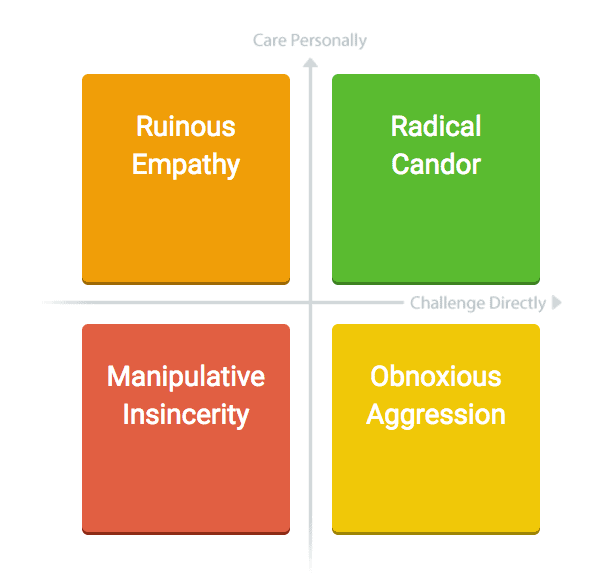
First, why is this statement - “I don’t want to waste your time” - Ruinously Empathetic? For review, Ruinous Empathy is high on the Care Personally axis and low on the Challenge Directly axis. In this case, it's clear that Jenny Cares Personally and by using this very common phrase, is trying to not hurt my feelings. She does not issue the Direct Challenge she wants to issue which is, "Why didn't you let me know this, and I would have rescheduled?" It's very clear to me based on a cursory review of her changing facial coloring, the volume and pitch of her voice, and her body language that she's not happy about meeting with "just me”. And yet she won't say anything resembling this, even though it’s painfully obvious how she feels. It's almost the definition of Ruinous Empathy.
If I stopped there, I think that most people would understand why Jenny said what she said. You might think that's that... another successful use of a disingenuous phrase to avoid pissing someone off. Chalk this one up to trust-building. Except she didn't succeed in building trust.
I - the person whose trust in that moment she is trying to gain - knew exactly what she really wanted to say. I knew exactly what she was feeling. It was written all over her face, was evident in her voice. I did not meet her status bar. So, now I'm in a situation where I'm thinking, "She's not saying what she really means," which is the first ingredient to build mistrust. I can appreciate her attempt to spare my feelings, but she doesn't achieve that at all. Here at Candor, we talk often about the arrogance of thinking you can control someone else's feelings. You can't, end of story. I could sense her disappointment and spoke up.
"I think it's ok that Kim's not joining because [our topic] is a workstream that I fully own and Kim's not really going to add a lot of value to the conversation."
"Yeah, but I just don't like to waste people's time."
Again, with this nonsense! Why can't you say what you mean?!
"Jenny, would you like to cancel our meeting?"
"Well, no..." (I'm paraphrasing here, but she was trying very hard not to say "Might as well meet now since I'm already here." She fumbled for her least offensive - and least honest - words to respond to me). "I have another meeting here in town so let's go and chat. I just wish I knew Kim wasn't coming."
It turned out that Kim’s conflict ended early, and she was able to meet us for lunch. We had salads and souvlaki. Jenny was happy, Kim was here!
This story has a happy ending. I should mention that Jenny is a kind and compassionate human being, and she's a passionate advocate for fairness and equality. We skipped the planned agenda entirely and Jenny became an investor. (and yes, Jenny becoming an investor was as out of left field for us in the moment as it was for you to read right here.) She's a real asset to have as an ally, and I'm happy she's with us.
There are two key points I want to call out from this story:
1. People are not Ruinously Empathetic, their behaviors are. Jenny is a good person. If you stopped reading before the last few paragraphs, you might have thought that Jenny was some kind of status-seeking jock sniffer. She's not at all. She behaved with Ruinous Empathy because of a complicated set of emotions, context, and relationships. We've all been in her shoes, but it's just not always as easy to see it in ourselves as it was to see it in Jenny.
2. Jenny's attempt to control my feelings was unsuccessful and your similar attempts are, too. You do this!!! I do this! We say something out of some vague sense of sparing people's feelings, but it's usually clear to the other party what we really mean. I guess at some level, you'd like to be able to give someone credit for trying to say things nicely. In reality, we all know when people are not shooting straight with us, and many of us will feel insulted that someone would attempt this sort of social mind control. "Does she really think I'm buying this?"
If you don't say what you mean to me, you are digging a trust ditch that's going to need to be refilled over time. Some people say "I trust folks until they prove otherwise," but I'm not one of those people. For me, trust is not granted - it's earned. Unfortunately, when you dig the trust ditch, you dig it quick and deep with a Caterpillar backhoe, but it takes hundreds of spoonfuls of dirt to refill it. Which is why Ruinous Empathy is a waste of your time - it’s counterproductive for building trust and showing you Care Personally.
I suspect that if you search your feelings, you might recognize that I'm not so alone.
Thanks for reading!
What makes Radical Candor radical is that it’s a deviation from the norm, which tends to fall somewhere between acting like a jerk and avoiding...

Kim Scott is the author of Radical Candor: Be a Kick-Ass Boss Without Losing Your Humanity and Radical Respect: How to Work Together Better and...
Do you think your feedback is often Ruinously Empathetic? If so, you're not alone. In our experience, most feedback mistakes fall in the Ruinous...
Share your perspective
Leave a comment below.