We’ve been so excited about all the engagement we’ve gotten from our podcast listeners. We are getting great, thoughtful questions after each episode, and we know they’re questions that others have as well! So we’ll be sharing some of the advice we’re giving to individual listeners here on the blog.
Here’s a question from Kathryn:
My question relates to how one can challenge directly regarding inflexibility. I have a staff member that really struggles with his daily responsibilities I think due to being inflexible. He appears to not be able to break the habit of black and white thinking, be open to change in process or suggestions on how to be more efficient. Anytime a request is made or even a suggestion for improvement is made there seems to be a wall that goes up or there are a million questions (about a simple task) or he is agreeable but then I receive a super long resistant email. Is it possible to be candid about this behavior in order to assist this individual to achieving his true potential within the organization?"
I penned a response to Kathryn and realized we have lots of advice about giving feedback in a few places, and I wanted to bring them together to help Kathryn solve her specific problem. I then realized that this is probably a pretty darn useful “playbook” to help you think about giving feedback.
TLDR for Kathryn: You can and must give this guy the feedback and you really should do it ASAP. This behavior is clearly getting in his way, and the longer you wait to offer him critical feedback, the longer he continues to confound his own success.
And I’ll go one step further: I’ll bet anything that this guy has faced this problem at his other jobs, and I’ll bet previous managers and peers never bothered to give him the feedback - perhaps they’ve been worn down by the behavior, perhaps they’ve feared an adverse response, perhaps they didn’t care. Someone has to help this guy, no matter how painful and difficult it is. Kathryn, you can be the one to end the cycle for him and help get him on the right track for today and for the rest of his career.
This is, in my view, a five-alarm feedback situation.
I think some helpful framing for the feedback and the conversation is the Center for Creative Leadership’s SBI Model. SBI means:
- Situation: context or a specific situation in which a behavior manifested
- Behavior: the behavior you are seeing that is not ideal (in this case) or the behavior you are seeing that is leading to success (in the case of praise)
- Impact: the articulation of the Impact of the behavior
For future reference, we also espouse a derivative of the SBI model that we invented, which is the SWI Model, which is Situation, Work, Impact. It means:
- Situation: context or a specific situation in which work was performed
- Work: the specific work product, project, deliverable, performance goal, etc.
- Impact: the articulation of the impact of the work product or specific performance
In Kathryn’s case, we’re talking about mostly behaviors, so we’ll stick primarily with SBI. A simple, clarifying practice can be to quickly write down the feedback. How this might look in Kathryn’s notebook:
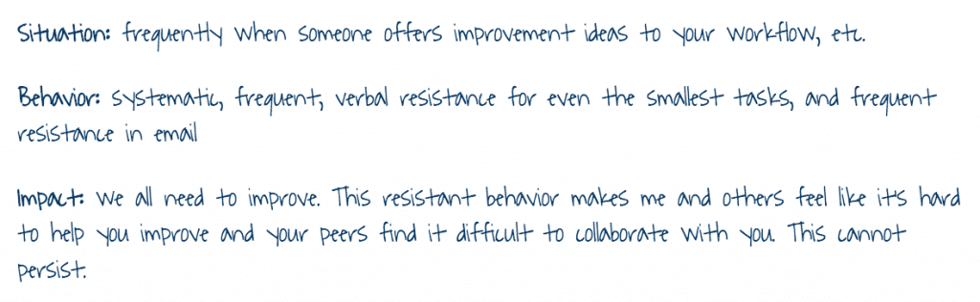
Kathryn will of course have to do the hard work of thinking through all of this, but you get the idea. One small execution detail: Kathryn should certainly be armed with a couple examples, but I recommend withholding the examples until after she’s discussed the impact of the behaviors. It’s a nuance, but I think it can be a bit easier for someone to hear the examples in the context of the impact of the behavior.

The Playbook
When you’ve got feedback to give, follow these guidelines to give it as kindly and clearly as possible.
1. Write your feedback down
Write down what you want to say - it helps clarify. Also, write down your objectives. Being clear about what you want to happen as a result of the conversation makes it more likely the conversation will be helpful. You don't need to write a federal case, just enough to clarify your thinking.
2. Practice
Find a peer or an HRBP (Human Resources Business Partner) type and practice actually giving the feedback. We often think we are much clearer in our heads than we are in actuality when we speak. Tell this person "I want you to help me refine and clarify this message." Recognize that as a human being you are naturally predisposed to the following: the more difficult the message, the less clear you will be. Practicing on someone helps you hold the line and remain clear.
3. Be HHIIPP
Think about these six ways to be kind and clear: helpful, humble, immediate, in person, public praise/private criticism, not about personality. If these ideas of HHIIPP are new to you, it can be useful to just focus on one or two HHIIPP principles at once, until you master them. I think “Humble” is often difficult and important to practice early on.
4. You don't need to have all the answers
All too often, managers hold off on giving important feedback because they think they need to be "solutions oriented" which gets defined in their heads as "I can't just bring a problem, I need to bring a solution." That's an impossibly high bar. Instead, offer to work with the other person to figure out how to help them improve in this area. In Kathryn’s case, this might mean providing resources to help this person be more open to feedback, like this article about taking feedback well.
5. Carefully assess emotions
You cannot control someone’s emotions, and if they become emotional - angry, crying, defensive... this does ***not*** mean you did something wrong. In Kathryn’s example, there is a decent chance the guy’s brain will move into threat zone given his regular behavior. How you react when someone is emotional is what matters far more than whether they’ve become emotional: Recognize they are not in a "teachable moment" if they are emotional or defensive. If you see this, you have some options.
- You can ask simple questions to move the person out of the limbic system/threat zone, such as "tell me how you are feeling right now," or "how would you like to proceed?" These have the effect of helping someone move out of threat response and into problem solving.
- Be prepared to give the person a bottle of water and a :15 minute break (or even a break until the next day) to make sure you can have a discussion.
- There is a solid chance the person will only have heard a fraction of what you said, so you will need to check to see that your feedback landed (Gauge your feedback) to make sure you both are seeing this thing similarly.
- Be sure to fully understand their perspective, too - this is really what give it "humbly" means.
That’s it for the Give Feedback playbook. Remember - giving feedback - especially critical feedback - is hard, but that doesn’t mean we get to skip it. Unfortunately, there is no silver bullet that if you say it in just the right way or just the right time, the other person will magically, certainly be able to hear it well. Use the tips above to get to good outcomes - delivering feedback that is kind and clear in the case of criticism and specific and sincere in the case or praise.
More from Radical Candor
How Do You Ask for Feedback? The Three Tests of a Good Go-To Question
The idea Get it. Don’t just be open to it.
How Do You Get Feedback? The Four Steps to Solicit Radical Candor®
A Story People often focus on feedback they get from their bosses. But the best feedback comes from the people who work for you. It can be difficult to get it—unless you create a …
Fixing the Employee Experience (with Tiffani Bova) 8 | 26
While the podcast team is on a Radical Sabbatical, Kim Scott is spending the season talking to authors of the books that have shaped her thinking. This week: Tiffani Bova, whose …
Share your perspective
This site is protected by reCAPTCHA and the Google Privacy Policy and Terms of Service apply.