 Kim Scott
Why Praising in Public and Criticizing in Private is Key to Giving Feedback Others Will Act On
A good rule of thumb for guidance is praise in public, criticize in private.

The first time a person in a class I was teaching asked about how to give humble feedback, I sat there with my mouth hanging open. It was all I could do not to break into the song from the 70s show HeeHaw. “Oh lord, it’s hard to be humble, when you’re perfect in every way!”
How can you answer a question like that? I didn’t take it seriously until about the 20th time somebody asked me how to give humble feedback. Finally, I realized it was a legitimate question and I needed to give a serious answer.
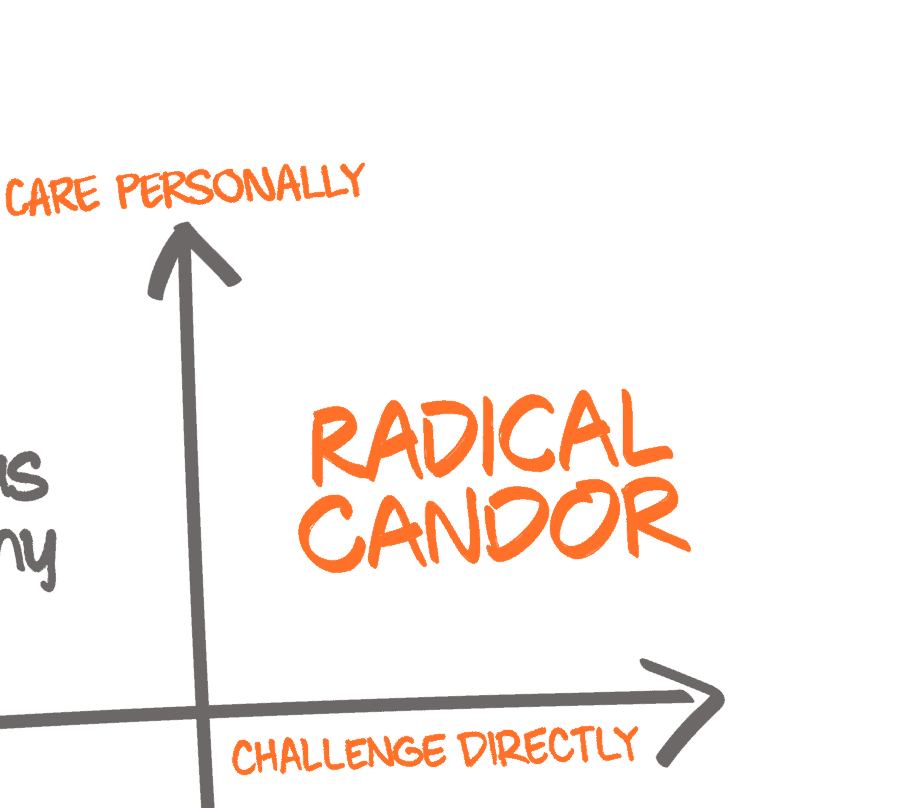
The ability to be humble is important for achieving Radical Candor, and it’s one of the tenets of our HIP Approach. You can’t Care Personally or Challenge Directly if you’re not humble.
It’s really hard to care at a personal level about somebody if you think you’re superior. And you can’t Challenge Directly and be open to the reciprocal challenge if you’re not humble enough to realize you may be wrong.
Don’t be arrogant. Be curious. Deliver your feedback firmly and with supporting rationale, but be open to push-back. Listen with true intent to understand so that you get full command of both perspectives before agreeing or disagreeing.
Need help with Radical Candor? Let's Talk!
https://www.youtube.com/watch?v=c5XXoXQXkXs
Andy Grove once told me, over a cup of Jamocha Almond Fudge ice cream at Baskin Robbins in Los Altos, “Fucking Steve [Jobs] always gets it right.”
“Nobody’s always right,” I said.
“I didn’t say Steve IS always right. I said he always GETS it right. Like anyone, he is wrong all the time, but he insists, and not gently either, that people tell him when he’s wrong, so he always gets it right in the end.”
I thought a lot about this conversation over the next couple of years. I think Andy was exactly right: a big part of Steve Jobs’s genius came from his willingness to be proven wrong. Here’s how he described it in his own words:
Jobs: I don’t mind being wrong. And I’ll admit that I’m wrong a lot. It doesn’t really matter to me too much. What matters to me is that we do the right thing. Watch the video >>
In other words, you don’t have to grovel or pretend to be worse than you are. You just need to accept the possibility that whatever you’re saying may be wrong. Don’t be arrogant. Be curious.
The thing that makes it tough is that giving criticism and praise does feel arrogant. How can you be humble and tell somebody their work isn’t good enough at the same time? It can feel equally arrogant to tell people when their work is great.
Don’t let the fear of arrogance stop you from giving the feedback people need. Here are some techniques and reminders for being Humble when offering praise and criticism.
The Center for Creative Leadership developed a technique called Situation, Behavior, Impact that ensures guidance is humble rather than judgmental. The idea is simple. It forces you to describe what you saw a person do and what impact you saw as a result. This prevents you from passing judgments or making assertions that seem arrogant or fall prey to the “fundamental attribution error.”
We took inspiration from this model to develop the Radical Candor CORE method — Context, Observation, Result, nExt stEps.
C — Context (Cite the specific situation.)
O — Observation (Describe what was said or done.)
R — Result (What is the most meaningful consequence to you and to them?)
E — nExt stEps (What are the expected next steps?)
Get the Radical Candor CORE guide >>
Instead of yelling, “You asshole” when somebody grabs your parking space, you say, “I’ve been waiting for that spot here for five minutes, and you just zipped in front of me and took it. Now I’m going to be late.”
If you say this, you give the person a chance to say, “Oh, I’m sorry I didn’t realize, let me move.” (Of course, the person might also just flip you off or say, “Tough shit.” Then you can yell with more justification, “You asshole!”)
To make sure you’re not criticizing someone’s personality when delivering criticism, you can follow the CORE framework:
Here’s some helpful criticism that Kim Scott received from her boss: “After the meeting when I told you that you said ‘um’ a lot and recommended a speech coach,” (context), “you made a brush-off gesture” (observation). “This makes me feel like you weren’t hearing me and won’t go to the speech coach I’m recommending, which would be a shame because if you stop saying um so much you’ll be more effective” (result). “Go to the damn speech coach! (nExt stEps)."
CORE also works with praise. For example, CORE praise that includes both caring and a challenge looks like this.
“I asked you to help us be more efficient (context), you went above and beyond by implementing Slack (observation), the team is spending less time on email but more time communicating, which allows us to get more done in less time (result). We’d love for you to explore other tools that can help streamline communication in the office. (nExt stEps).”
Chris Argyris and Donald Schon developed a method called the Left Hand Column exercise, which can be useful for keeping oneself humble. The idea is to create two columns on a piece of paper.
In the right-hand column, you write down how a particular conversation went, as closely as you can remember it. In the left-hand column, you write down what you were thinking and feeling.
While this helps identify thoughts you aren’t expressing and should, it can also help you see if arrogant thoughts from the left-hand column are leaking out into what you say.
If you can be more conscious of what you’re thinking and can adjust it, you can probably find a productive way to address it.
For example, if you are thinking, “So-and-so is lazy and sloppy and doesn’t care about the team’s results,” you’re not likely to be humble when you criticize the typos you saw in so-and-so’s last ten presentations.
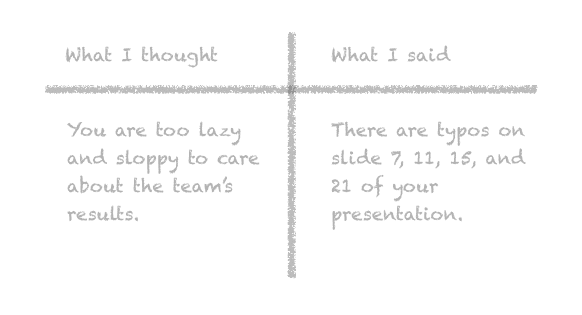
The point is that even though you didn't choose the wrong words to say, your tone of voice and body language is likely to betray what you really think. it's not just about fixing the words you use or using a CORE formula, you need to address your thinking.
Fred Kofman wrote a great chapter called Ontological Humility in his book Conscious Business. Here’s an excerpt:
“Ontological humility is the acknowledgement that you do not have a special claim on reality or truth and, that others have equally valid perspectives deserving respect and consideration. This attitude is opposed to ontological arrogance, which is the claim that your truth is the only truth.
Even though it may make sense intellectually that people have different perspectives, most people do not naturally act from this understanding, especially in the midst of disagreement or conflict.”
When you remember your criticism may be wrong, you’ll offer it more humbly. You will challenge others in a way that invites a reciprocal challenge, and you’ll be more likely to see things from the other person’s point of view.
Nothing is more corrupting to humility than formal power. Part of what gives bosses trouble with humility is that they have a little bit of power. Don’t let it go to your head...Remember, being a boss is a job, not a value judgment.
Most people find it harder to be humble when they’re mad, hungry, or tired. If I focus on managing my emotions it’s easier for me to prevent my ego from getting the better of me.
Ask yourself what you need to stay centered, and make sure to do those things to take care of yourself—get enough sleep, exercise, food, free time, adrenaline rushes, whatever—make sure to do it because your bad mood can have a ripple effect and infect the entire team.
Remember, you can’t give a damn about others if you don’t give a damn about yourself.
————————————————————————————————————————————————————————————–
*This post was updated March 13, 2023.

A good rule of thumb for guidance is praise in public, criticize in private.
We’re all about helping people become more Radically Candid with their feedback. By feedback, we mean praise and criticism. Being Radically Candid...

There is a big difference between Caring Personally and giving praise or criticism about somebody's personality. The final tip in our HIP approach to...
Share your perspective
Leave a comment below.