
Early in my career, I co-founded Juice Software. Despite raising plenty of money, it failed, and looking back, a lot of that had to do with feedback: I didn't know how to get it, how to give praise that didn't feel patronizing or criticism that didn't feel mean, or how to gauge whether any of it was actually landing.
My problem was that I tended to be "too nice," not "too mean." I'm not alone there. In polls I do during workshops, over 75% of people report that they, too, struggle more with being "too nice." Most feedback training, however, seems designed for people who tend to be "too mean."
After my startup failed, I got a job at a big tech company that offered a training session on using "I" statements for feedback: "I feel X when you do or say Y." This session was clearly aimed at people who thought saying things like, "You dumbass!" counted as feedback. But that wasn't my problem, or the problem anyone else in the room had.
I had some questions about this approach, and, trying to lighten the mood, I described a breakup that had happened long ago and became a funny story. I tried the "I" statement approach with this man: "I felt sad when you didn't call me on Valentine's Day." His response? "I was talking to a friend of mine about you, and he said, 'She sounds like she's a CEO used to getting her way all the time.'" I pointed out to the facilitator that my "I" statement hadn't worked, and asked him what to do when "I" statements go sideways. He got all serious and told me I was dating the wrong men. Now, that was not helpful feedback. One, it was none of his business who I dated. Two, I could break up with a boyfriend, but I couldn't fire my peers. And he was trying to teach us to communicate better with peers. His response did it answer my question. What happens when an "I" statement doesn't work when giving feedback to peers? to a boss?
The interesting thing? After I wrote Radical Candor, the man I'd dated called me up, and we agreed that if only I'd known then that good feedback starts with soliciting candor, not giving it, we might've had a happier Valentine's Day. He'd sent me a beautiful gift and was sitting around waiting for a thank you. When I called complaining about the lack of a call, he thought I was an ungrateful wretch. The problem? The gift never arrived, and it took years to piece the whole story together. All's well that ends well: we're both happily married to other people now, and we're friends. But if I'd known then to get feedback before giving it, we could have avoided a silly but painful misunderstanding.
Why Does Most Feedback Training Focus on Bosses Who Give Obnoxious Feedback?
Almost everyone has had an abusive boss at some point, a person who thought that humiliating people was a good way to motivate them. Those experiences of Obnoxious Aggression loom much larger in memory than the boss who was "too nice." The training I attended was built to prevent the most dramatically cruel behavior.
But that wasn't the problem at that company. Most people there, and indeed at most companies, wanted to be "nice," so they didn't say what needed to be said, which proved unkind in the long run. The simplest way out of that would've been to train people to solicit feedback, rather than training everyone not to be obnoxious when the real problem was silence.
How Is Radical Candor Different?
When I sat down to write Radical Candor and to develop our workshops, I spent a lot of time thinking about what good looks like, what gets in the way, and how to get it back out of the way. I tried to think of it in the simplest way possible: a 2x2 framework.
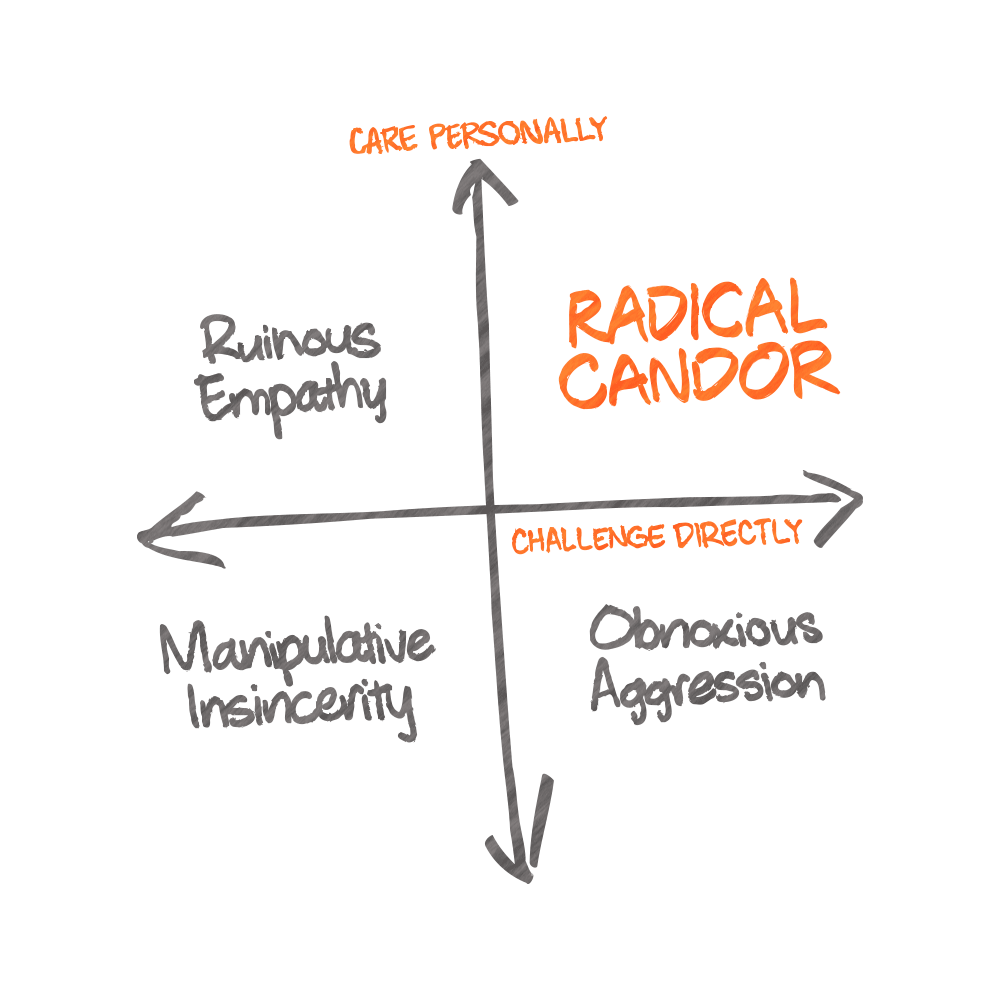
Most feedback training seeks to prevent Obnoxious Aggression. That's understandable: Obnoxious Aggression hurts people. But by far the most common mistake people make is Ruinous Empathy. That's why Radical Candor training focuses on helping people move away from Ruinous Empathy and toward Radical Candor. We also offer tips for avoiding Obnoxious Aggression and Manipulative Insincerity, but the focus is on preventing Ruinous Empathy. "Ruinous Empathy is responsible for the vast majority of management mistakes I've seen in my career." [Radical Candor, 2nd Ed., Ch. 2, p 32]
Ruinous Empathy doesn't only show up when you're giving feedback. It shows up the moment you ask for it, too. Asking for feedback creates an awkward moment for you and for the person you're asking. Nobody, except maybe your teenage kids, really wants to give you feedback. So when you ask, you're putting them in an uncomfortable spot. If you feel bad enough about that to let them off the hook rather than waiting for an answer, you'll never get the feedback that would have helped you.
Giving praise can feel awkward, too. Are you being patronizing? Will you sound arrogant? Too often we fear the discomfort and skip the praise, a strange but not uncommon form of Ruinous Empathy. Giving criticism can feel mean or offensive, so too often people retreat to Ruinous Empathy and say nothing instead.
Is Feedback Just for Managers?
Getting, giving, and gauging feedback is essential for any good relationship, up, down, or sideways. We teach you to be radically candid with your boss, your peers, and, if you're a boss, with your employees. And, as the story about the Valentine's Day mishap shows, it matters in your personal life too.
Is Feedback Just Another Way of Saying "Give Criticism"?
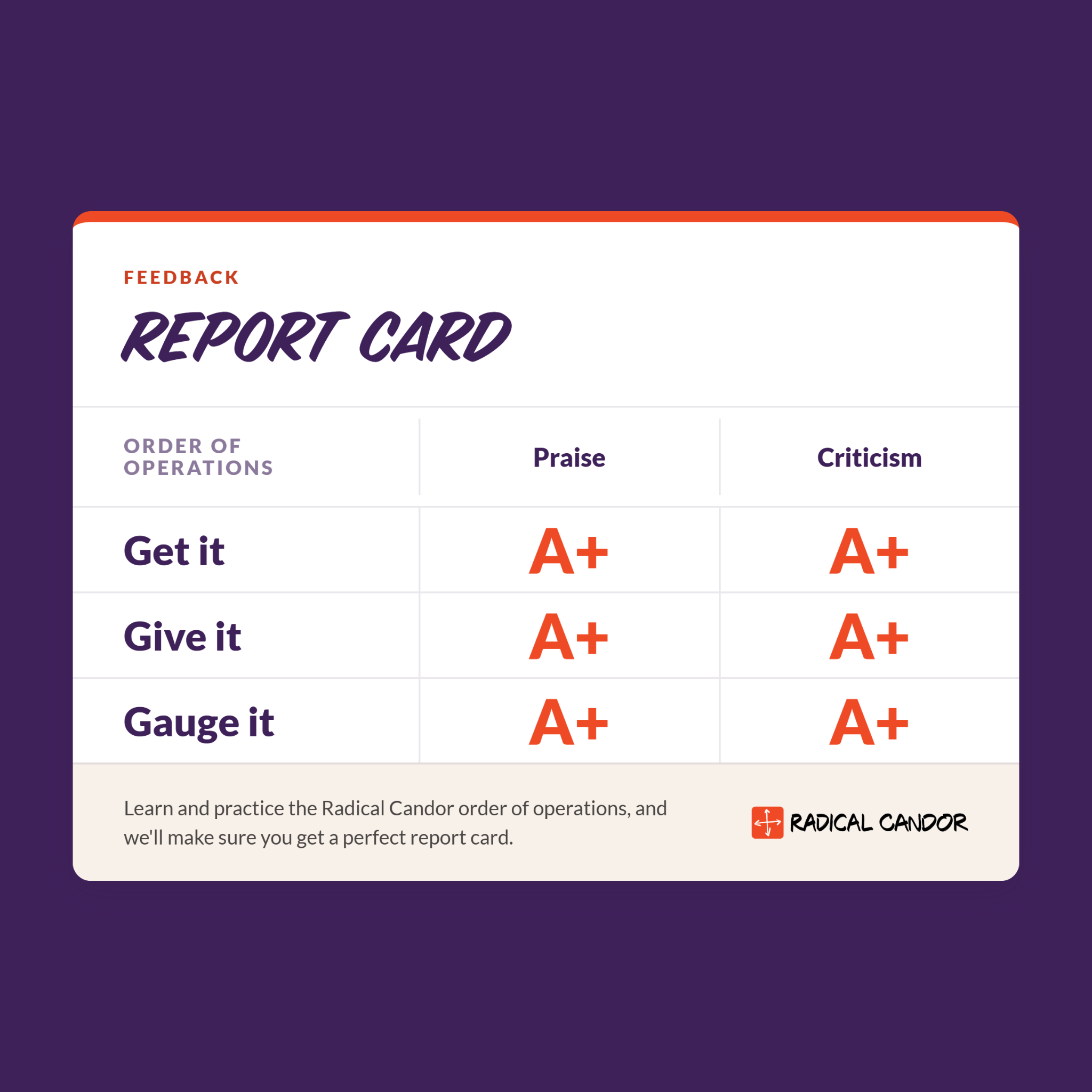
No! However, most feedback training just teaches how to give criticism. The Radical Candor “order of operations” explains why you’ve got to: get feedback before you give it; give more praise than criticism without offering up a “feedback sandwich”; gauge how what you said landed in case you need to “take a sad song and make it better.”
Worse, most feedback training assumes we’re all assholes. But the mistake people make most often is Ruinous Empathy: not asking for feedback because it’s awkward, withholding praise to avoid being patronizing, swallowing criticism to spare someone's feelings. As Simon and Garfunkel warned and Disturbed reiterated, “Silence like a cancer grows.”
Radical Candor training helps us “say something” in a way that is neither “too nice” nor “too harsh” and in a way that strengthens relationships rather than giving up on them.
We want to help you get an A+ on all the different things that go into a good culture of feedback:
Does Feedback Have to Feel Like a Root Canal?
No. Radical Candor should feel more like brushing and flossing than a root canal. We focus on the two-minute conversations that can help you nip problems in the bud. You'll be surprised how much you can improve your relationships and your work in two minute chats if you have them routinely. They're fast, they're free--but they do require a willingness to embrace the discomfort, to hear the thing you don't really want to hear and to say the thing you don't really want to say.
How to “Get it” this week!
This week, pick one person and solicit feedback--the right place to start. If all you do is say "Do you have any feedback for me?" you're wasting your breath. I can already tell you their answer: "Oh, no, everything is fine. Nobody wants to give you feedback, except your teenage children if you have those at home. There are four steps to making sure that people you work with tell you what they really think.
- Have a go-to question. Pick one person this week and ask a feedback question that can’t be answered with a yes or a no. Mine is: "What could I do or stop doing that would make it easier to work with me?"
- Embrace the discomfort. Ask the question, then stay quiet. Count to six in your head. The silence will feel super uncomfortable. That's the moment when it's tempting to hand the other person an escape route. Don't. And don't start counting faster :) The discomfort is part of the process!
- Listen with the intent to understand, not to respond. Manage your own defensiveness!
- Reward the candor. Don’t just say thanks. Fix the problem or explain why you disagree.
This is what I wish I'd known how to do back at that failed startup, and with that Valentine's Day disaster. Ask first. The rest gets a lot easier.
Get More From the Radical Refresher
If this resonated, the Radical Refresher covers the same ideas each week: a real story, the framework behind it, and the same worldview. Sign up here → https://radicalcandor.com/news
More from Radical Candor
How Do You Ask for Feedback? The Three Tests of a Good Go-To Question
The idea Get it. Don’t just be open to it.
How Do You Get Feedback? The Four Steps to Solicit Radical Candor®
A Story People often focus on feedback they get from their bosses. But the best feedback comes from the people who work for you. It can be difficult to get it—unless you create a …
Fixing the Employee Experience (with Tiffani Bova) 8 | 26
While the podcast team is on a Radical Sabbatical, Kim Scott is spending the season talking to authors of the books that have shaped her thinking. This week: Tiffani Bova, whose …
Share your perspective
This site is protected by reCAPTCHA and the Google Privacy Policy and Terms of Service apply.