

The idea
Get it. Don’t just be open to it.
Step one when soliciting feedback is “have a go-to question.”
If you ask, “Do you have any feedback for me?” I can already tell you the answer: “Oh, no, everything’s fine.” People are often uncomfortable giving feedback, which is why the go-to question matters so much. A good question is the difference between asking for feedback and actually getting it.
There are three criteria for a good go-to question.
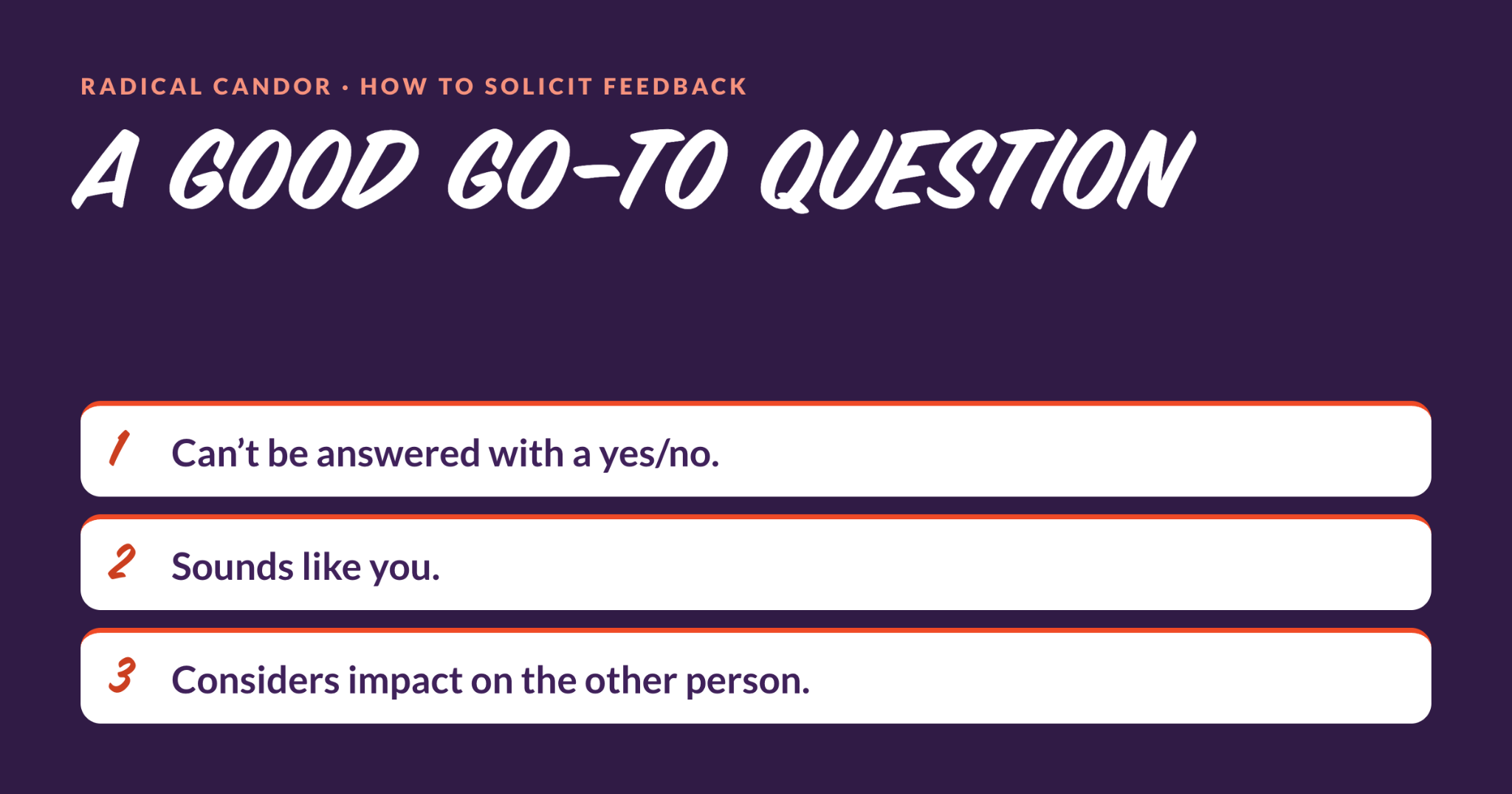
What makes a good go-to question?
1. It can’t be answered with a yes or a no.
“Is there anything I could do or stop doing that would make it easier to work with me?” That’s the question I recommended in the book Radical Candor, and it has a flaw. It’s a yes-or-no question. “Nope!” is a possible answer, and the conversation is over.
If you write a book about feedback, you’re bound to get a lot of it, and indeed I did. Many readers wrote in and suggested a much better question: “What could I do or stop doing that would make it easier to work with me?” Same idea, one word is different, and now there’s no easy exit to the conversation. A good go-to question demands a radically candid answer, even if it’s uncomfortable for the person to say it.
Questions that start with “Is there,” “Do you,” or “Would you,” don’t pass the test—it’s too easy for someone to answer them with “oh no, everything’s fine.”
Instead, start with “What” or “How” to prevent the easy exit.
2. It sounds like you.
My question works for me because it’s how I actually talk. It won’t work for everyone.
Case in point: I spoke with Christa Quarles when she was CEO of OpenTable. I suggested she try my go-to question (“What could I do or stop doing that would make it easier to work with me?”), and she stopped me.
“I can’t picture those words coming out of my mouth.”
It didn’t sound like her, and she was right to push back. If she’d tried my question, the person she was asking would never believe she really wanted the answer. It would have sounded like Manipulative Insincerity®.
Christa went with something much blunter: “Tell me why I’m wrong.” Technically not a question, but the request suited her and got her the candid feedback she was looking for.
If someone else’s question doesn’t fall trippingly off your tongue, that’s okay. Keep looking until you find the words you’d actually say out loud.
A good go-to question signals, in its authenticity, that you want a real answer. It also shows you care enough about the person’s opinion that you took time to craft a meaningful question, not something you’re reading off of a script.
3. It considers the impact on the other person.
Being authentic doesn’t mean ignoring the impact your words have on others.
So think about who you’re asking. What’s fine for one person may feel too aggressive for another. What’s funny for one person can seem mean to another.
A couple of people on Christa’s team found her way of asking for feedback too aggressive. For these people, she needed to soften her approach. For others, her hard-charging directness worked great.
When I co-founded Radical Candor with Jason Rosoff, he told me that he found my go-to question too open-ended. With him, I try to be more specific: “What did I do this week that bugged you?” Or, “Where did I get involved this week that you wish I hadn’t, and where did I fail to get involved that you wish I had?”
I learned a lot when I started asking this question. In Radical Candor, I write about being a thought partner, not an absentee manager or a micromanager. What I’ve learned when I ask that question is that some people want more of me, others want less :)
But just because Jason doesn’t like my usual go-to question doesn’t mean it’s bad for everyone.. Sometimes when I’ve asked “what could I do or stop doing that would make it easier to work with me,” I’ve learned about something I never would’ve thought to ask about.
Since Jason and I are partners, hierarchy doesn’t get in the way. But when you’re the boss, asking this question is more awkward for the other person than it is for you. They wonder whether it’s safe to answer candidly, and whether you want the real answer or just the comfortable one. They may fear reprisal if they say the wrong thing. Even if you know that you would never punish someone for giving you feedback, THEY don’t know that yet. You’ve got to prove it to them. The only way to prove it is to reward the candor when you get it. And you won’t get it unless you ask a question they’ll actually answer!
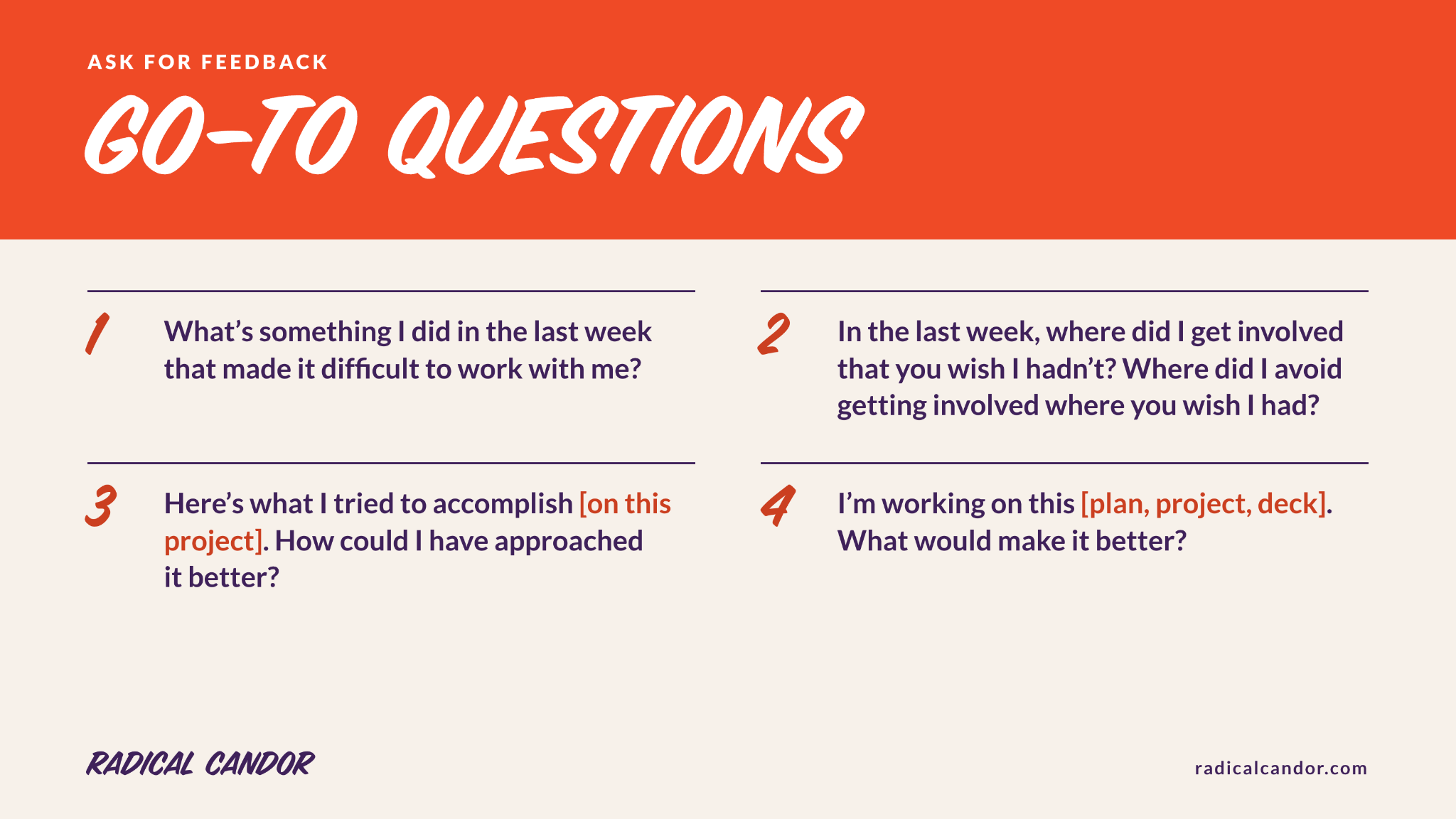
What should you do this week?
Refine your go-to question. Practice it.
Write down your question. Write down the name of the person you’re going to ask. Think about how they will hear it, and adjust if you need to. Then practice it in the mirror.
If you want some feedback on your question before you ask it, you can practice with Compass. But remember, what counts is a real, human conversation.
How could I have written this post in a way that would’ve better helped you come up with a good go-to question? What did I say here that you’d like to go deeper on. Put your thoughts in the comments and we can discuss!!
Up next
Practical, tactical suggestions for how to embrace the discomfort that is inevitable after you ask someone for feedback.
And if you want help teaching this to your whole team, reach out to our team.
Related reading: How Do You Get Feedback? The Four Steps to Solicit Radical Candor, How Do You Build a Culture of Feedback? Get It, Give It, Gauge It, Effective One-on-Ones
Share your perspective
This site is protected by reCAPTCHA and the Google Privacy Policy and Terms of Service apply.