
How to Get and Give Feedback Using the Radical Candor Order of Operations
There are four simple steps for how to give and receive feedback you need to excel at work. You might call it the solution to your feedback wipeouts....

Table of Contents
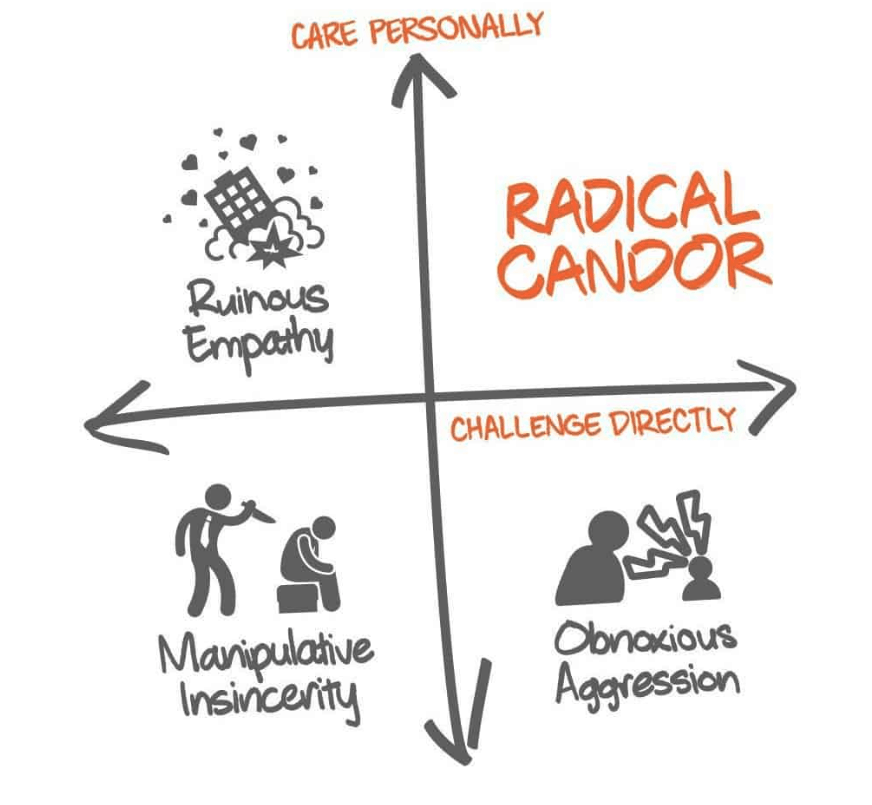
When you’re the boss, it’s really hard to get people to tell you what they really think -- to be Radically Candid with you. Showing that you want feedback and genuinely appreciate it when it’s given is key. The worst thing you can do is to criticize the criticism you get. In fact, it can actually be helpful to encourage people to be Obnoxiously Aggressive with you.
Here’s a funny example of Jim Koch, co-founder of the Boston Beer Company (makers of Sam Adams), doing just that.
https://www.youtube.com/watch?v=NjM9Vrtjwrg
Usually when we talk about embracing the discomfort, we are talking about enduring that awkward silence when you ask somebody who works for you what they think of your performance. But sometimes you don’t get awkward silence, you get an f-bomb. Now it’s your discomfort, not the other person’s, that you have to embrace.
Admittedly, the wording used — personalized and arguably unkind — is quintessential Obnoxious Aggression, and we don’t really advise encouraging that between employees. But, as the boss, you often have to be the emotional punching bag, able to absorb the f-bombs that get hurled at you.
We also want to highlight some of the underlying, more Radically Candid aspects of this approach for getting and encouraging feedback:
We say Kudos to Jim Koch for making people feel free to tell him what they really think!
But what do you say? How does this approach strike you? Does it put you off? Does it seem like Obnoxious Aggression?
Jim Koch, co-founder of Boston Beer Company (makers of Sam Adams), created a rule that encourages employees to say 'F you' to each other — and even to him — when they strongly disagree with something. The key conditions are that the phrase must be followed by specific reasons for the disagreement, and it must be delivered with humility, meaning the person saying it has to remain open to hearing the other side. It's an unconventional but deliberate culture-building tool designed to get honest feedback out in the open.
Getting honest feedback as a boss requires showing that you genuinely want it and won't punish people for giving it. Practical ways to do this include: having a go-to question like 'What could I do differently to make it easier for us to work together?', modeling openness by listening without getting defensive, and building feedback into team culture so it's normal rather than exceptional. The worst thing you can do is criticize the criticism — that shuts down future honesty fast.
Obnoxious Aggression is one of the four quadrants in the Radical Candor framework. It describes feedback that challenges directly but fails to show personal care — think blunt, harsh, or unkind delivery. It's not the ideal communication style, but it's actually considered less damaging than Manipulative Insincerity or Ruinous Empathy because at least the message gets through. The FU Rule, as practiced at Boston Beer Company, skirts this quadrant, which is why Koch adds conditions like specificity and humility to push it closer to Radical Candor.
As a boss, your team members often hold back because they fear consequences. When you actively solicit honest feedback, you may get uncomfortable responses — silence, strong emotions, or even an f-bomb. Radical Candor encourages leaders to absorb that discomfort rather than reacting defensively, because shutting it down sends a signal that honesty isn't safe. Embracing the discomfort means letting the feedback land, taking it seriously, and responding with curiosity rather than defensiveness.
Radical Candor doesn't recommend encouraging the literal FU Rule between peers or direct reports — the personalized and potentially unkind wording can veer into Obnoxious Aggression, which isn't healthy team culture. However, the underlying principles are worth adopting: create a go-to question that opens honest dialogue, build feedback into your culture systematically, and make sure direct challenges are paired with genuine care and specifics. As the boss, you may need to be an emotional 'punching bag' at times, but that doesn't mean your team should replicate that dynamic with each other.
Three ways to put this into practice.
Related reading
There are four simple steps for how to give and receive feedback you need to excel at work. You might call it the solution to your feedback wipeouts....
The good news is that the term “Radical Candor” has entered the lexicon. The bad news is that there’s a risk it becomes a meaningless buzzword.
When we talk about Radical Candor at companies or with individuals, we see a lot of heads nodding in agreement. People understand that Radical...