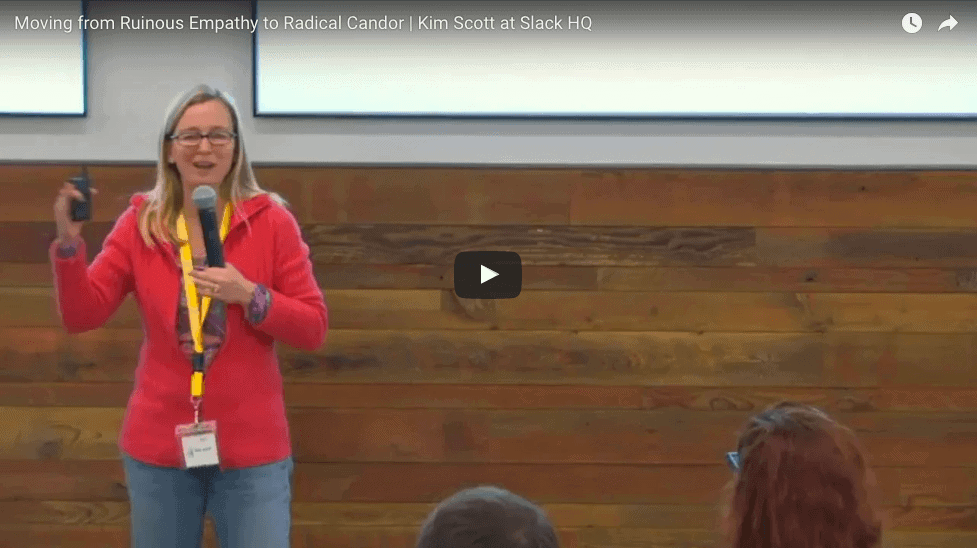
Video Tip: Move Your Feedback Away from Ruinous Empathy and Do This Instead
Do you think your feedback is often Ruinously Empathetic? If so, you're not alone. In our experience, most feedback mistakes fall in the Ruinous...
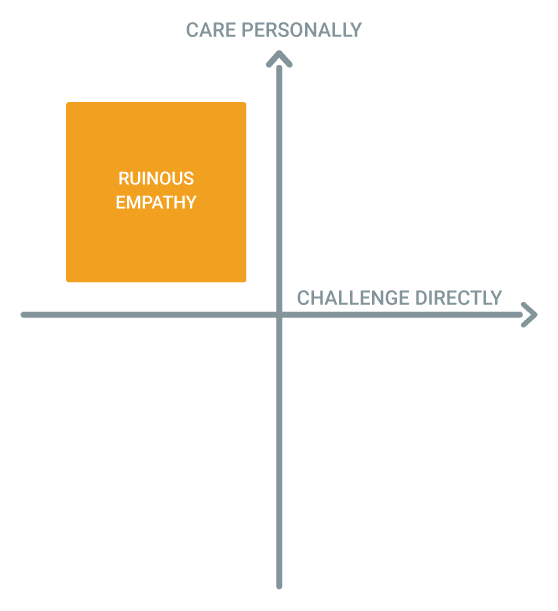
Table of Contents
Praise can be Ruinously Empathetic when bosses try to be “nice” and get things wrong. Below are a few cautionary tales of how trying to make a person feel good without taking the time to understand the details of their work to challenge them appropriately can go astray.
Perhaps the most famous example of praise gone wrong was when Bush said on national television to the head of the Federal Emergency Management Agency (FEMA) during Hurricane Katrina: “Heck of a job, Brownie!” What was so horrible about that? Brown was under enormous stress, and Bush was trying to be a supportive boss.
Problem was, FEMA was doing a disastrous job, and everybody knew it. Still, wasn’t Bush right to be supportive in the midst of a crisis? No! By publicly praising a person who was failing, Bush inadvertently highlighted what a terrible job Brown was doing and made him a laughing stock. Just because you’re the boss – or even the President of the United States – doesn’t mean that anyone will believe your assertion that somebody is doing a good job when in fact they are not. And your assertion will make you look either ignorant or soft-headed.
A boss’s job is not to win popularity contests. A boss’s job is to point out to people as clearly and with as many specifics as possible when they are doing a bad job, AND when they are really doing a good job. It’s generally a good idea to point out the good things in public and the bad things in private. But telling somebody in public they are doing a good job when in fact they are doing a bad job is far worse than just saying nothing at all.
The key is to avoid pat phrases like “good job,” or other things you’d say to your dog, and to be specific.
Another point to keep in mind for praise is to make sure to remark on something of substance.
A friend worked extremely hard on some analysis for the CEO of his company, and the only thing that got praised was the formatting of the presentation. No amount of criticism of his ideas could have been as discouraging as the flip praise of something he thought was unimportant.
When giving praise, it’s important to praise what is in fact best and most important. Be specific about what’s most relevant.
One boss tells a cautionary tale about a time he praised the wrong person right after a major launch. The team was working all night, and very late he bumped into an engineer, “Anatoly,” and asked him about a particular feature. Anatoly answered his question, and told him about several important aspects of the feature. A couple days later, when celebrating the launch, this boss, wanting to praise Anatoly, congratulated him on his excellent work on the feature. But Anatoly hadn’t worked on that feature. All the engineers who had worked on it now thought Anatoly had claimed credit for something he hadn’t worked on. Chagrined, Anatoly sent an email out to the whole company, explaining that he hadn’t worked on it and listing the people who had. The boss realized that, trying to make Anatoly happy, he’d accidentally thrown him under the bus by not being deep enough in the details when he gave praise.
In short, when giving praise, take just as long to get your facts straight when giving praise as you would when criticizing. Be specific.
---
More about this story and others is included in “Radical Candor: Be a Kickass Boss Without Losing Your Humanity,” published by St. Martin’s Press. Learn more
Ruinously Empathetic praise happens when a boss tries to be "nice" and make someone feel good without taking the time to understand the details of their work. The result is praise that's vague, inaccurate, or misplaced — and instead of motivating the person, it can embarrass them, mislead the team, or signal to everyone that you're not paying attention. In the Radical Candor framework, being truly caring means being specific and accurate, not just warm and encouraging.
When you publicly praise someone who is clearly failing — like Bush's famous "Heck of a job, Brownie!" during Hurricane Katrina — you don't fool anyone. Everyone around you already knows the truth, so the praise makes you look either out of touch or dishonest, and it can turn the person you're trying to support into a laughingstock. A boss's job is to be clear and specific about both good and bad performance, not to win a popularity contest.
The key is to be specific and to focus on what actually matters. Avoid generic phrases like "good job" — those are things you'd say to a dog, not a thoughtful colleague. Make sure you're remarking on something of real substance. As the post illustrates, praising the formatting of a presentation when someone worked hard on the underlying analysis can be more discouraging than saying nothing at all. Take the time to identify what was genuinely impressive and call that out clearly.
Praising the wrong person — even with good intentions — can seriously backfire. In the post, a boss congratulated an engineer named Anatoly for work he hadn't actually done. The real contributors felt like their work had been stolen, and Anatoly had to send a company-wide email to set the record straight. The lesson: get your facts straight before giving praise, just as carefully as you would before delivering criticism. Sloppy praise can damage trust and morale just as much as sloppy criticism.
Generally, yes — praising publicly and criticizing privately is a good default in the Radical Candor framework. But the post adds an important nuance: publicly praising someone when they are not doing a good job is actually worse than saying nothing at all. Public praise only works when it's accurate and specific. If the facts don't support the praise, going public will undermine your credibility and potentially humiliate the person you're trying to support.
According to Radical Candor, a boss's job is to point out — clearly and with as many specifics as possible — both when someone is doing a bad job and when they're genuinely doing a great job. It's not about being liked or making people feel good in the moment. It's about giving people accurate, actionable information so they can grow. That means putting in the effort to understand the details of someone's work before you praise or critique it.
Three ways to put this into practice.
Related reading
Do you think your feedback is often Ruinously Empathetic? If so, you're not alone. In our experience, most feedback mistakes fall in the Ruinous...
By Indiana Lee, a freelance journalist specializing in business operations, leadership, communication, and marketing who regularly contributes...
Seven years ago, before launching Femgineer and having Kim Scott on FemgineerTV, I had to make my first sales hire for my second startup, BizeeBee. I...