Manipulatively Insincere praise is given not because it is genuine, but for another motive or agenda.
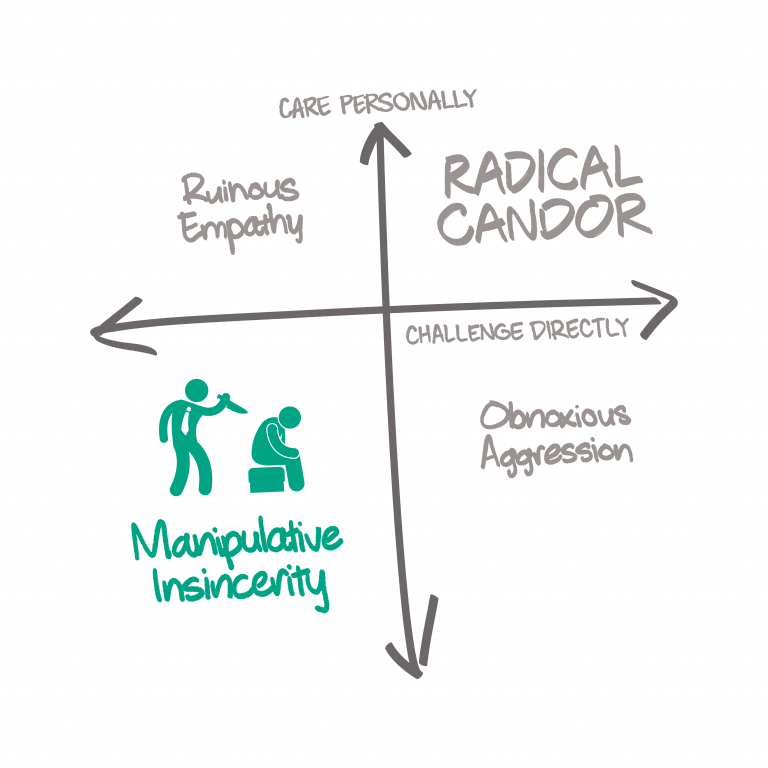
Here’s a story about how realizing you have been Obnoxiously Aggressive can lead to a worse place, Manipulative Insincerity — a not uncommon path.
A couple months after joining Google, Kim had a disagreement with Larry Page about his approach to an AdSense policy and wrote an openly critical and arrogant email (watch the video here).
Kim still didn’t understand why her assessment of Larry’s new policy was wrong. But she let fear drive her behavior. The next time she saw Larry, she stopped him and apologized, then offered him some praise that she didn’t really mean: she said she knew he was right (even though she didn’t). Apologizing was reasonable, but insincerity was exactly the wrong move. Larry had a finely tuned BS meter, and Kim isn’t a very good liar. He glared at her. A colleague standing nearby smiled in sympathetic solidarity as Larry walked away and muttered, “He likes it better when you disagree with him.”
Fear drove Kim to say something she didn’t really believe, in the hopes of gaining approval. Just remember that being under pressure can make anyone act like a jerk. And when one is called out for being a jerk, it’s an all too natural instinct to become less genuine and more political — to move from Obnoxious Aggression to a worse place, Manipulative Insincerity.
---
More about this story and others is included in “Radical Candor: Be a Kickass Boss Without Losing Your Humanity,” published by St. Martin’s Press. Learn more
More from Radical Candor
How Do You Ask for Feedback? The Three Tests of a Good Go-To Question
The idea Get it. Don’t just be open to it.
How Do You Get Feedback? The Four Steps to Solicit Radical Candor®
A Story People often focus on feedback they get from their bosses. But the best feedback comes from the people who work for you. It can be difficult to get it—unless you create a …
Fixing the Employee Experience (with Tiffani Bova) 8 | 26
While the podcast team is on a Radical Sabbatical, Kim Scott is spending the season talking to authors of the books that have shaped her thinking. This week: Tiffani Bova, whose …
Share your perspective
This site is protected by reCAPTCHA and the Google Privacy Policy and Terms of Service apply.