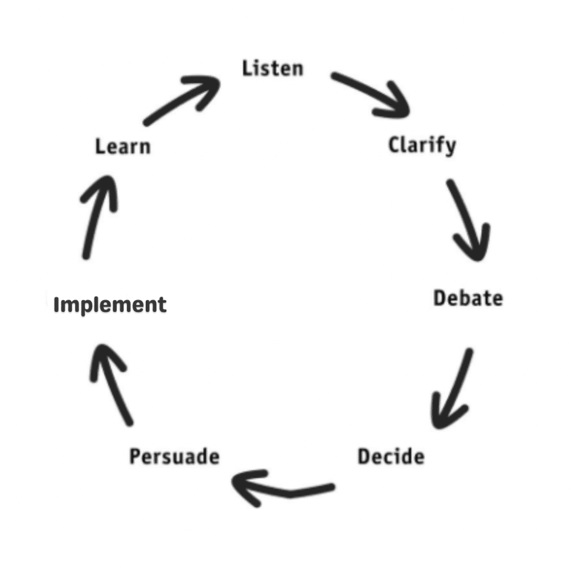
As we continue into 2022, or more accurately what feels like the third year of 2020, the mere idea of trying to get stuff done at work likely feels overwhelming. We've got you. On this episode of the Radical Candor Podcast, Kim, Jason and Amy talk about the Get Sh*t Done Wheel, a step-by-step process that can help make getting things accomplished much easier. The GSD Wheel has 7 steps: Listen, Clarify, Debate, Decide, Persuade, Implement and Learn. When run effectively, the GSD Wheel will enable your team to achieve more collectively than anyone could ever dream of achieving individually.
Listen to the episode:
Radical Candor Podcast Episode At a Glance
The Get Sh*t Done Wheel has 7 steps: Listen, Clarify, Debate, Decide, Persuade, Implement and Learn. Click the links in the list below to read posts and listen to deep-dive podcast episodes about each topic.
-
Listen: Your team should know what the company is trying to achieve, and they likely have some of the best ideas for what your team should be achieving. First, listen to their ideas in trying to figure out which goals your team should be pursuing. If you can build a culture where people listen to one another, they will start to fix things you as the boss never even knew were broken. (Learn more: podcast, blog)
-
Clarify: Remember that new ideas are fragile and therefore easily squished. A critical role a manager can play is to augment the voice of their team by helping the team clarify their ideas and by clarifying the manager’s own understanding of the ideas. (Learn more: podcast part 1, part 2, blog)
-
Debate: Allowing the team time and space to publicly debate the ideas is a critical step. Guidelines for good debate include making the discussion about the ideas and not about egos. It’s about finding the best answer together, not about who won the debate. (Learn more: podcast, blog)
-
Decide: The best bosses often do not decide themselves, but rather create a clear decision-making process that empowers people closest to the facts to make as many decisions as possible. Not only does that result in better decisions, but it also results in better morale. (Learn more: podcast, blog)
-
Persuade: This isn’t easy, and it’s vital to get it right. Persuasion at this stage can feel unnecessary and make the decider resentful of people on the team who aren’t fully in agreement. The decider has painstakingly gone through the listen, clarify, and debate steps and made a decision. Why doesn’t everyone else get why it’s obvious we should do this — or at least be willing to fall in line? But expecting others to execute on a decision without being persuaded that it’s the right thing to do is a recipe for terrible results. And don’t imagine that you can step in and simply tell everyone to get in line behind a decision, whether you have made it or somebody else has. (Learn more: podcast, blog)
-
Implement: As the boss, part of your job is to take a lot of the “collaboration tax” on yourself so that your team can spend more time implementing. The responsibilities you have as a boss take up a tremendous amount of time. One of the hardest things about being a boss is balancing these responsibilities with the work you need to do personally in your area of expertise. Here are the four things I’ve learned about getting this balance right: Don’t waste your team’s time; keep the “dirt under your fingernails;” block time to implement and fight meeting proliferation. (Learn more: podcast, blog)
-
Learn: By the time you’ve reached learn — the last spot on the Get Sh*t Done Wheel — you and your team have put in a ton of work, you’ve achieved something, and you want it to be great. And it is human nature for us to become attached — often unreasonably attached — to projects we’ve invested a lot of time and energy into. It can take almost superhuman discipline to step back, acknowledge when our results could be a lot better or are simply no good, and learn from the experience. (Learn more: podcast, blog)

Radical Candor Podcast Checklist
- Remember, the GSD Wheel is designed to be cycled through quickly. Not skipping a step and not getting stuck on one is equally important. If you skip a step, you’ll waste time in the end. If you allow any part of the process to drag out, working on your team will feel like paying a collaboration tax, not making a collaboration investment.
- Create an obligation to dissent. If everyone agrees on an idea right away, that’s a red flag.
- Don’t allow the wheel to grind your team to dust. There are times when people are just too tired, burnt out, or emotionally charged up to engage in productive debate. It’s crucial to be aware of these moments because they rarely lead to good outcomes. Your job is to intervene and call a time-out. If you don’t, people will make a decision so that they can go home; or worse, a huge fight stemming from raw emotions will break out.
Radical Candor Podcast Resources
- Are You a Quiet or Loud Listener? Listening Lessons from Apple
- Challenger: The Final Flight
- Challenger Launch Decision
- OODA Loop
- Primer on Decision Making: How Decisions Happen
- Aristotle's Rhetoric
- Joel On Software
- Blameless Retrospectives
- Performing a Project Premortem
- 8 Types of Arguments and Their Importance
- How Do You Get Stuff Done Without Telling People What to Do? Listen
- 2 Ways to Use Radical Candor to Clarify Thoughts and Ideas
- 6 Steps to Successfully Debating (Not Killing) Ideas
- 3 Things to Consider When Making Decisions to Get Sh*t Done In 2022
- How to Persuade Others You’ve Made the Right Decisions
- 4 Steps to Executing Your Ideas at Work
- How to Get Stuff Done: Never Stop Learning
- 10 Free Resources to Help You Practice Radical Candor
————————————————————————————————————————————————————————————–
The Radical Candor Podcast theme music was composed by Cliff Goldmacher. Order his book: The Reason For The Rhymes: Mastering the Seven Essential Skills of Innovation by Learning to Write Songs.
Sign up for our Radical Candor email newsletter >>
Shop the Radical Candor store >>
More from Radical Candor
Fixing the Employee Experience (with Tiffani Bova) 8 | 26
While the podcast team is on a Radical Sabbatical, Kim Scott is spending the season talking to authors of the books that have shaped her thinking. This week: Tiffani Bova, whose …
Unlocking Leadership Intelligence (with Caroline Webb) 8 | 24
What separates a leader who makes wise calls under pressure from one who gets stuck in their own point of view? Caroline Webb has spent decades studying the answer — first as an …
Get Situated for Success (with Angela Duckworth) 8 | 23
While the Radical Candor podcast team is on a Radical Sabbatical, Kim Scott is spending the season interviewing authors of the books that have shaped her thinking over the past …
Share your perspective
This site is protected by reCAPTCHA and the Google Privacy Policy and Terms of Service apply.