How Ruinous Empathy Ruins Praise 6 | 36
Praise can be powerful, but when it’s vague, generic, or something you can say to a dog like "good job," it can backfire and do more harm than good....
3 min read
On this episode of the Radical Candor podcast, Kim, Jason and Amy address how to respond to some specific scenarios with Radically Candid feedback that’s kind, clear, specific and sincere. If you truly want to get different results, you’re going to have to change your behavior. We know it’s hard, so we’re going to talk you through it.
Listen to the episode:
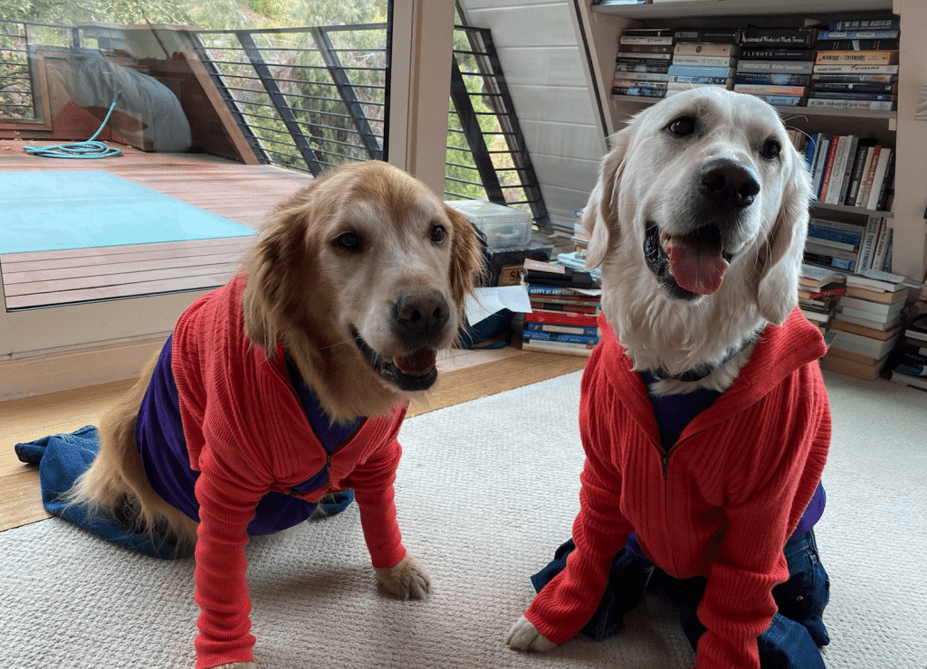 Kim's dogs dressed up as Kim for Halloween 2022.
We often get questions from folks who want us to talk through specific Radical Candor scenarios like how to overcome feedback hesitation or what to do when someone tells you not to bother giving feedback to someone because “that person will never change.”
Kim, Jason and Amy role-play two different Radical Candor wipeout scenarios and offer advice about what to do instead.
At today’s strategy meeting for Ocean Motion Cruise Ships, BiBi, a hospitality development manager, is presenting a proposal for a new restaurant called Turf & Chips for consideration on the company’s flagship vessel.
Her presentation is first on the agenda, and after presenting she receives some questions from the leaders in the room. The leaders determine that BiBi and her team should continue to iterate on the proposal and provide an update in two weeks.
As the meeting concludes, Jack, a senior leader, approaches Kalinda, another senior leader and BiBi’s manager, to share his opinion.
Listen Kalinda, Turf & Chips is definitely not something we would consider for Ocean Motion’s flagship vessel. It doesn’t fit from a thematic perspective and although I’m sure BiBi and the team have done great work; the numbers for another steak-and-fries eatery don’t seem compelling enough for us to take the risk at this point. I’m pretty sure no matter what the next iteration shows, it’s going to get rejected. I just feel bad telling BiBi that after her first presentation to the strategy team.” — Jack
Ted has been with Catahoula Car Rentals for 10 years and oversees a large global team. He is an expert at what he does and enjoys the challenging and dynamic aspects of his job managing a fleet of off-roading vehicles.
Although Ted has a large team, he likes knowing the details of all projects and being the central point of contact for every decision. Because of his expertise and long tenure, he has a wealth of institutional knowledge and is confident he knows what works best.
Lucas is on Ted’s team and has confided in his mentor, Chelsea, that Ted’s micromanagement style is inhibiting the team’s growth. He and several team members feel their learning potential is stunted because Ted doesn’t impart knowledge to them and simply asks them to execute his plans.
Additionally, when Lucas and other team members have proposed new ideas, Ted becomes defensive and is not willing to consider things he has not come up with himself.
Chelsea is Ted’s peer and has witnessed several of the points Lucas has raised about Ted’s management style. Chelsea shared this feedback with her colleague Elsa whose response was not helpful.
I hear what you’re saying, Chelsea, but everyone knows that’s just how Ted is. He has been that way for 10 years and no one is going to change him. Unfortunately, the team will just have to deal with it.” — Elsa
How would Kim, Jason and Amy handle these scenarios? Listen to the episode to find out!
Have questions about Radical Candor? Let's talk >>
————————————————————————————————————————————————————————————–
Episodes are written and produced by Brandi Neal with script editing by Amy Sandler. The show features Radical Candor co-founders Kim Scott and Jason Rosoff and is hosted by Amy Sandler.
The Radical Candor Podcast theme music was composed by Cliff Goldmacher. Order his book: The Reason For The Rhymes: Mastering the Seven Essential Skills of Innovation by Learning to Write Songs.
Sound editing by PodcastBuffs.

Praise can be powerful, but when it’s vague, generic, or something you can say to a dog like "good job," it can backfire and do more harm than good....
On this episode of the Radical Candor podcast, the team delves into a mash-up of Ruinous Empathy and Manipulative Insincerity. Ruinous Empathy—being...
Ruinous Empathy is what happens when you want to spare someone’s short-term feelings, so you don’t tell them something they need to know. You Care...
Share your perspective
Leave a comment below.