
Giving immediate feedback is one of the most important things a manager can do. When you provide feedback right away, it has a much greater impact than waiting for the "right time."
First, it saves you the burden of trying to remember to give the feedback later. The details are fresh in your mind, so you can be much more specific. This allows you to give clear, actionable feedback.
Secondly, giving immediate feedback gives the person a better chance to actually improve right away. If you wait too long, the opportunity to course-correct may have passed. But by addressing things in the moment, you give them the best chance to learn and grow.
Immediate feedback is crucial for several other reasons, particularly when it comes to fostering a culture of Radical Candor.

Immediate feedback is one of the highest leverage activities a manager can engage in. It directly impacts the individual's, the team's, and the company's ability to achieve results. So don't make excuses — get in the habit of providing feedback right away.
Why Immediate Feedback is Important

Specificity and Clarity: When feedback is given immediately, the details are fresh in your mind. This allows you to provide specific and clear feedback. Whether it's praise or criticism, the more specific you can be, the more useful the feedback will be to the recipient. Acknowledging a job well done on the spot or pointing out a mistake right away helps the person understand exactly what was good or what needs to be improved.
Timeliness and Relevance: Providing immediate feedback makes it more relevant and impactful. Waiting too long to give feedback can diminish its effectiveness because the context may no longer be fresh or pertinent. Immediate feedback ensures that the person can connect the feedback directly to their actions and make adjustments in real-time.
Promotes Quick Improvement: When criticism is given immediately, it allows the person to correct their behavior or performance right away. This speeds up the learning process and helps prevent small issues from becoming bigger problems. Quick adjustments can lead to continuous improvement and better results over time.
Encourages a Culture of Feedback: Consistently giving immediate feedback helps normalize the practice within the team or organization. It fosters an environment where open communication and continuous improvement are valued. This can lead to higher engagement, better performance, and stronger relationships among team members.
Reduces Anxiety: Knowing that feedback will be given immediately can reduce the anxiety that comes from waiting for formal reviews or scheduled meetings. It creates a more transparent and open atmosphere where employees understand that feedback is a tool for growth rather than a punitive measure.
Feedback Has a Short Half Life: Remember, the benefits of feedback deteriorate quickly. If you wait to tell somebody for a week or a quarter, the incident is so far in the past that they can’t fix the problem or build on the triumph. Seize the moment immediately to get the most out of the feedback opportunity.
Unspoken Criticism Builds Up: If you stay silent about something that’s wrong for a long time, you are likely to get more frustrated or furious or both. The longer the problem goes unfixed, the more likely you are to blow up in a way that makes you look irrational, harms your relationship, or both. Don’t let this happen to you. Just say it right away!
Give Immediate Feedback Because Waiting Wastes Brain Cycles

If you wait too long to give feedback you’ll experience something like the following scenario. You’ll start to see things and think, 'oh I need to write that down so I can remember to tell so and so about such and such at some date in the future.' Then, you need to remember to jot it down. Then when you finally do have time to write it down you’ll forget what it was and have to sit there trying to remember and hating yourself for not jotting it down sooner.
Then you need to keep track of where you jotted it down. Then you need to remember to schedule the meeting. And then before the meeting you need to find time to look at the list of random things you’ve been jotting down. They won’t really hang together and you’ll have a pretty random conversation.
You won’t be able to use the “show don’t tell” and “CORE” tips for being helpful and humble because you won’t have written down enough details.
Then, you’ll start to see things. You’ll start to imagine that they already “got the message” and that you no longer need to give the feedback because they self-corrected. Just as you start to relax because of your self-correcting team, BAM, the subject of the original feedback reemerges, and you’re back to square one.
Unspoken feedback will start to take up more and more of your mental space. It will feel like a “dreaded list” of things you don’t want to say to your employees, but know you “should” say. It will feel daunting and exhausting, instead of productive and kind.
But there’s no reason to waste all those brain cycles. It’s much more effective and less burdensome to just say it right away!
Immediate Feedback Examples
It shouldn’t. If you give praise and criticism immediately, it really won’t take too much time. Impromptu feedback is something you can squeeze in between meetings in three minutes or less. Truly. The best feedback I’ve gotten in my life generally happened in super-quick conversations between meetings or standing waiting for a light to change.
Giving impromptu feedback is more like using a toothpick than getting a root canal. Don’t schedule it. Just do it consistently and immediately when it’s needed, and maybe you won’t ever have to get a root canal.
Be Willing to Be Late: Giving more impromptu feedback does take discipline. Prioritizing something generally means making time in your calendar for it. But how do you immediately make time in your calendar for something that is impromptu? You can’t, but there are a couple of ways around this.
In order to give immediate, impromptu feedback, you must do one of two things.
- Keep slack time in your calendar, either by not scheduling back-to-back meetings or by having 25 and 50-minute meetings, not 30 and 60-minute meetings.
- Be willing to be late.
If you can possibly help it, don’t schedule meetings back to back. I learned one technique, that I admired but couldn’t implement, from Qualtrics co-founder Jared Smith. When I worked with him at Google, the first thing he did each morning was look at his calendar and cancel at least one meeting.
If avoiding back-to-back meetings is impossible for you, just schedule all the 30-minute meetings you own as 25-minute meetings and all the hour-long meetings as 50-minute meetings. Encourage others to do the same, and be disciplined enough to keep meetings on schedule.
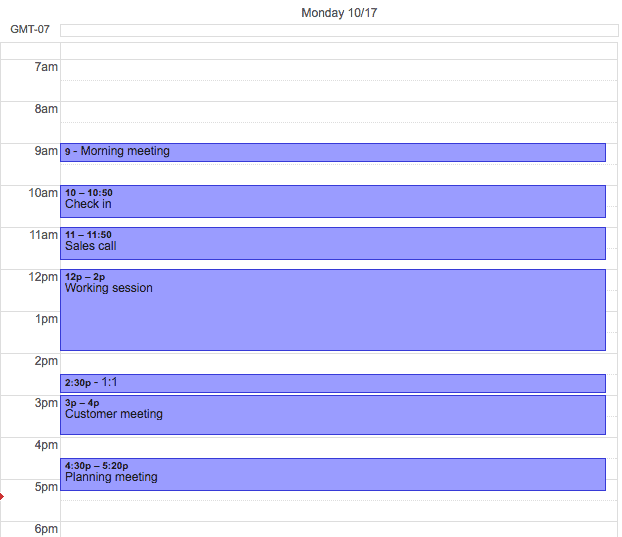
If neither of these is an option for you, you’re simply going to have to be late to some meetings. In many cases, it’s more important to give impromptu immediate feedback to somebody who works for you than it is to be on time to your next meeting.
When I’m leading a team, I am always scheduled within an inch of my life, so giving immediate feedback always meant making a lot of little impromptu adjustments to my schedule -- i.e., being late.
You’re going to have to apologize to people for being late and then do some real-time prioritization when you finally do arrive at your next meeting. We think this is a good tradeoff.
Don’t Save feedback for a 1:1 or Performance Review
If you were impressed by something somebody in your personal life did, you wouldn’t wait for a formal performance review to mention it -- you’d just say it right away. Yet, when you become a manager, it’s too easy to throw everything you know about how important impromptu communication is to having a productive relationship out the window.
All too often, bosses forget about ordinary communication and rely instead on all the formal processes, such as 1:1 meetings, annual or bi-annual performance reviews, or employee happiness surveys. Ironically, these processes were put in place to reinforce ordinary communication. But if you let them substitute for impromptu immediate feedback, they do more harm than good. The details will be fuzzy, and the person may have already developed some bad habits that are harder to break.
Don’t lose the opportunity to give immediate feedback because of the formal processes of your organization. Catch yourself if you find you’re making a mental note for a future feedback opportunity. Just say it right away!
What are your challenges with giving immediate feedback? Do you have your own reminders and tips?
*This post was updated July 19, 2024.
More from Radical Candor
How Do You Ask for Feedback? The Three Tests of a Good Go-To Question
The idea Get it. Don’t just be open to it.
How Do You Get Feedback? The Four Steps to Solicit Radical Candor®
A Story People often focus on feedback they get from their bosses. But the best feedback comes from the people who work for you. It can be difficult to get it—unless you create a …
Fixing the Employee Experience (with Tiffani Bova) 8 | 26
While the podcast team is on a Radical Sabbatical, Kim Scott is spending the season talking to authors of the books that have shaped her thinking. This week: Tiffani Bova, whose …
Share your perspective
This site is protected by reCAPTCHA and the Google Privacy Policy and Terms of Service apply.