Workplace Harassment: Tackling Toxicity at Work 6 | 30
Kim and Jason tackle a challenging listener question about dealing with severe workplace harassment. They explore the importance of managerial...
3 min read

On this episode of the Radical Candor podcast, we're dropping a bonus episode from Kim's Just Work podcast featuring a conversation about bullying at work, in Hollywood and within our greater society with co-host Wesley Faulkner and guest Eric Deggans. When someone is bullying you, the person’s goal is to harm you. Telling the person you are being harmed is just going to result in more bad behavior. Ignoring bullies doesn’t work, either. The only way to stop bullying is to create negative consequences for the people doing the bullying.
Listen to the episode:
Wesley Faulkner, who has led developer relations and been a community manager at a number of tech companies, joins Kim as co-host for season two of the Just Work podcast.
They talk to guests about their experiences with bias, prejudice, bullying, discrimination, harassment, and physical violations in the workplace. By sharing experiences, they help to build community and to help listeners recognize problems they are experiencing at work, and get some ideas about how to handle them.

When someone is bullying you, the person’s goal is to harm you. Telling the person you are being harmed is just going to result in more bad behavior. Ignoring bullies doesn’t work, either. The only way to stop bullying is to create negative consequences for the person doing the bullying.
Only when bullying stops being practical or enjoyable will bullies alter their behavior. When you’re the victim of bullying, though, you often feel powerless to stop it. In an ideal world, the leader would create consequences for bullying. The world is rarely ideal, however.
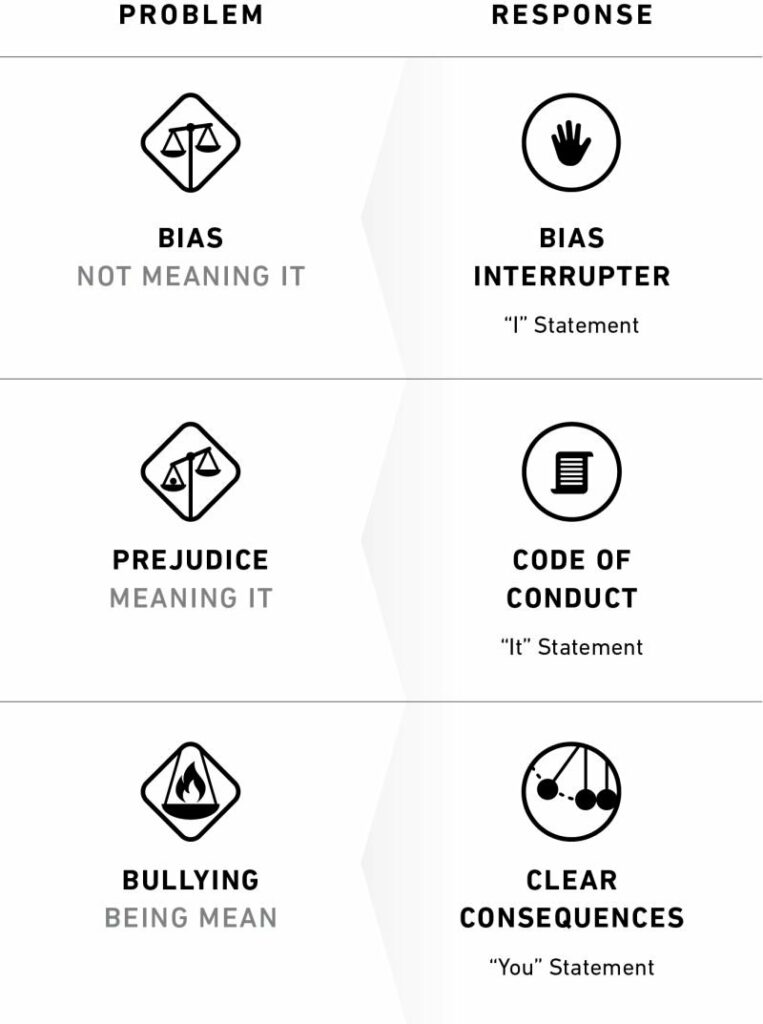
One way to push back is to confront the person with a “You” statement, as in “What’s going on for you here?” or “You need to stop talking to me that way.” A “You” statement is a decisive action, and it can be surprisingly effective in changing the dynamic.
Bullying has to incur real consequences to be stopped. A “you” statement is effective. “You can’t talk to me like that!” or “What’s going on for you here?”
That’s because the bully is trying to put you in a submissive role, to demand that you answer the questions to shine a scrutinizing spotlight on you. When you reply with a “You” statement, you are now taking a more active role, asking them to answer the questions, shining a scrutinizing spotlight on them.
An “I” statement invites the person to consider your perspective; an “It” statement establishes a clear boundary beyond which the other person should not go. With a “You” statement, you are talking about the bully, not yourself. People can let your statement lie or defend themselves against it, but they are playing defense rather than offense in either case.
Here is a “cheat sheet.”
Eric Deggans is NPR’s first full-time TV critic, media analyst and guest host, appearing on the network’s shows, such as Morning Edition, Here & Now and All Things Considered, along with writing material for NPR.org. He also appears on NPR podcasts such as Consider This, Life Kit, Code Switch, It’s Been a Minute and Pop Culture Happy Hour.
In addition, Eric is also an adjunct instructor in the Sanford School of Public Policy at Duke University, a guest instructor at Indiana University’s Media School and a member of the National Advisory Board for the Poynter Institute for Media Studies in St. Petersburg, FL.
From 2017 to 2021, he served as a contributor and media analyst for MSNBC/NBC News. And in 2020, he was given the Distinguished Alumni Service Award by Indiana University – the institution’s highest alumni honor -- four years after Indiana University’s Media School of Journalism and Communications named him a distinguished alumnus.
Eric came to NPR in September 2013 from the Tampa Bay Times newspaper in Florida, where he served as TV/Media Critic and in other roles for nearly 20 years. He is also an author of or contributor to several books, including Race-Baiter: How the Media Wields Dangerous Words to Divide a Nation, a look at how prejudice, racism and sexism fuels modern media, published in October 2012 by Palgrave Macmillan.

Episodes are written and produced by Brandi Neal with script editing by Amy Sandler. The show features Radical Candor co-founders Kim Scott and Jason Rosoff and is hosted by Amy Sandler. Nick Carissimi is our audio engineer.
The Radical Candor Podcast theme music was composed by Cliff Goldmacher. Order his book: The Reason For The Rhymes: Mastering the Seven Essential Skills of Innovation by Learning to Write Songs.
Download our free learning guides >>
Sign up for our Radical Candor email newsletter >>
Shop the Radical Candor store >>
Get Radical Candor coaching and consulting for your team >>
Get Radical Candor coaching and consulting for your company >>

Kim and Jason tackle a challenging listener question about dealing with severe workplace harassment. They explore the importance of managerial...

The Workplace Bullying Institute describes workplace bullying as: “Repeated mistreatment of an employee by one or more employees; abusive conduct...

On this episode of the Radical Candor podcast, we're bringing back our Radically Candid Conversations series. Amy talks to Kim Scott about her new...
Share your perspective
Leave a comment below.