Building a team is hard. But as we’re seeing now during the Great Resignation, failure to spend time building and investing in a team can have disastrous consequences. In order to be successful, this means developing people on both steep and gradual growth trajectories, or as we like to say at Radical Candor, people in both rockstar mode and superstar mode. On this episode of the Radical Candor podcast, Kim, Jason and Amy discuss how to balance growth and stability by developing people who are in both superstar and rock star modes.
Listen to the episode:
Radical Candor Podcast Episode At a Glance
In order to build and sustain a great team, you need to understand how each person’s job fits into their life goals. You need to get to know each person who reports directly to you, to have real, human relationships — relationships that change as people change.
When putting the right people in the right roles on your team, you’ll also have to challenge people in a way that will impact not just their feelings but also their income, their career growth, and their ability to get what they want out of life. This means developing people on both steep and gradual growth trajectories and clearly understanding the difference between the two.
To keep a team cohesive, you need people who are in rock-star mode and superstar mode. People in rock-star mode are solid as a rock. Think the Rock of Gibraltar, not Bruce Springsteen. They love their work. They have found their groove. They don’t want the next job if it will take them away from their craft.
People in superstar mode, on the other hand, need to be challenged and given new opportunities to grow constantly.
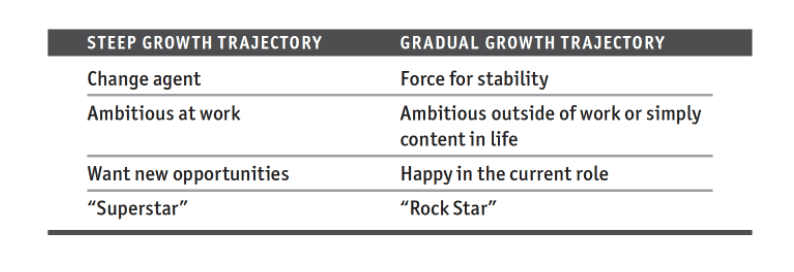
“Steep growth” is generally characterized by rapid change — learning new skills or deepening existing ones quickly. It’s not about becoming a manager — plenty of individual contributors remain on a steep growth trajectory their entire careers, and plenty of managers are on a gradual growth trajectory.
Nor should steep growth be thought of as narrowly as “promotion.” It’s about having an increased impact over time.
Gradual growth is characterized by stability. People on a gradual growth trajectory, who perform well, have generally mastered their work and are making incremental rather than sudden, dramatic improvements.
Some roles may be better suited to a person in rock-star mode because they require steadiness, accumulated knowledge, and attention to detail that someone in a superstar mode phase might not have the focus or patience for.
People in a superstar mode phase are bad at rock star roles, and people in a rock star phase will hate a superstar role.
Radical Candor Podcast Checklist
- If you want to know what mode the folks you work with are in listen to what they say they want — what is their desire to grow? What's their demonstrated ability to do new things and what is the team's need that might support that team member's growth?
- When it comes to growth management don't clip the wings of people who are in superstar mode and don't disrespect people who are in rock star mode. Don't sort of view them as lesser mortals. Especially if you yourself are in superstar mode. Be aware we have such a bias when we're in one mode — we want everyone else in that mode with us, so be aware of your own biases.
- Don't put people in boxes and leave them there. All of this is temporary — none of these states are permanent. So when you're thinking about people's growth trajectory don't allow your perception to limit the future choice that they might make.
Radical Candor Podcast Resources
- Balancing Growth and Stability: Why Your Team Needs People In Both Superstar and Rock-Star Modes
- Gallup: How to Win the 'Great Resignation'
- Enduring Ideas: The GE–McKinsey Nine-Box Matrix
————————————————————————————————————————————————————————————–
The Radical Candor Podcast theme music was composed by Cliff Goldmacher. Order his book: The Reason For The Rhymes: Mastering the Seven Essential Skills of Innovation by Learning to Write Songs.
Sign up for our Radical Candor email newsletter >>
Shop the Radical Candor store >>
More from Radical Candor
Fixing the Employee Experience (with Tiffani Bova) 8 | 26
While the podcast team is on a Radical Sabbatical, Kim Scott is spending the season talking to authors of the books that have shaped her thinking. This week: Tiffani Bova, whose …
Unlocking Leadership Intelligence (with Caroline Webb) 8 | 24
What separates a leader who makes wise calls under pressure from one who gets stuck in their own point of view? Caroline Webb has spent decades studying the answer — first as an …
Get Situated for Success (with Angela Duckworth) 8 | 23
While the Radical Candor podcast team is on a Radical Sabbatical, Kim Scott is spending the season interviewing authors of the books that have shaped her thinking over the past …
Share your perspective
This site is protected by reCAPTCHA and the Google Privacy Policy and Terms of Service apply.