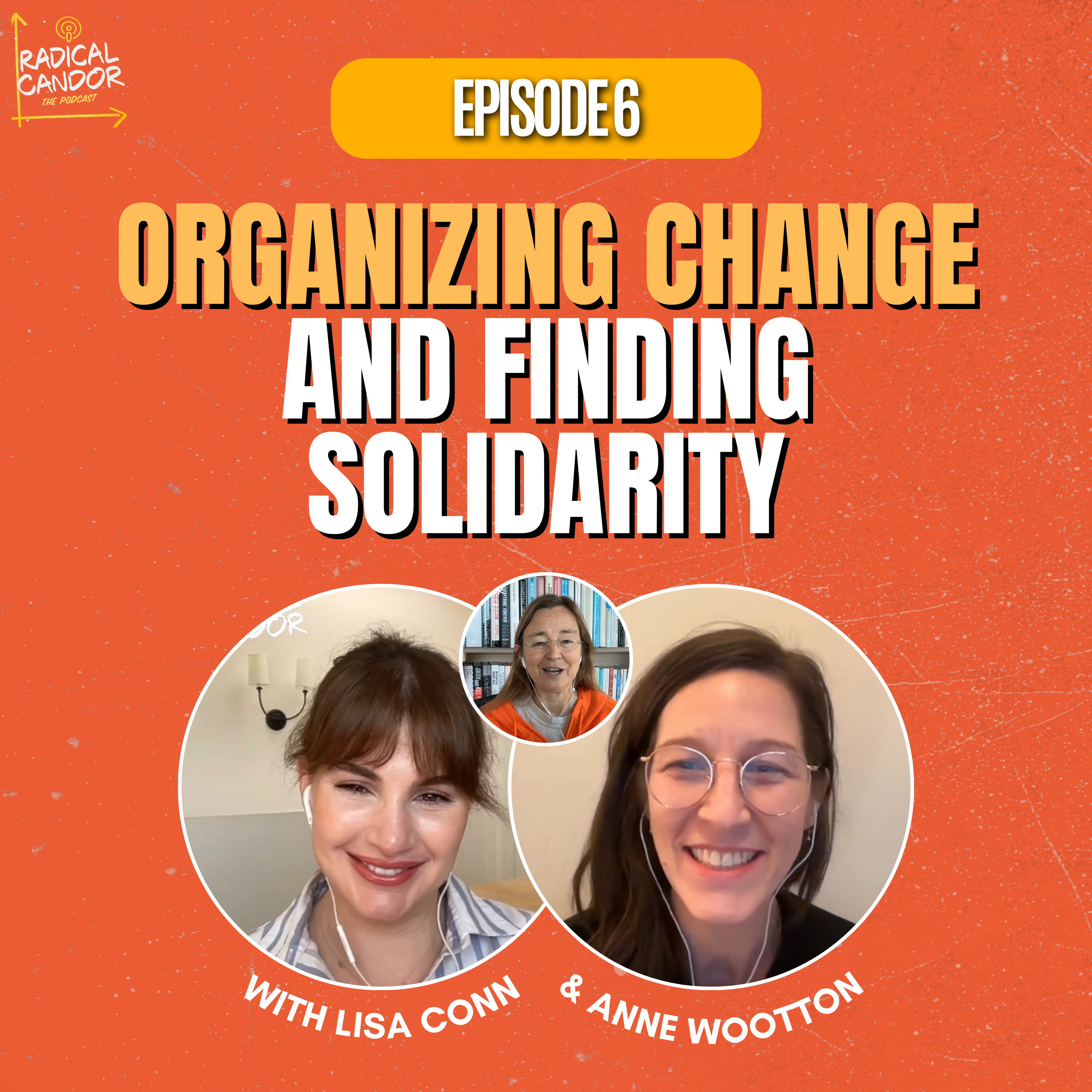
How Tech Employees Can Organize for Change with Lisa Conn and Anne Wootton 8 | 6
When tech is at its best, it’s a group of people working together to solve hard problems in a way that makes the world a better place. That goal is...
31 min read
 Kim Scott
Aug 5, 2026, 8:55:07 AM
Kim Scott
Aug 5, 2026, 8:55:07 AM
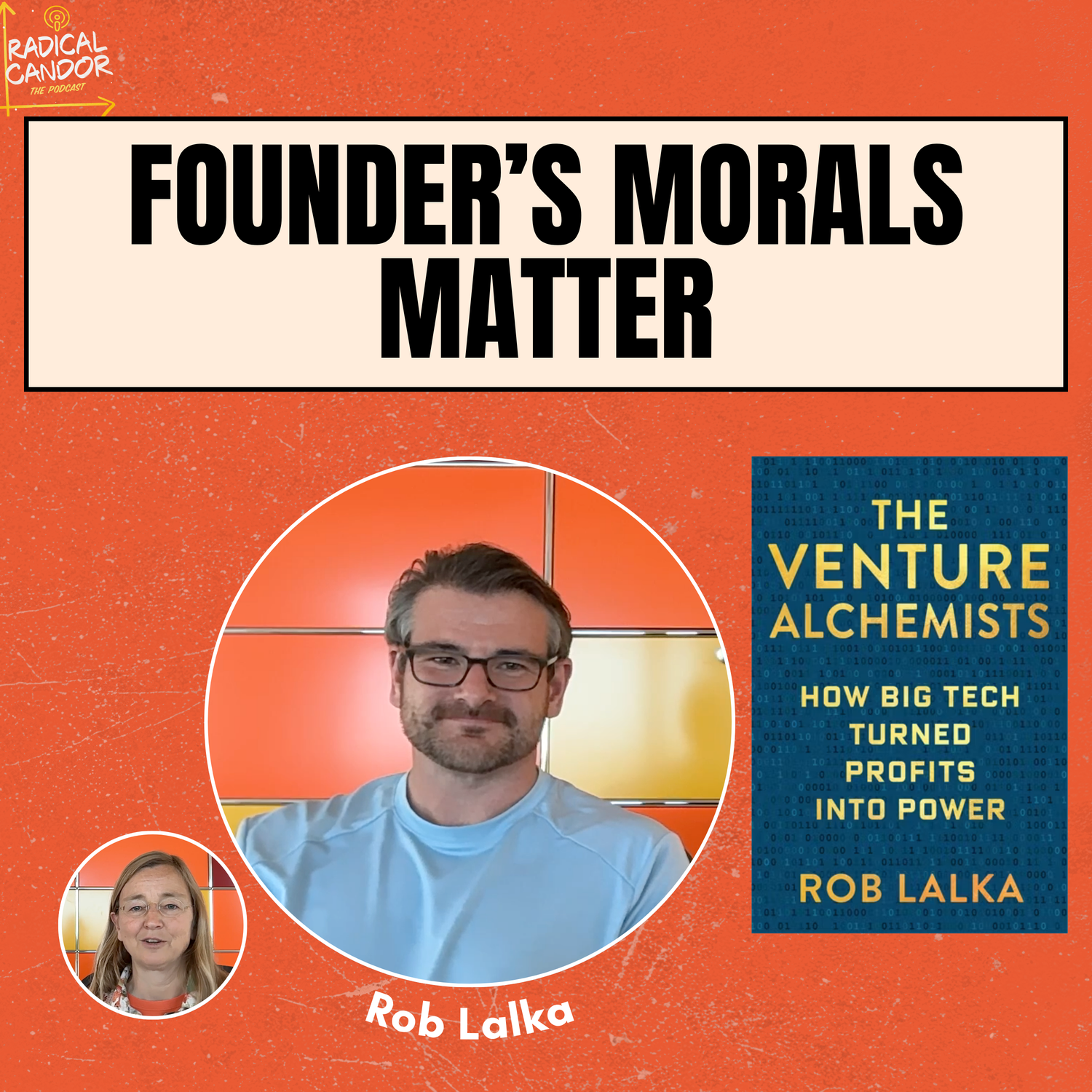
Table of Contents
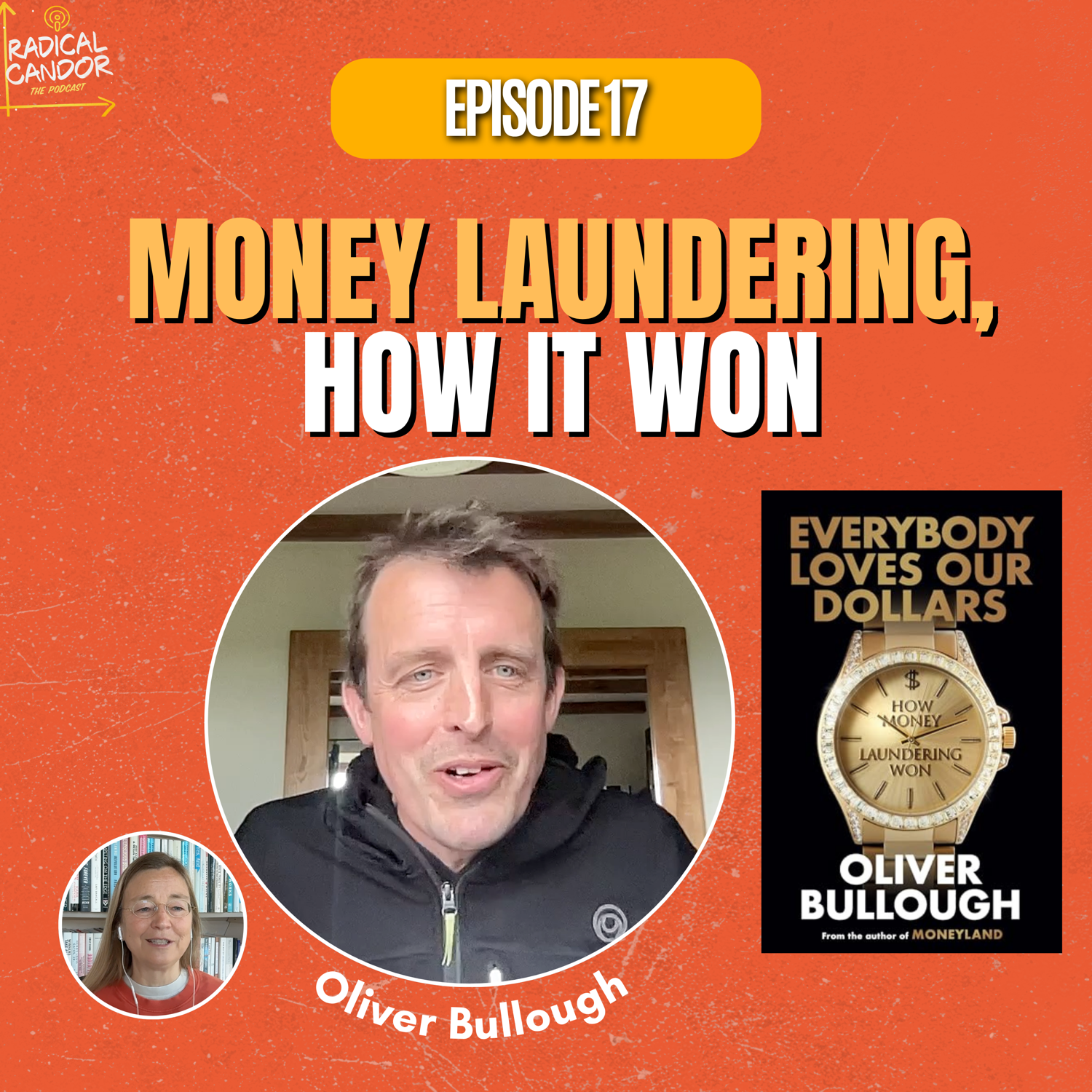
While the Radical Candor podcast team is on a summer break — the "Radical Sabbatical" — Kim Scott is talking with the authors of books that have shaped her thinking over the past couple of years.
On this episode of the Radical Candor Podcast, Kim talks with Rob Lalka, Tulane professor and author of The Venture Alchemists: How Big Tech Turned Profits Into Power, about why some tech founders start out corrupt and others get corrupted along the way — tracing the very different origin stories of Mark Zuckerberg, Google's Larry Page and Sergey Brin, and the so-called "PayPal Mafia," and asking what it actually takes for a leader to resist the pull of unchecked power and money.
Watch the episode:
Lalka's title comes from the word alchemy — literally turning base metal into gold. He argues that venture capital was never just about the capital; it's about power and domination, and that business model rewards founders who start out bad while corrupting many who start out good. Understanding that distinction, he says, is the key to understanding why the last 30 years of tech has such a mixed track record on good intentions.
Lalka dug into Zuckerberg's own real-time blog posts, subpoenaed IM logs, and the original FaceMash source code to trace how Facebook's earliest design choices — judging classmates' looks, the "poke" feature — set up a business built on judgment as entertainment. Google's founders, by contrast, started out as self-described moral philosophers who believed advertising was inherently corrupting and initially planned to run Google as a non-profit. Both companies ended up serving trillions of ads — which is exactly the paradox Lalka is trying to explain.
Lalka's research into Peter Thiel and David Sacks's Stanford years — including the controversial book The Diversity Myth and the incidents of homophobic and misogynistic speech tied to it — traces a throughline from campus grievance to a business philosophy built on tracking "outlier behavior." That same thinking, he argues, runs from PayPal's early fraud detection straight through to Palantir, and into the political rise of some of its founders.
Two years after the book came out, Lalka says the picture hasn't gotten much better — so he's put his energy into teaching. He and a co-instructor built a new tech ethics class at Tulane modeled on Yale's "Life Worth Living" course, asking students to define what a good life looks like before debating the hard tech questions of the day. His students, he says, are where he finds real hope for how the next chapter of AI and power gets written.
Rob: If we look at the last 30 years of tech and people who have good intentions trying to keep those good intentions pure — not a really great track record in terms of what they were originally trying to do versus what happened. Now, to be clear, I'm a business professor. I believe capitalism is the greatest force for good, and uplift, and economic opportunity. And I believe in free and fair markets. I think it's both of them. And that's what I argue is that it always has to be both. We always talk about liberty and justice, freedom and fairness. They're always in tandem. It's never just one or the other. And when they conflict, we figure it out.
Kim: Hello everybody, I'm Kim Scott. Welcome to the Radical Sabbatical, where I'm talking to the authors of books that have meant a lot to me that I've read over the last couple of years. Thrilled to have you with us here today, Rob. In person, in flash, in the flesh.
Rob: It's gonna be so much fun, Kim.
Kim: Thank you. Rob Lalka is the author of Venture Alchemist and also a professor at Tulane. Welcome.
Rob: Thank you.
Kim: I love your book. I love your book so much. And, starting with the title — so what does alchemy mean?
Rob: So I kept thinking about how — I mean, I teach venture capital. Everything that I know about this world in terms of how entrepreneurship thrives is because of this business model.
Kim: Yeah.
Rob: And the way it's backed.
Kim: Yeah.
Rob: And the main thing for me is that it was always about the capital.
Kim: Mm-hmm. Right?
Rob: It was like the adventure of being able to go off and do something new, right? Start something new.
Kim: That's it.
Rob: And it took a lot of money and made a lot of money.
Kim: Yeah.
Rob: It was about the capital. Really fast. And faster and faster and faster.
Kim: Yes.
Rob: But what I realized is it wasn't just about the capital. And that was the key, I think, insight that took me from "I'm interested in this topic" to "there is a book here."
Kim: Yeah.
Rob: Which is that it wasn't just about capital, it was about power.
Kim: Yeah.
Rob: And so when you think about the business model of venture capital, where it's not just about creating businesses that are making money, it's about domination.
Kim: Mm-hmm.
Rob: That is a certain ethos and ideal that you're pursuing that is different than trying to create a business that creates value.
Kim: Yeah. Yeah. Yeah.
Rob: And it's the word alchemy — where you're turning base metals into gold. But that's what they're doing, and seeking, and pursuing. And I think that that is one of the things — we wouldn't be here without the incredible power of silicon and just how amazing that has been to reframe the way that we work and think.
Kim: Yeah.
Rob: And they have created out of that so much power and influence as well. And I think it's worth saying that the problem, I think, is the business model. It's not like all these people are evil — it's not judgment of any particular person, it's judgment of a system that is leading to this outcome that is really problematic. Yeah, when I decided how I wanted to approach all of this and really write the book, I was sort of hinged around a William F. Buckley line, actually, that I just always — it's always stuck with me — which is that he wanted to always try and shed more light than heat.
Kim: Yes.
Rob: And that became sort of the hallmark of how I approached the research and then the writing — was, am I shedding light, or is this going to be unnecessarily overheated? And so that was the main thing for me: was, can I shed light with this? And so every decision that I made along the journey of how I was going to present the information, and especially how I was going to document it, was trying to shed light. So I was a history major in college and a literature and English major in college as well. And so I wanted it to be really great storytelling — the English majoring.
Kim: Amazing storytelling in this book. I would say you succeeded.
Rob: Thank you. Well, I wanted to have the research too.
Kim: Yeah.
Rob: And so it was sort of both of those things.
Kim: Yeah.
Rob: Because that's how I was trained to think in college. And so the research was meant to shed light.
Kim: So, what — two of the stories, and I think the way you open is amazing because you tell the origin history of Zuckerberg and then how Larry and Sergey got started. They're very different stories.
Rob: Absolutely different.
Kim: Yep.
Rob: So the Zuckerberg story is well known in pop culture.
Kim: Yes.
Rob: Thanks to Aaron Sorkin and others.
Kim: Yeah.
Rob: And yet, I think one of the things that I realized as I was writing it was that there's a lot that Zuckerberg himself wrote in real time.
Kim: Yes.
Rob: That had not been discussed openly. He was blogging in real time.
Kim: Yeah.
Rob: He was literally boasting about his exploits. And it was amazing to me to go back and actually read that, because we think about — what responsibilities does a business leader have?
Kim: Yeah.
Rob: What's actually within their control in terms of their teams and how they manage? What happens once you're no longer, you know, fully involved in every aspect of the company? No — this was the moment that he was coding with his own hands, you know, the very language on the first website of FaceMash.
Kim: Yeah. Right?
Rob: Where he's comparing college-age kids, most of them girls.
Kim: Yeah.
Rob: And to be clear, they were freshmen, so most of them underage.
Kim: Yeah.
Rob: So he was comparing photos of college girls, most of them were female, and saying, "Were we let in for our looks?" As in, were we let into Harvard for how we look?
Kim: Yeah. No.
Rob: Will we be judged by them?
Kim: Yes. Yeah.
Rob: Click to choose.
Kim: Yeah.
Rob: That's literally what Zuckerberg coded with his own hand.
Kim: And he had just had a date with somebody who dissed him or something?
Rob: Exactly right. Yeah, that's what happened. It was a bad breakup and he was bitter. It was very bitter, because he coded — it was actually — he did it in the HTML code, it was sort of hidden in the code, that if you would actually go and look at the source code, you could see that he was grousing about the fact that he had just — he said this girl is a bitch. It — like, named her — and then, I think that's what he said.
Kim: That's exactly right.
Rob: And he also — there's also the famous line, but worth repeating — like, "They trusted me, the dumb fucks." (Rob, recounting a line from Zuckerberg's own IM logs that he found in his research.)
Kim: Like, what was that about? What prompted him to say that?
Rob: Yeah, so those were his AIM instant messenger conversations that later came out because they got subpoenaed — court order.
Kim: Exactly. Yep.
Rob: And he was bragging to a friend that the number of people who had then signed up for the earliest version of Facebook.com had submitted their screen names and their email addresses, and soon other things, like their political views and all that. And he was bragging to his friend that he had all this information. And the friend said, "Whoa, how'd you get that?" And he said, "They trusted me, the dumb fucks."
Kim: When I met him early on, he was visiting Google — this was before even Facebook had gone outside of the Ivy League.
Rob: Wow.
Kim: And I got the business card that said, "I'm the CEO, Bitch."
Rob: Yeah. I think that was part of it, right — is that there was a sense of "I'm going to do it my way, regardless of what the quote-unquote adult world cares about."
Kim: Yeah.
Rob: And there was that sort of childishness to the way that even the platform was designed.
Kim: Yeah.
Rob: Let's not forget, there was the poke feature. Poking someone to get their attention is antisocial — it's like the kid who didn't quite know how to flirt.
Kim: Yeah.
Rob: Choosing to do that, and that was coded into the earliest version of Facebook — which even, you know, is one of those things you look at and you're like, we can't just discredit that as being sort of childishness or even prankishness, because this has real consequences, right?
Kim: Yeah. And choosing to steal photos of underage girls and ask for that judgment — where does that play through to today?
Rob: Yeah. Well, I would argue that Instagram, Facebook is very much about — still — judgment as entertainment.
Kim: Yes.
Rob: That — I am not out there to try and have a deep, meaningful, intellectual conversation with someone about a topic that matters, that will solve a problem, that will improve people's lives.
Kim: Yeah.
Rob: No, I'm judging them and I'm being judged. And that was set up from the very earliest days. And I think the more that we understand the design principles and the motivations and what that led to in our world and how that affects —
Kim: — our children especially?
Rob: Yeah. I think the more that we will be able to then decide, what do we want to create, what do we want to do around this.
Kim: Yeah. That's right.
Rob: I mean, and it wasn't even a new idea. There was a website, Hot or Not, that had been around for many years, and Zuckerberg actually talked about Hot or Not.
Kim: Yeah.
Rob: That's what Zuckerberg was quote-unquote inspired by, though — he was doing a version of Hot or Not, which was choosing between two different people. He literally says, in that moment, it gives the whole thing a very Turing feel.
Kim: Yes.
Rob: Alan Turing feel — which is fascinating when we think about the number of people who are working on artificial intelligence these days, and the Turing test, and how obsessed they are with that. Zuckerberg was talking about that as early as when he was building Facebook in 2003, 2004.
Kim: Yeah.
Rob: And it was more — it was more addictive to choose between two people than to get a rate from one to ten.
Kim: That's exactly right.
Kim: I think that, you know, one of the things that comes very clear in your book is that there's a business model, and there's a couple of different problems with the business model. One is that it rewards people who start out bad — I'm gonna put Zuckerberg in that category, given the origin story. But it also corrupts people who start out good. So — maybe this is my own bias because I worked at Google and loved my experience there — but anyway, I do feel like the origin story of Google is quite different. So Sergey and Larry, they were basically, what I would say, moral philosophers.
Rob: And if you go back and read their original thesis, which is online and easy to do — I spent the time actually trying to say, what do they mean by this? What are they trying to do? And a lot of interesting ideas there. They called it "the dark arts of corporate deception" — when you would run ads next to each other. Ads were evil.
Kim: That's right.
Rob: Which is where "don't be evil" comes from — because they knew, when they started running ads, they couldn't possibly do good.
Kim: Yeah.
Rob: And so they at least tried not to be evil. Initially they weren't gonna serve any ads — they thought it was gonna be a non-profit, actually.
Kim: That's right.
Rob: They were literally trying to organize the world's information and make it universally accessible and useful. And they thought money would just get in the way of that goal.
Kim: That's exactly right.
Rob: And they meant that goal, actually. And they call out Yahoo — you know, David Filo — and they're saying, look — who's a Tulane alum, by the way? I'll give a shout-out.
Kim: I didn't know that. Wow.
Rob: David was a Tulane alum. They are calling out Filo and Yang, and they're saying these guys are running ads next to answers, which corrupts the truth, essentially — it's, if we're searching for the truth, we're trying to figure out what is actually at least consensus, if not, you know, capital-A capital-T absolute truth.
Kim: Yeah. Right?
Rob: Yeah. If we're at least trying to figure out what consensus is, this is distracting us from consensus, because the idea of truth, you know, should be created independent of what a corporate entity wants you to believe.
Kim: Yeah.
Rob: And they really believe this. In their master's thesis, they spend considerable time talking about how a different model is needed, because the ad-based businesses that existed — they were decrying them.
Kim: Yes. Right.
Rob: And they literally talked about how the number of dot-coms versus the number of dot-edus [and] they saw that as a way of moving away from academic inquiry and a search for truth.
Kim: Yes.
Rob: And you think about, you know — Yale's motto is Lux et Veritas, light and truth. Harvard is Veritas, truth. These universities cared a lot about creating a place where truth mattered. But I will say this too: they were professors' kids. And so it makes sense — that didn't come out of nowhere. Both of these men were raised by people who were, you know, involved in academic inquiry — which also then is where the light bulb went off for me, of, obviously, peer review and citation counts — that's Google.
Kim: I think the anti-advertising — you shared a really good example about, I think, cell phones, where if you searched for cell phones, the thing that you would find were [articles about] driving while distracted by cell phones.
Rob: That's what they put in their thesis.
Kim: Yes, yeah. That's right.
Rob: Yeah — whereas — and they said, they call out AT&T and say AT&T would want to bury this information, that distracted driving was bad for their business.
Kim: Yeah.
Rob: And so they would not want that to be what would come up in terms of the Google search results.
Kim: That's right.
Rob: And how many trillions of ads later?
Kim: That's right.
Rob: It's like — what if? This is something I think about all the time. What if advertising were illegal? Like, what if we had to come up with a different business model for our newspapers — not only for Google and for social — but it would be very different. I'm not sure what it would be, so if you have any thoughts — the thing I think a lot about, especially for what we're giving to the next generation, is that their time and their attention and their data and their content is not theirs.
Kim: Yeah.
Rob: It's occupied by corporate entities that are advertising to them in a way that — this isn't just billboard ads, but they're surveilling all of that data and content. And the bargain that, of course, has been made is that, well, we get all this stuff for free, quote-unquote.
Kim: It's not for free.
Rob: Absolutely not. There are real costs. I asked my students, at the beginning of every year, to pull out their phones and look at how much screen time they spend. So the answer is, if ads were illegal, then that number would not be that high — I can guarantee you that — it's the six, seven, even eight hours a day that they're spending. And that's what I tell them — that's the cost of this. Historically, with the labor movement, they always talked about how it was eight hours for sleep, was rest, eight hours for work, and eight hours for "what you will."
Kim: Yes. That was the way they talked about it, right?
Rob: Yeah. As — up, twenty-four hours — we didn't get any more hours. And so "what you will" is what they will.
Kim: Yeah.
Rob: Basically what happened was there was this quote-unquote free asset that nobody had figured out how to monetize until Google did, and now there's a lot of others who have figured that out.
Kim: Well, and if we pull that thread all the way — if you are willing to say that maybe our attention is not theirs, it's ours.
Rob: Mm-hmm.
Kim: And maybe our content is not theirs just 'cause we post on their platform.
Rob: Yeah.
Kim: It's ours.
Rob: Yeah.
Kim: And then maybe even our data, and where we go, and our geolocation — but also these crumbs that we leave.
Rob: That's it.
Kim: All of it is not theirs alone, at least — it should at least be ours. Shouldn't we share in the value there?
Rob: Mm-hmm.
Kim: And wouldn't that change the economic calculation?
Rob: Mm-hmm.
Kim: And if it did — and I think that's the interesting thing about your argument — what if attention was not the thing that they were trying to play at? What if you're not allowed to monetize? Like, I feel like there's this money-brain problem. Like, the flip would be —
Rob: What would happen if there was at least some sharing in that value, in a way that was more — and this is my argument — more free and fair. Because a free economy is one thing, a free and fair economy is another. And I think that if we look at the free economy taken to its extreme, in the hands of the very, very, very few, that's no longer free.
Kim: No.
Rob: No. It's free for a few that then benefit from it, and who create the monopolies. But that's not actually a market anymore.
Kim: Yeah.
Rob: And I think — it's not even a free market in the way that Adam Smith talked about a free market. The distortions are what he warns against.
Kim: Yeah. That's right.
Rob: Yeah. And so I think that when we think about these business models, I would encourage people to think through — it's very technically possible for us to be able to figure out how people can share in the value of their data and their content.
Kim: Yeah.
Rob: And to ensure that people have more agency over their attention.
Kim: Yeah.
Rob: And if those are ways that we can start to think about what it means to have dignity in the way that we are conducting business, and we view the way that business and society can operate at its very highest use, not just the way it does for the enrichment of very, very, very few.
Kim: Yeah.
Rob: But I think that we're having a better conversation.
Kim: Yeah, a much better conversation.
Rob: And building a better world, which is ultimately the goal.
Kim: I do.
Rob: I mean, one of the arguments that I make in the book is that the idea of "greed is good" — and I think it's important to put it in the exact right terms — is: since when did a private, personal vice, at scale, become a public virtue?
Kim: Yeah. Since when?
Rob: Yeah. That entire idea from the eighties and nineties.
Kim: Yeah.
Rob: First of all, it will lead to overextension — greed leads to overextension, which leads to market failures.
Kim: Yeah, as we saw, you know, time and time again.
Rob: And the students I'm teaching, they have never seen a recession, really — because the Great Recession, government bailouts; COVID recession, government bailouts — there's never even been a serious market correction from the tech-based growth that we've seen through their entire lifetime.
Kim: Yeah.
Rob: Now, I'm not someone who's going to sit here and try and prophesy about when and how and where, but I do think it's important for us to realize that markets are cyclical, and that's natural.
Kim: Yeah.
Rob: And this hyper-growth that we have seen — this is very unusual in the course of human history, and also the way that capitalism has generally functioned.
Kim: Yes. All right, so let's talk a little bit about the PayPal mafia and the origins of it in The Diversity Myth — who wrote it, and how it came to be, and how it is having an impact on our world today.
Rob: So Peter Thiel and David Sacks were in college together, and then at Stanford.
Kim: At Stanford, yeah.
Rob: And then Sacks went on to law school at Chicago, and Thiel stayed at Stanford. I'll say this — that if my book's too heavy of a lift, George Packer has a really great piece in The Atlantic — I just read that, it's so good.
Kim: We'll put that in the show notes.
Rob: And so, you know, I'm glad that these topics are getting attention. My eyes went wide when I was reading about these origin-story moments.
Kim: Yeah.
Rob: And then I went to the Stanford archives, and I was literally going through all the original documents.
Kim: Uh-huh.
Rob: And, you know, there are others that have done this too. So The Contrarian is another really good book — Max happened to be a college classmate of mine, so I know how he thinks and have enjoyed that for a long time, and he's someone who I really admire as well. And there's some of that in there, but — as did Jimmy Soni in his book — he covered some of this as well, on the PayPal Mafia. He went and interviewed and talked to Thiel and Sacks and others. So there were a few books before mine came out that had walked this turf. But I wanted to go into the archives and really try and understand what were they writing and what was going on. And, candidly, these were some college kids that, like Zuckerberg, were up to some mischief, and they really wanted to be seen as the conservatives on campus. They were the quote-unquote "new campus radicals" — that's what Sacks called them — as, you know, college students, saying that the prior generation of radicalism on campus was to be liberal, and now conservative was [the new radicalism]. Especially Thiel — he really admired Buckley and his book God and Man at Yale.
Rob: And so they wrote a book called The Diversity Myth. But there's an interesting moment there where they write this book, and the book is long, and there are lots of different stories to it, and it's confusing in points. It's, candidly, you know — you're reading through it and it's somewhat loosely structured, I would say, in terms of trying to navigate the arguments that they're making, because they're sort of picking different moments of what's happened at Stanford and they're upset about many of them.
Kim: That's exactly right.
Rob: It doesn't — I'm trying to see where they could get a reaction, in many ways.
Kim: Yeah.
Rob: One of the most painful parts is the story of Arthur Hall. So Keith Rabois is one of their classmates. Keith, of course, goes on to invest in many of the same companies that they do. And Keith, it should be said, was the community outreach lead for PayPal. And so when Thiel and Sacks all start PayPal, Rabois is the person he's chosen to hire. But that's what happens to them later — now they're all students at Stanford. It's a January night, [and] he goes to a professor's house — a professor who lived on campus — and this is like a week after Arthur Hall has died.
Kim: That's right.
Rob: So Arthur Hall was a man who died of AIDS, and a wonderful, much-loved professor.
Kim: That's right.
Rob: And this professor — and I don't think this was just coincidental — had taken over his coursework, had taken over the classes he was [teaching]. Rabois yells at the guy — and the man's not even home. He also, for what it matters for the story, is heterosexual.
Kim: And the professor is?
Rob: The professor is. Yes.
Kim: Mm-hmm.
Rob: And Keith Rabois yells at him — "You faggot, you fucking faggot, I hope you die of AIDS, you're going to get what's coming to you." (Rob recounting, from his research, the words attributed to Keith Rabois.) And part of this was that he was trying to test the limits of free speech. Or so he says.
Kim: That's what he says.
Rob: I would say one thing that I uncovered in my research is that this was a very contentious moment on Stanford's campus in terms of homosexuality and AIDS. There were —
Kim: So what year is this?
Rob: So it's like — ninety-two, I think. Ninety-one or ninety-two — this is where I need to go back and check my own sources.
Kim: That's all right. It's roughly in the nineties.
Rob: Yes, early nineties.
Kim: That's right.
Rob: And, for instance, one of the things that I found — this is in the book — is there were bomb threats that were made to the student gay and lesbian organization. And so, that's the moment that we're in — that sort of violent rhetoric is happening on campus at that moment.
Kim: Okay.
Rob: And Keith Rabois says those words. And then, when they follow up with him — the student newspaper follows up with him, the Stanford Daily — he says, you know, that's mostly close to what I said. And he says some other things that show that he's doing this to be incendiary, not just in that one night. It wasn't like he was just out late one night, partying and saying something — this is part of the way he was presenting himself, right?
Kim: Yeah.
Rob: And the reaction on campus was very violently against that, and so students started printing flyers of his face, and they wrote "homophobia is ugly," and they would cross out his face with an axe.
Kim: Uh-huh.
Rob: Also, the university itself really clamped down hard on this — there was a formal press release that came out from the university, saying that they were denouncing this, and that this speech was legal, but it was juvenile and it was brutal — they call it that. But I thought the press release was sort of a pretty reasonable response. But here's what's interesting — the reaction that then the conservative students, including Rabois, is to feel — and whether this is right or not, this is what happens — victimized.
Kim: Now they're — exactly right?
Rob: And in The Diversity Myth, though, they literally set themselves out as the rebels against the empire.
Kim: Right, using Star Wars as the metric, right?
Rob: Well, and the evil empire, at that point — the provost was Condoleezza Rice.
Kim: Wow. Which is fascinating.
Rob: It must be said — the first female, you know, African American Secretary of State.
Kim: Yeah.
Rob: Under George W. Bush.
Kim: And so — let's say that we have this moment. Okay. Now why do you need to go back and try and understand what these guys are doing on college — like, what's the point, Rob?
Rob: And it dawned on me as I was doing this research.
Kim: Okay.
Rob: They were aggrieved, and they were fighting against what they thought of as a repressive system. That is obviously how they then had the fuel to do PayPal, because that was their first real fintech breakthrough — a company that could go up against the banking system that was, you know, government-regulated, and it was something that was different. But then think about what they did with PayPal — they learned how to basically build a payment system where they could track the data better than anyone else was doing.
Kim: Yeah.
Rob: And so then they're tracking data, they realize — that outlier behavior, and that's a key idea here when you're learning from the story — outlier behavior is not only interesting, it's actually something that you can follow and track and learn from. Outliers can become organizers.
Kim: Yes. Okay.
Rob: Yeah — they know this because they were this. And so then with PayPal, they can do fraud detection. This is where Palantir comes from.
Kim: Mm-hmm.
Rob: Outliers can become organizers.
Kim: Okay. Who are outliers?
Rob: Well, let's think about it — it's crime behavior, it's outlier behavior, it's drug cartels, it's terrorist cells. That's all outlier behavior from society.
Kim: Mm-hmm.
Rob: They become organizers. And if any of your listeners doubt this, look at what Alex Karp studied for his PhD. He studied taboo speech and the way that taboo speech can lead to organization. He was studying sociology at the Goethe Institute in Frankfurt, and that's his PhD. He studied outlier behavior because outlier behavior and data, it leads to Palantir. Now, why is this so interesting? Fast-forward to today — the MAGA movement was the outlier movement within conservatism. And so, obviously, these people were the ones to see Trump's — what looked like to most people in the Grand Old Party as being outlier behavior — and they said this could be the future, and it clearly was.
Kim: And it also matters because of who Sacks is today, which you didn't even know when you were writing this book.
Rob: Because he wasn't it yet, yeah — as with J.D. Vance.
Kim: And so Vance and Sacks both —
Rob: Feature prominently in my book, as people who I thought were just interesting and important to the story that I was telling. They become even more interesting and important in our world, based upon the positions of power that they have come into since this book was published over two years ago.
Kim: Yeah. So not only does this book — and does the work that they did when they were undergrads at Stanford — sort of justify homophobic speech, it also makes a claim that there's no such thing as rape, that basically anybody has a right to have sex with anybody else, whether or not that other person wants to have sex. But I mean, what's the story there?
Rob: So David Sacks and Keith Rabois both wrote articles in what they called "the rape issue," which was a special edition where they were mocking women who claimed that they had been raped. They're doing this in general — they say any woman who is making this claim is someone who doesn't deserve to be heard and respected, is someone who deserves to be doubted, essentially, because they think — and this is using their words — that people who then basically regret a sexual encounter could then later say it was rape. That's what they're saying. (Rob, describing what Sacks and Rabois wrote in their student publication.) But there was a very specific incident at Stanford where a fifth-year senior, who was in his mid-twenties by this point —
Kim: Okay.
Rob: — who is an athlete, goes to the freshman dorms and gets a girl really drunk. I mean, he plies her with nine different alcoholic beverages, and he told one of his friends that that was his intention that evening. And he ends up, at the end of the day, admitting to it. There's an entire story in there which, again, I wanted to make sure I was shedding light on — it's hard to do when you're looking at these stories.
Kim: Yeah.
Rob: But I will say that, you know, it was one of those moments that I would hope that we can look at now and say, yeah, this is something that we need to have a moral stand on. And at least then, they didn't. What's interesting is that Sacks has since apologized and said that he was saying the wrong things, even though the things he said then were atrocious — and I want to just call that out. Thiel has also said more recently that he was pretty much right about everything in The Diversity Myth. And that's something that I think, when we look at the issues around equity, diversity, inclusion, and these other topics that have become such a hallmark of the way that education is approached — I do think about how that didn't come out of nowhere. That comes from a book that they wrote called The Diversity Myth.
Kim: Yeah.
Rob: And it comes from a belief about what they were writing back then that plays forward into the way that we view the ways that policies are made.
Kim: Yes, yeah. So I think it really — like, they miseducate a lot of young people in the name of, you know, I don't know — domination?
Rob: Yeah — in a way that is actually — well, they claim it's in the name of free speech, but it's not. That's why I'm like, this is not about free speech, it's about domination.
Kim: That's right. And when you think about how sick that is, and disgusting, and sad that is — and just immoral, it's really wrong.
Rob: It is — just like — and we should be able to call some things out as that — as immoral.
Kim: Yeah.
Rob: And I do think that — what's important, and I trace these stories in my book too — you look at the story of Uber, and where that corporate culture led to.
Kim: Yeah.
Rob: And not just with Susan Fowler, but with many others.
Kim: Yes.
Rob: And you learn that that is the result of decisions that are made by real people in real time.
Kim: Yeah.
Rob: And I think that's the key thing here — when we think about the trajectory that society is on, our country is on, moral leadership requires people making better choices.
Kim: Yes. Yes. That's what has to happen.
Rob: Yeah, and rejecting violence — interpersonal violence. No — and that's the one thing that I would look at, more recently, since my book has come out, and call out very directly — the idea that we need more quote-unquote "masculine energy," the idea that we need to not ask for permission, the idea that we need to do what feels right as a business leader in terms of your responsibilities to society. This gets into territory that is very, very dangerous, and, therefore, making it very difficult for people who are trying to lead a different kind of business.
Kim: That's exactly right. And that's the key.
Rob: And Eric Ries's new book, Incorruptible, offers a lot of suggestions about how, if you want to start a company, you can still be an entrepreneur and resist this kind of corruption that's coming from the market.
Kim: So, thank you for going deep on those stories. There's another aspect of your book that I really, really loved, which is about Nietzsche and Ayn Rand, and how aspects of those philosophies had an impact on Thiel and the PayPal mafia and the businesses they created — because it's very disturbing.
Rob: Yeah, I mean, that comes from my curiosity around — okay, if this is what they're saying in college, then what were they reading? What were they thinking about? What inspired them, what encouraged them? 'Cause, for me — I'm from Roanoke, Virginia. I'm from a small town in Virginia, you know, that unless you've driven up and down I-81, you may not have heard of. You know, I come from a place that is a very great community, where we both really love each other, really care about each other — we lift each other up and we hold each other accountable. I mean, that is where I — that's where I grew up. And, sure, it's in the buckle of the Bible Belt, and so, you know, a lot of these lessons come from Sunday school. And that was a really great, in my opinion, for myself — a great way to start life. And it equipped me to go off to everything I've done, and to be able to know where my moral center was, and where what was okay and what was not. And I try and bring that into even how I teach today — where, when I help students start companies, I say: this company will be a manifestation of what you are creating into the world, and it will outlive you if you're successful. People will know you through this company, like, a generation from now. And people will make decisions within this company based upon the way that you set it up early on.
Kim: Yes.
Rob: The incentives, and the ways you encourage people, and what you allow to be corrupted or not, and how you add good governance or don't — that really matters as early as the very first conversations of what you want to do.
Kim: Yeah.
Rob: What problem you want to solve, but how do you go about solving it? So your values matter. And I have my students sit there, and I have them interrogate for themselves, before they look at any assumptions about their business model — what are they doing this for? What's the purpose? What are their values, and how do they want to show up in the world? That's the way that I approach teaching — it comes from — that's the way I was raised, and that's the way that I have tried to do all of my business and work in the world. And so — these people are driving towards different outcomes and different priorities, and so they must have had different inspiration, is what I was thinking about. And for me, a lot of what they're talking about is from Ayn Rand, and it's Milton Friedman, of, you know, the only responsibility of a business is profit — and that's where it's coming from.
Kim: Yeah. Is this the idea that anyone who puts any restraints on a person — which would be Ayn Rand — or a business — Milton Friedman — that that person is doing a disservice to society writ large?
Rob: And that, to me, is nonsensical — because, well, first of all, business is in society and operates as a part of society. It is not the point of society.
Kim: Yeah.
Rob: And so if that's reality, then we have to at least reconfigure that part. But also — as we said earlier — greed is not good, and selfishness is not a virtue. But Ayn Rand teaches that selfishness is a virtue. And that is — and, beguilingly, her books are — I mean, her books are fun to read, I'll admit.
Kim: Yeah.
Rob: As a teenage boy, I love them, just like any other teenage boy does.
Kim: Yes, absolutely. Yeah.
Rob: But my views also got more complex and interesting over time.
Kim: Yes, yes.
Rob: I mean, at the core is this belief that some people are so superior to others — I mean, it's the sense of superiority that is really so problematic. Like, my right — if I'm this superman, my right to swing my arm does not end at your nose. Like, I can swing my arm, even if I, you know, knock off everybody's head — I get to do it. That's freedom.
Kim: That is not freedom. That is brutality.
Rob: It's —
Kim: Interesting you use the word "Superman," because, of course, the origin of that word goes back to Übermensch.
Rob: Yes. From Nietzsche.
Kim: From Nietzsche.
Rob: And that's where Rand gets it from as well. Which is, I would argue, where "Uber" comes from. And Marc Andreessen has recently said that — "I went back and reread my Nietzsche, and what we need is a new, even more elite elite." One of which, if we want to talk about Palantir, is that the three co-founders — Karp, Stephen Cohen, and Thiel — have 49.9999, six nines after the decimal point, of the voting shares of that company, forever, no matter what — even if they sell all their economic interests.
Kim: Wow.
Rob: Likewise, with SpaceX, Elon Musk has over eighty-five percent of the voting shares, regardless. And the board is structured such that the only way that he is ousted is if he fires himself.
Kim: And it's so interesting, because I think a lot of that — if we go back to Google, if you read the S-1 letter that Larry and Sergey wrote — it was an effort, actually, not to be corrupted by the market, and not to let short-term market drivers screw up the business.
Rob: And it's, you know, the initial instinct is: if I'm in charge, none of that other terrible stuff will happen. But absolute power corrupts absolutely.
Kim: Well, if we — I mean, if we are very clear about the stakes right now —
Rob: Mm-hmm.
Kim: — and I think your listeners are well aware of this, but — OpenAI starts as a not-for-profit because they're so worried about being corrupted.
Rob: Yes, and about having too much power.
Kim: Anthropic then spins out — those people leave, and they say, "You are corrupted. You're getting corrupted, and we're gonna do it differently."
Rob: Yeah.
Kim: But the thing — I think the question that everyone should be asking is: both of these companies are now public benefit corporations that are at least ostensibly supposed to serve the benefit of society. And — they are going public now and feeling the pressures that will naturally happen for any company that has to do quarterly returns, right? What happens? We don't know.
Rob: And I think the key question is: if we look at the last 30 years of tech, and people who have good intentions trying to keep those good intentions pure — not a really great track record in terms of what they were originally trying to do versus what happened. Now, to be clear, I'm a business professor — I believe capitalism is the greatest force for good, and uplift, and economic opportunity, all of that — I'm gonna be very clear about that. And I believe in free and fair markets.
Kim: Yes. I think it's both of them.
Rob: Yes — and that's what I argue in my book — is that it always has to be both. We always talk about liberty and justice, freedom and fairness — they're always in tandem. It's never just one or the other. And when they conflict, we figure it out. The problem is, we're not taking the time to actually figure out what a free and fair market looks like — because if we did, I think it would mean more power for people.
Kim: Yes.
Rob: Yeah — and not to have too much money in too few hands. In some senses, that's not capitalism, it's more like feudalism. So I at least think that what's happened with the internet is more of a version of what my friend Temica Tillman calls "digital feudalism."
Kim: Yeah. Right.
Rob: Yeah, so I think that's — that's right — at least in terms of the inability for us to share in the value of our data, or even know where it goes or how it's used, or even how we choose to spend our days.
Kim: It's hard. It's very — and the number of things that are, you know, clamoring for our attention — it's hard. Which also distracts us. It means that we don't pay attention to the fact that [we don't know] what we need.
Rob: Yeah.
Kim: But especially in this time, like, with the amount of money that you're talking about — it's not just about the money.
Rob: Again, venture alchemy — it's not just about the capital, that's being converted into power. It's turning money.
Kim: Yes. This is all kind of depressing — what are you optimistic about? What gives you hope?
Kim: I think one of the things that I admire about this book is — it's really hard to tell these stories about these people without seeming like you're off-kilter yourself, because they seem so off-kilter — and you manage to stay rational.
Rob: Yeah, and I'll go ahead and give the ending, which is: I went back and interviewed people that I found through the college newspapers, as these technologies were hitting college campuses. And I asked them, what do you think about how things have turned out, and how would you do it differently? So [I got] some really beautiful ideas about what the future could be, including a lot of optimism — like what you were describing about, hey, well, why couldn't we have a world in which data is something that we could share value of, or in which attention — you know, that's a really interesting thought process, like, how could we change the attention economy? And so I do conclude the book with that.
Kim: And yet the book came out two years ago, and it hasn't gotten better since it came out, has it?
Rob: Yeah. And so, since then, I've spent a lot of my time trying to be a really great teacher — that's where I've really spent a lot of my time. There's a new tech-ethics class that we're teaching at Tulane.
Kim: Wow.
Rob: Yeah, and I'm very fortunate that I got to meet a woman named Roz Picard. So Roz and Sherry Turkle teach a class at MIT that is inspired by Yale's Life Worth Living course. And so this is a course that originally came from their seminary — from the divinity school — but that has gone across Yale, and is now at a whole bunch of schools and other programs all around the world.
Kim: Wow.
Rob: And the book is called Life Worth Living. And the notion is that we've thought about what makes for the good life, the flourishing life, for a long time, and have lots of opinions and views on that — so why don't we stop and actually try and understand that and learn about that through a book? And so this book is a survey book that goes across all the different traditions.
Kim: Wow. It's a beautiful book. Amazing.
Rob: And we use it in the course, where — my co-instructor, Matt Asquara, and I go through the first seven weeks, and each week is a different topic — what is the good life? Who is in your forest is one of the things that's — who's included in that, right? Does the good life require suffering? Many people would say, "No, I want pleasure, I want hedonistic happiness, I don't want to suffer" — but that actually is counter to what most of the great teachings of the world have shown.
Kim: Yeah.
Rob: That actually, suffering is what enables you to be better.
Kim: Yeah.
Rob: It's what helps you to understand and learn. And actually, suffering is actually where you get tested, where your integrity is tested.
Kim: Yeah.
Rob: So actually, the good life very much requires suffering.
Kim: Okay. So we go through —
Rob: But not gratuitous suffering.
Kim: It's just — right, suffering is inevitable.
Rob: Exactly.
Kim: Yeah. Yeah.
Rob: And you look through all those seven weeks, and we go through different topics. And in the second half of the course, we go through seven different tech topics.
Kim: Wow.
Rob: And so we say — you've defined what the good life is, and what the world would be better with, you know, if you pursued it. And let's look at a topic like the future of AI and labor — let's study the BLS data, the Bureau of Labor Statistics data, where we are now. Let's read up on it, and let's debate where is this going, and what sort of world do we want to live into. The course is titled Life Worth Living, a Future Worth Having. And so that, to me, is where I do find so much inspiration — my students are very thoughtful, and they're very smart, and they want to live a good life. And I think they will. I think they're gonna do so much. They're gonna help us figure it out. They can change the world, I really do believe, for the better. And so, when I think about my own research and my own book — we're at a very important moment with what's happening with artificial intelligence, where we don't get this chance back — where we have to decide how these origin stories turn out.
Kim: Yeah.
Rob: And I think that's the thing — if there's anything that came out of my research that is going to be, you know, contributing to that moment, that's where I'm most excited. And so, yeah — I'm going to Cal Berkeley for two weeks.
Kim: I love it.
Rob: With a National Endowment for the Humanities program, where we're gonna be debating AI and philosophy. And I think that's — for me — where this journey is leading. I think I needed to do this first book, to try and understand where it was all coming from.
Kim: Yeah.
Rob: But I can be hopeful about where it's going, because of my students.
Kim: Amazing. What a great note to end on. Thank you so much. Great conversation.
Rob Lalka is a business professor at Tulane University and the author of The Venture Alchemists: How Big Tech Turned Profits Into Power. The book traces the origin stories of founders like Mark Zuckerberg and Google's Larry Page and Sergey Brin, and the so-called "PayPal Mafia," to explore how the venture capital business model can corrupt even well-intentioned founders — and reward those who start out bad.
Lalka argues that venture capital isn't just about turning capital into more capital — it's about turning capital into power and domination. He borrows the word "alchemy" because, like the medieval pursuit of turning base metal into gold, the venture-backed business model chases a kind of transformation that goes beyond ordinary business value creation.
According to Lalka's research into Larry Page and Sergey Brin's original graduate thesis, the two saw themselves as moral philosophers who believed advertising was inherently corrupting to the search for truth — they called it "the dark arts of corporate deception" and originally planned for Google to run as a non-profit rather than sell ads.
The "PayPal Mafia" refers to the group of PayPal co-founders and early employees — including Peter Thiel, David Sacks, and Keith Rabois — who went on to found or fund many of Silicon Valley's biggest companies. Lalka traces how their early work tracking "outlier behavior" for fraud detection at PayPal became the founding logic behind Palantir.
Lalka says his hope comes from teaching. He co-created a new tech ethics class at Tulane, modeled on Yale's "Life Worth Living" course, that asks students to define what a good life looks like before debating today's hardest tech questions — and he says his students give him real optimism about how the next chapter gets written.
Three ways to put this into practice.
When tech is at its best, it’s a group of people working together to solve hard problems in a way that makes the world a better place. That goal is...
While the Radical Candor podcast team is on a Radical Sabbatical, Kim Scott is sitting down with the authors of the books that have most shaped her...
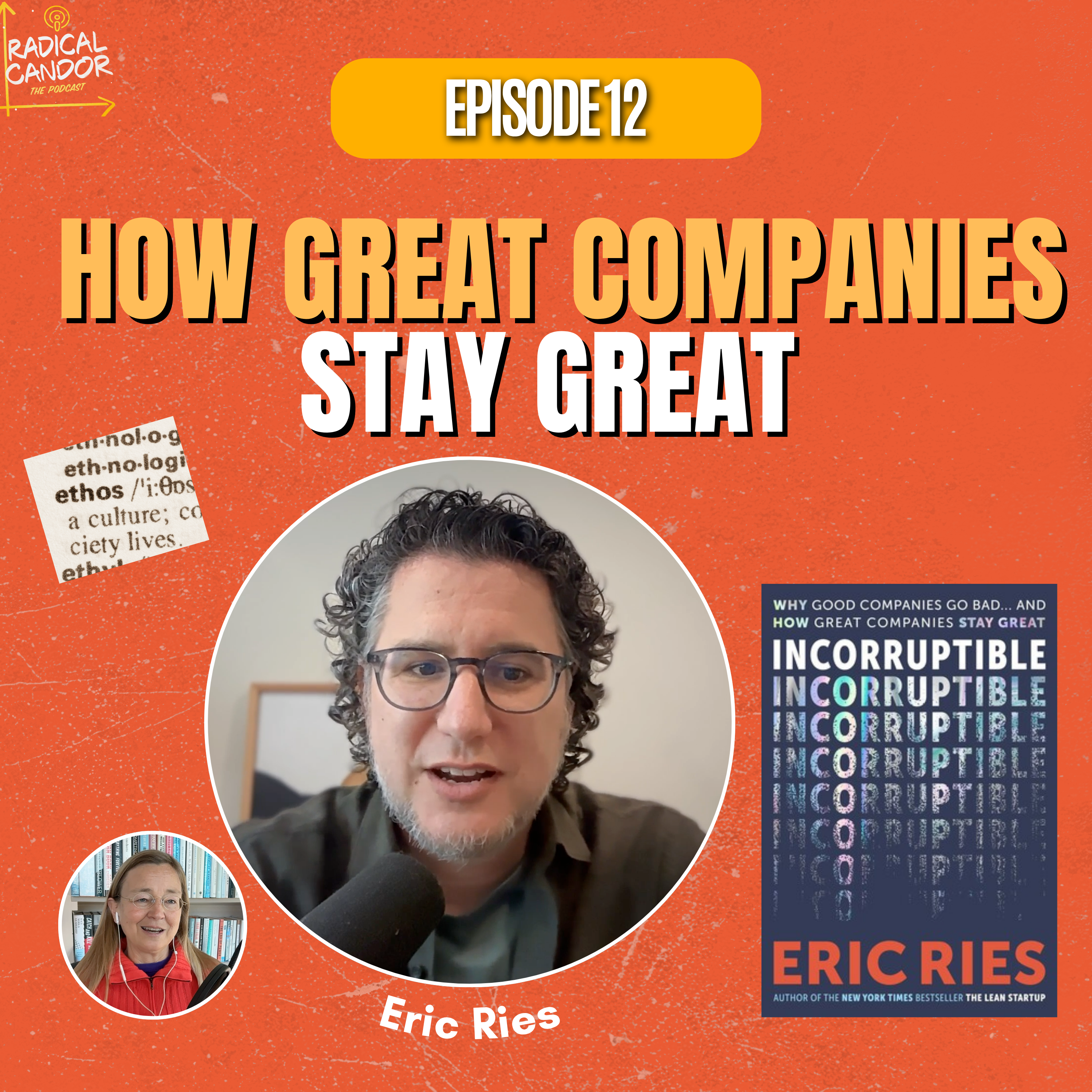
All too often, founders start a company and hire an incredible team dedicated to solving an important problem and leaving the world better off. Then...
Share your perspective
Leave a comment below.