41 min read
Unlocking Leadership Intelligence (with Caroline Webb) 8 | 24
 Kim Scott
Sep 15, 2026, 6:43:07 AM
Kim Scott
Sep 15, 2026, 6:43:07 AM
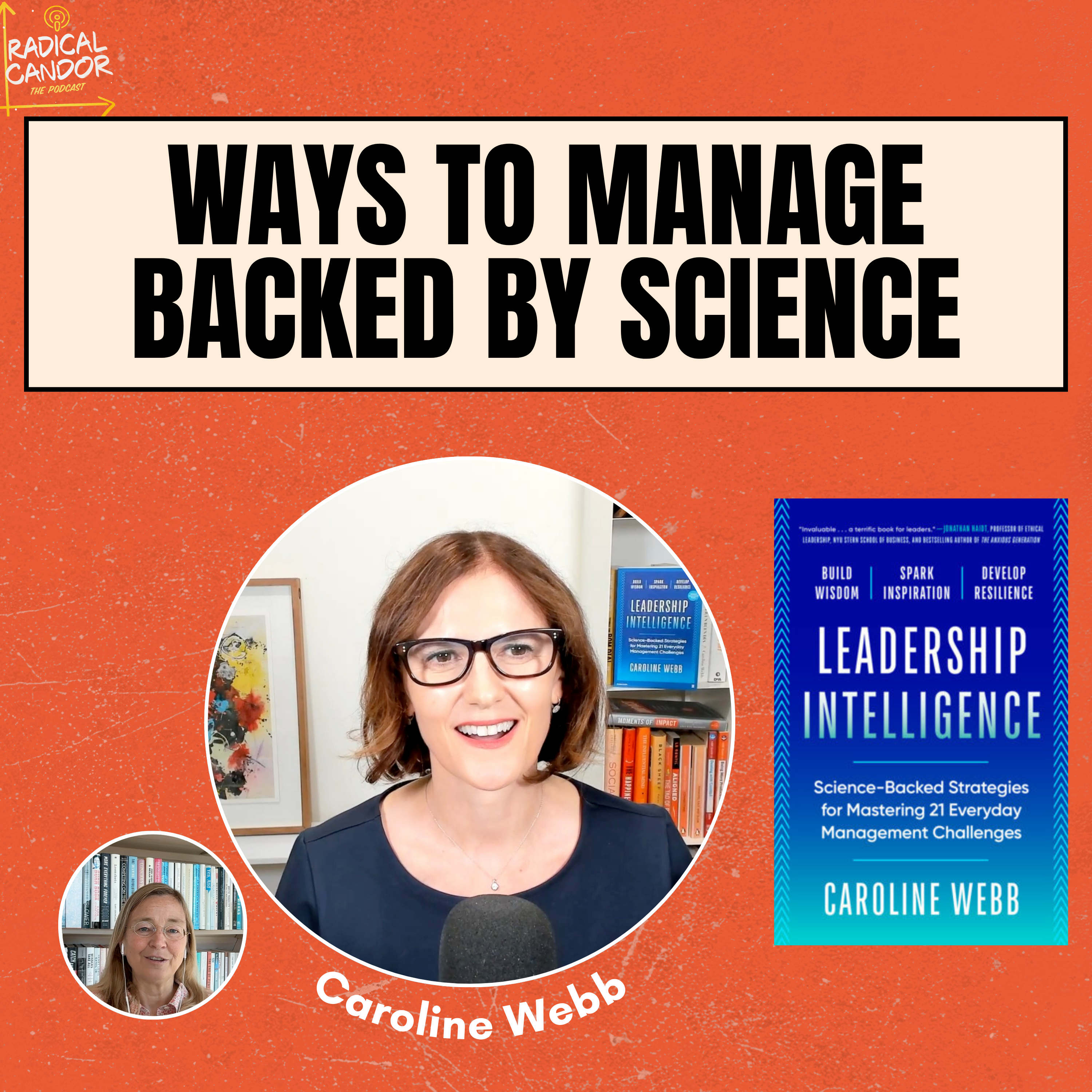
Table of Contents
What separates a leader who makes wise calls under pressure from one who gets stuck in their own point of view? Caroline Webb has spent decades studying the answer — first as an economist and McKinsey partner, now as a leadership coach and bestselling author.
On this episode of the Radical Candor Podcast, Kim talks with Caroline Webb about her latest book, Leadership Intelligence, and the science-backed system behind it: widening perspective to make wiser choices, lightening cognitive load so people can do their best thinking, and building the kind of team resilience that holds up under real stress.
Watch the episode:
Widening Perspectives and Deliberate Wisdom
Caroline and Kim explore what it takes to practice "deliberate wisdom" — stepping back from a narrow, reactive view of a problem. They talk through tools like causal maps and driver trees for untangling complex situations, and how leaders can navigate disagreement productively instead of digging into opposing corners.
Lightening the Load for Better Decisions
Cognitive load is a hidden tax on good leadership. Caroline explains how something as simple as turn-taking in a discussion can ease the mental strain on a team and lead to clearer, better decisions.
What Really Drives Motivation
Kim and Caroline dig into the roots of intrinsic motivation — competence and connection — and why feedback delivered well, including public praise, is one of the most powerful levers a leader has for engagement.
Gratitude, Stress, and the Five C's of Resilience
The conversation closes on building resilient teams: the role of gratitude and appreciation in strong working relationships, understanding stress before it becomes burnout, and Caroline's five C's — communication, clarity, calm, connection, and capacity — as a practical framework leaders can use to build resilience on purpose.
Radical Candor Podcast Resources
Radical Candor Podcast Transcript
[00:00] Caroline Webb: I think that in particular something that you and I both write about is the importance of specificity. there are various different reasons for that. But one is that the brain remembers specifics more than it remembers generalities. And that's true on the positive side and on the developmental side. I think that honestly fixes a great deal of what managers are not doing as optimally as they could in the feedback realm. They don't understand perhaps just how powerful it is to make a very specific observation and then explain why it matters.
[00:38] Kim Scott: Hello, everybody, and welcome to the Radical Sabbatical. I'm Kim Scott talking to the authors of the books that have meant a lot to me while the rest of the Radical Candor Podcast team is on sabbatical. Today with me is Caroline Webb. Welcome, Caroline. I'm thrilled to have you.
[00:57] Caroline Webb: great to be here. Thanks for having me.
[00:59] Kim Scott: Thank you. Caroline is the author of Leadership Intelligence and How to Have a Great Day and is a wonderful coach. Anything else I should say about you, Caroline, before we jump in?
[01:11] Caroline Webb: I've been leadership coaching for a long time and I actually live in New York despite my accent
[01:17] Kim Scott: I love your book so much, Caroline. it is packed with wisdom. And it has a very strong structure. I love a book with a very strong structure. And so what I would love to do is I'm gonna actually share my screen so that folks can see your your structure of your book, and then I'll describe it for people who aren't looking. But leadership intelligence is about three things: deliberate wisdom, intrinsic ex inspiration, and reasoned resilience. And there's two parts to each of those two things. So it's very balanced. For deliberate wisdom, you want to widen your perspective where it matters and lighten your cognitive load where you can. For intrinsic inspiration, you want to expand everyone's sense of personal competence and deepen everyone's sense of social connection. And then for reasoned resilience, you want to make the situation feel manageable and amplify what's meaningful. Caroline. What else is there to say?
[02:25] Caroline Webb: Thank you. This is my leadership intelligence system. That's what glues the leadership intelligence book together. And my background is in economics and I'm a behavioral scientist broadly speaking. And this is my grand synthesis of everything that leaders should know about how the brain works, how their brain works, how other people's brain works. And what that means is the right way to make good choices. motivate great performance in your people and help everybody keep going and build resilience through the ups and downs. And each of those three is based on fundamental science about how the brain works. The deliberate wisdom is based on the science of how the brain processes information. Intrinsic inspiration is about how the brain processes reward and reasoned resilience is about how the brain processes threat. And that's the backbone to the book behind all of the practical advice.
[03:17] Kim Scott: And it's it the great thing about this book is that as you read it, you will feel less alone. You and yeah, Caroline
[03:25] Caroline Webb: that means a lot.
[03:27] Kim Scott: is she's in your corner, which is important for leaders because leadership and management, it's a lonely job and can feel like a thankless task as well.
[03:39] Caroline Webb: Yeah, it can be wonderful. It is
[03:42] Kim Scott: It is wonderful, yeah.
[03:43] Caroline Webb: wonderful. It's a noble thing to be bringing the best out of other people and to enable everybody to do more than you could on your own. mean, that is just, it's the most beautiful human thing to be able to do that. But yes, it is always harder to bring the best out of many people than just yourself. that's
[04:02] Kim Scott: Yes.
[04:04] Caroline Webb: why we think about what it takes to do it better and make it easier to do it better.
[04:09] Kim Scott: Yes. Well, so let's jump right in. Let's jump into deliberate wisdom and what you say about widening the perspective. if you had to boil it down, what's the best way for a leader to widen their own perspective? Because I think one's own perspective is often a limiting factor in your ability to lead well.
[04:30] Caroline Webb: Yeah, so true. So, you know, your brain has a billion pieces of information coming at it at any given time. And depending on which study you read, you know, 10 to 100 is actually the capacity for us to consciously process. And a billion is bigger than 100, let's agree. So you've
[04:40] Kim Scott: Right. Right. Yeah. Yeah.
[04:45] Caroline Webb: got this tiny amount of conscious attention. And I think one of the central responsibilities of a leader is to be really intentional about where that tiny, tiny piece of attention goes. And left to yourself, your brain is going to try and figure out where should this tiny bit of attention go? And it's going to choose whatever is matching what's already on your mind.
[05:07] Kim Scott: Yeah.
[05:08] Caroline Webb: And you know, that might be, you've got an aim in mind and you're very attached to it. So you're to see everything that confirms that, you know, that's the
[05:13] Kim Scott: Mm.
[05:14] Caroline Webb: right thing to be focused on. You might have an assumption that's, you know, you're going to look for everything that confirms your right. And you know, even
[05:21] Kim Scott: Mm.
[05:21] Caroline Webb: your attitude is going to shape what you notice. You know, we all know. deep down and the research backs this up in a bad mood you see more negative things. So,
[05:30] Kim Scott: Yes.
[05:32] Caroline Webb: and the other way around as well. mean, in a good mood, you see more positive things. You might not actually notice some glaring risk that someone is trying
[05:40] Kim Scott: Yeah.
[05:41] Caroline Webb: to get your attention about. So a really smart leader notices what's on their mind because it's gonna drive whatever that's on their mind now is gonna drive what they notice next. And
[05:51] Kim Scott: Yes.
[05:52] Caroline Webb: you wanna be deliberate about that. And specifically, when you're doing something that really matters, you don't want to just notice what's right in front of you. You want to say, okay, let me take a moment.
[06:02] Kim Scott: Mm. Yeah.
[06:04] Caroline Webb: I understand what my point of view is now. What else is there out there? What's a different way of thinking about this? What could I be missing? And you
[06:12] Kim Scott: Yeah.
[06:13] Caroline Webb: don't, and it's easier said than done, but actually it really helps to have a couple of really simple questions that just remind you, okay, what's another way seeing this? What could I be missing? And there's a lot of more detailed advice that spins off that, but that's really what it is at its heart.
[06:29] Kim Scott: Yeah, so let's just like double click on that. What am I missing? Wait, what were the two questions? See, you said them and I've already forgotten them.
[06:35] Caroline Webb: What, what am I missing? What's another way of seeing this?
[06:40] Kim Scott: Yes, what's another way of seeing this and what am I missing?
[06:43] Caroline Webb: And another one in the AI area is how could I test that? How can I check that? Right? You know, because
[06:47] Kim Scott: Yes, yeah.
[06:49] Caroline Webb: you're getting work presented to you or, you know, information delivered to you you're like, okay, yeah, that looks great. And you've got to do that step back and say, okay, how do I test this? How do I check this?
[06:58] Kim Scott: Yeah.
[06:59] Caroline Webb: So I like those three questions as a trilogy, you know, for keeping your attention going where it needs to go.
[07:06] Kim Scott: Yeah, yeah. I think another thing that you talk about and another great way that resonated well for me about widening your perspective is and and asking those two questions is soliciting feedback and rewarding rewarding the candor.
[07:18] Caroline Webb: for sure. absolutely. Yeah. I mean, you know, because we can't see everything at the best of times.
[07:26] Kim Scott: Right.
[07:26] Caroline Webb: And the thing we can see least is ourselves. So I 100 % agree. Yeah.
[07:29] Kim Scott: Yeah. Yeah. Yeah. That's the best way of being self aware is to invite the people around you to hold up a mirror. and what about what you you write about the causal map in the driver tree. Can you explain the difference between those and and and what how how we can use that understanding to broaden our perspective?
[07:52] Caroline Webb: Yeah, sure. So, you know, I'm a big advocate of, you know, getting beyond your first assumption, getting beyond your first impression, doing a little bit to test by talking to your mentors and saying, please kick the tires on this or talking
[08:06] Kim Scott: Mm-hmm.
[08:07] Caroline Webb: to your team and really inviting challenge and ideas from them. Okay, then you've got a lot of information. Maybe you've even done some benchmarking and, you know, right. Okay,
[08:14] Kim Scott: Mm-hmm. Right. Yeah.
[08:18] Caroline Webb: lot of information. and your brain's got a small amount of conscious attention. So how do you use it really well? And
[08:22] Kim Scott: Right. Yeah.
[08:25] Caroline Webb: the way that you can make better use of your limited attention is to actually look for connections between, so if you've got a list of 20 things and
[08:32] Kim Scott: Mm-hmm.
[08:32] Caroline Webb: you start to organize that list and look at what causes what, you've got a map that gives you more of a sense of, where are the real drivers in this
[08:43] Kim Scott: Yeah.
[08:44] Caroline Webb: whole system? And, know, funnily enough, it's less... strain on your brain to have everything written down in a map than have a long list that just feels totally unwieldy. And it's an
[08:54] Kim Scott: Yeah. Yeah.
[08:56] Caroline Webb: evolution on the driver tree because I think many of us, you know, have learned how to do driver trees where you break down a KPI and you look at all the things that drive it. Right,
[09:03] Kim Scott: This causes that cause yeah.
[09:06] Caroline Webb: right. And the challenge is that a lot of things that we look at as managers and leaders is they're not linear.
[09:12] Kim Scott: Right. Right.
[09:12] Caroline Webb: complicated, messy and so a map really helps in that way. And I would say even people who are not visual, you you don't have to be, you know, doing this as a sort of beautiful piece of art. It's just, you know, scribble on the back of a piece of paper and just start
[09:27] Kim Scott: Right.
[09:28] Caroline Webb: to kind of map, okay, well, I think this causes that. And then
[09:31] Kim Scott: Right.
[09:31] Caroline Webb: usually you see new relationships and new possibilities when you see,
[09:35] Kim Scott: Yeah.
[09:36] Caroline Webb: actually that causes five things. I think that might be the place to intervene.
[09:38] Kim Scott: Yeah. Yeah, yeah. And the causal map looked less hierarchical than the driver tree. a
[09:45] Caroline Webb: Right, exactly.
[09:46] Kim Scott: and life really is not as hierarchical as we imagine it to be, I think. Yeah, yeah.
[09:50] Caroline Webb: So true, so true, yeah.
[09:53] Kim Scott: The other thing that you wrote about that I found really helpful was disagreement. and and what happens when you you wrote that when people feel they're not being listened to, it can trigger a defensive response that impairs their ability to reason. So what why is that? And and how can we have the kinds of disagreements, both as leaders but also fostered disagreements between people. that help them feel listened to rather than ignored.
[10:22] Caroline Webb: Yeah, well, jumping off where we were just at, you know, if we all have this tiny amount of conscious attention, we're all noticing and experiencing the world in a different way. So, you know how you come out of a meeting or you come out of a conversation and you talk to someone you think, were we even in the same? Like, how do you, I
[10:40] Kim Scott: Yeah. Yes.
[10:43] Caroline Webb: mean, maybe you see a movie with, you know, with
[10:45] Kim Scott: Right.
[10:45] Caroline Webb: your spouse and you're like, I, how, it was a different movie for me.
[10:49] Kim Scott: Yeah.
[10:50] Caroline Webb: because we each perceive our version of reality and it's driven by what's on our mind to start off with. So I think having a good debate in the workplace actually starts with that understanding that actually you may not have the whole picture. I remember when I was a management consultant that I got a clue on this because I noticed that however good my idea was, I noticed that whenever we sat with the team, it got better because of
[11:16] Kim Scott: Yes, yeah.
[11:18] Caroline Webb: other people's points of view. So I think it starts with that acknowledgement that actually you probably are going to get to a better answer if you can listen to where each other is starting from.
[11:29] Kim Scott: Yes.
[11:30] Caroline Webb: But there's no doubt if someone's disagreeing with you, it can challenge your sense of competence. It can feel like it's a sort of existential threat if it feels like it's not controllable. I need them to believe what I believe. And you know that can be a classic stress trigger. But the more you bring it back to, OK, we have plenty of common ground, most likely, and you start from that common ground, you list
[11:53] Kim Scott: Mm-hmm. Right. Yes.
[11:57] Caroline Webb: all the places you agree, you have a very different type of conversation. Because then you can focus on, where is it that we disagree? What's driven that difference? that's interesting. It's
[12:05] Kim Scott: Yes. Yes. Yes.
[12:09] Caroline Webb: because you saw this go horribly wrong one time. and it's never gone anything but perfectly for you. okay, interesting, let's learn from both. So
[12:15] Kim Scott: Right. Right. Yeah.
[12:18] Caroline Webb: I do think there are ways to acknowledge the differences and make the most of them in the workplace. It helps to have a little run sheet of, I'm gonna start with where we agree, not with where we disagree. And then you're
[12:30] Kim Scott: Yes.
[12:30] Caroline Webb: much less likely to get the defensive response.
[12:33] Kim Scott: Yeah, yeah. So starting with you know, if if if it's a Venn diagram, you start with the overlap and then you explore the two. Or you know, or
[12:39] Caroline Webb: Exactly. Exactly.
[12:41] Kim Scott: it's a Rogerian argument, right? Where
[12:43] Caroline Webb: Ha ha ha!
[12:44] Kim Scott: where I take your side and you take my side and
[12:47] Caroline Webb: Well, yeah, in fact, so the I think the pro approach here is exactly what you say, where you start with you articulate the other person's point of view in a way that's so brilliant, makes them sound so fantastically
[13:01] Kim Scott: Yeah.
[13:02] Caroline Webb: smart that they couldn't argue, you know, that they would just they would just feel, wow, you really got it. Yeah.
[13:05] Kim Scott: Yeah, yes, yeah, yeah, yeah.
[13:08] Caroline Webb: And if you're a leader and you've got disagreement in your team. Sometimes you have to be the one that summarises each side and says, okay, well, you think this because of that and you think this because of that. But it's even better with a team if you can say, okay, so could you just articulate his point of view
[13:25] Kim Scott: Yes.
[13:26] Caroline Webb: and as if you really liked it. And can you articulate her point of view as if you really
[13:31] Kim Scott: Yes.
[13:31] Caroline Webb: like it? Wow. Now that's, you're in a very different place. And then list all the things that you agree on and then talk about, okay, what's driven the disagreement.
[13:37] Kim Scott: Yeah. Yeah. Yeah.
[13:40] Caroline Webb: Yes, so I 100 % agree that that's the pro, the pro move.
[13:43] Kim Scott: I love that I love that. So let's make a commitment to each other. Let's try to do that at least once or twice in the course of this conversation. All right. Thank you.
[13:49] Caroline Webb: You got it. Okay, fantastic.
[13:53] Kim Scott: there's so much we agree on, it'll be hard, but we can find some stuff.
[13:56] Caroline Webb: Yeah. Yeah.
[13:58] Kim Scott: the the other thing you talk about in in terms of building sort of widening your own perspective and your team's perspective is in discussion to try turn taking instead of allowing one person to dominate. Why is that so important?
[14:15] Caroline Webb: Well, there's really good research. I mean, you don't even need the research. You just need common sense to say, actually, teams that let one person dominate or, you know, maybe it's all the extroverts that speak and the introverts that don't do not do as well as teams that bring forth the intelligence from everybody
[14:30] Kim Scott: Yes, yes, yeah. Yeah.
[14:34] Caroline Webb: that's around the table, whatever their style is. And so, you know, I think it's so simple and yet actually a lot of managers don't do it. They don't say, I'd like to hear from everybody. That's all you have to say. I'd like
[14:47] Kim Scott: Yeah. Yeah.
[14:49] Caroline Webb: to hear from, you can go around the table, you know, for things that are really important, but just setting the intention that you actually want to draw people out is such an easy thing to do as a manager. And it brings so much more intelligence onto the table.
[15:03] Kim Scott: Yeah, yeah. And this is another place where a I have a lot of ambivalent feelings about AI note takers. But you can ask your note taker to hold you accountable, to say how many people were in the meeting, what percentage of time should I have talked? And what percentage of time did I talk? And
[15:22] Caroline Webb: Yeah, yeah, I do think that's a really, really useful aspect of the tools. I agree because, you know, the people that do talk too much, if you ask them, were you intending to dominate the meeting? Did you hear from other people in their minds? I mean, most
[15:39] Kim Scott: Yeah. Yeah.
[15:40] Caroline Webb: people are not badly intended. Most people would say, yeah, yeah, I know, it was a good conversation. Right, right.
[15:45] Kim Scott: Yeah, and they're shocked when they see the data. And and that's why it's I r I don't recommend that as a manager you create a dashboard and rub people's noses in the data, but ask people to collect their own data because th they'll learn something from it.
[15:59] Caroline Webb: Yeah, yeah, no, it's smart, it's smart, yeah.
[16:03] Kim Scott: I also want to talk about because I think turn taking can be taken to an extreme. There was one team that I was advising and the CEO of this company, who was wonderful, had really gotten he had read the memo on making sure that everybody but as a result the conversations nobody was ever allowed to interrupt anyone else. And so you had to wait your turn to disagree with what somebody said four people ago. And it it it stifled. So when is interruption
[16:37] Caroline Webb: Yeah.
[16:37] Kim Scott: good? And I'm maybe I as an inveterate interrupter I wanna find Thank you! Tell me more
[16:44] Caroline Webb: It's great Kim, it's great! think, so first of all I think yes, you don't want to be mechanical about it because there are some topics where you do not need to hear absolutely everybody's point of view. Though I will say, you know, the things that you should be talking about in your team are generally the things where there are multiple points of view that are
[17:03] Kim Scott: Yeah.
[17:04] Caroline Webb: going to be useful, otherwise you should take it offline. You know, there's
[17:06] Kim Scott: Yeah.
[17:06] Caroline Webb: no point kind of using everybody's time on something that isn't really interesting to more than two or three in the room. That aside, yeah, I don't think it has to be... I don't think it has to be too mechanical, but I do think that it helps to know what your personal pattern is. you know,
[17:25] Kim Scott: Yes.
[17:25] Caroline Webb: I think, you know, really smart teams at some point do do some kind of discussion about, okay, what are my strengths and, you know, what are my blind spots? And if you've had a conversation with a team, it's like, yeah, I, I interrupt a lot. I worked once with a, still a, still a good friend, deep. introvert who wasted a long time, would just sit and ponder and everybody would just jump into the space because they couldn't believe that he really wanted that amount of time to reflect. One of the wisest people I've ever known. And so, you know, we have a conversation about it. Okay, so, you know, this is David's pattern and this is my pattern. My pattern is to talk quite a bit. You know, I'm more towards the Kim end of the scale.
[18:12] Kim Scott: Right, right.
[18:14] Caroline Webb: And let's talk about how do we handle that. And if you have the explicit conversation about it with your team, then it's so much easier than to say, know, Kim, you're doing that thing. Just mentioning. Or saying, OK, David, if you want to take a moment and think about this, let's just do some admin in the meantime, or whatever. You can have a sense of humor about it
[18:37] Kim Scott: Yeah. Yeah. Yeah.
[18:39] Caroline Webb: if you understand where everybody's preferences are. And of course
[18:43] Kim Scott: Yeah.
[18:44] Caroline Webb: there are really pro moves that you can put in place, again, to have, for example, everybody reflect for 10 seconds, 15 seconds, make a note or two before speaking. And then that brings everybody to the same place in the conversation.
[19:02] Kim Scott: Yeah, yeah. I love that. give David, you know, at least six seconds. But six seconds so long.
[19:06] Caroline Webb: I mean, but we've all got our quirks and I think great teams really surface that stuff and
[19:15] Kim Scott: Yeah.
[19:15] Caroline Webb: understand that it's not coming from a bad place, that we're all well intentioned.
[19:19] Kim Scott: Yeah, yeah. And learn how to adapt to each other. We all have different quirks, you know. Some people need you know, are so uncomfortable with the silence. So when David understands that, you know, it's cruel and unusual punishment for me to give him six seconds, but I'm willing to do it because I care so much about him and I want to hear what he says, like then we all get together, get along better.
[19:40] Caroline Webb: Yeah, yeah. And if you say at the beginning of the meeting, I'm going to ask everybody to think about this topic, you know, when we get to that point in the agenda. What a gift to everybody, you know, give people a heads up.
[19:50] Kim Scott: Yes, exactly.
[19:52] Caroline Webb: Yeah.
[19:53] Kim Scott: So the other part, the other part of deliberate wisdom, in addition to widening perspective, is lightening the cognitive load, which I love. I feel like the breakthrough in my career came when I decided that I was gonna throw away my to-do list, that my brain was pretty good at prioritizing tasks, and I was, if I forgot to do something, awesome. so that probably wasn't exactly what you had in mind about lightening cognitive load. What's a better way?
[20:24] Caroline Webb: I think, first of all, everyone is different. I love that you notice that you are feeling overloaded because I think that's where this starts. So back to this point, small amount of conscious attention processing capacity. So
[20:37] Kim Scott: Mm-hmm.
[20:38] Caroline Webb: if I'm asking you to widen your perspective on things that matter, well, hold on. You've just told me, Caroline, that I don't have much attention to go around.
[20:47] Kim Scott: Yeah, my perspective is actually pretty narrow.
[20:50] Caroline Webb: Right, so you've got to save your attention where you can. And I think so many of us fritter our attention across whatever's incoming, you know, that ping, that, you know, interruption, there's so much going on. And we're not that attentive to the fact that, yes, actually our working memory is quite small. And if we fill it, we're going to make poorer choices. We're going to make it
[21:11] Kim Scott: Mm.
[21:12] Caroline Webb: much harder to do the, I'm going to step back and check my perspective and test what's in front of me. So I think it's just as important to be really smart about that. And that means you know, single tasking where you can rather than multitasking, because, you know, as we know,
[21:27] Kim Scott: Mm-hmm. Yes.
[21:30] Caroline Webb: right, multitasking makes you make many more mistakes and slows you down. So that's one thing. Being really aware of what matters most so that you don't fill your mind with, I've got to do the grocery shopping. And I mean, we've all got stuff, we've all life stuff to do. Right.
[21:45] Kim Scott: Yes. The dreaded list, yeah.
[21:49] Caroline Webb: So having a process for... dumping that so that it's not getting in the way of your ability to think about what really matters. And then just being aware that the more tired you are, the harder it is to bring your attention to what matters. And so I really think, you know, sleep brings, it nudges its way into this part of the book because you have to think about how you're getting enough rest. you know, sleep is of course the best type of rest, but even just breaks in between. Being more deliberate about that is really well proven to sharpen your thinking and help you see new solutions.
[22:28] Kim Scott: Yeah, yeah. No, I remember w w the first time I ever quit my job to write a book, I was for the first time getting enough sleep. And I was astounded at how much my memory improved and how much more clear my thinking was. It was it was it's remarkable. So
[22:43] Caroline Webb: There you go. Yeah, there you go. There you go.
[22:46] Kim Scott: sleep is a great way to lighten your I mean that's what sleep is. It lightens your cognitive load. It c clears out the cruft, I think, somehow. Yeah.
[22:52] Caroline Webb: Exactly, exactly. Yes. So there we go. Widen the lighten.
[22:57] Kim Scott: This. All right, so let's talk about intrinsic inspiration. what so here this is this part of the book is about competence and connection. Why are why are these two things, competence and connection, so important for intrinsic motivation?
[23:14] Caroline Webb: Well, the brain's reward system is the engine of motivation. It's the
[23:19] Kim Scott: Mm-hmm.
[23:20] Caroline Webb: combination of brain areas and neurochemicals that makes you want things, want to move towards things, want to do things, want to do them again, want to repeat. And
[23:29] Kim Scott: Mm-hmm.
[23:29] Caroline Webb: so we have to have our reward system and that of our colleagues firing if
[23:35] Kim Scott: Mm.
[23:36] Caroline Webb: they're to feel like putting in the effort and feeling really engaged and trying hard.
[23:40] Kim Scott: Yeah.
[23:41] Caroline Webb: So it's really interesting looking at the research. I there's all sorts of different strands of research and what engages the reward system. And of course, money and extrinsic rewards like that do, but only temporarily. And so if you're looking for something that's lasting and unlimited in supply, you look at the intrinsic rewards, hence intrinsic
[24:04] Kim Scott: Mm-hmm.
[24:05] Caroline Webb: inspiration. everything that is relevant in the workplace, think, ends up coming down to, do I feel good about my competence, my ability to do what I'm doing? And, okay, if I don't feel confident right now, am I at least learning and growing? Does it feel like I'm getting there? Right, right,
[24:19] Kim Scott: Right. Yeah. Do I have some optimism I may become con confident and
[24:25] Caroline Webb: right, right. Right. And then, you know, and as part of that, you know, autonomy is really important because we don't feel
[24:31] Kim Scott: Yes.
[24:31] Caroline Webb: very competent if there's someone leaning over our shoulder telling us what to do. And
[24:35] Kim Scott: Right.
[24:36] Caroline Webb: then, you know, there's a... whole cluster of research that goes under that. There's a whole cluster of research that goes under social connection and by that I mean not just connection to your immediate team but also connection to humanity writ large. Do I feel useful to either the people I can see or people more broadly? Am I feeling respected and included?
[24:59] Kim Scott: Right, right.
[25:00] Caroline Webb: Do I feel that I in turn respect and feel like including or trusting the people around me. So that's pretty much everything that you really need to keep in mind as a leader, she says, heroically. I really did feel
[25:15] Kim Scott: Ha ha
[25:16] Caroline Webb: like, OK, if you can remember those two things, you're going to get
[25:20] Kim Scott: Yeah.
[25:20] Caroline Webb: to a lot of what drives motivation and engagement and, therefore, performance in your colleagues and in yourself, actually. Yeah.
[25:27] Kim Scott: Yeah. Yeah. No, a hundred percent agree. And there there's some things in these in these chapters that might feel surprising to people. For example, you say that employees who say they get all the feedback they need are five times more likely to say they feel engaged by their work. And I think that one of the big mistakes that a lot of managers make is they don't give feedback because they're afraid that it'll demotivate people. But it's actually s silence that is demotivating. So what what's what's going on there?
[26:00] Caroline Webb: Yeah, absolutely. It's fascinating. I mean, there's other research that says that, you know, people think they're getting less feedback than managers think they're giving. Hmm.
[26:15] Kim Scott: Yes.
[26:16] Caroline Webb: Now that's, wow. Okay. So not only do people want more feedback and, you know, not only does it drive, does it, does it drive in great engagement? Does it, you know, and not only is this about negative feedback as well as positive feedback is about developmental messages
[26:33] Kim Scott: Yes.
[26:34] Caroline Webb: and support and so on. In fact, actually, you know, the research seems even stronger on that front. So not only that, but also, you know, there is this gap. And I think it's so much the perception gap between the amount of feedback managers think they're giving and the amount of feedback that employees think they're getting is because it's not very, it's not done very well. You know, they
[26:55] Kim Scott: Yes.
[26:56] Caroline Webb: haven't read, they haven't read your book deeply enough.
[26:58] Kim Scott: Ha ha
[27:00] Caroline Webb: So, you know, I think that in particular something that you and I both write about is the importance of specificity. there are various different reasons for that. But one is that the brain remembers specifics more than it remembers generalities.
[27:16] Kim Scott: Yes.
[27:17] Caroline Webb: And that's true on the positive side and on the developmental side. I think that honestly fixes a great deal of what managers are not doing as optimally as they could in the feedback realm. They don't understand perhaps just how powerful it is to make a very specific observation and then explain why it matters. Again, whether it's you did this and was wonderful because it had this effect or you did this and not so good because it had this effect. I think... I think that, you know, there's still so much further to go on that. So more work for you and me to do. Right.
[27:51] Kim Scott: Yes, yes. Yes, yes, yeah. There and there will be for a long, long time. I mean I think that the I I forgot who said it, but the the biggest problem with communication is the illusion that it has happened. Like
[28:07] Caroline Webb: Right, right, you know, yes, and if you think you've communicated but the other person hasn't heard, you haven't communicated. There are all sorts of, right, exactly, these sorts
[28:13] Kim Scott: Yes, exactly.
[28:15] Caroline Webb: of summaries. But yeah, I think, you know, if I think about the leaders that I coach, I would say that feedback and the importance of giving feedback and really drilling down to how they're doing it comes up even with the most senior people that I'm working with. And there's
[28:31] Kim Scott: Yes.
[28:32] Caroline Webb: really nobody that it hasn't been a topic with, so.
[28:35] Kim Scott: Yeah, because w it it is so none of us want to hear it, really. I don't want to hear especially criticism. I mean, I do want to, like I want to. I want to want it, but I don't actually want it. You know, if you know what I mean. And then I also know I should give it, but I really, even though I wrote a whole book or radical candor on giving feedback. I dread it. I don't want to do that. Yeah, I do. I do. Yeah. Yeah.
[29:02] Caroline Webb: Do you? Do you? well, I think it's nice for people to hear that. I mean, I, so I have a model called factual feedback, which
[29:09] Kim Scott: Yes.
[29:10] Caroline Webb: nestles very neatly within your radical candor quadrant. And it does start by articulating that you have a positive intention for the conversation, you
[29:21] Kim Scott: Yeah.
[29:22] Caroline Webb: know, that you, you actually, so let's talk about developmental feedback, because I think that's what, you know, people often find hardest is to say, I care about your development.
[29:30] Kim Scott: Mm-hmm. Mm-hmm. Mm-hmm.
[29:31] Caroline Webb: Your work's important, so I really want to raise this with you. And then specific observation, very, very precise, not generalising, not interpreting. And
[29:42] Kim Scott: Mm-hmm.
[29:42] Caroline Webb: then owning the implication, this makes me feel concerned
[29:45] Kim Scott: Mm-hmm. Yeah.
[29:47] Caroline Webb: because blah, and it matters because. And then invitation,
[29:49] Kim Scott: Mm-hmm.
[29:50] Caroline Webb: so tell me what was going on. Because we
[29:52] Kim Scott: Yes.
[29:53] Caroline Webb: so often, you know, I think we so often think that we're being smart by making assumptions about what's happening and...
[30:00] Kim Scott: Yeah.
[30:01] Caroline Webb: smart people like making patterns and seeing
[30:03] Kim Scott: Yeah.
[30:04] Caroline Webb: connections and so we jump, we jump, we jump and you know the person didn't send the report out on time because they're perhaps lazy and not good at time management. no
[30:15] Kim Scott: Yeah.
[30:15] Caroline Webb: actually maybe there was a catastrophic failure of the know of the email system that day and
[30:20] Kim Scott: Yeah, yeah.
[30:21] Caroline Webb: they should have put their hand up and actually the thing that they should you know maybe get some coaching on is hey tell me if something's going wrong, you know, tell me if something
[30:29] Kim Scott: I need some help. Yeah. Yeah. Yeah.
[30:33] Caroline Webb: rather than, you know, actually you're lazy and you can so easily solve the wrong problem. So
[30:38] Kim Scott: Yes.
[30:38] Caroline Webb: that's, those are my five steps. Intention, observation, implication, invitation and collaboration is the end. Say, how could we do this better? How could you do this better? And how can I help you? So yeah.
[30:45] Kim Scott: Yes, yeah. Yeah. Yeah. I l I love that. We call it we we have a similar sort of acronym. It's called core. Context, so in the meeting, observation, when you said
[30:57] Caroline Webb: Yes. Yes.
[30:58] Kim Scott: every third word, the result, R is for result, is it made you sound stupid. Explore next step is you know go visit the speech coach or whatever it is. And
[31:10] Caroline Webb: There you go. There you go.
[31:11] Kim Scott: and it also applies to praise core, which
[31:15] Caroline Webb: Yes.
[31:16] Kim Scott: is, you know, in the meeting,
[31:18] Caroline Webb: Yes.
[31:18] Kim Scott: context, observ and by the way, that's a good reason to have the conversation right away. It's you don't have to rem six weeks ago, you know, the context can be complicated.
[31:25] Caroline Webb: Yes. Yes, yes, yes.
[31:29] Kim Scott: the observation when you shared both the pros and the cons, the result, you earn credibility, explore next step. do more of that. But I think the thing that's missing from core is intention. I th like stating
[31:43] Caroline Webb: Hmm.
[31:44] Kim Scott: your intention to be helpful is really important. Otherwise I would
[31:47] Caroline Webb: Yeah, yeah, well thank you.
[31:48] Kim Scott: say it's more or less the same. What do you think?
[31:51] Caroline Webb: There's a little bit more focus on inviting them to do some analysis, I think. That's the other, you know,
[31:56] Kim Scott: Yes, yeah, yeah, and yours.
[31:58] Caroline Webb: because you, you actually, it's funny, was coaching a CEO a few weeks ago talking about this and he said, you know, I've just realized this is actually making them work really hard. And I said, yeah, because
[32:12] Kim Scott: Yeah, yeah.
[32:13] Caroline Webb: the invitation of saying, okay, so tell me what was going on. Why do you think that happened? And you know, how do you think now about this? If you look.
[32:20] Kim Scott: Yeah.
[32:22] Caroline Webb: that's them
[32:23] Kim Scott: Yeah.
[32:24] Caroline Webb: solving the problem to an extent themselves. So I think that's the other little bit that
[32:28] Kim Scott: Yeah.
[32:29] Caroline Webb: I've seen be very useful. Thank you. That's an honour from you my goodness.
[32:31] Kim Scott: All right, I'm sold. We had a small a small disagreement and you taught me something new. So thank you. the the other thing when you when you write about connection, you're really talking about praise, public praise. You have the four H's, one of which is heroes and public praise. Tell me why public praise is so important.
[32:57] Caroline Webb: Hmm. well, you know, I hear you talk about the introduction to my book and you know, there's a little burst of joy within me because you know, what
[33:06] Kim Scott: Right.
[33:07] Caroline Webb: you're doing there is actually speaking both to competence. you're making me feel really good, but you're also making me feel really connected, both to you, but also my standing in the group is supported by you doing that. I feel I'm walking on air, you know? So, you know, one little... twist on those, you know, if you're thinking about that as a leader, you need to think about, well, I need to make sure I'm doing that with everybody, you know, within reason, you know, and,
[33:34] Kim Scott: Yeah, yeah, because yeah. Yeah.
[33:37] Caroline Webb: I have clients who kind of keep a list and they're making sure that they're making, you know, they're being balanced and giving shout outs, know, within reason, right? Because, you know, it's,
[33:45] Kim Scott: Mm.
[33:46] Caroline Webb: and then, I mean, the thing that I would say is there's just something so wonderful about the team recognizing each other.
[33:54] Kim Scott: Yes.
[33:55] Caroline Webb: And there are all sorts of different practices for doing that. I don't think there's one right answer, but it does really help to do a kind of strengths exercise of some sort or some kind of structured sharing of peak moments in your life so that people
[34:10] Kim Scott: Yeah.
[34:11] Caroline Webb: can hear what you're like when you're at your best. think these are actually much less hard to do than a lot of people think they have to bring in a... external facilitator, but it's
[34:21] Kim Scott: No.
[34:22] Caroline Webb: actually over a dinner to say, what's a really peak moment from your last five years? It's
[34:27] Kim Scott: Yeah, yeah.
[34:28] Caroline Webb: just a great conversation. You get to reveal something that you're proud of. That's a really, really
[34:32] Kim Scott: Yes.
[34:33] Caroline Webb: nice sense of mutual appreciation that
[34:35] Kim Scott: Yeah.
[34:36] Caroline Webb: comes in there.
[34:37] Kim Scott: And I think also creating structure for people to brag about each other as heroes. Like a a simple thing I used to do is bring in a a big stuffed orca whale. And and I would ask people to nominate each other and for awesome stuff, whatever had happened, and then somebody got the Orca whale to put on their on on the on their desk that week. And it
[35:00] Caroline Webb: Aww. I love that. I love that.
[35:03] Kim Scott: was like because if you don't give people you you kind of need to give people a platform to brag about each other and a reason to do it. Otherwise it
[35:11] Caroline Webb: Yeah. Yeah.
[35:12] Kim Scott: feels like, you know, I don't know, r like patronizing or something.
[35:17] Caroline Webb: Yeah, yeah, and I think it also equalizes if you put some degree of light structure in there. You know, some of the people that I've worked with have an appreciation jam kind of thing like you
[35:30] Kim Scott: Yeah.
[35:30] Caroline Webb: do. you know, there's one way that I used to do it where everybody would get someone's name in a hat. Back in
[35:40] Kim Scott: Yeah.
[35:40] Caroline Webb: the day when you could have a physical hat, but you you can do
[35:42] Kim Scott: Yes.
[35:43] Caroline Webb: this electronically as well. And then, you know, by the end of this week, send this person an appreciative note.
[35:51] Kim Scott: Yeah.
[35:52] Caroline Webb: And obviously you have to have built some trust and some connection before you do something like that, but it doesn't take a lot to start to weave this fabric of mutual appreciation in your team if you're deliberate about it. my goodness, it makes so much of a difference.
[36:03] Kim Scott: Yeah. Yeah. Yeah. Yeah. Gratitude and appreciation, we all know, you know, it's uncommon sense. We know that that it's a good way to build stronger relationships. And yet it feels like when I first got married, I was keeping a gratitude journal of the things I and then I'm like, why am I keeping a journal? I need to just tell him, thank you. Like, why am I keeping this to myself?
[36:31] Caroline Webb: I love that. I love that. did do the, you know, I've done this in all sorts of different ways, but I did do the gratitude letters. I did, I actually wrote to people,
[36:41] Kim Scott: Yes. that's good.
[36:43] Caroline Webb: especially after my last book came out, I just had this overwhelming sense of all the people who'd helped me and shaped,
[36:49] Kim Scott: Yeah.
[36:50] Caroline Webb: you know, shaped my work over the years. Yeah. But it doesn't have to be that big an effort. think just teaching people, this actually really makes a huge difference. So when someone
[37:00] Kim Scott: Yeah.
[37:00] Caroline Webb: does something nice, just drop them a line, say thank
[37:03] Kim Scott: Yeah.
[37:04] Caroline Webb: you. It's a small thing, and you can start very small, and if
[37:08] Kim Scott: Mm-hmm.
[37:08] Caroline Webb: anyone listening to this is thinking, well, I'm not gonna get a hat, or I'm not gonna get an orca whale, don't worry, you don't have to, but you can
[37:12] Kim Scott: Yeah. You d you don't have to have a stuffed animal.
[37:16] Caroline Webb: talk about appreciation, talk about how you appreciate each other more, and encourage it, and open up the
[37:18] Kim Scott: Yeah. Yeah.
[37:21] Caroline Webb: space for it.
[37:22] Kim Scott: Yeah. Yeah. Totally agree. All right, let's move on to reasoned resilience. Not that we could not talk about gratitude and appreciation for the for the rest of the day, but reasoned resilience.
[37:32] Caroline Webb: Yeah.
[37:36] Kim Scott: So you write about how the brain processes threats and stress. So what's the what's your core insight there?
[37:45] Caroline Webb: Well, this is one of the areas where there's been perhaps more new research and
[37:49] Kim Scott: Mm.
[37:50] Caroline Webb: a couple of things. So first of all, when you think about what the brain treats as stressful, it's a combination of things. It's something demanding because it requires more of your brain or
[37:57] Kim Scott: Mm-hmm. Yes.
[38:00] Caroline Webb: your body. It's something that is uncontrollable because
[38:04] Kim Scott: Mm-hmm.
[38:05] Caroline Webb: if it's controllable, it wouldn't be that stressful. And it's also unpleasant because if it's pleasant, what's the problem? So
[38:09] Kim Scott: Yes. Yeah.
[38:12] Caroline Webb: it's the combination of those three things.
[38:14] Kim Scott: Mm.
[38:14] Caroline Webb: It's not even that this is something that's necessarily happening right now, but it's what your brain predicts is going to happen. So if it reminds
[38:20] Kim Scott: Yes, yeah.
[38:21] Caroline Webb: you of a situation that was uncontrollable.
[38:23] Kim Scott: Yeah.
[38:24] Caroline Webb: And so as leaders, we've got this opportunity to help people feel it's unlikely that you can make a demanding situation feel undemanding, but you can
[38:34] Kim Scott: Yes.
[38:35] Caroline Webb: look for ways to make an uncontrollable situation look a bit more manageable. And
[38:39] Kim Scott: Yes.
[38:40] Caroline Webb: you can often find a way you can't make it pleasant. but you can look for things that might feel meaningful, know, satisfying,
[38:48] Kim Scott: Yes.
[38:49] Caroline Webb: a sense of pulling together, a sense of humanity.
[38:51] Kim Scott: Yeah.
[38:52] Caroline Webb: And so if you keep manageable and meaningful top of mind,
[38:56] Kim Scott: Mm-hmm.
[38:57] Caroline Webb: and it's not even that, you know, as I say, it's not even that you're having to rework what the situation is, but you can talk to people about what it's going to be, and you can change
[39:06] Kim Scott: Yes.
[39:06] Caroline Webb: people's expectations, then that's an even more powerful intervention in reducing stress. So,
[39:10] Kim Scott: Yes. Yeah.
[39:13] Caroline Webb: yeah.
[39:12] Kim Scott: I love that. I love that. And so talk about making things manageable. I mean, you're not talking about toxic positivity. So you're not saying, everything's gonna be okay when maybe it won't be. Like I remember
[39:26] Caroline Webb: Right.
[39:26] Kim Scott: shortly after September 11th, I was leading a startup. I was co-founder of a startup, and we were based in Manhattan, and we were not far from the it felt very awful. A lot of our
[39:39] Caroline Webb: Ugh, yeah.
[39:40] Kim Scott: customers We had just launched our product to Wall Street. A lot of our customers were in the, were in the Trade Center. and the sales, sales guy called me in and he said, I need you to come and sort of rally the troops, rally the sales team. And I stood up in front of them and I just burst into tears. Which felt it felt like such an unleaderly thing to do, but they all told me later it was like the best thing I could have done. Like, like sh. sort of sharing with them, yes, this is hard. Yet like I'm not pretending this is okay. And
[40:11] Caroline Webb: Yes. Yes. Yes.
[40:15] Kim Scott: what I know is, you know, here's here's what we here's what we can do. you know, and and we're here for each other, you know.
[40:22] Caroline Webb: Beautiful, beautiful. There you go, there you go. And you know, I think that is the core of it is you want to acknowledge what feels tough because even acknowledging it actually nudges you a tiny bit towards feeling manageable because you know,
[40:39] Kim Scott: Yeah.
[40:39] Caroline Webb: you're naming what's out there.
[40:41] Kim Scott: Yeah.
[40:42] Caroline Webb: And I think, you know, I have a little thing I used to remember is no be do. Like what can you...
[40:48] Kim Scott: Yes.
[40:49] Caroline Webb: What can you emphasize here that you know for sure, even if everything is chaotic?
[40:53] Kim Scott: Yeah. I know you all are sad and I'm sad. Like that's what I was expressing. That's what I know.
[40:56] Caroline Webb: Yes, yes, right. And you know, we don't know when we'll get the news on this, but we do know the timing.
[41:03] Kim Scott: Mm-hmm. Yeah.
[41:04] Caroline Webb: We don't know what's going to happen with that, but we do know that the priority now is this. And so,
[41:10] Kim Scott: Yeah.
[41:11] Caroline Webb: you know, that's something that you can almost always do even in the middle of really something awfully unpleasant like what you were going through. And I think you can also reconnect people to who they are and who they continue to be. So values and strengths and experience,
[41:24] Kim Scott: Yeah.
[41:28] Caroline Webb: maybe past things that they've triumphed or at least found a way
[41:32] Kim Scott: Mm-hmm.
[41:32] Caroline Webb: through. And then the do piece is perhaps the most obvious, but it's what can we do even though there's a lot that we don't control? So what
[41:43] Kim Scott: Yes.
[41:44] Caroline Webb: is there that we can choose? It could be that we can choose our attitude. It's
[41:48] Kim Scott: Yes, yeah.
[41:50] Caroline Webb: often the case that there are some no regrets moves that you can... take. And actually one of things that you can often do is talk about different scenarios and take those. It's not that the worst case scenario isn't awful but if you talk about it, it takes
[42:05] Kim Scott: Yes.
[42:05] Caroline Webb: some of the sting out of it and you say okay and then if that happens then this is what we'll do. All right
[42:10] Kim Scott: Yes.
[42:11] Caroline Webb: it's awful let's hope we don't get to that but there's something right right right right.
[42:14] Kim Scott: But this we have a plan, yeah, for what to do. You have a great I love a good two by two, and you have a great two by two about sort of take taking
[42:22] Caroline Webb: I like a two by two.
[42:24] Kim Scott: taking action and doing nothing. So the horizontal axis is take action, do nothing, and then the vertical
[42:30] Caroline Webb: Mm-hmm.
[42:30] Kim Scott: axis is the upside and the downside. And we
[42:33] Caroline Webb: Yes.
[42:34] Kim Scott: tend to ignore the upside and the downside in the wrong boxes. So can you walk
[42:40] Caroline Webb: Yes.
[42:40] Kim Scott: folks through your two by two?
[42:42] Caroline Webb: Yeah, well, if you, if anyone, this is for anyone who is putting off doing something. So I'm guessing many of us, you know, have something that we're, right, right. It's a tough decision that you just really don't want
[42:47] Kim Scott: Right. Yes, everyone listening is procrastinating something. Yeah.
[42:56] Caroline Webb: to make or, know, whatever. So what happens is there's two biases that come into play here. One of them is present bias and one of them is
[43:04] Kim Scott: Mm-hmm.
[43:05] Caroline Webb: omission bias. So present bias is we tend to value and kind of pay attention to what's here and now much more than we do what's in the future. So something that pays off in the future that you kind of know is the right thing to do, if it involves present hassle or kind of effort, that looms much larger than the long-term payoff. And then...
[43:28] Kim Scott: Yeah. Or or even upset, which is the worst. This is why people you just explained why so many managers wait too long to deal with a performance problem.
[43:39] Caroline Webb: Yeah, absolutely. this goes back to something we were saying earlier on about the power of specificity. The reason that being specific in feedback is useful is because your brain is much better at handling concrete specific things.
[43:51] Kim Scott: Yes.
[43:51] Caroline Webb: So this plays out into procrastination as well. And then the other bias is omission bias, which is that we often think about the pros and cons of taking action. Shall I do this? I don't know. Shall I do it? We don't think about the pros and cons of not taking action.
[44:07] Kim Scott: Yeah, the downside of doing nothing. No
[44:09] Caroline Webb: Right, the downside of doing nothing. And so we miss the upside of doing something, we miss the downside of doing nothing. And that can get us stuck, but once we draw out our two by two and kind of fill in the quadrants evenly, you know, it doesn't mean necessarily that you should do the thing, but it does mean you're gonna have a more balanced perspective of whether you should do
[44:31] Kim Scott: Yeah.
[44:32] Caroline Webb: the thing.
[44:33] Kim Scott: Yeah. All right. let's end on what you end with in the book, which is how how can leaders amplify what's meaningful? What are the five C's of team resilience?
[44:45] Caroline Webb: Yeah, I think, you know, as leaders, we're responsible not just for the energy and output of our team now, you know, sustaining it and keeping it sustainable.
[44:55] Kim Scott: Yes.
[44:56] Caroline Webb: And that requires you to think not just about how the team is set up now, but what are you doing to create that resilience? And the five Cs, if you're curious. So the first
[45:08] Kim Scott: Yes.
[45:08] Caroline Webb: is conversation, which is actually having a conversation about how you do your best work in a sustainable way. And, know,
[45:12] Kim Scott: Yeah. Yeah.
[45:14] Caroline Webb: okay, it seems sort of obvious, but a lot of leaders will try and kind of fix things on the edges without talking to their team about, okay, well,
[45:21] Kim Scott: Yeah.
[45:21] Caroline Webb: what does it look like when we're running on empty?
[45:24] Kim Scott: Yes.
[45:24] Caroline Webb: How do we notice that more quickly? And what can we do to, you know, protect against it? So it starts with a conversation. And then there's, I think, real clarity about the fact that, you know, you can have a good calendar and you can have a bad
[45:36] Kim Scott: Mm-hmm.
[45:37] Caroline Webb: calendar.
[45:37] Kim Scott: Yeah.
[45:38] Caroline Webb: And wouldn't it be great as a team if we had some norms that meant that we were helping each other organize our time, manage our calendars in really good ways. So that includes
[45:46] Kim Scott: Yeah.
[45:47] Caroline Webb: being transparent with each other about what our constraints are.
[45:50] Kim Scott: Yes.
[45:50] Caroline Webb: It means, you know, being smart about when are we going to get focus time? What's our mode of talking to each other about? I'm going offline to focus on this, to widen my perspective back to the beginning. And then, you know, how do you give people the right type of flexibility around the stuff of life? And teams that do that do have higher performance.
[46:12] Kim Scott: I think that's really meaningful for people. One of the things that I recommend that teams do is sit down and share with each other what's their own personal recipe for staying centered? what do they need to do? And I learned
[46:23] Caroline Webb: go. Perfect.
[46:25] Kim Scott: this actually, I I spent all of 12 weeks at McKinsey. I was just a summer intern there. And
[46:31] Caroline Webb: Ha
[46:32] Kim Scott: in that summer on the on the team that where I was working, there was a guy who whose child was was having brain surgery. So a lot of stress between him and his wife.
[46:41] Caroline Webb: Yeah. Yeah.
[46:44] Kim Scott: And we sat down and we s we talked at the beginning of the engagement about what each of us needed to do our best work. And he said, I need to take a walk in daylight hours with my wife. And this s I mean it seems like such a simple thing, but it seems like an impossible ask for
[47:04] Caroline Webb: Right, right.
[47:05] Kim Scott: for for the McKinsey engagement. But we were like, okay, we're gonna figure out how to make that happen. And if it was
[47:11] Caroline Webb: Right.
[47:11] Kim Scott: 3 30 and he had to drive an hour to get back to h home, we would stop what we were doing and we'd say, Well we'll pick it up after dinner on the phone, you know, and he got
[47:21] Caroline Webb: I love that.
[47:21] Kim Scott: his walks. And that helped I think it it helped us more than it helped him, actually. 'Cause 'cause when someone's going through something that difficult and you know it, like that sort of unspoken guilt is not productive.
[47:36] Caroline Webb: Yeah, yeah. And I think he probably made it easier for other people to talk about what was going on in their lives too.
[47:41] Kim Scott: Yeah. Yeah.
[47:43] Caroline Webb: And another thing that sometimes people surface here is, I mean, obviously caring responsibilities, sort
[47:48] Kim Scott: Mm.
[47:49] Caroline Webb: of an extension of what you're talking about, whether it's kids or parents,
[47:53] Kim Scott: Mm-hmm.
[47:54] Caroline Webb: and body clocks. I mean, I say this is an extreme night owl. This was, okay, great, fantastic.
[47:56] Kim Scott: Yes. Yes, me too. We are inter we're interrupting night owls together.
[48:05] Caroline Webb: I love it. So that is a really helpful conversation to have because it can be an enormous strength of a team to have people with different body clocks, but only really if you're talking to each other about it so that you're making good use of the time where you overlap. And then the third C is calm, which is
[48:22] Kim Scott: Uh-huh.
[48:22] Caroline Webb: about recovery time because it turns out that everybody's brains perform better when they have some downtime. Think of it like a race car.
[48:28] Kim Scott: Yes.
[48:31] Caroline Webb: You have to have pit stops and sometimes those pit stops need to be longer than others. So
[48:31] Kim Scott: Yeah. Yes. Yes.
[48:36] Caroline Webb: thinking actively for your team about, what's your cadence around recovery time? And how do you make sure that people are taking breaks? How do you role model that yourself, honestly, so that people can see that
[48:46] Kim Scott: Yeah. Yeah.
[48:49] Caroline Webb: they understand that there needs to be a rhythm, that you're not peddled to the metal all the time? And then cause is about reconnecting people to what's the point of what the work is about. And when it's
[49:00] Kim Scott: Yeah.
[49:01] Caroline Webb: very busy, you know, I do quite a bit of work in healthcare and you think, well, it must be obvious in healthcare. Obviously the point of the work is obviously to, you know, patient care.
[49:07] Kim Scott: Yeah. Save lives, yeah.
[49:11] Caroline Webb: But when people are really stretched and really busy, it's still helpful to reconnect them to, hold on, what's the point of this? And,
[49:18] Kim Scott: Yes.
[49:19] Caroline Webb: okay, all right, so it's tough right now. Let's just stay connected to what really matters. This is what we're doing this for.
[49:25] Kim Scott: Yeah.
[49:26] Caroline Webb: And then finally, perhaps it sounds, you know, It sounds less lofty, but it's capacity and
[49:32] Kim Scott: Yes.
[49:33] Caroline Webb: being really alert to where capacity is building to the point where people cannot sustainably keep doing what they're doing and you have to make choices about where to reallocate time. And that's so often a conversation that happens in a sort of crisis. It's really
[49:51] Kim Scott: Mm-hmm.
[49:52] Caroline Webb: helpful if you can decide ahead of time as a leader, okay, so this is what I'm gonna look out for.
[49:58] Kim Scott: Yeah.
[49:58] Caroline Webb: And this is how I'm going to handle it if we have to rethink a little bit our priorities and our workload. The more you can do that ahead of time with any of this, the easier it is when you're really under pressure to remember, yeah, hold on, this is one of the things I needed to be thoughtful about.
[50:14] Kim Scott: Yeah. Yeah. And different people have such different capacities for work. Like there's there was one guy who worked for me who could work a hundred hour weeks. He had a great capacity for work, but then he needed to take two months off and go on a bender around
[50:31] Caroline Webb: Ha
[50:32] Kim Scott: You know, and I was at first I was I I was a little self righteous about that. And I'm like, that's just how he works. I it's my job to like make that happen.
[50:42] Caroline Webb: Right, it goes back to the benefits of actually sharing with your team. Well, you know, what's our quirk? You know, how do we work best? So
[50:47] Kim Scott: Yeah, yeah.
[50:48] Caroline Webb: I 100 % agree. Yeah. And I do think, you know, if you've got someone on your team who's at risk of burning out, and you know, that's something we talk about a lot these days, you know, something I see leaders do really well is saying, okay, what could I do to reallocate work temporarily, just to give this person a bit of breathing room? Could it
[51:04] Kim Scott: Mm-hmm. Yeah. Yeah.
[51:08] Caroline Webb: be an opportunity for someone to step up? Ooh.
[51:10] Kim Scott: Yeah,
[51:11] Caroline Webb: interesting, might even be a development opportunity.
[51:11] Kim Scott: yeah, yeah, yeah.
[51:14] Caroline Webb: you know, yeah, think being proactive about this and recognising that just because you're reallocating work doesn't mean it's going to stay like that, right? It doesn't have to be permanent.
[51:21] Kim Scott: Yeah. Yeah. And helping people not get self-righteous about what they need versus what other people need. Like it was easy
[51:29] Caroline Webb: official.
[51:30] Kim Scott: for people to say, you know, it's terrible that he's working so hard and it's terrible he's and like it's just the way he works, you know?
[51:37] Caroline Webb: Yeah, yeah, absolutely. We're all different and I think we each bring something really special to a team and it's the leader's job to help that specialness come out and to find
[51:49] Kim Scott: Yeah.
[51:50] Caroline Webb: ways to have everybody compliment each other.
[51:52] Kim Scott: Yeah, and and to help one person's specialness not touch not stomp on somebody else's special toe, you know.
[52:00] Caroline Webb: Special toe, that's great.
[52:04] Kim Scott: well Caroline, thank you so much. Your book is gonna help so many people sort of bring the best
[52:10] Caroline Webb: Thank you.
[52:11] Kim Scott: out of their teams and feel less alone while doing it. So such
[52:14] Caroline Webb: Thank you. Thank you.
[52:16] Kim Scott: a such a wonderful book. what where can people find you and what's the best way to stay in touch with you?
[52:23] Caroline Webb: People can find me at my website which is carolinewebb.co, that's dot co not dot com and they can find all sorts of information about my books and sign up for a newsletter. There's a bunch of free stuff which is downloadable there and then of course you know people can find me on LinkedIn. Always happy to see people there.
[52:42] Kim Scott: Perfect. Thanks so much.
[52:44] Caroline Webb: My pleasure. Thanks so much, Kim.
[52:46] Kim Scott: Take care.
Key Questions Covered
What is "deliberate wisdom" and why does widening your perspective help leaders make better calls?
Deliberate wisdom is the practice of consciously stepping back from a narrow or reactive view before making a decision. Caroline Webb argues that leaders who widen their perspective — using tools like causal maps to see how different factors connect — make wiser, less reactive choices, especially in moments of disagreement.
How does cognitive load affect decision-making, and what can leaders do to lighten it?
Cognitive load is the mental strain that builds up during complex discussions and decisions, and it can quietly undermine good leadership. Caroline points to practical fixes like structured turn-taking in meetings, which reduces the mental burden on everyone in the room and leads to clearer thinking.
What actually drives intrinsic motivation at work, according to Caroline Webb?
Caroline Webb points to two core drivers of intrinsic motivation: a sense of competence and a sense of connection. When people feel capable and genuinely connected to the people around them, engagement follows naturally — which is why well-delivered feedback and recognition matter so much.
What makes feedback and praise effective, and why does public praise matter?
Effective feedback is specific, timely, and genuine — and Caroline and Kim discuss how public praise in particular reinforces good work in a way that ripples beyond the individual being recognized, strengthening trust and gratitude across a whole team.
What are the five C's of team resilience, and how do they show up in day-to-day leadership?
Caroline Webb's five C's of team resilience are communication, clarity, calm, connection, and capacity. Together, they give leaders a structured way to help their teams handle stress and setbacks without burning out, built through regular conversations and practices rather than left to chance.
Keep going.
Three ways to put this into practice.
Share your perspective
Leave a comment below.