Kim Scott & Debora Spar Discuss the Intersection of Technology and Human Relationships 2 | 13
Our podcast series, “Radically Candid Conversations,” features experts and guests who help us learn, reflect and put our insights into action. On...
30 min read
 Kim Scott
Jun 23, 2026, 9:00:00 AM
Kim Scott
Jun 23, 2026, 9:00:00 AM
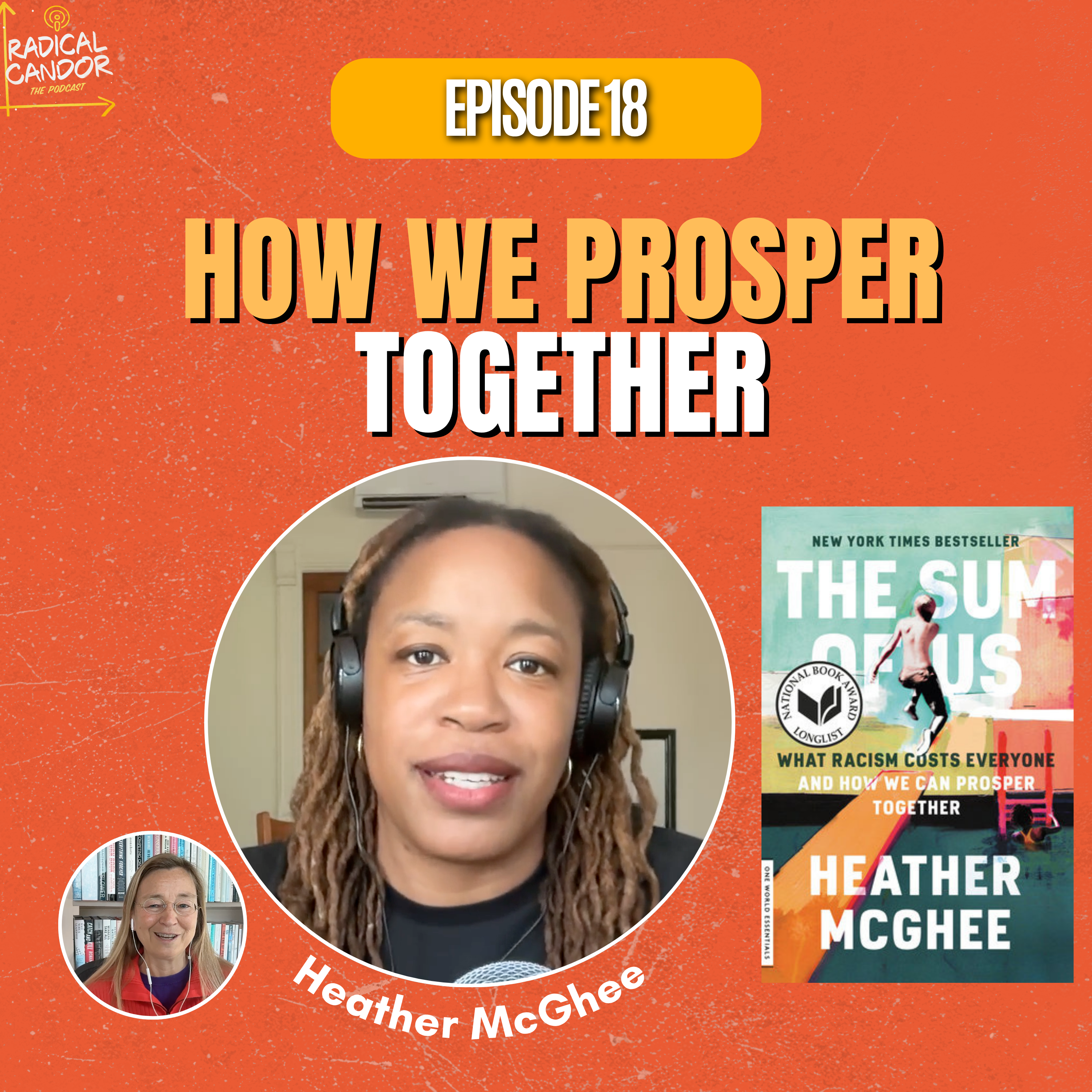
Table of Contents
While the podcast team is on a Radical Sabbatical, Kim is interviewing authors of books that have shaped her thinking over the past two years.
On this episode of the Radical Candor Podcast, Kim talks with Heather McGhee, author of The Sum of Us: What Racism Costs Everyone and How We Can Prosper Together, about how zero-sum thinking drained America's public goods — and how a solidarity mindset can bring them back.
Watch the episode:
Heather McGhee opens The Sum of Us with the story of America's grand public swimming pools — some, like the Fairground Park Pool, holding up to 10,000 people and open to everyone for free. When cities were forced to integrate them, many towns chose to fill the pools in with dirt rather than let Black and white residents swim together. Nobody got to swim for free again — except the people wealthy enough to join private clubs.
Starting in the late 1960s, McGhee argues, the same zero-sum logic spread to more consequential public goods. As welfare, healthcare, education, and infrastructure funding came to be seen as benefiting Black and Brown Americans, political support for those programs collapsed. When Texas rejected the Obamacare Medicaid expansion, for example, its rural hospitals began going bankrupt — creating medical deserts and economic devastation in small Texas towns that had little to do with race on the surface.
McGhee frames the choice starkly: a solidarity dividend, where public goods that benefit everyone stay funded and shared, or the devastation that results when zero-sum thinking leads a community to destroy a public good rather than make it available to all.
[00:05] Kim Scott: Hello, everybody. I'm Kim Scott, and welcome to the Radical Sabbatical part of our podcast. With me today is Heather McGee, who is the author of The Sum of Us, one of the books that has really meant so much to me over the last couple of years and had a huge influence on me as I was writing Radical Respect. So Heather, thank you so much for joining us today.
[00:31] Heather McGhee: Kim, I'm so glad to be with you and thanks for the kind words.
[00:34] Kim Scott: Well, I love your book. And I think about you. You wrote about Bacon's Rebellion kind of early on in the book. And I have to say, I think about Bacon's Rebellion probably once a day, since. Yes. So describe Bacon's Rebellion, because it's so relevant. It's like it's so relevant to what's happening.
[00:51] Heather McGhee: That's my kind of gal thinking about a rebellion in the 17th century.
[01:04] Kim Scott: today I think.
[01:05] Heather McGhee: Well, it really is. I wrote about it in The Sum of Us. I also managed to go deeper into it in a chapter for a book called 400 Souls, which takes a five-year look at every year of the presence of Africans in the United States from 1619 on and assigned it to a different writer who then spent a couple of pages.
[01:17] Kim Scott: wow.
[01:31] Heather McGhee: talking about an event or a person from that period. And I chose Bacon's Rebellion because it does feel very...
[01:35] Kim Scott: Okay.
[01:41] Heather McGhee: foundational to American race relations and to our economy, which is my background. My background is as an economic policy person working on solutions to economic inequality. so Bacon's Rebellion, the story of it reminds us that none of the things we accept today as what would become our history was inevitable, right? We had
[01:41] Kim Scott: Yes. Yes, yes. No.
[02:06] Heather McGhee: a group of enslaved Africans in colonial Virginia. had European colonists who were in various levels of unfreedom and indenture. They were landless, they were uneducated, they lived short and brutal lives. And we had a fighter who basically whipped up a cross racial servant class.
[02:18] Kim Scott: Yeah.
[02:33] Heather McGhee: uprising against the colonial plantation elite in colonial Virginia and was largely successful, burned the capital of colonial Virginia to the ground, ran the governor out of town. And it was this cross racial uprising that really struck heart, struck fear, excuse me, that really struck fear in the hearts of the colonial plantation elite. And so after they finally broke the rebellion, that is when
[02:36] Kim Scott: Right. Yeah.
[03:00] Heather McGhee: the legislature in Virginia passed, the colonial legislature passed laws that really separated the racists and really created the racial caste system that we know would go on and define the next two, 300 years of American history from colonial times forward. Said, if you are European, you are this new thing, white, and you have the potential to be a citizen. And to create that sort of economic
[03:12] Kim Scott: Yeah. Yeah.
[03:29] Heather McGhee: bargain. It was really a racial bargain. said, hey, folks, don't do that again, white folks. Side with your color instead of your class. Help enforce this strict racial hierarchy. And we'll give you some things. We'll give you a few benefits. But no, yes, a few things.
[03:31] Kim Scott: Yes. Yeah. Yeah. very few benefits though. Like we're not going to give you the money that you were looking for. We're not going to give you the land you were looking for.
[03:51] Heather McGhee: Exactly. But you can serve on a jury. can spit on a Black person if they cross you. And so it was really that which, and I pull this through in all the chapters about economic power and organizing, it has really often been in American society the Achilles heel of the kind of organizing that we know it takes for working in middle class people to rewrite the rules of the economy. It has been
[03:54] Kim Scott: Yeah. Ugh. Yeah.
[04:21] Heather McGhee: racism and racial divisions that have been the Achilles heel ever since Kim Bacon's rebellion.
[04:25] Kim Scott: Yes, Bacon's Rebellion. Yeah, and it seems like this divide and conquer, using race to persuade white people not to demand what they need in order to prevent people who are not white from not getting it. It's so irrational, and yet it worked then, and it's working now. So I think we need to really challenge that.
[04:49] Heather McGhee: Yeah.
[04:52] Kim Scott: challenge that narrative because it's bad for almost everyone in the end.
[04:56] Heather McGhee: Well, that's right, Kim. mean, that's the subtitle of my book is what racism costs everyone and how we can prosper together. That's right. And so my thinking was, something is holding us back from being the country that can really create broadly shared prosperity. The opening line of the book is why does it seem like we can't have nice things in America?
[05:00] Kim Scott: Yes. Yes. Mm-hmm. Yeah. Yes.
[05:22] Heather McGhee: And as I went to discover what was happening with the history of the rapid growth of inequality in this country, I found the fingerprints of racism in our politics and policymaking in a way that impacted everyone, not equally, right? I mean, if you look at the economic charts, obviously people of color, especially black and brown people are still held back, but ultimately none of us
[05:33] Kim Scott: Yeah. Yes.
[05:50] Heather McGhee: has the kind of comfort and security that we think we should have in America. And the elite has been able to use racism politically to scare us away from one another. And that's really been a big source of the problems.
[05:54] Kim Scott: Yeah. Yeah. Yeah, devastating for for the economy for, you know, for for us emotionally. Yeah, practically emotionally. Yeah. And one of the things that is so I mean, there's a lot of things that are inspiring. And I mean, there's a lot of sad stories in this book, but also a lot of hope. give us a lot of reasons for hope. And one of one of the things that you wrote about that I really loved was your your race class narrative project.
[06:13] Heather McGhee: Yes.
[06:34] Kim Scott: and then how that helped create this greater than fear project in Minnesota. I would love to hear about that because I feel like the stories you tell throughout this book must have emerged in part as a result of your race class narrative project.
[06:34] Heather McGhee: Mm-hmm. Yeah, mean, so basically I was running a think tank, a public policy organization that did economic research and crafted solutions. And I was realizing that even though we could do reams of data describing the economic benefits of raising the minimum wage or of universal childcare or canceling student debt and lowering the cost of college.
[06:56] Kim Scott: Mm-hmm. Mm-hmm.
[07:18] Heather McGhee: creating green jobs, all of these policies, we could do the cost benefit analysis until we were blue in the face, but that fundamentally what was going on was not that we didn't have solutions to our problems, but that we couldn't come together to fight for them over an entrenched elite that didn't want to give up that power. And so the not being able to come together was really about racial scapegoating. And you really began to see that
[07:25] Kim Scott: Yeah. Yeah.
[07:46] Heather McGhee: the economic elite, especially on the right, but not exclusively, you know, it's historical throughout the country's history, but really in the wake of the civil rights movement, began to use as part of their core playbook, an anti-government rhetoric that was fused with anti-black racism and xenophobia around immigration. so the...
[07:58] Kim Scott: Yeah. Yes.
[08:11] Heather McGhee: The core metaphor at the heart of my book is the story of what happened to so many of the lavishly funded grand resort style public swimming pools that used to be a part of the American landscape. We used to have nearly 2,000 of these huge public swimming pools that are like, you know, they're not the kind of neighborhood pools that you and I may have grown up with. These are the kinds of pools that could hold thousands of swimmers at a time. And they were this real
[08:22] Kim Scott: Yes.
[08:41] Heather McGhee: result of a building boom of economic public goods in the New Deal era. And I talk about how beautiful they were and how they were a free public good and they were kind of like a glittering reflection of this public goods ethos. And that once those segregated, because they were almost always segregated, even in the North Midwest, the West, pools were integrated usually by court order in the civil rights era. Many towns and cities
[08:52] Kim Scott: Yeah.
[09:09] Heather McGhee: drained their public pools rather than integrating them.
[09:14] Kim Scott: It's just horrible. I mean, it's so dumb. You know? I mean, in addition to being wrong, you know, it's so dumb.
[09:19] Heather McGhee: You know, as I... It's so much self-sabotage, but as I dug into the stories of these drained public pools, it was revealed to be the kind of story that was both unbelievable and, if you know this country, totally believable.
[09:27] Kim Scott: Yeah. Yes, yeah. Well, I'll confess, here's part of why those stories resonated so much. For me, when I was a child, I was maybe 10 years old, it was probably like 1976, so not that long ago. I mean, not that recently, but not that long ago either. This was a private pool that my parents were members of, probably had started after they drained the, this was in Memphis.
[09:56] Heather McGhee: Mm-mm. Mm-hmm. That's right, that's, yeah.
[10:08] Kim Scott: And my mother's friend brought her child and her child's friend who's black to the pool. And they were swimming around and they were told to leave. then then 1976. No, it gets worse. They then drained the pool like this is 1976 drained the pool, even though they thought the pool might collapse by if they drained it because they did, you know, was and
[10:18] Heather McGhee: Wow. In 1976.
[10:37] Kim Scott: I mean, I remember thinking what the hell is wrong with these people? Like, what the hell is wrong with these It's like these things were... And I just remember thinking, this is so shameful. This is so stupid. And yet, yeah, so I totally believed it happened.
[10:52] Heather McGhee: Mm. Mm. Yeah. And yet, and yet people were taught that. mean, what is interesting to me to really dig into and this, and I do realize that you asked me about the race class narrative, so I will come back to it, is, is what, so what does narrative mean, right? Narrative is a story and story shape beliefs. Everything we believe comes from a story we've been told. And so you, what's interesting to me is not to point my finger at the people who,
[11:14] Kim Scott: Yeah. Yeah. Yeah.
[11:27] Heather McGhee: were willing to drain the pools rather than share them, but rather to question what were the stories that they were told that shaped their beliefs that made it perfectly right and fitting and proper for them to do that. And when we think about, and I try to do this throughout the book, really back up and sort of ask why. What were the stories? Why is this happening? Let's not just sort of assume.
[11:29] Kim Scott: Yeah. that made them re- Yeah.
[11:56] Heather McGhee: So for example, this is just one small example. A major narrative, a major belief, a major story in American society, according to sociologists, is that we are trapped in a zero sum game. That the relationship between the races in this country is a zero sum story. That progress for people of color has to come at white folks' expense. That more immigrants is going to come at the, is a threat, literally a physical threat.
[12:18] Kim Scott: Yeah. Yeah.
[12:24] Heather McGhee: to Native citizens. And so this zero sum, where there can be no mutual progress, is a core story. Exactly. Exactly. It's a core story. And what's interesting is that the sociologists have found that it's actually not universally held that white Americans are far more likely to view the world through a zero sum lens than are Black Americans.
[12:32] Kim Scott: Yeah, if you get something, I lose something kind of. Yeah.
[12:53] Heather McGhee: And that's not about biology, right? It's not about melanin, right? It's about a story that's been told. And so I'm saying to myself, okay, well then who's telling my white brothers and sisters that if I succeed, it has to come at their expense, that they should fear and resent anything that could help my community because it's a threat to them. And of course, then who's selling that story? How are the people selling that story profiting from its sale, right? And that's where you get to the economic
[12:55] Kim Scott: now. Yeah. Yeah. Yeah.
[13:23] Heather McGhee: rationale for creating this zero sum framework. Because to be very clear, things like a well-funded public pool are public goods that make life better for most people. They are paid for by taxes. Things like clean air are a public good. They are enabled by regulation. Those government goods do require some check on the economic power and
[13:43] Kim Scott: Yeah.
[13:53] Heather McGhee: impunity of large corporations and very wealthy people. And so that is who benefits from the zero sum story.
[13:56] Kim Scott: Yeah. Yeah, yeah, it's interesting is it's there's part of it that's economic and there's also part of it of the zero sum story. I feel like that is almost moral. Like, like, I feel like there's a I'm either going to be the victim or the culprit, you know, and I don't want to be the victim, but even less do I want to be the culprit. That was sort of my emotion, my emotional response to this draining of the swimming pool. I'm like,
[14:14] Heather McGhee: Yeah.
[14:30] Kim Scott: I don't want to be part of a club that does this kind of stuff.
[14:39] Heather McGhee: So Kim, that early experience for you introduced you to what is known in the psychological literature as the psychological costs of whiteness. It is often a moment for children where they experience the moral betrayal of the morality that they've been taught, the fairness, the good and wrong. And they have to.
[14:48] Kim Scott: Yes. Yeah. Yeah. Yeah.
[15:08] Heather McGhee: find a way to square that with the parents they love, the institutions that they're reflected in, and it is challenging. But of course, it is that moral test that awakens a full sense of humanity in so many white people who choose to reject the lie of racism. our history has always been the better for those moments and how they've shaped people.
[15:17] Kim Scott: Yeah. Yeah.
[15:38] Heather McGhee: white people throughout history.
[15:38] Kim Scott: Yeah, yeah, yeah. Well, thank you. I mean, I think the metaphor of the swimming pool plays throughout the book and it's a powerful one. It works. So thank you for the narrative project. So the other thing that I loved about this book is how you explore the way that this sort of Bacon's Rebellion approach has hurt education, has hurt healthcare, has hurt home ownership, maybe led to the financial crisis, has hurt unions and just basic fair pay, has hurt voting, and has hurt the environment. So let's take some, we don't have to cover all those.
[16:20] Heather McGhee: Yeah.
[16:30] Kim Scott: all those topics in the next 20 minutes. But let's start with education because I feel like there were some really incredibly important stories there about how the rising cost of education, how we've ceased to support education as it's become more necessary for folks.
[16:54] Heather McGhee: Yeah. Yeah, this was something that I worked on in my economic policy career. You know, we were looking at the data of the shrinking public support for the cost of higher education, right? You know, at the period that I was looking at it, it had fallen 26 cents on the dollar, the state funding for the cost of running a college or university. And I'm talking about public schools where the vast majority of people still go to college and.
[17:07] Kim Scott: Mm-hmm. Yeah. Yeah.
[17:25] Heather McGhee: And so in order to make up for the fact that the cost of running a college was not being borne as much by the public, schools were hiking up tuition and families were taking on debt, right? So you see this explosion, trillions of dollars in student loan debt, unaffordability, the crisis we are still dealing with in so many ways. And if you look at the timeline of when college went from being a public good that was seen by states as a great investment in the economic engine of their state and was paid for by progressive taxation and was seen as sort of economic development to when it was seen as, this is something good for the individual students, so they should shoulder it, right? Exactly.
[18:00] Kim Scott: Mm-hmm. Yeah, they need to take on this burden of debt. And meanwhile, the costs also were exploding. Yeah.
[18:13] Heather McGhee: Yes, exactly. Well, that's how it's happening, right? So the tuition costs were exploding. And so the way the timeline is that it was really part of a reaction to the diversification by women and people of color of higher education. And I'm not saying it's the only factor at play by no means, right? Many things can be true at once. But when you began to see colleges
[18:37] Kim Scott: Yes. Yes.
[18:43] Heather McGhee: I'm sorry, when you began to see states back away from their investment in colleges, it was a large part of this sort of anti-government, anti-government spending, anti-public investment shifting onto the individual. And it was as the face of the average college student began to change from 90 % white and mostly male to more reflective of a growing population. so, but.
[19:01] Kim Scott: Yeah.
[19:10] Heather McGhee: Of course, when you drain the pool of public resources around college, white, black, brown people, men, women, everybody suffers and the economy suffers and all of that. so, you know, I try to make the case that it has an impact on our housing market as an impact on our job market as an impact on on wealth accumulation. And it's just no way to run a country. And if we really believed that each and every person was
[19:16] Kim Scott: Everybody suffers. Yeah. Yeah. Yeah. Yeah. Yeah.
[19:40] Heather McGhee: worthy of investment and had something to contribute, then it would be a no-brainer. And most societies have learned from the example of public investment in college that we set forward in the early 20th century, right? And helped make the last century the American century. We showed the world what it was to lead on innovation and education. Of course, it makes zero sense, even less sense because we began to divest from supporting public colleges.
[19:52] Kim Scott: Yeah. Yeah. Yeah.
[20:08] Heather McGhee: exactly at the time where we said, but that'll be our competitive advantage. We'll be the smart guys in the world. Right. And we don't need these good factory jobs because we'll be the innovators. And it's like, well, you know, you can have one, you can't have both.
[20:13] Kim Scott: Yeah, yeah, yeah. No, I mean, you know, I think that the, for example, my, my, both my husband and I worked at Google and at one point there was a guy on his team at Google and this, this young man had, you know, burdened himself with enormous college debt, but he had done all the things that society told him he should do, including getting this job at Google, but he could not afford to live in Mountain View. And the guy was living in his truck in the parking lot at Google, you know, because he couldn't both pay off his debt. I mean, it's nobody should have to live in their truck, you know, whether but but it just it sort of highlighted
[20:46] Heather McGhee: Yeah, played by the rules. Mm-mm.
[21:10] Kim Scott: how by not taking care of everybody, were sort of had gotten to the point where we're not taking care of anybody and where, you know, the founders of the company who certainly didn't intend for this to happen, like I like Larry and Sergey, I liked working for them. But they've got, you know, $250 billion each, you know, I think Plato said that for a democracy to survive, for a Republic to survive.
[21:17] Heather McGhee: Yeah.
[21:38] Kim Scott: nobody should have more than five times more than anybody else. That's probably a low number, two billion times more is certainly too, I'm closer to Plato than our current situation.
[21:47] Heather McGhee: This prick. That's right. You can have a democracy or can have concentrated wealth and the power of a few hands, but you can't have both. Right? That was Brandeis.
[21:56] Kim Scott: Yeah, you can't have both. yeah. So another really, think, stories that really packed a punch for me were around health care and hospitals in rural Texas, like what like it was in this child who, you know, had swallowed a grape and died because there was no hospital near.
[22:09] Heather McGhee: Hmm... Yeah... Yeah. Yeah. This is a story that is that, you know, I wrote this book basically in the era of 2017 to 2020. It came out in 2021. But so many of the dynamics I wrote about are even worse now. Right. I mean, Drainpool politics in general are even worse now. had the literally the wealthiest man in the world gleefully cutting, you know, children's pediatric cancer research and public health.
[22:31] Kim Scott: Yes. Yes. Yeah.
[22:44] Heather McGhee: both here and abroad and all of these public goods with this sort of very racialized logic, right? That government was too generous to, what did he call folks? Parasites, right? mean, this is, you know, this this is from someone, you know, raised in Afrikaner apartheid ideology, right? So this is, this is,
[22:53] Kim Scott: Yeah. yeah, the sort of. Yeah.
[23:11] Heather McGhee: drained pool politics on steroids, but especially when we think about healthcare right now, five million people are losing their healthcare this year. The Affordable Care Act was the closest we've gotten to universal health coverage. It is a pro-market solution. It did not include a public option. It is basically, it expanded Medicaid thresholds so that a working class person, a waitress,
[23:14] Kim Scott: Yeah. Yeah. Yeah.
[23:40] Heather McGhee: could qualify for Medicaid. And that's only necessary because so few employers are actually providing healthcare anymore that of course you've got to have some kind of way for working class folks to be able to afford to see a doctor. And the decision to do that as part of the Affordable Care Act was struck down by a state's rights legal theory.
[23:43] Kim Scott: Yeah.
[24:07] Heather McGhee: Here's a hot tip if you ever hear a state's rights theory, know that it is racist in its origin and effect. So a state's rights legal theory convinced Chief Justice Roberts to strike down the 50 state requirement of Medicaid expansion. And so you had this sort of new Mason-Dixon line of healthcare coverage in 2012. And so many... post Confederate states refused to expand Medicaid. The rhetoric around the campaigns not to expand Medicaid were very racialized. They were very racialized about Obama and associating free healthcare with Black people who were lazy and undeserving, right? And of course, who is impacted by this drained pool of politics? It is, yes, disproportionately Black people who have for... very explicitly racist reasons, always been kept far away from affordable healthcare, especially in the rural South. But when you think about Medicaid, it holds up rural hospitals, right? And so in the book, I talked to a lobbyist, white rural country boy lobbyist for rural hospitals who says, you know, the failure to expand Medicaid, the refusal is killing us. And so you had,
[25:15] Kim Scott: Yes. Yeah. Yeah.
[25:31] Heather McGhee: So you've seen, it's only gotten worse, an epidemic of rural hospital closure so that people in rural areas, like that little girl in Texas who had a medical emergency, she was choking on a grape, her parents literally couldn't get her to a doctor in time because she's just too far away, right? And today we've seen an even further gutting of Medicare, Medicaid, and the Affordable Care Act by...
[25:46] Kim Scott: in time to save her life.
[25:57] Heather McGhee: Trump and the Republicans. And so you're seeing even more people going without healthcare and people losing their lives for lack of it.
[26:05] Kim Scott: Yeah. Going without not only healthcare, but without a hospital nearby. Like, like it's one thing to close down the swimming pool. That was bad enough, but closing down the hospital is like shocking. Yeah. Yeah. Yeah. that, that really, that, that I hadn't really thought about it in those terms until you, until you laid it out. So the power of narrative.
[26:09] Heather McGhee: Yeah, exactly. Yeah, it's life and death. It's life and death. Mm-hmm.
[26:32] Kim Scott: Another, another of the stories that you told in this book that, that was really powerful was the story of Janice and Isaiah Tomlin who, who were, you know, fighting foreclosures. So I'm going to read a passage that I really loved. And then I love to hear your, explain the story to folks. But so, so Janice has, they're going to see the judge. And the judge was skeptical. And Janice Tomlin said to the judge, I just remember telling the judge that every morning when I walked into my classroom before we started our day, I taught my second graders to place their hands on their hearts and quietly say the Pledge of Allegiance. And I taught them that when you give allegiance to something, you say, honor this and that I have faith in it. And I knew that if I taught that to my children, that I must that I best be living it myself. So I just love how she, that sort of the straightforward logic of this. Yes.
[27:40] Heather McGhee: Yeah, yeah, yeah, she's amazing. This is a woman, a Black couple who scrimped and saved and were able to buy their first home as a teacher and an auto mechanic. And they were targeted by unscrupulous brokers who deceived them as was commonplace in Black and Brown communities in
[28:07] Kim Scott: Yes.
[28:10] Heather McGhee: the early 2000s. And this is an area in which I sort of gained my first expertise and really cut my teeth as an economic policy wonk in basically running around the country and trying to chicken little that there was a house of cards in the mortgage industry. through that, met so many people like Janice and Isaiah. Janice and Isaiah were a
[28:26] Kim Scott: Right, right. Yeah.
[28:37] Heather McGhee: their case was entirely emblematic and typical in so many ways. These were people with fine credit who were nonetheless steered into a high cost mortgage with terrible terms and balloon payments and prepayment penalties. These were not first time home buyers who shouldn't have been able to afford a house. These were people who already were homeowners and for whom the refinance loan was stripping wealth out.
[28:54] Kim Scott: Yeah.
[29:06] Heather McGhee: These were steered by brokers who then got a kickback for the higher cost, the loan, the more they would personally benefit. And then of course we know through securitization that the loans were quickly sliced and diced up and then spread across the market. And so you had no sense of responsibility to the borrower. Everybody was getting a slice until the music stopped. And it was my experience and my experience of my
[29:11] Kim Scott: Yeah. Yeah.
[29:34] Heather McGhee: colleagues at the time, both in my organization and throughout the movement, the consumer movement, who was trying to raise the alarm on consumer protections, that by targeting formerly redlined neighborhoods where there was a lot of relatively new black wealth, these brokers, lenders were preying on
[29:41] Kim Scott: Right.
[30:01] Heather McGhee: the racist indifference and the stereotypes of the people in power who should have stopped it. Because when you first began to show data of these rising foreclosures in these neighborhoods, the people almost always white, almost always who had grown up in an era where redlining had an economic logic. wasn't, we hate these people. And so we are saying that they should not have mortgages. It was.
[30:03] Kim Scott: Yeah. Yes, yeah. Yeah.
[30:29] Heather McGhee: Well, this is just not a wise decision because Black people are sort of inherently not credit worthy. And this would be a bad investment to invest, to lend in these neighborhoods. It's that same economic logic that they were raised in. Right? Argument, right? But it, so if you think about those people, I mean, know, Alan Greenspan was how old, right? Like all of these people who are making these decisions were
[30:42] Kim Scott: Yeah, or illogic. mean, it was wrong, but it was. Yeah. Yeah. Yeah.
[30:56] Heather McGhee: were very much sort of came up when that was an acceptable economic approach. And so, yeah, no, no, go ahead. Yeah. That if you got yourself in economic trouble, if you got yourself in foreclosure, it's because you couldn't handle your money and you shouldn't have had the loan in the first place. And I cannot tell you the number of times I heard exactly that sort of excuse being given for.
[30:59] Kim Scott: Yeah. And that was sort of this judge's, sorry I interrupted you, but that was sort of this judge's mentality that they were going to see. Yeah.
[31:24] Heather McGhee: when we began to see these subprime mortgages go bad. And it wasn't until, because again, the book is about how racism has a cost for everyone, it wasn't until the ignoring of the canary in the coal mine that was black and brown borrowers ended up spreading out into the wider and whiter mortgage market where you had white people using these mortgages, the option arms and all of it.
[31:37] Kim Scott: Yeah. Yeah, well, it was confusing. mean, like...
[31:53] Heather McGhee: This is, there is a saying that in the financial industry, after a certain point, more complexity is just fraud. Because if the, the party, the related, but the party does not understand the product, the process, the service, then it's just fraud. Right. You are not actually entering knowingly into this contract. And, and that was, that was the name of the game. And I'll just say that it was very important to me to write this chapter, which is called the canary in the coal mine or ignoring the canary because today still.
[32:00] Kim Scott: Yes, yes. Yeah, yeah, yeah.
[32:23] Heather McGhee: Most people have a story that says that we got into the financial crisis because people were greedy or underprepared financially. And there is not an understanding of the racism behind the targeting. And there's not an understanding of the culpability of the financial sector.
[32:44] Kim Scott: Yeah, yeah. mean, I saw someone who worked for my husband bought a car. And then she was like, I'm not so sure about this. And she showed him. And he was like, my God, you just bought a Honda for the price of like a high end Mercedes. And he, he went charging into the dealership and, and, and the dealer was chagrined, you know, but like, but
[32:56] Heather McGhee: Yeah. Yeah. Yeah. Yep, yep. Yeah.
[33:13] Kim Scott: But it shouldn't have taken my white hut like my white hut, know, and only because he knew and respected this woman, you know, he knew that she had been screwed. Not that she was not sophisticated, but she had just been screwed. She had been deceived. And yeah. Yeah.
[33:15] Heather McGhee: Mm-hmm. Mm-hmm. Yeah. Yeah. Mm-hmm. Mm-hmm. Mm-hmm. Yeah, that's right. It happens all the time. It's still happening. And one of the reasons why we fought so hard to get an agency in government whose only job was to protect consumers financially in these big consequential things, these car loans, these student loans, these housing loans, payday loans, is because
[33:48] Kim Scott: Yeah. Yeah.
[33:54] Heather McGhee: This is just a feature of the American marketplace. of course, Elon Musk and Donald Trump have gone after that consumer agency, the Consumer Financial Protection Bureau, because there's no better way to make a lot of money than to cheat a lot of Americans out of their money.
[33:57] Kim Scott: Yeah. Yes. Yeah, to cheat a lot. And like, I'll never forget moving into I was moved, I moved into an apartment and a neighborhood that was kind of in transition. And there were a lot of kind of loan payday loan. And I like, I was like, it was closer than a bank, I walked in the cash and check and they were like, I had my jaw was on the floor. like, you can't charge me that much to cash a check. You know, but they were like, and then they were like, you're the idiot.
[34:18] Heather McGhee: Mm-hmm. Yeah.
[34:38] Kim Scott: And I was, I had no idea that this was happening to people until it was close to me. So the other, so many aspects of our economy have succumbed to this divide and conquer mentality, probably nowhere more than in the unions. you with.
[34:43] Heather McGhee: Yeah. Mm-hmm. Mm-hmm.
[35:04] Kim Scott: You write about the white, the workers at Nissan at the Nissan plant in Mississippi.
[35:08] Heather McGhee: Yeah, this was a great experience for me. I love nothing more than when my research gets to take me to a place, you know, where I just sit with people in their lives and hear them tell, you know, paint their America for me. And so I went to Mississippi right after a vote to unionize a big Nissan car factory had failed. A pro-union vote had failed.
[35:20] Kim Scott: Yeah. Mm-hmm. Mm-hmm.
[35:34] Heather McGhee: I grew up in Chicago in the Midwest in the eighties and nineties. And so I'm used to like the auto jobs being these great manufacturing unionized jobs and, and see what happens to a community when there's a strong union and good manufacturing jobs and stuff like that. And so I was like, well, why would they have voted? No, I want to know. And I went down, I sat in the worker's center and got to know these workers, white and black, who spoke so frankly about the way that the management used.
[35:36] Kim Scott: Yeah. Yeah. Yeah. Mm-hmm.
[36:05] Heather McGhee: kind of a racial hierarchy to convince both white workers and black workers who sort of aspired to be management and who wanted to not, you know, to distance themselves from anyone on the kind of bottom of the line, both metaphorically and literally, to think that unions and linking arms collective action was for the weak and for black folks who couldn't cut it.
[36:15] Kim Scott: Right. Yeah. Yeah. Yeah. Yeah.
[36:33] Heather McGhee: And that if you were a real man, if you were, you know, if you could make it on your salt, then you would say no to the union. we, and then that chapter, I, you know, I zoom out from this, this factory story with these amazing workers to talk about how the South has always been anti-union and that that is a real vestige of slavery and that, the
[37:00] Kim Scott: Yeah.
[37:02] Heather McGhee: over the course of the time in which unions were at their peak and then have been relentlessly under attack and have had state laws passed to weaken their power. So has gone the fate of the American middle class and that in some ways what we've seen with stagnant wages and the middle class really being hollowed out has been a story of a sort Southification of the American economy and
[37:17] Kim Scott: Yeah. Yeah.
[37:29] Heather McGhee: manufacturing jobs moving to the anti-union South. But then I tell a hopeful story, which I try to do in each and every chapter. I don't know if you noticed that, but I try to end on a hopeful story. It's the exact opposite in Kansas City, where an explicitly multiracial group of minimum wage workers, fast food workers, were able to really address racist distrust.
[37:37] Kim Scott: Yes. Yes. Yes.
[37:59] Heather McGhee: among each other, woman named Bridget, an indelible in my mind, this white woman who was really raised to believe that Black people were lazy and immigrants were stealing jobs and all of that, who then realized that she couldn't win a better life for her and her kids without being in solidarity with other minimum wage workers. And that meant getting over her racial fear and distrust.
[38:21] Kim Scott: Right.
[38:24] Heather McGhee: And she realized that the, that people who were benefiting economically from her division, you know, were the kind of folks who were talking to her about lazy black folks on talk radio. And she joined with the fight for 15 and they had an explicitly multiracial, pro pro wage increase campaign that was able to win. And I think it's really important that we tell stories of hope, because.
[38:35] Kim Scott: Yeah. Yeah.
[38:54] Heather McGhee: That's the only way we can sort of wake up and do the hard thing. And I'm, I feel very, very inspired every day because of the perch that I've had to be able to get to know ordinary Americans doing extraordinary things.
[38:58] Kim Scott: Yeah. Yeah. And that fight for 15 had put, you said something like $68 billion in the pockets of 22 million people. Like it had a huge impact. Yeah.
[39:18] Heather McGhee: That's, it absolutely had a huge impact. It continues to have a huge impact. You know, I think about, had decades of stagnant wages until the fight for 15. And remember that the federal minimum wage is still $7.25 an hour, $2.13 if you get tips.
[39:31] Kim Scott: Yeah. Yeah. I you'd have to work four jobs just to barely scrape by. Like you'd be working 24 seven. It's ridiculous. It's too low. But can we go back to Mississippi for a moment though, to the Nissan? Like one of the, mentioned that the Koch brothers were leafleting. Like why would they?
[39:42] Heather McGhee: Yeah, that's right. Yeah. Hmm.
[40:08] Kim Scott: Were the Koch brothers interfering in a, like, was in it for them?
[40:09] Heather McGhee: yeah. well, this is what's so beautiful about the right wing is they really understand. They have a coherent understanding of power, who they're for and who they're against, right? And so they're anti-union because that means sharing more profits with workers. Right. They want to control their workers. They want to reap as much profit as they can. And also, and this is something that one of the workers really beautifully spoke to,
[40:23] Kim Scott: Yeah. Yeah. They want to control their workers.
[40:44] Heather McGhee: Unions aren't just about ordinary people having a say in pay and safety and benefits. Unions are about collective action. And so in Jackson, as he explained, if we had a union, he said, we'd be able to fight in the state house for more funding for education. He understood that it was not just about the shop floor.
[40:52] Kim Scott: Yeah. Yeah. Yeah. Yeah. Yeah.
[41:11] Heather McGhee: but it was about having a countervailing power to who was calling the shots in Washington, in the state house. And so that's why the Koch brothers and the sort of entire kind of anti-government, anti-union right wing understands that for there to be a pro-union victory in a manufacturing plant in the South would have been a big blow to their power.
[41:38] Kim Scott: Yeah. Yeah. Yeah. Yeah. Yeah. It's just, it's sort of, it's shocking. And yet it's not, you know, I mean, because it's not only anti the Koch brothers are off have also said explicitly, they don't think that we should pay for public education period. Like it's, it's, it's quite shocking. The
[41:57] Heather McGhee: Yeah, yeah. Yeah, and we should say, we should acknowledge that one of the Koch brothers is gone, but it's the movement, it's the institutions that continue to play a real role in undermining public goods of all kinds. And once you...
[42:05] Kim Scott: Yes, yeah.
[42:18] Heather McGhee: You know, Kim, right now we are really deluged with information. And I think that, you know, there's a, there's a middle and high school version, a young reader's version of The Sum of Us. And what my time going to libraries and schools with that book really taught me is that young people right now, just like all of us, but really young people, they have all the information, right? They have all the information, whether it's accurate.
[42:23] Kim Scott: Yes. Yeah.
[42:47] Heather McGhee: is another thing, but they have all of this information. they click to the second page of the Google Reserves, they can probably get some accurate information. And yet what they need and what we all need are frameworks, sort of lenses to be able to put on, to be able to make sense of this deluge of information. so understanding that if somebody is trying to attack public goods, you should be asking, what are they gaining economically from it?
[42:48] Kim Scott: Yeah. Yeah. Yes.
[43:17] Heather McGhee: If somebody is telling you to blame your circumstances, to scapegoat, to villainize, to dehumanize somebody who has very little power in society, then you should be with your hands on your pockets and wondering how they're gonna try to pick your pocket while you're busy blaming your neighbor, right? And if we have...
[43:34] Kim Scott: Yes. Yeah. Yeah. Yeah.
[43:45] Heather McGhee: vessels, moments, anything that encourages us and enables us to turn to one another for solutions and not just look for the individual answer, then that's a good thing because it is our narrative of individualism in the US that gets us going three rounds against our bills every night.
[43:58] Kim Scott: Yes. Yeah.
[44:12] Heather McGhee: when actually the answer is about collective action. We're not going to get a better deal from our health insurance company. We're not gonna get a pay raise. We're not gonna get better schools. None of that is gonna happen on our own. It takes collective action. Yes, one of my favorite words.
[44:16] Kim Scott: Yeah. Yeah. Yeah. Yeah, unless we're, yeah, take solidarity. And yes, me too, me too. And I think you also talk about how this impacts sort of the willingness to pollute. Like in the illusion that I can dump my stuff, my...
[44:47] Heather McGhee: Yes.
[44:52] Kim Scott: trash or burn my trash in this night and it's not going to come back. It's going to come back at all of us.
[44:58] Heather McGhee: Yes, that's right. Kim, you're from Memphis. So when I, so I wrote the chapter about pollution, it's called The Same Sky, and I argued exactly that. We're all living under the same sky, ultimately. And a young man who was an environmental activist in his hometown of Memphis read the book, and I got to know him through that. And then when I...
[45:01] Kim Scott: I am. I am. Mm hmm. Yeah, we're all living under the same sky. Yes.
[45:24] Heather McGhee: did a podcast, a documentary style limited series podcast, also called The Sum of Us, where I found more stories of cross-racial solidarity and hope. I went to Memphis and I was able to tell the story there of the David and Goliath fight against a big polluting oil pipeline that really was able to create a cross-racial coalition between neighbors in a very segregated city because the pipeline company made the little gaffe of saying, well, we chose to cite the pipeline through the black neighborhoods of Memphis because that was the path of least resistance. And when they said that, Kim, it was just saying a truth of environmental racism. It always has been, right? You've got a massive disparity in where toxics and things that you don't want in your backyard are cited.
[45:56] Kim Scott: Right. God. Yeah. Yeah. Yeah.
[46:23] Heather McGhee: and it's about race and it's about political power. But Memphis also has some of the cleanest drinking water in the world because of this big sand aquifer. And so the white environmentalists and moms were like, we don't want this oil pipeline to leak and pollute our water. And so we're going to join arms with the Black community that is seeing their land seized for this pipeline. And they beat that pipeline and they won. And the young man who read my book and
[46:23] Kim Scott: Yeah. Yeah.
[46:51] Heather McGhee: who led that fight is named Justin J. Pearson. And he's now running for US Congress in a district that was just radically racially gerrymandered to be away from the black heart of Memphis when they gutted the Voting Rights Act. And as Ginsburg said, it was taking away an umbrella in the middle of a rainstorm gutting the Voting Rights Act.
[46:59] Kim Scott: Wow. Wow. Yeah. Yeah.
[47:20] Heather McGhee: has immediately resulted in an attack on Black political power. But if I think about who would benefit from having someone like Justin J. Pearson in Congress, it's all of us.
[47:31] Kim Scott: It's all of us. Yes. Okay, well, I will contribute to his campaign. I know, I know, I will, I will, I will. Absolutely. That's amazing. And you know who's in Memphis trying to gut the aquifers now? Yeah, Elon Musk. Elon Musk. Yeah.
[47:36] Heather McGhee: I didn't say you had to, but look him up. yeah. I mean, talk about David Goliath, little Justin J. Pearson against Elon Musk.
[47:55] Kim Scott: So far, though, I think that that he's been pushed. think he decided not to go. I think he got pushed out, actually, believe it or not. Yeah. Because like we that the water was good. Like the water is one of the good things. yeah, yeah.
[48:02] Heather McGhee: that would be great. mean, listen, they beat the pipeline. The water is amazing. Yeah, exactly.
[48:12] Kim Scott: Well, Heather, thank you so much. I know that writing a book is a labor of love and this book is definitely a labor of love. So thank you so much for writing it and for joining me on the podcast. Your stories are beautiful and your message is vital.
[48:32] Heather McGhee: Thank you so much, Kim. Thank you for your voice and thank you for reading. I really appreciate it.
[48:37] Kim Scott: Thank you. I hope all of our listeners will go out and buy at least five copies of this book and then plant it where it will grow. Thanks so much.
[48:42] Heather McGhee: You Thank you, Kim.
The Sum of Us: What Racism Costs Everyone and How We Can Prosper Together argues that racism carries a real economic cost for everyone, not just the people of color it directly targets, and traces that cost from history through today's policy debates.
When courts forced desegregation, many towns chose to drain and fill in grand public pools — some serving up to 10,000 people — rather than let Black residents swim alongside white residents, leaving the whole community without a free public resource.
It's the benefit everyone gains when public goods — healthcare, education, infrastructure — are funded and shared across racial lines instead of being cut once they're perceived to primarily benefit Black and Brown Americans.
When Texas declined to expand Medicaid under Obamacare, rural hospitals lost funding and began closing, creating medical deserts and economic devastation in small Texas towns.
Heather McGhee designs and promotes solutions to inequality in America. The Sum of Us spent 10 weeks on the New York Times bestseller list, was longlisted for the National Book Award and Carnegie Medal, and was adapted into a Spotify podcast by Higher Ground, the production company of Barack and Michelle Obama.
Three ways to put this into practice.

Our podcast series, “Radically Candid Conversations,” features experts and guests who help us learn, reflect and put our insights into action. On...
Our new series, "Radically Candid Conversations," features experts and guests who will help us learn, reflect, and put our insights into action. Our...

People in the U.S. get fewer days off than folks in Europe, and most of us still feel guilty taking them. Kim and Amy dive headfirst into a viral...
Share your perspective
Leave a comment below.