Why Your Meetings Suck (And How to Fix Them): Insights from Dr. Steven Rogelberg 6 | 37
Explore the surprising science of meetings and how to make them suck less with Dr. Steven G. Rogelberg, a renowned organizational psychologist and...
35 min read
 Kim Scott
Aug 18, 2026, 1:16:05 PM
Kim Scott
Aug 18, 2026, 1:16:05 PM
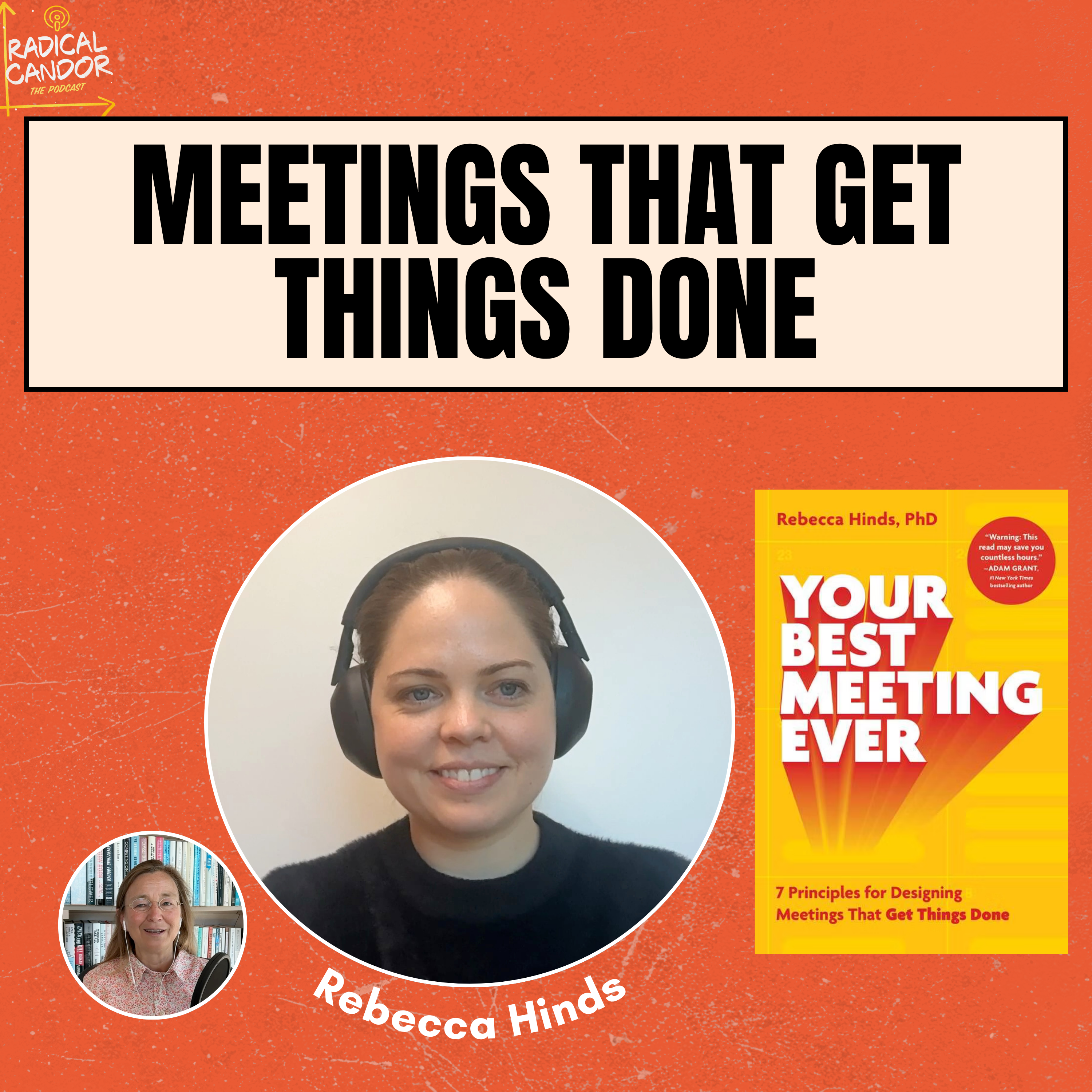
Table of Contents
In 1944, the U.S. Office of Strategic Services — the wartime precursor to the CIA — printed a field manual for ordinary citizens living under occupation, full of quiet ways to sabotage the enemy. One of its recommended tactics: run long, inefficient meetings. Eight decades later, that "sabotage" looks a lot like business as usual. Leaders spent under 10 hours a week in meetings back in the 1960s; today it's more than double that, and climbing since the pandemic.
On this episode of the Radical Candor Podcast, Kim talks with Rebecca Hinds, author of Your Best Meeting Ever: 7 Principles for Designing Meetings That Get Things Done. Rebecca has spent more than 15 years studying how work actually gets done — she founded the Work Innovation Lab at Asana and now leads the Work AI Institute at Glean — and she and Kim dig into why more meeting tools haven't made meetings any better, and what would.
Watch the episode:
Rebecca opens with the story of the OSS's Simple Sabotage Field Manual, declassified only in 2008, which advised resistance members to disrupt enemy operations by running unproductive, long-winded meetings and pushing everything "through channels." It's a wartime tactic — but as Rebecca and Kim discuss, most of what it describes reads like an ordinary week in a lot of organizations today.
Leaders spent less than 10 hours a week in meetings in the 1960s. By the turn of the century that had more than doubled to 23 hours, and the time spent specifically in dysfunctional meetings has kept rising since the pandemic — across every level, from individual contributors to executives. Rebecca argues that's a symptom of a broken communication system, not a fact of modern work.
Rebecca and Kim walk through her framework for fixing meetings: deciding which ones shouldn't exist at all, measuring whether the ones that remain are actually working, and redesigning meeting flow and structure around how people actually focus and communicate — rather than defaulting to a recurring calendar invite.
The conversation turns to culture: how leaders can build teams where people feel safe disagreeing openly in a meeting, and when to move a conversation to strong asynchronous communication instead. Rebecca and Kim also talk about preparation, timing meetings to people's natural rhythms, and using technology to support collaboration instead of adding more noise to it.
[00:00] Rebecca Hinds: So at the at the highest level, right, technology should amplify what's best about us as humans and the technology.
[00:07] Kim Scott: Yes.
[00:09] Rebecca Hinds: and we should be using technology strategically, not just because we can use technology. I talk a lot about AI. Unfortunately, I'm seeing more examples of AI making our meetings worse than making our meetings better. the the number of note taker bots that come to meetings and you
[00:28] Kim Scott: Yes.
[00:28] Rebecca Hinds: know, the number of people people who deploy their bots instead of showing up themselves. Right. Those are the epitome of, you know, where technology can go
[00:36] Kim Scott: It's yeah.
[00:37] Rebecca Hinds: wrong.
[00:43] Kim Scott: Hello, everybody, and welcome to the Radical Sabatical. The rest of the Radical Canner team is focusing on summer, and I am thrilled to be here today with Rebecca Hines. I'm talking to a bunch of my favorite authors. And Rebecca Hines is the author of Your Best Meeting Ever, And this book is gonna help you. love your work and the people you work with more than ever. So welcome Rebecca.
[01:15] Rebecca Hinds: Thank you so much for having me, Kim.
[01:18] Kim Scott: it's a thrill to be talking to you. And you start this book with an incredible story, about how meetings actually were wartime weapons. So can you share that with folks?
[01:31] Rebecca Hinds: Sure. So I I start the book with the story of what's called the Simple Sabotage Field Manual. And this was a manual written in World War Two era. It was written by the Office of Strategic Services, which was essentially the
[01:44] Kim Scott: Mm-hmm.
[01:44] Rebecca Hinds: precursor to the CIA. It was only declassified in two thousand and eight, so relatively, you know, recently in the grand scheme of things.
[01:54] Kim Scott: Right.
[01:54] Rebecca Hinds: And it's fascinating. You know, the manual was designed to advise Ordinary citizens, so people like all of us who were living in enemy territory, advise them as to different ways to disrupt the enemy, inject inefficiencies into enemy operations.
[02:13] Kim Scott: Right.
[02:14] Rebecca Hinds: And one of the tactics that was mentioned throughout the manual is meetings. You know, run unproductive meetings, long-winded meetings, do everything through channels, right? And you read this manual,
[02:27] Kim Scott: Wow.
[02:27] Rebecca Hinds: and certainly there are components. Where you can tell it's World War II. But when we think about the aspects around meetings, you know, largely the same as, you know, how we might think about, you know, inefficient meetings today. And it's, you know, it's ironic, it's unfortunate, it's a little bit humorous that this,
[02:46] Kim Scott: Yeah.
[02:46] Rebecca Hinds: you know, tactic that was once advised as a weapon of of sabotage is now very much business as usual in in too many organizations.
[02:55] Kim Scott: That's like pouring sand into the gas tank. Right?
[02:58] Rebecca Hinds: Well I think I I I think that was actually one of the gravel gravel in the in the sh right. And well yes, and
[03:02] Kim Scott: Yes. Gravel or sugar into although sugar was rationed, so you probably wouldn't waste your sugar that way.
[03:11] Rebecca Hinds: you know, it's it's metaphorical today. It was less so back then, but but still a lot of these tactics ring ring largely familiar.
[03:20] Kim Scott: Yeah. Yeah. It's unbelievable. well, thank you for starting that way, 'cause I think that's how a lot of people feel about meetings. So there's one other statistic that really that really struck me. In the nineteen sixties, how many how many hours a week did most leaders spend in meetings?
[03:40] Rebecca Hinds: Less than 10 hours, less than 10 hours per week. And by the turn of the century, you know, we were seeing that double. 23 hours per week spent in meetings. and we continue to see not only does the time in meetings increase, but in particular since the pandemic, we've seen the time we spend across every level, from individual contributors to executives,
[04:05] Kim Scott: Mm-hmm.
[04:06] Rebecca Hinds: the time we spend in dysfunctional meetings increase. And that is, you know,
[04:10] Kim Scott: Yes, yes.
[04:11] Rebecca Hinds: when we think about communication, the communication system, right? That is a function of a broken communication system. There's no reason why we should be spending more time in dysfunctional meetings than we've ever spent before. We have all of this technology. The technology
[04:24] Kim Scott: Yes.
[04:27] Rebecca Hinds: is often not working for us.
[04:29] Kim Scott: so you have seven solutions to this problem. The get us back to the glorious years in the nineteen sixties the economy was growing faster and we were spending less time in meetings. But not no time in meetings.
[04:42] Rebecca Hinds: Uh-huh.
[04:43] Kim Scott: so you have seven things: volume, measurement. meeting minimalism flow engagement timing and technology. So let's start with number one. You have a radical suggestion for the volume of meetings on calendar.
[04:57] Rebecca Hinds: I do. And when we think about so these seven ideas, they're very much grounded in product design principles. So the premise of the book is we need to treat meetings like a product. Meetings are the most important product in our entire organizations where decisions get made. And so we should be applying the same product design principles that we know make great everyday products work to our meetings. So volume is, you know, just as we have technical Debt that builds up in our products. Well, we have meeting debt that builds up on our calendars. So I think we all
[05:28] Kim Scott: Mm-hmm.
[05:28] Rebecca Hinds: feel it. These legacy meetings that perhaps
[05:30] Kim Scott: Yeah.
[05:31] Rebecca Hinds: were valuable six months ago, not valuable today. And so, you know, I've worked with organizations over the years to think about how do we do a calendar cleanse? I call it a meeting doomsday. It's essentially a 48-hour cleanse
[05:43] Kim Scott: Mm-hmm.
[05:44] Rebecca Hinds: where employees will delete recurring meetings from their calendar. After those 48 hours have elapsed, they're invited to rebuild their calendars from scratch. So add back the meetings that have
[05:56] Kim Scott: Mm-hmm.
[05:57] Rebecca Hinds: some value, but make sure you're designing them in a way that's going to be most valuable for the current state of work. And any meetings that lack value, don't bring them back at all. Right. It gives that social permission to clean the slate. Often we feel so much guilt associated with pushing back or decl deleting meetings. This gives employees the social permission to do so.
[06:22] Kim Scott: So we're gonna sunset all recurring meetings.
[06:26] Rebecca Hinds: Sunset all recurring meetings that have outlived their value and for the ones that still have value, figure out, okay, how do we design them across every dimension, length, cadence, attendees, agenda items to be most valuable for our current state of work.
[06:43] Kim Scott: I love that. one of the people who I really enjoyed working with at one of my startups, and then we also worked together at at Google, used to come in every morning, look at his calendar, and routinely just cancel one meeting. And it felt like everybody
[07:00] Rebecca Hinds: Yeah.
[07:02] Kim Scott: was like, my God, you can't do that. That's so you know, but it it It bought him an hour a day and that was really valuable. What do you think about that approach as as kind of a version? I don't know if it's a softer or harsher version of the meeting cleanse.
[07:17] Rebecca Hinds: So I love and what I what I find in the most effective organizations, they and our our mutual colleague and friend Bob Sutton will talk a lot about subtraction and the importance of subtraction. Light Lydie Klotz as well has
[07:29] Kim Scott: Yes. Yes.
[07:31] Rebecca Hinds: done amazing research. And what I see consistently is the most effective organizations, they have some rhythm where they are incentivizing or building in a subtraction habit. To their day-to-day. And that's what essentially this is. You know, it's it, you know, it's building and subtraction, not just
[07:47] Kim Scott: Mm-hmm. Yeah. Yes.
[07:50] Rebecca Hinds: our bias to add. So I love that aspect. We also need to recognize that meetings are highly interdependent on other people. You know, they're not something that just affects us as individuals. And that's the problem. You know, if you're, if there's a level
[07:58] Kim Scott: Yes, yes, that's that's the problem. Yeah. Yeah.
[08:05] Rebecca Hinds: of unpredictability, especially if you're in a position of power, you're deleting meetings, you know, there are all of these psychological factors that kick in. employees overanalyze why was it deleted? You know, what does this mean? What is the hidden
[08:17] Kim Scott: Yes, yeah.
[08:19] Rebecca Hinds: meeting? So that aspect I I don't love, but you know, we need to be diligent about the subtraction just as much as our knee-jerk reaction to add these things to our calendars.
[08:30] Kim Scott: how do you know like for example, I believe a one on one meeting with each of your direct reports, if you are a manager, is those are your most important. Do I do I do those meetings, they're standing meetings, do they also get subjected to the calendar cleanse?
[08:49] Rebecca Hinds: They they should. now one on one meetings I agree. There's no more important type of meeting for the well being of your employees and your organization. These are meetings that, you know in most cases should be on the calendar on a recurring
[09:05] Kim Scott: Mm.
[09:06] Rebecca Hinds: basis, you know, weekly meetings. There is nothing a manager can do that's more impactful for the direct report. But we should be thinking about okay, are they at the right cadence? Are they the right length?
[09:18] Kim Scott: Yes.
[09:19] Rebecca Hinds: in particular, have we designed the agenda to make these meetings most impactful? I'm a big proponent for the direct report taking ownership in designing the agenda. Certainly
[09:30] Kim Scott: Yes.
[09:32] Rebecca Hinds: I think it should
[09:32] Kim Scott: Yes.
[09:32] Rebecca Hinds: be a collaborative effort. But, you know, often we see these meetings being held very performatively, very much power-driven, where it's, you know, largely
[09:42] Kim Scott: Mm-hmm. Yeah.
[09:43] Rebecca Hinds: the manager designing the agenda, right? We need to think about, you know, how do we design these these these meetings, the agendas, to ensure that we are setting our employees up for success and we're giving them what they need out of the meeting, not just what we need as the manager.
[10:01] Kim Scott: Yeah, yeah, yeah. Never give feedback in a one on one, I would say. Like 'cause then your employee dreads it. Ya you know, that's it's your time to listen to them and to learn what they need. Yeah.
[10:06] Rebecca Hinds: Mm-hmm. Yes. Yes. Solve problems and mm-hmm.
[10:14] Kim Scott: So next let's talk about suggestion number two. now people have done this cleanse, they figured out which ones they need to keep, they've got they've scraped the barnacles off the ship. next you talk about measuring. So how do you measure the effectiveness of a meeting?
[10:32] Rebecca Hinds: This is this is hard. It's less hard now than it was Pre-AI, and I'm working with
[10:38] Kim Scott: Mm.
[10:38] Rebecca Hinds: a lot of different companies to think about okay, how do we actually use objective behavioral data to measure our meetings?
[10:44] Kim Scott: Mm-hmm.
[10:44] Rebecca Hinds: But one of the simplest things we can all do is what I call, and I learned from my colleague Elise Keith, return on time investment. After about
[10:53] Kim Scott: Mm-hmm.
[10:53] Rebecca Hinds: 10% of the meetings you run, ask attendees:
[10:56] Kim Scott: Mm.
[10:57] Rebecca Hinds: Was this worth the time you invested on a scale of zero to five? And as a bonus, what could I do as the organizer to boost that rating by
[11:07] Kim Scott: So you're soliciting feedback about the meeting.
[11:11] Rebecca Hinds: Just as you would in any other product or service, right? We would never launch a product to our customers without asking
[11:14] Kim Scott: Yeah. Yeah.
[11:17] Rebecca Hinds: for customer feedback, surveying our customers. Now it's not a heavy lift. It's two to three minutes after you know, 10% of the meetings you lead, but you get a ton of information. You get a ton of information. Often you find there are split ratings. You know, you have half the meeting
[11:34] Kim Scott: Mm-hmm.
[11:35] Rebecca Hinds: attendees rating the meetings five or four, but you have another half rating them zero to one, right? In that Case it's pretty
[11:41] Kim Scott: Mm-hmm.
[11:42] Rebecca Hinds: clear the solution. The solution is half the meeting attendees don't need to be in that meeting. But most of us don't
[11:47] Kim Scott: Right. Right.
[11:49] Rebecca Hinds: take the time to get feedback, to not to gather feedback. And what we also know to be true is there are two people, two types of people who tend to leave meetings more satisfied than anyone else. This is great research my colleague Steven Rogelberg has done. It tends
[12:07] Kim Scott: Yes.
[12:08] Rebecca Hinds: to be the meeting organizer, right? The meeting organizer tends to leave.
[12:10] Kim Scott: Yeah. Thanks. That's
[12:11] Rebecca Hinds: the meeting
[12:11] Kim Scott: awesome.
[12:12] Rebecca Hinds: because they've they've designed it. And the person who who talked the most is the is the second type of person because, you know, they they were able to influence and and share their opinions and you
[12:23] Kim Scott: Yeah.
[12:23] Rebecca Hinds: know dominate the the airtime. So we need to get in the habit of not designing our meetings for ourselves as the organizer, but designing them for the users of the meeting, which are the attendees.
[12:35] Kim Scott: so and how do you how do you do that? Do you just send an email out? can you like bake that into the calendar invite automatically so it so it auto magically does and then just delivers this feedback to the meeting organizer?
[12:48] Rebecca Hinds: Yes, it should be automated. It should be anonymous in most cases. but you there's certainly lots of, you know, automations we can do. I've seen automations built into work management platforms where you, you know, the meeting concludes, you're given a follow-up task to complete this two to three minute activity, certainly build it into to calendaring systems as well. And then what I've also seen is organizations start to say, Okay, if an organizer is getting Low, low, low ratings, we're going to give them nudges to encourage them to design the meeting more effectively. And if they fail to do so, you know, that meeting is going to be flagged as one that should be considered to be, you know, deleted permanently. Mm-hmm.
[13:35] Kim Scott: Right. Maybe a little training for the meeting organizer. a a little help for them. And also maybe a little bit of maybe a prompt for the meeting organizer to share the feedback and to have a actual conversation for at the ten minute, you know,
[13:50] Rebecca Hinds: Yes. Yes.
[13:53] Kim Scott: s take ten minutes once every ten meetings seems like a good way to make sure it's on track.
[13:57] Rebecca Hinds: Yes. Yes, certainly. And I'm seeing so many examples of organizations do this really well. And that public sharing of the feedback gives employees a lot of confidence and it demonstrates your leadership as an organizer and person within the organization. If you can think strategically about how do I take this feedback, share it, and use it to improve the the overall design.
[14:22] Kim Scott: Yeah, yeah. Love it. All right. Measure what matters. so what about meeting minimalism? how can we y we have fewer meetings and then we gotta make the meetings sort of have a smaller footprint, maybe. How does that work?
[14:37] Rebecca Hinds: Mm-hmm. So meeting minimalism really entails four key dimensions of our meetings: the length, the cadence, the attendees, and the agenda items. And for
[14:48] Kim Scott: Mm.
[14:48] Rebecca Hinds: each of these dimensions, there are different strategies we can put in place to ensure not just that our meetings are more efficient, but also they're more effective as well. So thinking about the length, we know that meetings suffer from what's called Parkinson's Law, meaning work expands
[15:02] Kim Scott: Yeah. Yes.
[15:04] Rebecca Hinds: to fill the time allotted. We all feel it. We give a meeting 30 minutes, probably It's going to take 30 minutes, regardless of whether it needs it or not. So really creative strategies in terms of, okay, how can we become more intentional about setting lengths? I studied an individual for the book who ran 27-minute meetings. And even a small change like that can jolt people out of the status quo because they start to question, okay,
[15:31] Kim Scott: Yeah.
[15:31] Rebecca Hinds: why is the meeting now 27 minutes? Did we really need 30 minutes? And
[15:33] Kim Scott: Yeah. Yeah.
[15:35] Rebecca Hinds: a large part of this is just getting people out of The inertia that happens with meetings, getting people out of that rhythm of assuming that the 30 minute weekly meeting is the right cadence and length for the task at hand. It's only right because that's what our calendar tells us should be a meeting. There are no reason, no logical, rational reason why most of our meetings should be, you know, that default of 30 or 60 minutes weekly or monthly. We should be thinking much more intentionally about how we design those aspects. Because the next natural step and thing that happens is the the the attendees start to really question, okay, what is needed for this meeting to be effective.
[16:20] Kim Scott: there was one guy I worked with also at Google one of his OKRs every quarter was to to end at least fifty percent of his meetings early. And he would announce it at the beginning and it was such a relief.
[16:30] Rebecca Hinds: Yeah.
[16:33] Kim Scott: It's like all right, we're done. In fact, I was on a meeting today with a wonderful radical candor salesperson and sh The meeting was an hour and she said, I don't think we're gonna need the whole hour and everybody got thirty minutes back. Like, what a gift. It was great.
[16:47] Rebecca Hinds: Yeah. It's a gift. It's a I I t I I share a little bit of research in the book on how powerful that can be. time confetti, it's often called, you know, giving
[16:57] Kim Scott: Yes.
[16:57] Rebecca Hinds: people back the the gift of time is one of the most powerful things we we can do. And certainly we don't want every meeting to to end early, but
[17:06] Kim Scott: Yeah.
[17:07] Rebecca Hinds: but definitely giving people that gift of time back is is just that. It's it's a gift.
[17:14] Kim Scott: another thing that you said that I say all the time, I wholeheartedly agree with this, is make all your thirty minute meetings twenty five minutes and all your hour long meetings fifty minutes. because those five or ten minutes in between meetings, I mean, A, you have to go to the bathroom. That certainly is one of the things.
[17:30] Rebecca Hinds: Right.
[17:31] Kim Scott: But that's when most the that's when the best feedback I've ever gotten in my career has always happened in those spaces in between meetings.
[17:38] Rebecca Hinds: Yes. Certainly. And then the question is, and I did quite a bit of research, probably a little bit too much research in terms
[17:45] Kim Scott: Yeah.
[17:45] Rebecca Hinds: of okay, what happens when you start five minutes late versus end five minutes early, or same with you know,
[17:52] Kim Scott: Yeah.
[17:53] Rebecca Hinds: ten. And there, you know, are lots of reasons why it can be more effective to start the five minutes late or the ten minutes late as opposed to
[18:01] Kim Scott: Yes.
[18:01] Rebecca Hinds: ending early because w you know, one of the key reasons is you're not up against Parkinson's law, right? Those those meetings at the end no longer exist.
[18:07] Kim Scott: Yes, yeah, yeah.
[18:10] Rebecca Hinds: And so you're more likely so that's I studied some fascinating individuals who went through the the the thought process of, you know, where do you put those meetings? do you put it on the front end or the the back end?
[18:23] Kim Scott: Yeah. So the other thing that you talked about that was very wise is the number of people in the meeting. one of the things I describe in radical canner is there came a moment when I realized with my staff meeting that everybody who was in it felt like it was a waste of time and took too long and everybody who was not in it felt sad and bad and left out. I'm like, this is the worst of all.
[18:42] Rebecca Hinds: Yeah.
[18:44] Kim Scott: So how do you decide who needs to be there and who doesn't?
[18:48] Rebecca Hinds: I I studied an individual, I I don't know if it made I don't think it made into the book, but he used to run these meetings and he Became upset that no one was showing up to the meetings. So he started to make it a very close group. It was an exclusive group of five or six people. And then everyone wanted to attend the meeting, right? Because there's this fear of missing out that is at
[19:09] Kim Scott: Yeah.
[19:12] Rebecca Hinds: the core of, but absolutely, you know, a lot of this is psychology. And what we know with, you know, a lot of certainty is once a team size, any team size, but this holds for meetings certainly,
[19:25] Kim Scott: Mm.
[19:26] Rebecca Hinds: once a team size gets above seven. or eight people, a whole host of negative consequences start to kick in. Sometimes it's called the Ringleman effect where
[19:35] Kim Scott: Yes.
[19:36] Rebecca Hinds: social loafing kicks in, people start stop feeling accountable for the outcome.
[19:38] Kim Scott: Yes. Yeah.
[19:41] Rebecca Hinds: We start to veer towards consensus, people start
[19:44] Kim Scott: Yes.
[19:44] Rebecca Hinds: to stop feeling comfortable sharing dissenting opinions. And in particular, when we start to think about decision-making meetings, as soon as we get above seven or eight people, you know, the decision quality decreases significantly. We need to think very carefully about who needs to be in the meeting. And, you know, spectators don't need to be in the meeting. People who might need to stay abreast of what happens in the meeting but aren't actively contributing. Well, they can if we've developed the
[20:14] Kim Scott: They can get the notes, yeah.
[20:16] Rebecca Hinds: a hundred percent, and that's often a big problem. You know, if if people feel like the information about the meeting, what happens in the meeting is transparently shared after the fact, well, they're significantly less likely to feel like they need to be in the meeting because they can self-serve
[20:34] Kim Scott: Yeah.
[20:35] Rebecca Hinds: the information through through other channels.
[20:37] Kim Scott: There's a whole song about this in the room where it happens, right? So how do we how
[20:41] Rebecca Hinds: Yes, yes.
[20:43] Kim Scott: how do we make it be less important to be in the room where it happens?
[20:46] Rebecca Hinds: Mm-hmm. Mm-hmm. Transparency is a is a key way to do that.
[20:50] Kim Scott: Yeah, yeah. Okay. Let's now talk about flow. I love this chapter. I have so many questions.
[20:58] Rebecca Hinds: Ha ha ha.
[20:59] Kim Scott: so my first question is this you you made the point about Sandy Pentlin, I think that was the name, could predict a
[21:05] Rebecca Hinds: Yes.
[21:05] Kim Scott: team's success by studying their communication patterns. Can you describe in three words what the right communication pattern is? Maybe not three words. I'll give you thirty.
[21:16] Rebecca Hinds: Well meh. One of the biggest predictors of team effectiveness is equality, airtime equality,
[21:25] Kim Scott: Yeah. Yeah.
[21:26] Rebecca Hinds: right? If we start to see, you know, you never want to create situations where everyone is contributing exactly equal, right? That doesn't make sense. But
[21:36] Kim Scott: Mm-hmm. Mm-hmm.
[21:38] Rebecca Hinds: all else being equal, if you're seeing wildly lopsided contributions in meetings, that is one of the biggest best signs that the meeting doesn't need to be a meeting. Probably it can be a status update, a BOSS briefing, or,
[21:52] Kim Scott: Yeah.
[21:53] Rebecca Hinds: you know, it hasn't been designed in a way that is going to make the meeting more most effective if you're having, you know, wildly different airtime distributions across participants.
[22:02] Kim Scott: Yeah. The bloviating bullshitter does a lot of harm, I think. okay,
[22:06] Rebecca Hinds: Yes, yes, I agree.
[22:10] Kim Scott: what about tools? what what Talk talk to me about tool like I have I have so many questions here. so talk to me about tools.
[22:21] Rebecca Hinds: there's there's so much here. You know, we could talk for for hours and hours just about this
[22:25] Kim Scott: Hours, yeah.
[22:26] Rebecca Hinds: piece. It's you know, every organization is under you know, under pressure. From an ineffective, unproductive communication system. It looks different in every organization, but this is why
[22:44] Kim Scott: Mm-hmm.
[22:45] Rebecca Hinds: we saw dysfunctional meetings increase through the pandemic. Organizations started to stockpile all of these communication tools: Slack, Zoom, Asana,
[22:55] Kim Scott: Mm.
[22:56] Rebecca Hinds: Figma, Canva. None of them spoke well together. Work
[23:00] Kim Scott: Yeah.
[23:00] Rebecca Hinds: started to live in four, five, six different places. Employees
[23:04] Kim Scott: Mm.
[23:05] Rebecca Hinds: started to confuse urgency. See with importance, the slack ping that comes in that's immediately gets
[23:11] Kim Scott: Yeah.
[23:11] Rebecca Hinds: to the top of the priority list. When work starts to live in five different places, when workers are no longer sure where to go to find the real work, well,
[23:21] Kim Scott: Yeah.
[23:21] Rebecca Hinds: meetings start to become that default solution because they start to feel and sometimes are the most reliable way to get information or share information. It becomes this really toxic spiral where if we don't take a step back and understand. understand okay what is the specific purpose of each tool and how should I be using each tool? What are the SLAs? You know, what happens when a slack ping comes in? Do I need to respond to it immediately? Well if you don't create the expectation that that's not the case, employees will default to that, you know, rapid ping-ding response. It becomes very, very detrimental. And we're seeing it now with AI on another level. You know, there's a whole new subset of tooling that employees feel pressured to respond to and with. Often
[24:10] Kim Scott: Yeah.
[24:11] Rebecca Hinds: the, you know, there's not a concerted effort into what is the bigger communication system and how do I use each specific Yeah.
[24:22] Kim Scott: Yeah, yeah. and I think also there's like I mean, I've managed to make my phone never ever make a noise and my computer never ever makes a noise, except a phone call that will make a noise. So that's great.
[24:33] Rebecca Hinds: Yeah, yes.
[24:34] Kim Scott: But why do we have all these things Dinging it. You can't really hear yourself think
[24:42] Rebecca Hinds: this is why notification pausing is so important, being able to shut off the the pings and dings because they're they're dopamine hits and, you know,
[24:52] Kim Scott: Yes.
[24:53] Rebecca Hinds: we have natural human reactions. It's, you know, I do I've done a lot of research over the years on, you know, collaboration tools. We call it the toggle tax that happens within organizations
[25:04] Kim Scott: Mm-hmm. Yeah.
[25:05] Rebecca Hinds: where you can look at, and there's been research to suggest that if we are talking about an enterprise organization, a Fortune 500 organization, workers pre AI were switching between tabs and apps twelve hundred times per day. You know, it's enormous. And that's not, you know Often not a direct impact of pings and dings. It's a direct impact of work living in so many different places and you know technology
[25:35] Kim Scott: Yes.
[25:36] Rebecca Hinds: not communicating. We know that it can take more than 23 minutes to return back to your original task once you are distracted and go to another tab or app. It's a massive cost that we don't often appreciate because we live in this, you know, technology-enabled world where if we take a step back and really look at the cost. We recognize that you know the cost often offsets and overwhelms the the benefit of potentially, you know, the one or two use cases you might use a another tab or app or tool for.
[26:10] Kim Scott: Yeah, yeah. Protecting that builder time is important. that sort of hour and a half long chunks of time to where you can really think. all right. Another thing that I love that you said is the four Ds. A meeting should an in a meeting you should either decide, discuss, debate, or develop. either a person or an idea. But what is the difference between discuss and debate? In my mind I've lumped those two things as the same kind of meeting.
[26:40] Rebecca Hinds: They they can certainly both happen in the same meeting. Debate is you are very clear on the options at play and you're weighing
[26:50] Kim Scott: Got it.
[26:51] Rebecca Hinds: the trade offs of each one. Discuss is more in the brainstorming. Camp, right? It's pre-outlining
[26:57] Kim Scott: Yeah.
[27:00] Rebecca Hinds: the specific courses of action in terms of what are we even trying to optimize for. now I talk a lot about brainstorming and how those very early brainstorming, ideally, there should be some independent brainstorming before collective brainstorming, but discussion I'd say is is is is much earlier in the coordination life cycle where we might not even be sure. Yeah.
[27:30] Kim Scott: Yeah. Okay. That's really helpful. And I think in all of these kinds of meetings, we need to learn how to disagree. Like we need to learn
[27:38] Rebecca Hinds: Yes.
[27:39] Kim Scott: how to disagree with each other in public. it's really interesting. I my I have twins who are seventeen and I did an AI class with my son last weekend. It was really fun. And I disagreed with something that the person who was facilitating the class said and I I said what I thought. And I thought my son was gonna jump under the table or punch me in the nose. He was like he just couldn't believe that I disagreed publicly. So why are we so reluctant to do this? Like has maybe life has just become so psychologically unsafe that that kids these days feel like they can't like I I disagreed in public. I can remember telling my art history teacher in high school, like, this modern art's a bunch of B S and she's like, You do have strong opinions. uninformed opinions, but strong.
[28:35] Rebecca Hinds: Yeah, it's so important. And when we look at the great, you know, organizations and the great leaders, you know, in history, they've created environments where it does feel safe to disagree. And,
[28:48] Kim Scott: Yes.
[28:48] Rebecca Hinds: you know, we hear disagree and commit. Amazon was
[28:51] Kim Scott: Yes.
[28:51] Rebecca Hinds: was famous for for sort of championing that. But in the best organizations, there's a culture of we are going to debate openly and share
[29:01] Kim Scott: Mm-hmm.
[29:02] Rebecca Hinds: dissenting opinions once we've committed to the Idea or the course of action, right? We're gonna live and breathe it ideally. So there's not this, you know, untangling of the decision after the meeting. But I think as humans, you know, we avoid conflict, you know, all else being equal, and we
[29:17] Kim Scott: Mm-hmm. Yeah.
[29:19] Rebecca Hinds: veer towards harmony and consensus. And that is a big problem because you don't get the diversity of opinions, you don't get the real raw
[29:27] Kim Scott: Yeah.
[29:28] Rebecca Hinds: conversations, the creativity, the innovation, and so much of it does have to do with psychological safety. and the environments we've we've created within our our organizations.
[29:40] Kim Scott: Yeah. And I think if we can't disagree in any of those other four D meetings, then we have the meeting after the meeting. Which and the meeting before the meeting. And that is
[29:49] Rebecca Hinds: Mm yes, yes. Yes.
[29:53] Kim Scott: meeting proliferation disaster.
[29:56] Rebecca Hinds: Yes, and the politics. I mean, if there's not a
[29:58] Kim Scott: Yeah.
[29:58] Rebecca Hinds: openly transparent culture around disagreeing, well, if you disagree, you're going to try to, move forward with that disagreement through back channel communications, which, you know, is almost always worse than the than
[30:10] Kim Scott: Yes.
[30:11] Rebecca Hinds: the live conversation.
[30:13] Kim Scott: Yeah. And the other really great point you made in this chapter is about strong asynchronous cultures. BS doesn't
[30:21] Rebecca Hinds: Yes.
[30:22] Kim Scott: survive. Like you c don't you're not allowed to have the meeting after the meeting and a s so talk a little bit about why that is, 'cause I think it was a really important point.
[30:31] Rebecca Hinds: And one of the biggest misconceptions, and we certainly saw this through the pandemic, I continue to see it in organizations. We we often assume that Technology is inherently synchronous or asynchronous. That is not the case, right? There's no technology that we can use
[30:44] Kim Scott: Yes. You know it's not.
[30:47] Rebecca Hinds: every technology synchronously, and Slack is the classic example, where in theory it
[30:51] Kim Scott: Yes.
[30:51] Rebecca Hinds: can be an asynchronous, it rarely is it. And so building an asynchronous communication culture involves several different components where technology is often, you know, not as important as some of these other dimensions. Strong documentation cultures, strong written
[31:07] Kim Scott: Mm.
[31:08] Rebecca Hinds: communication cultures. I work with an organization. That has a norm around no lazy asks, right? If we're going to ask someone
[31:14] Kim Scott: Yes.
[31:15] Rebecca Hinds: to do something, we need to provide the why, the context, you know, where it is in the scheme of priorities. Because if we don't, we're going to have to have those synchronous interactions to make sense of the complexity and ambiguity that we could have communicated in advance. My colleague Jen Reimer, who's at University College of London, she's done a lot of research to show it's not just enough to document the end product. And have you know the documents in their final state available for asynchronous consumption, we also need to be documenting the why behind decisions because we know
[31:50] Kim Scott: Mm.
[31:51] Rebecca Hinds: organizations suffer from amnesia. You know, we relitigate decisions,
[31:55] Kim Scott: Yeah.
[31:55] Rebecca Hinds: we make the same decisions over and over again, bring up the same debates, right? If you're also documenting the why behind why certain decisions or courses of action have occurred within the organization, you also create strong asynchronous norms because people can. can also self-serve the why behind the decision.
[32:15] Kim Scott: I love that. And and what about having scheduling time to read the doc like I I want you to read this Rebecca,
[32:20] Rebecca Hinds: Yeah.
[32:22] Kim Scott: I want you to read this by noon on Thursday. Am I then allowed to like try to put some time in your calendar or ask you to put time in your calendar? Or I think this is part of the genius of the of the Jeff Bezos with the first ten minutes of the meeting, we're actually gonna sit together and read the document because otherwise half the people will have read it and half the people won't. And then we're starting off the meeting with everybody annoyed at everybody else.
[32:52] Rebecca Hinds: Yes. And there's the you know, there's the ideal state and then there's the realistic state. The ideal state
[32:58] Kim Scott: Yeah.
[32:58] Rebecca Hinds: is that everyone does their homework. You know, you say there's a pre-read for a meeting and everyone is expected to do that pre-read.
[33:05] Kim Scott: I will never do the pre read, so I'm not even gonna say that's ideal. It's not ideal for me.
[33:10] Rebecca Hinds: Well it's it's not I I mean there's there's certainly organizations where that is the expectation
[33:19] Kim Scott: Yes.
[33:19] Rebecca Hinds: and people show up prepared. The vast majority that is not the case. It's ideal because everyone consumes information at different sta paces, they all
[33:31] Kim Scott: Paces. Yeah.
[33:33] Rebecca Hinds: are coming in with slightly different levels of context as to the meeting. And so it is i ideal in the sense of it i everyone will will s need to spend different amounts of time. And so to s to to structure the study hall as Amazon does brilliantly isn't, you know, ideal in the sense that people are going to finish the the reading in 10 minutes versus 15 minutes.
[33:56] Kim Scott: Yeah. Yeah.
[33:57] Rebecca Hinds: But the reality is that doesn't happen in most organizations. And so I am in those cases a proponent of having these study halls blocking time on the calendar because often we do need to carve out time and take control of our our calendars to be able to bake in that necessary time for for prep work. I think whether it's done by the individual or the organizer depends again on the the culture and context. but it's often, you know, what is warranted in our, you know, overwhelmed, overburdened
[34:27] Kim Scott: Yes.
[34:28] Rebecca Hinds: work life.
[34:29] Kim Scott: here's my ideal world. You can tell me if it would be your ideal world too. if you send me something and you want me to read it before Thursday at noon, there's a button in there and it says find time in my calendar to do this during working hours. And if I don't have any time to do it, I say, I'm so sorry I don't have time Part of the problem is when you s w when I get stuff like that, I'm like, I'm gonna have to do that tonight at ten thirty when I really need to be winding down and getting ready to for bed.
[35:00] Rebecca Hinds: Mm-hmm. So that that is half a step to my ideal. My ideal is, and I've seen this, I do this, with with AI right now. If AI knows enough about you, the organizational context, it can help you make that determination. And, you
[35:18] Kim Scott: Yes.
[35:18] Rebecca Hinds: know, you can imagine a world, and I I see it day to day where you've attended a meeting or you're prepping for a meeting, and AI will Auto schedule those focus blocks or those pre-read
[35:32] Kim Scott: Mm-hmm.
[35:32] Rebecca Hinds: times on your calendar and go the extra step in you know figuring out okay, given your specific working style and what's on your calendar
[35:41] Kim Scott: Yes.
[35:41] Rebecca Hinds: and the level of cognitive taxing that is going to happen
[35:45] Kim Scott: Mm-hmm.
[35:46] Rebecca Hinds: in preparation for this meeting and your chronotype. You know, where should I
[35:50] Kim Scott: Yes.
[35:51] Rebecca Hinds: be scheduling this this block in your calendar? And if you don't have the time, you know, auto-generating that note back to the organizer, not just saying you don't have time to to attend to the pre-read, but also XYZ reason why. Here are my priorities, here are where I think you know the meeting
[36:07] Kim Scott: Yeah.
[36:08] Rebecca Hinds: fits in. You can start to do this really exciting calculus that we've never been able to do before. Those are the things that I get really excited about in terms of the positive use cases of of AI.
[36:15] Kim Scott: Yes. Me too. AI. AI for the win.
[36:19] Rebecca Hinds: Okay.
[36:21] Kim Scott: and maybe AI will say, actually, Kim, you should skip this other thing 'cause reading Rebecca's document is more important than anything else on your calendar. it's not just like it's
[36:29] Rebecca Hinds: Yes. Mm-hmm. And that's why
[36:31] Kim Scott: blocked, but you should skip something else.
[36:34] Rebecca Hinds: Totally. The more we shift from reactive, which is, you know, very dangerous with the pings and dings and dopamine hits, to
[36:41] Kim Scott: Yes.
[36:42] Rebecca Hinds: proactive, you know, I wake up, I work for for Glean, the AI platform. I wake up every day and my priorities are prioritized for me, given, you know, what the AI tool knows about me and my organization, it starts to become a much more, you know, efficient but also empowering way to work because your human capability are directed at the things that you are uniquely suited to handle and everything around it, you know, can start to be offloaded and delegated to to AI or to other humans or, you know,
[37:15] Kim Scott: Mm-hmm.
[37:16] Rebecca Hinds: deprioritized because of where they sit in the grand scheme of things.
[37:22] Kim Scott: all right, I'm I'm sold. I'm ready to be gleaned. all right, so engagement. Talk about engagement in a meeting.
[37:33] Rebecca Hinds: And we've talked about several dimensions of this already. So meetings should be designed for the attendees. They shouldn't be designed first and foremost for ourselves
[37:41] Kim Scott: Yes.
[37:42] Rebecca Hinds: as the organizer. And so this has a couple different components. One is the agenda, making sure the agenda is relevant, useful for the people in the room. Sometimes this involves
[37:53] Kim Scott: Mm-hmm.
[37:54] Rebecca Hinds: ask asking the people, you know, to to weigh in or co-create the agenda. There's another big component about the physical. environment in the book that we don't often think
[38:03] Kim Scott: Mm-hmm. Mm-hmm.
[38:05] Rebecca Hinds: about. whenever is feasible. We shouldn't be having meetings in the same bland, you know, conference room. We should think
[38:11] Kim Scott: Yeah.
[38:11] Rebecca Hinds: about how can we inject energy, walking meetings, you know, there are lots
[38:15] Kim Scott: Yes.
[38:16] Rebecca Hinds: of reasons why walking meetings or standing meetings can be more effective. Plants, greenery, you know, the colors of the wall, the the shape of the table, all of these aspects, air quality, natural light, all of these aspects fundamentally change how we collaborate and, you know, they're underappreciated in in in how we design better better meetings.
[38:38] Kim Scott: Yeah, and also just the equipment needs to work.
[38:41] Rebecca Hinds: No, it's the technology makes a big difference. And
[38:44] Kim Scott: Yeah.
[38:45] Rebecca Hinds: there's also, you know, research I unpack in the book and you know, audio quality, our brains have very clear reactions to poor audio quality. And, you know, the harder it is for us to consume information, the more we start to trust that information less. And it's very fascinating. You know, we
[39:07] Kim Scott: Yes. Yeah.
[39:09] Rebecca Hinds: you know, quality of of Sound of video is a key way that we process information and the key a key way through which we trust other people as well and and information
[39:22] Kim Scott: Right.
[39:22] Rebecca Hinds: as well.
[39:23] Kim Scott: Yeah, yeah. So important. All right, timing. How do you decide
[39:28] Rebecca Hinds: Timing.
[39:29] Kim Scott: when to have the meetings?
[39:33] Rebecca Hinds: This is I this is one of my favorite chapters of the book because we don't think about it enough. And there are various rhythms.
[39:39] Kim Scott: Mm-hmm.
[39:40] Rebecca Hinds: You know, as humans, we are hardwired for rhythm. You know, the way we talk, the way we breathe, our steps when we walk, and great products, the same thing. You know, Netflix is giving us exactly the right recommendation at the right time, seemingly. Mm-hmm.
[39:53] Kim Scott: Yeah. At the right moment. Yes.
[39:56] Rebecca Hinds: And so we should be thinking about: okay, what are those rhythms within our organizations that we live in? And breathe every day, and how do we align our meetings to those natural rhythms? And so the obvious one is you know the fiscal calendar. How do we think about aligning our meetings to take advantage of that fiscal calendar? But also within, you know, project life cycles and team life cycles, there are specific moments within a project or life cycle of a team that matter more than others. One of my
[40:27] Kim Scott: Yes.
[40:27] Rebecca Hinds: favorite examples is the midpoint. You know, there's fascinating research, sometimes it's called punctuated. punctuated equilibrium where right in the smack middle of a team formation and the deadline, the end of the team life, whether that team lasts six hours, six days, six months, six years, the midpoint has this weird psychological power because we've officially used up half the time. And abundance turns to scarcity, right? So there's this natural
[40:56] Kim Scott: Yeah. Yes. That's so interesting.
[41:00] Rebecca Hinds: Burst of energy. Most teams don't take advantage of that, right? Very few project
[41:04] Kim Scott: Mm.
[41:04] Rebecca Hinds: leaders are saying, okay, we've reached the midpoint. I'm gonna capitalize on this natural burst of energy. But it's one of the most effective things we can do to catapult our team to the finish line. It is much more effective in most cases to schedule that meeting in the midpoint than to default to this weekly project meeting cadence that is, you know, just by default. And so they're, you know, thinking about rhythms, thinking about what we what happens at certain points within the project. I talk about premortems and the psychology behind why that works at the start of the project, you know, imagining the project has failed and and coming up with all the reasons why increases our ability to forecast risks. And it's most important at the start of the project because that's when optimism tends to be highest, right? Researchers call it the planning policy. All of
[41:54] Kim Scott: Yeah. Yeah.
[41:56] Rebecca Hinds: these moments in a project where we should be designing meetings around these moments. And not defaulting to the weekly, monthly cadence that has very little to do with the work itself.
[42:10] Kim Scott: That is so smart. That is I love that. All right. All right, last but not least, technology, which is different from tools. So explain explain the
[42:20] Rebecca Hinds: Yes.
[42:21] Kim Scott: use of technology in meetings.
[42:23] Rebecca Hinds: Huh. So at the at the highest level, right, technology should amplify what's best about us as humans and the technology.
[42:32] Kim Scott: Yes.
[42:34] Rebecca Hinds: and we should be using technology strategically, not just because we can use technology. I talk a lot about AI. Unfortunately, I'm seeing more examples of AI making our meetings worse than making our meetings better. You know, the the number of note taker bots that come to meetings and you
[42:53] Kim Scott: Yes.
[42:53] Rebecca Hinds: know, the number of people people who deploy their bots instead of showing up themselves. Right. Those are the epitome of, you know, where technology can go wrong. Mm-hmm.
[43:01] Kim Scott: It's yeah. What do you all about the bot about the note taker bots in meetings? 'Cause I had this very strong visceral reaction. I started my career in what was then the Soviet Union and and everything I did was surveilled. But the every room I was in had a listening device. And I I didn't think I was afraid of it. I mean I I didn't think I was gonna get arrested by the KGB or anything like that. So I thought, who cares? It's listening. I'm s I'm still me. And then one time I left Moscow and I flew to New York and I called my parents every Sunday and I c and I found I was talking much more openly to my parents from New York than I was from Moscow. I was like, it does have it. Like this s the the
[43:44] Rebecca Hinds: Yeah. Mm-hmm.
[43:47] Kim Scott: surveillance, it has a dampening effect on candor, which is something
[43:52] Rebecca Hinds: Yes.
[43:52] Kim Scott: I care a lot about.
[43:54] Rebecca Hinds: Yes. And that's why and we've done some research on this because I was, you know, I think very clearly most people are frustrated by the proliferation of these note taker bots when you have, you know, more note taker bots in the meeting than at human attendees, you know.
[44:12] Kim Scott: People. Yeah, people are sending their bots instead of themselves.
[44:15] Rebecca Hinds: And that is there are very few use cases where that makes sense. As soon as you
[44:20] Kim Scott: Mm-hmm.
[44:20] Rebecca Hinds: start to have more than one note taker bought in a meeting, it's probably a sign you haven't designed the meeting effectively because you should only have one note taker bot. You should figure out a way to disseminate that information. But transcriptions are a bit different. And that's where I've,
[44:35] Kim Scott: Yes.
[44:35] Rebecca Hinds: you know, long been on the fence because we talked about the importance of a documentation culture, a transparent culture,
[44:41] Kim Scott: Yes.
[44:42] Rebecca Hinds: right? Transcriptions are a key lever to do that. at scale, but at the same time, for exactly the reasons you've articulated so well, you know, there can be a negative impact. What's fascinating is we've done a little bit of research and this isn't published yet, but it's it's coming in terms of depending on how you are approaching AI fundamentally, whether you see it as a threat or whether you're enthusiastic
[45:07] Kim Scott: Mm-hmm.
[45:08] Rebecca Hinds: about it, well you have very different reactions to AI transcription happening in meetings. If you are in A in an environment where the mental model around the technology is that of a teammate where we really see the technology as amplifying our human capabilities. But if you're s if you're in an environment where, you know AI is being cited as the driver of layoffs. There are these top-down mandates to use AI, or else, as we see in so many organizations, and the technology is perceived as a threat. Well, you have a very different reaction to transcriptions and you start to
[45:46] Kim Scott: Mm-hmm.
[45:47] Rebecca Hinds: filter more and more. So
[45:49] Kim Scott: Yeah.
[45:49] Rebecca Hinds: that, you know, the culture matters a lot. And certainly I'm a proponent of certain meetings. There should never be another, you know, AI bot in the meeting. But I think all else being equal. equal, we should we should leverage the technology for transcriptions, but we should create environments where this technology is positioned as augmenting and amplifying human potential, not as a as a replacement or substitute.
[46:16] Kim Scott: Yeah, yeah. I think maybe if the transcription had a if we sunset the transcription, then I would feel less surveilled by it or something. Like I really want the power of AI, but I still feel
[46:30] Rebecca Hinds: Yeah.
[46:31] Kim Scott: I mean I and I so I've s sort of have come around to accepting the note takers as inevitable. and I view AI as a partner in all you know.
[46:41] Rebecca Hinds: Yeah.
[46:41] Kim Scott: But I
[46:41] Rebecca Hinds: Mm-hmm.
[46:42] Kim Scott: do I do worry that that it has a dampening effect.
[46:50] Rebecca Hinds: and again, this is where, you know, if we understand enough about the purpose of the meeting and what the end objective is, if it is for relationship building or honest, candid conversations, well, we're gonna think about transcription a little bit differently as opposed to whether this is, you know, debating, discussing, you know, s there's a lot of overlap. But the more we can be clear about what we're trying to achieve in the meeting and the level of emotional intensity involved and the psychological safety, well, we can start to also make the determination in terms of, okay, is a transcription or a note taker bot really going to help the outcome of that Aim as opposed to be in tension with it.
[47:32] Kim Scott: Yeah, I love it. Well, Rebecca, thank you so much. This writing a book is a labor of love. And I feel like your book is gonna help so many different teams communicate better. Because really, in the end, the meetings that we have with each other, it's about the way that we collaborate as human beings. So thank you so much.
[47:55] Rebecca Hinds: Thank you so much for having me, Kim. This has been fun.
[47:58] Kim Scott: Really fun. Where can people find you? And what should they do next? one I would say they should buy your book, but what else do you want to tell people to do next?
[48:08] Rebecca Hinds: My website's Rebecca Hinds dot com. So some of my research on meetings, but also other topics there. I lead our WorkAI Institute at Glean, so workAI dot institute is where you can find all the research on AI that we've done. and I'm on LinkedIn as well.
[48:26] Kim Scott: Amazing. All right, folks. You heard it here. Get your best meeting ever. Thank you so much. Take care.
Rebecca points to the OSS's Simple Sabotage Field Manual, a WWII-era guide for resistance members that recommended running long, inefficient meetings and routing everything through official channels to quietly disrupt enemy operations. Declassified in 2008, it reads as darkly familiar: many of its "sabotage" tactics describe exactly how meetings go wrong in organizations today.
Leaders spent less than 10 hours a week in meetings in the 1960s; by the turn of the century that had more than doubled to 23 hours, and time spent in dysfunctional meetings specifically has continued to rise since the pandemic. Rebecca frames this as a broken communication system rather than an inevitable cost of more work.
Rebecca's book, Your Best Meeting Ever, lays out seven principles for eliminating unnecessary meetings and redesigning the ones that remain — covering everything from measuring meeting effectiveness to structuring flow and communication so meetings actually accomplish something.
Kim and Rebecca discuss why encouraging people to voice real disagreement in the room — rather than saving objections for the hallway afterward — is central to meetings that actually move work forward, and how leaders can model and reward that openly.
Rebecca makes the case for shifting more work to strong asynchronous communication and better preparation, freeing meetings for the conversations that genuinely need real-time discussion, and timing the meetings that remain to people's natural energy and attention rhythms.
Three ways to put this into practice.
Explore the surprising science of meetings and how to make them suck less with Dr. Steven G. Rogelberg, a renowned organizational psychologist and...
Kieran Snyder, founder of nerd processor and co-founder of Textio, joins the Radical Candor podcast to explore inclusivity in meetings, revealing...
.png)
Endless meetings can be exhausting — but what if they could actually be productive and meaningful? Kim and Amy talk with Dr. Steven Rogelberg, author...
Share your perspective
Leave a comment below.