
*This article about learning is part of our new series about the Get Stuff Done (GSD) Wheel and has been excerpted from Radical Candor: Be a Kickass Boss Without Losing Your Humanity.
Consistency is the hobgoblin of little minds.”
— RALPH WALDO EMERSON, 'SELF-RELIANCE'
By the time you’ve reached “Learn” — the last spot on the Get Stuff Done Wheel — you and your team have put in a ton of work, you’ve achieved something, and you want it to be great.
And it is human nature for us to become attached — often unreasonably attached — to projects we’ve invested a lot of time and energy into. It can take almost superhuman discipline to step back, acknowledge when our results could be a lot better or are simply no good, and learn from the experience.

Drew Houston, co-founder and CEO of Dropbox, is the most committed and humble learner I’ve ever encountered in my career. The reason why Dropbox has hundreds of millions of users is because the company, led by Drew, has been relentless in making the product intuitive and easy to use.
Drew has been singularly willing to try things, admit they didn’t work as well as he’d hoped, and pivot. Hard as it is to launch and iterate with your company’s products, though, it’s much harder to do the same with one’s self.
But what really impressed me about Drew was that he is even more relentless in reshaping himself as CEO than he is in improving upon the product his company builds.
Drew has probably read and reread every book on management ever written. He has thought extremely deeply about what kind of company he wants to build, and what kind of leader he wants to be.
In his book Denial, Richard Tedlow writes about dozens of painful failures that have resulted when otherwise brilliant and successful people refused to see, let alone admit to, their mistakes.
A colleague of mine once built a team that was getting absolutely terrible results, but he just couldn’t admit it. Those of us who were trying to point it out to him were mystified.
When we finally got through to him, he exclaimed, “It’s unbearably painful to admit it when you have an ugly baby!”
It’s obvious that good bosses learn from mistakes and successes alike and keep improving. And yet, denial is actually the more common reaction to imperfect execution than learning. Why is learning so rare?
When managing a large team, I found there were two enormous pressures that tempted me to quit learning.
1. The Pressure to be consistent can derail learning
We are often told that changing our position makes us a “flip-flopper” or “erratic” or “lacking principles.” I prefer John Maynard Keynes’s idea that “When the facts change, I change my mind.”
The key, of course, is communication. Someone might reasonably complain, “Just two months ago you convinced me of X and now you’re telling me maybe not- X after all?”
You obviously can’t change course like this lightly, and if you do, you need to be able to explain clearly and convincingly why things have changed. I’d often revisit the listen, clarify, debate, and decide steps with an inner circle.
When it was time to persuade the broader team again after we’d reached a new conclusion, it was important to take a deep breath and share, patiently and repeatedly, how we’d gotten there, and to call out the change in direction explicitly.
2. Burnout makes learning more difficult

Sometimes we’re overwhelmed by our work and personal lives, and these are the moments when it is hardest to learn from our results and to start the whole cycle over again.
That’s why you are at the very center of the wheel that moves you forward as a manager.
You’ve got to take care of yourself, first and foremost. That’s easier said than done, of course.
Dick Costolo showed a remarkable ability to remain centered. While I was his coach, the press took Dick on a hero-shithead roller-coaster ride the likes of which I’ve never seen.
Watching from the sidelines stressed me out more than it stressed him out, even though he was at the center of the storm and I was at a safe distance.
After a particularly horrible day of bad press, I woke up in the middle of the night after having a dream that the Twitter office building was on a launchpad and that we were blasting into space without our space suits.
I woke my husband up with a shout and then couldn’t go back to sleep. Dick told me he’d slept soundly through the night.
When everybody was singing Dick’s praises as if he were the Second Coming, he reacted with characteristic self-deprecating humor.
Every celebrity you could imagine was offering Dick invitations that most of us would have given our eyeteeth to have, and he declined most to make sure he could both focus on operations at Twitter and get home to have dinner with his family.
When everyone went on the attack, he quoted his daughter: “Dad! Bad news and good news. Bad news: you’re on the Yahoo! Finance list of the five worst CEOs this year. Good news: you’re number five.”
But Dick didn’t pretend that nothing was wrong, either. This was not just a difficult time for him, it was a difficult time for Twitter. He gave a talk to the company about the “mental toughness” required to remain confident in the face of a barrage of bad press.
I felt awkward as I got weepy listening to him talk, but then I looked around and saw I was far from alone.
I think a lot of Dick’s mental toughness came from his ability to stay centered, to do things like block two hours of think-time on his calendar every day.
We undervalue the emotional labor of being the boss. But this emotional labor is not just part of the job; it’s the key to being a good boss. Make sure to set yourself up for success by doing what you need to do to stay centered.
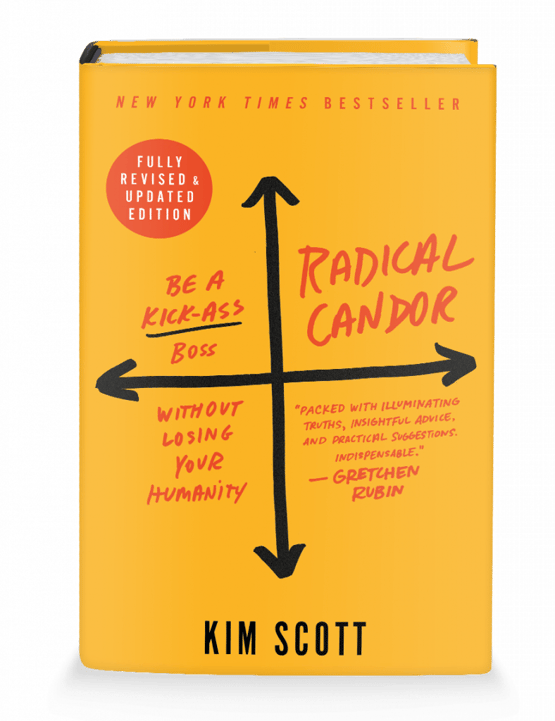
This post has been excerpted from Radical Candor: Be a Kickass Boss Without Losing Your Humanity (get bulk book discounts for teams!). Learn more about the GSD Wheel in chapter 4 of Radical Candor and download our reading guide to test your knowledge of the concepts as you go. (Read the previous post about implementation >>)
————————————————————————————————————————————————————————————–
Sign up for our Radical Candor email newsletter >>
Shop the Radial Candor store >>
More from Radical Candor
How Do You Ask for Feedback? The Three Tests of a Good Go-To Question
The idea Get it. Don’t just be open to it.
How Do You Get Feedback? The Four Steps to Solicit Radical Candor®
A Story People often focus on feedback they get from their bosses. But the best feedback comes from the people who work for you. It can be difficult to get it—unless you create a …
Fixing the Employee Experience (with Tiffani Bova) 8 | 26
While the podcast team is on a Radical Sabbatical, Kim Scott is spending the season talking to authors of the books that have shaped her thinking. This week: Tiffani Bova, whose …
Share your perspective
This site is protected by reCAPTCHA and the Google Privacy Policy and Terms of Service apply.