 Kim Scott
Feedback, the Law, and Mandated Manipulative Insincerity
I spend a lot of time these days showing people how to put the Radical Candor framework of “Care Personally + Challenge Directly” into practice by...
James, you’ve touched the third rail that is gender. I’m writing not to add to the abuse pouring down on you, but because I believe that third rail is hurting not just you but all of us. I’m writing an open letter because I know that there are a lot of others who believe what you believe but are remaining silent. I think this stuff is better out in the open.
I’ll admit as a liberal, a woman, and a former Googler who led a 700-person team, I can knowledgeably – and vehemently – disagree with most of what you wrote.
But, I’m also glad you wrote it. Seriously. When you say what you really think, you give others a chance to challenge your thinking. And in return I promise to be open to giving you a chance to change my thinking.
Let’s start with where we agree: “We all have biases which are invisible to us. Thankfully, open and honest discussion with those who disagree can highlight our blind spots and help us grow.” Amen!
I also agree that “Google has several biases and honest discussion about these biases is being silenced by the dominant ideology.” I have several conservative friends at Google. While I don’t share their politics, I hate the reality that they often feel invisible and unable to speak their minds. This shouldn’t happen at a global champion of free expression that prides itself on building a reasonable culture where people are expected to disagree and argue fiercely and respectfully. Google’s CEO Sundar Pichai and pretty much every leader I know there is deeply committed to making sure everyone has a voice at Google. But they’ve got a ways to go; I have total confidence openness to diverse views will continue to improve there. Conservative Googlers have both Sundar and you to thank for that.
If you have views but can’t give voice to them you don’t have a sense of psychological safety. Getting fired certainly didn’t contribute to your feeling of psychological safety. I care about psychological safety in general, and your psychological safety in particular. I wish you’d had a boss or a mentor who could have helped you to find a more productive way to express yourself, and to challenge some of your views.
To that end, and in the spirit of Radical Candor, I’d like to explain where I think you mis-stepped, and to offer some ideas for how you can find a way to share your opinions more productively in the future. In general, it’s better to criticize in private, but when an issue is so public an open letter will scale. However, I’m also happy to have a private conversation.
Of course, you probably thought you wrote in the spirit of Radical Candor as well. But Radical Candor gets measured at the other person’s ear, not at your mouth.
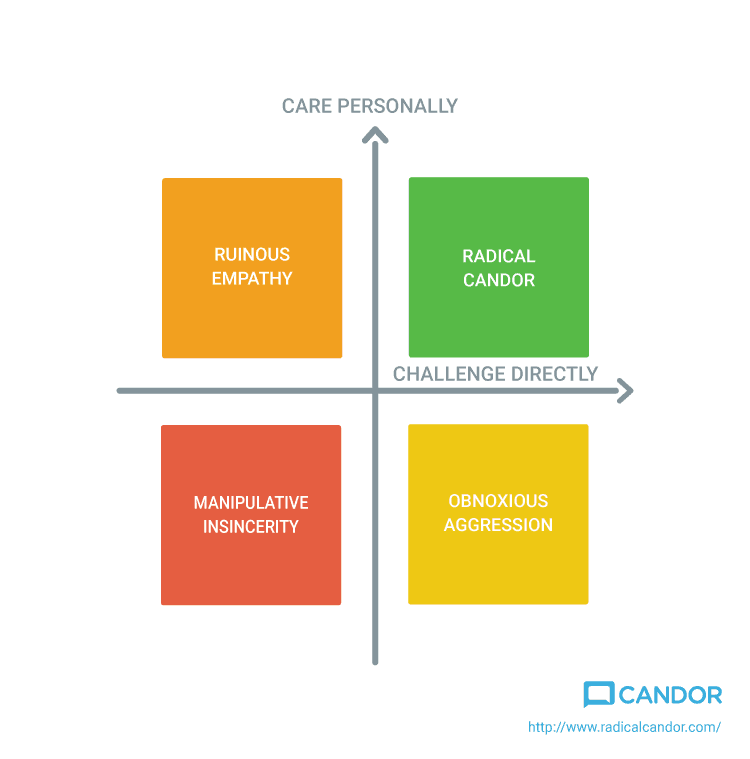
When you make an argument that shows no concern for the people you’re talking to, and exhibits little awareness that your argument is more an ensemble of opinion than proven science or fact, others will experience your words as Obnoxious Aggression. This makes them reluctant to engage in productive conversation with you—you’ve lost credibility and hurt your relationships all in one fell swoop.
 In what you wrote, you didn’t quite come out and say that you thought the gender problem in tech is that women are stupider and more neurotic than men. But you came pretty damn close--“the left tends to deny science concerning biological differences between people (e.g., IQ and sex differences)” and “Women, on average, have more neuroticism (higher anxiety, lower stress tolerance).”
When writing about IQ, you alluded one body of research showing men have a higher IQ, but failed to acknowledge the other body of research that shows they don’t. More importantly, the real world suggests IQ doesn’t matter in the way you assert that it does. As EO Wilson wrote, “Isn’t the cutting edge a place only for geniuses? No, fortunately...in most fields most of the time, extreme brightness may be a detriment.”
When you imply that the problem with women in tech is the size of the female brain, you are ignoring both your intellect and your emotional intelligence. I have no doubt you are a rational thinker, and that you are a decent human being, but what you wrote about IQ/neuroticism and their role in the small percentage of female tech leaders was neither smart nor true.
Of course, you are far, far from alone in your assumptions. My own son asserted that boys were smarter than girls when he was six. He now understands that’s not accurate and the dangers of gross generalizations and prejudice. I just hope I’ve educated him with love, not by pressing his hand to the third rail. Perhaps you have some advice for me there?
I would be interested in having a conversation about whether or not it makes sense to mandate unconscious bias training for all promotion committees, and a number of other suggestions you make. BUT I’m not eager to have that conversation with a person who indicated, perhaps without meaning to or even really believing it, that I’m likely to be stupider and more neurotic than he is.
Not being obnoxious doesn’t mean you have to become Ruinously Empathetic, as you indicated in what you wrote. I agree that it’s a terrible mistake to be so concerned for somebody else’s feelings that you can’t point out a problem when you see one. But thinking you must choose between Obnoxious Aggression and Ruinous Empathy is just a false dichotomy. You don’t.
Of course much worse than caring so much we don’t challenge or challenging so hard we forget to care is Manipulative Insincerity, what happens when we neither care nor challenge but fume silently. And all too often the current climate of gender politics pushes both men and women to be manipulatively insincere on the topic. I am guessing that is in part what you were reacting to and why you wrote as you did. In today’s legal climate, it’s hardly surprising that Google fired you for writing what you did; if your words had gone unchallenged many people would have felt the company was not doing enough to prevent a hostile work environment. I’ll confess I wouldn’t want to work as your peer or your employee after what you wrote. However, my offer of coaching does stand if you’d like it. That’s because I believe the laws that have been put in place to protect women from discrimination sometimes make open conversations in which we explore ideas (and get some things wrong) too dangerous. That is a shame and I’d like to find a way forward. And get your thoughts on that as well.
You don’t have to become emotionally unengaged to avoid Ruinous Empathy. When you pretend the emotional factors that govern all of us--even you--don’t exist, you don’t become more rational, you just fall prey to self-deception and become a worse communicator. You don’t need to choose between your mind and your emotions. You can be the master of both. You can care and challenge.
Google’s founders showed how to do that at a company meeting in 2004 when an engineer asked why Google’s executives were spending so much time getting a daycare set up. Why was it such a priority? There were a lot of abstract reasons given, but the best answer was Larry’s. He said, to the best of my memory, “Well, Susan just returned from maternity leave. We love working with her, and if she wants to come back to work, we want to make it as easy as possible for her.” Susan figured out how to make brand advertising work at Google, a multi-billion- dollar business, and she’s now CEO of YouTube. I’d say that explaining the decision through an anecdote was more effective than stats, and that building the daycare center paid off, wouldn’t you?
I spend a lot of time these days showing people how to put the Radical Candor framework of “Care Personally + Challenge Directly” into practice by...
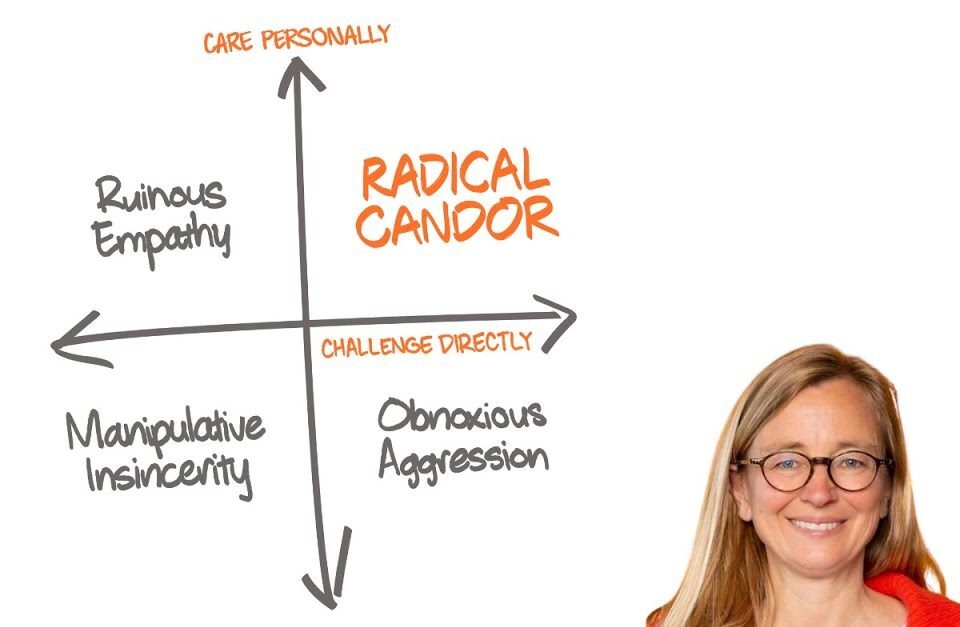
What is Radical Candor? People often get confused about what Radical Candor really means.
What makes Radical Candor radical is that it’s a deviation from the norm, which tends to fall somewhere between acting like a jerk and avoiding...
Share your perspective
Leave a comment below.