The Human Cost of NDAs and Forced Arbitration in the Workplace
Edited By Brandi Neal, Radical Candor podcast writer and producer, and director of content creation for Radical Candor. This article about the...
3 min read

Edited By Brandi Neal, Radical Candor podcast writer and producer, and director of content creation for Radical Candor. This article about the importance of pay transparency has been adapted from a transcript from Radical Candor podcast S6, Ep. 47 about the same topic.
The topic of pay transparency has long been a source of tension and confusion in workplaces. Salary secrecy can feel frustrating and unfair to employees while addressing pay openly can feel awkward and uncomfortable to leaders.
However, as recently discussed on the Radical Candor podcast, pay transparency is critical to fostering trust, fairness, and a healthy work culture.

Brandi Neal, Radical Candor’s director of content creation and marketing, knows this firsthand. Throughout her career, she has experienced the harmful effects of pay secrecy.
“I’ve had interviews where I didn’t find out the salary until the very end, and it was far below my expectations,” Neal recalls. “It wasted my time and theirs. Transparency from the start could have prevented that.”
Neal isn’t alone in her frustration. Kim Scott, author and co-founder of Radical Candor, and Jason Rosoff, co-founder and CEO of Radical Candor, argue that pay transparency is not only fair but also an essential tool for eliminating pay inequities and building trust in the workplace.
“When I raised this with my boss, he got angry and dismissed my concerns,” she says. “It was a classic example of how secrecy allows inequity to thrive.”
Neal recounts a similar experience, noting that when she was hired at a lower range than other employees in similar roles with comparable experience, she couldn't catch up without management taking action.
Until it was corrected, the pay disparity shifted her focus from doing the work she was hired to do and fostered feelings of resentment.
Scott emphasizes that forcing employees to repeatedly advocate for fair pay is deeply demoralizing—and it can unfairly paint them as aggressive or entitled.
“When employees have to keep coming back to ask for fairness, it creates a dynamic where they feel like they’re fighting uphill,” she explains. “It’s exhausting and leaves them feeling undervalued.”
Rosoff believes that the onus should be on leaders to proactively address inequities. During his time at Khan Academy, he discovered a pay gap between a male and female employee doing equivalent work.
Instead of waiting for the employee to advocate for herself, he worked with the leadership team to resolve the issue immediately.
“By proactively fixing the disparity, we demonstrated that fairness was a priority,” Rosoff says. “If we had waited for the employee to raise the issue, we risked undermining her trust in leadership. Worse, we could have made her feel like she was being punished for speaking up.”
“It was incredibly helpful,” Scott recalls. “We avoided endless negotiations, and candidates knew what to expect from the start. It saved everyone a lot of time and emotional energy.”
Rosoff echoed this experience, noting that transparency also forces organizations to confront inequities head-on.
“When you make pay transparent, disparities become obvious,” he explains. “It pushes leaders to fix the problem proactively rather than waiting for someone to demand it—because by then, the damage to trust is often already done.”
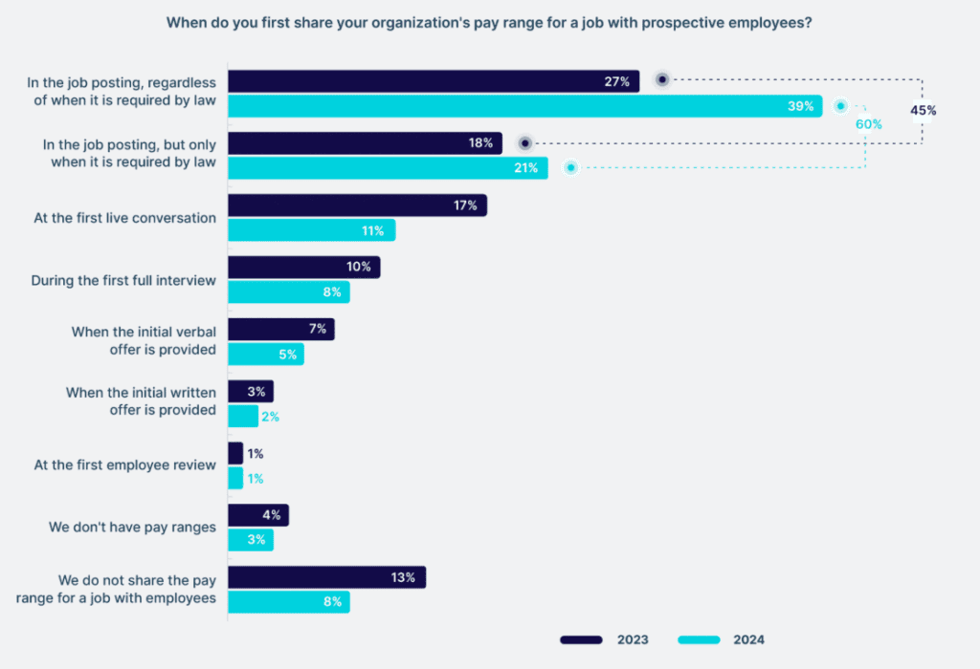 Payscale 2024 Compensation Best Practices Report. Click image to download.
To build a transparent and fair pay system, organizations need a clear compensation philosophy. As Rosoff puts it, “You need a theory of the game.”
A good starting point, he says, is gathering market data using tools like Payscale or other benchmarking platforms. “From there, decide where you want to position yourself in the market—whether it’s the 50th or 75th percentile—and apply that consistently across roles and demographics.”
Scott emphasizes the importance of internal consistency as well. “Too often, organizations benchmark salaries for specific roles but fail to look at the big picture,” she says. “If the gap between the highest and lowest salaries isn’t justifiable, it creates resentment and undermines morale.”
Fixing pay gaps requires courage and discipline. Leaders must be willing to address inequities proactively and communicate openly about how salaries are determined.
“If you discover a pay gap, fix it,” Scott says. “Most employees will appreciate the effort and see it as a sign of good leadership.”
Neal agrees, pointing out how the lack of transparency wastes time and creates unnecessary stress. “When we don’t know what to expect, we’re left in the dark. Transparency sets clear expectations and eliminates a lot of guesswork.”
Rosoff encourages employees to advocate for transparency within their organizations. “Volunteer to help create a transparent compensation plan,” he suggests. “Be part of the solution and show your leaders how transparency benefits everyone.”
Pay transparency isn’t just about fairness—it’s about building trust, improving efficiency, and creating a culture of Radical Candor.
By addressing pay inequities openly and proactively, organizations can create workplaces where everyone feels valued and respected. As Scott puts it, “Sunlight is a great disinfectant.
Plus, aside from it being the right thing to do, paying people fairly can improve your bottom line, according to a survey from Indeed.
"82% of workers feel more engaged with and fulfilled by their work when they are paid fairly, and 81% of respondents say they are more productive and loyal to their employers."

Edited By Brandi Neal, Radical Candor podcast writer and producer, and director of content creation for Radical Candor. This article about the...
Edited By Brandi Neal, Radical Candor podcast writer and producer, and director of content creation for Radical Candor. This article about Temple...
Edited By Brandi Neal, Radical Candor podcast writer and producer, and director of content creation for Radical Candor. This article about Russ...
Share your perspective
Leave a comment below.