5 min read

How to Design Better Meetings: 7 Principles

How to Design Better Meetings: 7 Principles

Table of Contents

How to Design Better Meetings: 7 Principles
8:46


During World War II, the Office of Strategic Services, the precursor to the CIA, wrote a manual for ordinary citizens living under enemy occupation. Declassified in 2008, it was called the Simple Sabotage Field Manual. Its advice for quietly disrupting the enemy from the inside: insist on doing everything through channels, refer important decisions back for further study, hold conferences instead of making decisions, and above all, have meetings. Have as many meetings as often as possible and make them loooooooong.

Read that manual today, and it doesn't sound like sabotage. It sounds like Tuesday.

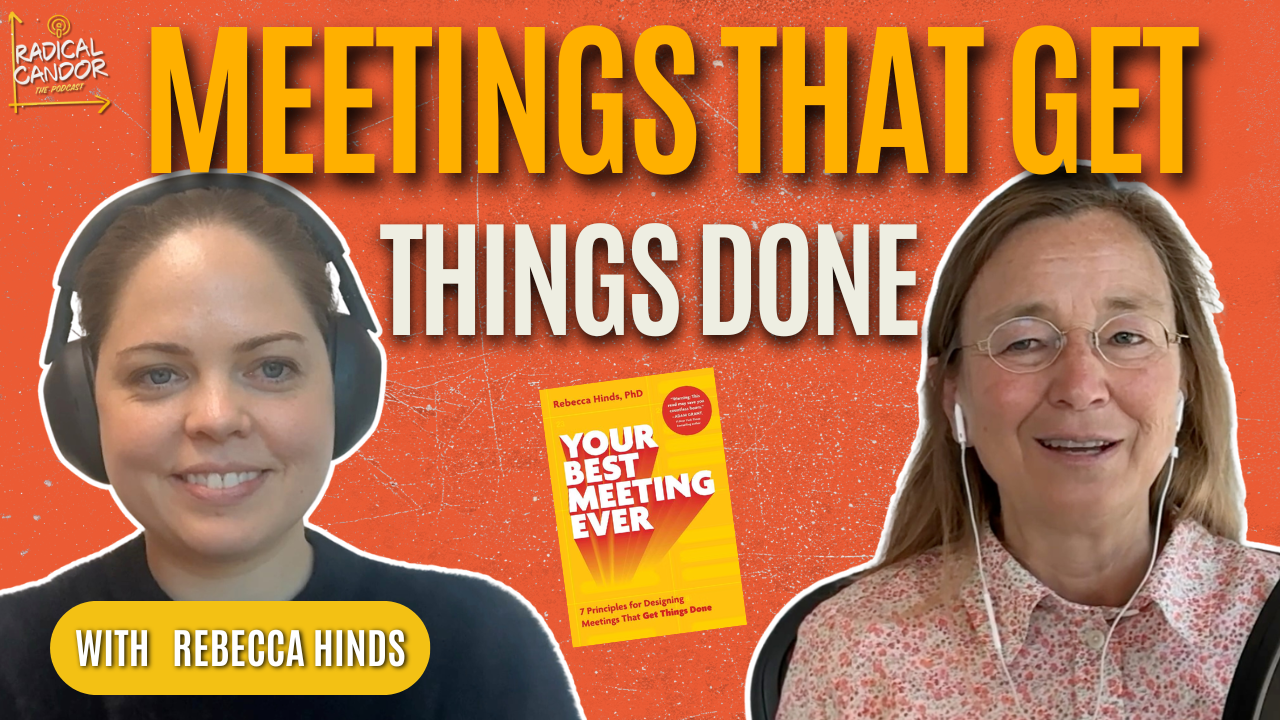
That's the story Rebecca Hinds opens her new book with, and we talked about it when she joined me on the Radical Sabbatical Podcast (the rest of the Radical Candor team is off for the summer, so I've been spending it talking to some of my favorite authors). Rebecca wrote Your Best Meeting Ever, and she's spent years studying why meetings, a tactic once designed to cripple an enemy's productivity, have become business as usual in too many organizations that seem to be at war with themselves rather than a competitor.

Here's the number that stuck with me. In the 1960s, leaders spent less than ten hours a week in meetings. By the turn of the century, that had more than doubled to 23 hours. And since the pandemic, the time we spend specifically in dysfunctional meetings has kept climbing, even though we have more collaboration technology than any generation before us.

For years I had a New Yorker cartoon taped up in my office: one guy on the phone saying, "Nope, Thursday's out. How about never? Is never good for you?" Rebecca's research explains why that cartoon is still funny.

What Are the Seven Principles of Meeting Design?

Rebecca's fix is to stop treating meetings as something that just happens to your calendar and start designing them like a product: arguably the most important product your company makes, since it's where decisions actually get made. She breaks the redesign into seven parts:

  1. Volume: have as few as possible
  2. Measurement: measure how useful participants find meetings
  3. Minimalism: make them as short as possible with as few people as possible
  4. Flow: do as much as possible asynchronously; make sure everyone participates; identify which of the 4 D's describes the meeting's purpose: Decide, Discuss, Debate, or Develop
  5. Engagement
  6. Timing
  7. Technology

How Do You Reduce the Number and Length of Your Meetings?

Volume: Run a meeting doomsday.

Just like technical debt piles up in your codebase, meeting debt piles up on your calendar: recurring meetings that were valuable six months ago and aren't anymore. Rebecca's version is a 48-hour cleanse where everyone deletes their recurring meetings, then rebuilds only the ones worth keeping, redesigned for how the team actually works now. The point isn't just efficiency. It's giving people social permission to delete something without having to defend the decision. I told Rebecca about a colleague of mine, from one of my startups and later at Google, who had a habit: every morning he'd look at his calendar and cancel one meeting. People thought it was reckless. It bought him an hour a day.

One meeting doesn't get the doomsday treatment: your 1:1s. Rebecca and I agree this is a meeting you should NOT cancel; there's no more important meeting for your direct report's well-being, and it should stay on the calendar every week. But it can still be redesigned. Your direct report should own the agenda, not you. You can solicit feedback, but do NOT give feedback in a 1:1. That's a time your report should be able to walk in without dreading what's coming.

Measurement: Ask for a return on time investment.

After roughly 10% of the meetings you run, ask attendees to rate, zero to five, whether it was worth their time, and what you could have done to make it better. Rebecca's colleague Steven Rogelberg has found that two types of people consistently rate meetings highest: the organizer, because they designed it, and whoever talked the most. Which tells you something important: we design meetings for ourselves, not for the people sitting in them.

Minimalism: Shave five minutes off everything.

Meetings suffer from Parkinson's Law: work expands to fill the time you give it. Rebecca studied someone who runs 27-minute meetings on purpose, just to jolt people out of assuming 30 is the right number. I know a Googler whose OKR one quarter was to end at least half his meetings early, and he'd announce it right at the start, which was its own small gift. Make your 30-minute meetings 25 and your hour-long meetings 50. You need the bathroom break, sure, but some of the best feedback I've gotten in my career happened in those five minutes between meetings, not during them.

Meeting Minimalism: Keep the room under eight people.

Once a meeting grows past seven or eight, the Ringelmann effect kicks in: people stop feeling accountable, dissent gets quieter, and decision quality drops. I once realized that everyone in my staff meeting thought it was a waste of time, and everyone not in it felt sad and bad and left out. That's the worst of both worlds. My fix was to quit making decisions in my staff meetings, so that we were pushing more decisions into the facts. We set up Big Decisions meetings, and made sure everyone got the notes, even if they were not in the meeting. Rebecca's fix is also transparency: if people trust they'll get the notes, they stop needing to be in the room.

How Do You Design the Meetings Worth Keeping?

Flow: Design around the Four Ds.

Every meeting should exist to decide, discuss, debate, or develop — either a person or an idea. Debate means you know the options and are weighing trade-offs. Discuss is earlier than that, closer to brainstorming. Naming which one you're in changes how the meeting should run, and whether it needed to be a meeting at all.

Engagement: Kill the meeting after the meeting.

If people don't feel safe disagreeing openly, they'll go build a coalition in the hallway instead, which is almost always worse than just having the argument out loud. Strong async cultures make this less necessary: no lazy asks (give the why and the context when you hand someone work), and document not just what you decided but why, so the organization doesn't relitigate the same debate every six months.

Timing: time meetings to moments that matter, not just the calendar grid.

Rebecca's favorite finding: the midpoint of any project, whether it runs six days or six years, carries real psychological weight. Abundance turns to scarcity, and you get a natural burst of energy that most teams waste on a routine status update instead of using to catapult toward the finish. Premortems work the same way in reverse: imagining a project has already failed surfaces risk best right at the start, when everyone's optimism is highest.

Technology: Watch the bots.

Rebecca's rule of thumb: if you've got more than one notetaker bot in a meeting, you probably haven't designed it well. Rebecca and I talked about why people sometimes feel AI Notetakers are helpful and when they feel like a spy. I worked in what was then the Soviet Union, where every room I worked in had a listening device. I told myself it didn't bother me, until I moved to New York and noticed I talked far more openly to my parents on the phone from there than I ever had from Moscow. Surveillance dampens candor, even when you don't think it's getting to you. Rebecca's unpublished research backs this up: whether people trust AI in the room depends entirely on whether their organization treats it as a teammate or as a threat.

Why Is Meeting Design Really About Collaboration?

Rebecca's argument, in the end, isn't really about meetings. It's about whether the people you work with actually look forward to being in a room, virtual or otherwise, together. A meeting everyone looks forward to is going to be more productive than one everyone dreads.

You can find Rebecca's book, Your Best Meeting Ever, wherever you buy books. Her research lives at RebeccaHinds.com, and her AI work is at workai.institute through the WorkAI Institute at Glean, and she's on LinkedIn too.

Want Your Team's Meetings to Be Worth Showing Up To?

Our feedback workshops will teach you to solicit feedback and reward candor, so your must-do 1:1 meetings are more productive.

Bring Radical Candor to your team →

Questions Covered

What are the seven principles of meeting design?

Rebecca Hinds, author of Your Best Meeting Ever, breaks meeting design into seven parts: Volume (have as few meetings as possible), Measurement (track how useful attendees find them), Minimalism (short, small meetings), Flow (as async as possible, with a clear purpose), Engagement (make dissent safe), Timing (align meetings to moments that matter), and Technology (watch how many bots are in the room).

What is a "meeting doomsday"?

It’s a 48-hour cleanse where everyone deletes their recurring meetings, then only rebuilds the ones worth keeping, redesigned for how the team works now. The point isn’t just efficiency — it gives people social permission to cancel something without having to defend the decision.

Should you ever cancel your 1:1s?

No. Of all the meetings a “meeting doomsday” might cut, your 1:1s should stay on the calendar every week — there’s no more important meeting for a direct report’s well-being. It can still be redesigned: your report should own the agenda, and 1:1s shouldn’t be used to deliver feedback.

How many people should be in a meeting?

Rebecca’s research points to eight as the ceiling. Past that, the Ringelmann effect kicks in — people stop feeling accountable, dissent gets quieter, and decision quality drops.

Why do AI notetakers sometimes feel like surveillance instead of help?

Whether people trust an AI notetaker in the room depends on whether the organization treats it as a teammate or a threat. Surveillance dampens candor even when people don’t think it’s affecting them — which is also why Rebecca’s rule of thumb is to question any meeting with more than one notetaker bot.

Share your perspective

Leave a comment below.

Keep going.

Three ways to put this into practice.

Apply what you've learned Get personalized coaching with Compass
Your AI-powered Radical Candor coach. Free to try.
Used by managers at Apple, Dropbox, and Twitter Try Compass free
Stay sharp More like this, every week
Practical leadership tips in your inbox.
Join 50,000+ leaders Subscribe free
For your whole team Bring Radical Candor to your organization
Workshops, keynotes, and rollouts for teams of 50+.
Trusted by 100+ Fortune 500 leadership teams Talk to our team

EXPLORE MORE FROM RADICAL CANDOR

How to Have Effective 1-on-1 Meetings With Your Direct Reports

How to Have Effective 1-on-1 Meetings With Your Direct Reports

There are a lot of ways to think about holding effective 1-on-1 meetings with the people on your teams. New leaders often hem and haw over how to get...

Read More
3 Easy Steps to Staff Meetings That Don't Suck

3 Easy Steps to Staff Meetings That Don't Suck

Every CEO, middle manager and first-time manager I have ever worked with has struggled to figure out how to run a productive staff meeting.

Read More