
5 min read

What If You Don't Train Employees and They Stay?

What If You Don't Train Employees and They Stay?

Table of Contents

What If You Don't Train Employees and They Stay?
8:43

Newsflash: training increases employee engagement, customer happiness, and revenue growth

When I led the AdSense team at Google, we had a large customer support team. To make sure I understood the work they were doing, I made a point of answering some tickets myself. Thinking I was taking work off their plate, I'd grab customer emails from my employees' queue and answer them. My theory? When an employee came to me with improvement ideas, I'd understand what they were asking for and why, because I'd done the job myself.

Despite these good intentions, our employee engagement metrics were not that good. I didn't understand why. Then one day, a new employee came up to me and said, "Kim, I wish you'd quit grabbing tickets in my queue, because you're not doing a good job answering them. You're hurting my customer satisfaction metrics." I was well-meaning. But I hadn't been properly trained, so, unsurprisingly, I was doing a bad job. That was why my employees weren't happy.

I shared this story with Tiffani Bova, author of The Experience Mindset (podcast). She explained that there was an obvious explanation for my poor performance: an untrained employee (me, in this case) usually does a crappy job!

Too many leaders ignore the direct link between training, employee engagement, customer happiness, and revenue growth.

Treat your employees the way you want them to treat your customers

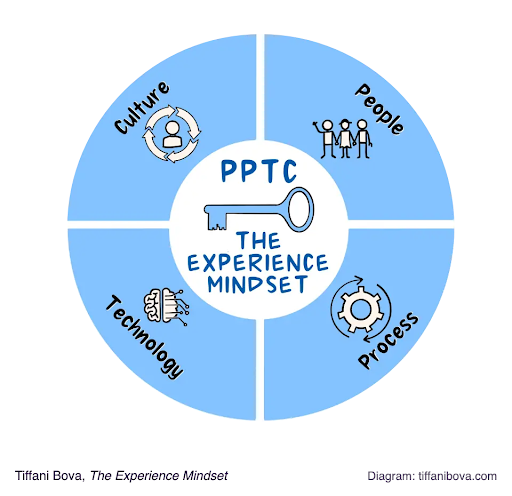
Making your employees miserable is wrong ethically, and it's bad for business. In The Experience Mindset, Tiffani lays out a framework called People, Process, Technology, and Culture (PPTC). The four parts of the framework work together to affect employee experience, and employee experience directly impacts customer experience and company growth. If you want revenue growth, you need happy customers; if you want happy customers, you need happy employees.

Training lives in the People dimension, the part of the framework most likely to get treated as optional. Today, many companies are cutting management training budgets, given investments in AI and economic uncertainty. But when they promote new people to management and then hope for the best, it becomes a "sink or swim" moment. The problem is, when a manager sinks, they drag a whole team down with them. Needless to say, this hurts the customer experience too, which hurts growth. And meanwhile, a bunch of people are unnecessarily miserable.

Meanwhile, Process and Technology get project plans and dedicated budget line items. But too often, companies fail to consider how new processes and technology will impact managers and their employees. That new process that is supposed to improve customer satisfaction but introduces friction into your employees' workflows? Ultimately, employee dissatisfaction will translate to customer dissatisfaction.

If the way you're rolling out AI makes your employees miserable, you're unlikely to get a good ROI on that AI investment.

Care about your employees the way you want them to care about your customers and products, and growth will follow. This is the golden rule, in two senses. First, the ethical one: you treat people well because it's the right thing to do. Second, the enlightened self-interest one: you get more gold (or at least revenue). Treat your employees well, and they're more likely to treat your customers well, keeping them coming back for more of what you're selling.

What if you pay to train people and they leave? But what if you don't train people and they stay?

The most common objection to spending on training is: what if I pay to train someone and they leave? It sounds prudent, but it's the wrong question. By Tiffani's account from her years in technology sales, training is one of the first budget lines to get cut when a company gets nervous about spending.

Here's the much bigger risk that knee-jerk reaction fails to recognize: what if the person who doesn't get trained does NOT quit? They stay, they keep doing the job badly, and the company pays for that every single day in terms of employee disengagement and customer dissatisfaction, many multiples of what the training would've cost.

Back to my story about those support tickets: what if I had just kept answering them, inadvertently hurting my employee's morale and impacting the company's customer service metrics? And my company kept absorbing the cost of that impact for months? What if nobody understood the reason for the dip in employee morale and customer satisfaction–an untrained employee (me) answering customer questions?

Luckily, that didn't happen. We had a "speak truth to power" culture. I rewarded the candor my employee gave me–I stopped grabbing tickets from his queue. I asked him what a better way to stay close to the work might be, and he invited me to shadow him for an hour a week.

Tiffani encourages leaders to ask not "what if they leave," but "what does it cost me every week that they stay untrained?" That number is usually bigger; it's just less visible because it never shows up as a single line item, and it never stays contained to the undertrained person. It shows up downstream, in the metrics leaders actually watch: customer satisfaction, retention, the churn nobody can quite explain.

If you're only looking at the budget line to determine the value of training, you're looking in the wrong place. Look at the impact on employee engagement and customer happiness.

Reward the Candor When You Collect Employee Surveys

At Radical Candor, we teach that the last and most important step in soliciting feedback is to reward candor. This rule matters as much for employee engagement survey feedback as it does in your 1:1s. According to Tiffani's research, 87% of executives don't know what to do with the employee feedback they collect. Companies run the survey, collect the data, and then it goes nowhere. Employees who give feedback without any response draw an obvious conclusion: their leaders don't listen, don't care, or both. Gathering feedback and then ignoring it is a value-subtracting round trip.

Treating an investment in people as an expense you can cut, instead of an investment you must make to keep your business growing, is a big mistake. That's true whether it's a training budget or an hour spent acting on survey results. Skip either one and the cost doesn't disappear. It just moves and grows. Skipping training moves the cost downstream to employee happiness and customer satisfaction. Skipping survey follow-through moves the cost to employee retention or worse, a culture where people stay but stop speaking up. In the words of Simon and Garfunkel, "silence like a cancer grows…"

How Will You Reward the Candor This Week?

Here's the way you can put Tiffani's uncommon sense into practice this week, and it takes five minutes. Go back to your last employee survey, the one that's probably buried in a folder somewhere. Pick one specific thing people told you in that survey. Then share it with your team at an all-hands meeting, by email, in a Slack thread or Teams message–the more mediums, the better: "You said X. Here's what we're doing about it," or, "You said X. I can't fix that right now, and I want to explain why." Make your listening tangible by rewarding the candor. You don't need a task force or a new process to do this. You simply need to identify one bit of feedback and to address it.

This works not because it makes people "feel heard" in some abstract sense. It works because you fix a real problem, or you explain why a problem can't be fixed. Either way, you make people's work a little less frustrating. That's what turns "we value your feedback" from a slogan into a tangible reality your team actually experiences.

You make your listening tangible by making your employees' lives better. And when their lives are better, your customers' lives are better, and your business grows.

I never went back to grabbing support tickets without getting properly trained first. Your company shouldn't go another quarter asking people to do a job you never taught them how to do, and then wondering why the numbers don't move in the right direction.

I hope my mistakes with those support tickets, and Tiffani's research, are a reminder that the cost of skipping training, or ignoring what your people tell you, doesn't disappear. It just shows up later, in your people and your customers. Reward the candor now, and you won't pay for the silence later.

Questions Covered

Why is "what if they leave after I train them" the wrong question to ask?

Because the bigger, less visible risk is what happens if they don't leave and stay untrained. That cost shows up every day in employee disengagement and customer dissatisfaction, and it usually outweighs the cost of training many times over.

What's the fastest way to reward employee feedback this week?

Go back to your last employee survey, pick one specific thing people told you, and tell your team what you're doing about it—or explain honestly why you can't fix it right now. It takes about five minutes and doesn't require a task force or new process.

Share your perspective

Leave a comment below.

Keep going.

Three ways to put this into practice.

Apply what you've learned Get personalized coaching with Compass
Your AI-powered Radical Candor coach. Free to try.
Used by managers at Apple, Dropbox, and Twitter Try Compass free
Stay sharp More like this, every week
Practical leadership tips in your inbox.
Join 50,000+ leaders Subscribe free
For your whole team Bring Radical Candor to your organization
Workshops, keynotes, and rollouts for teams of 50+.
Trusted by 100+ Fortune 500 leadership teams Talk to our team

EXPLORE MORE FROM RADICAL CANDOR

Video: Why to Avoid

Video: Why to Avoid "Don't Take it Personally"

It's hard to take general management and feedback advice and visualize how to apply it in real-life situations. Some Radical Candor readers have...
Read More
Don't Save It Up: Why Immediate Feedback is So Important

Don't Save It Up: Why Immediate Feedback is So Important

Giving immediate feedback is one of the most important things a manager can do. When you provide feedback right away, it has a much greater impact...

Read More
How to Practice Radical Candor With Strangers

How to Practice Radical Candor With Strangers

"I can see how Radical Candor works when I already have a relationship... but what about with people I barely know? Isn’t it too risky to give...

Read More