 Kim Scott
AI Gods, Space Empires, and the Stories Tech Uses to Justify Power with Adam Becker
Leadership conversations often center on feedback, culture, and performance. But sometimes the most important leadership questions are bigger: What...
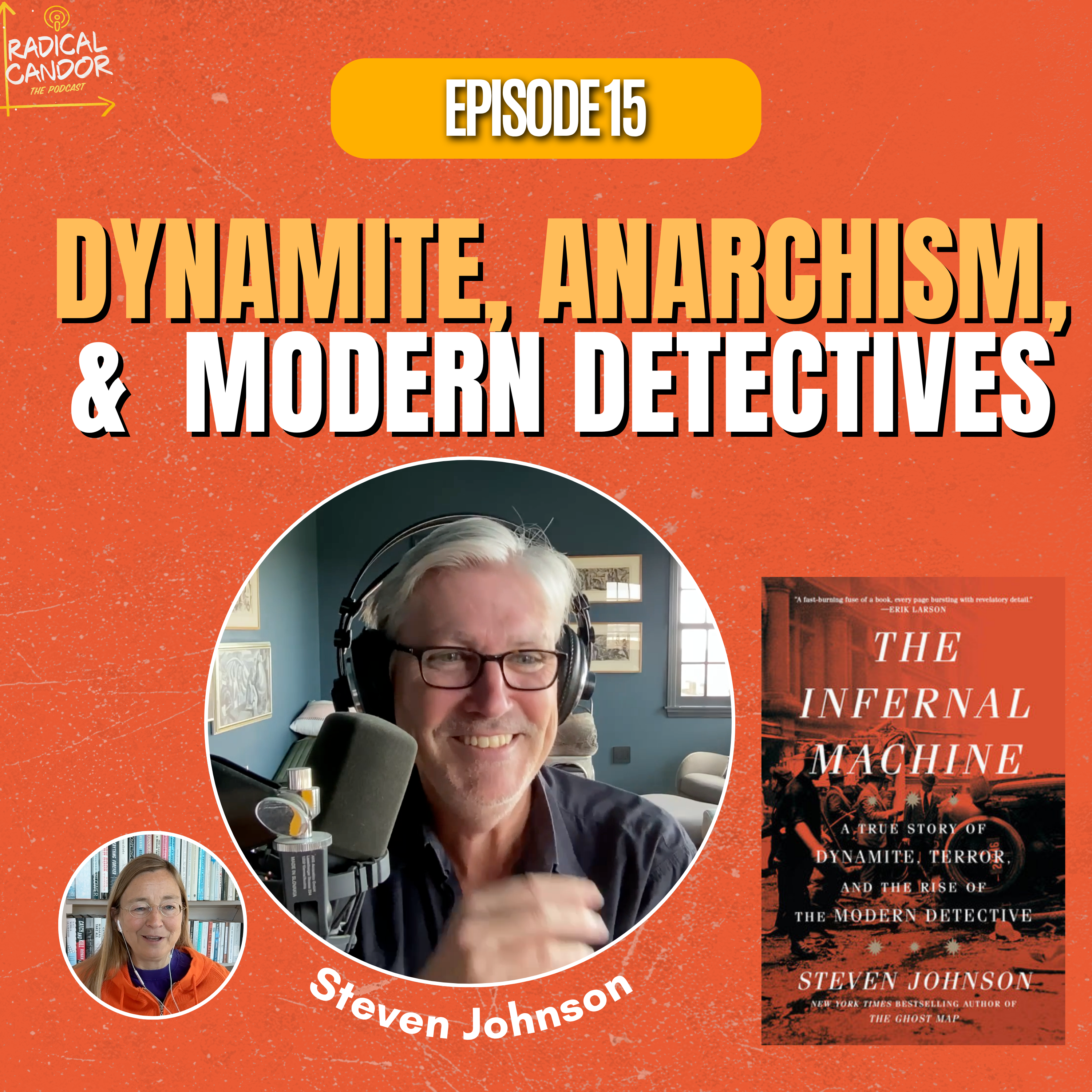
Table of Contents
While the podcast team is taking a Radical Sabbatical, Kim is interviewing authors of the books that have had a big impact on her over the past two years. In this episode, she's speaking with Steven Johnson — co-founder of NotebookLM and author of fourteen books on science, technology, and innovation — about his latest, The Infernal Machine: A True Story of Dynamite, Terror, and the Rise of the Modern Detective.
On this episode of the Radical Candor Podcast, Kim talks with Steven Johnson about how three intertwined stories — the invention of dynamite, the rise of political anarchism, and the birth of modern detective work — reshaped the world at the turn of the 20th century. They start with Swiss watchmakers in the Jura Mountains, follow Peter Kropotkin's theory of mutual aid into the bottom-up ethos that built early Silicon Valley, and trace how dynamite handed small groups a disproportionate amount of force — and how the state's response built the modern surveillance apparatus. They end on a question worth sitting with: what would the 20th century have looked like if the anarchists had taken a page from Gandhi instead?
Watch the episode:
The word anarchism, Steven Johnson reminds us, didn't start out as a synonym for disorder. Its etymology means "no rulers" — leaderless, bottom-up, the opposite of top-down command and control. The thinker most associated with that original vision was Peter Kropotkin, a Russian aristocrat-turned-scientist who walked away from his title and spent his life arguing that cooperation, not competition, was the dominant force in both nature and human society. His theory of mutual aid drew on years of observing remote communities in eastern Siberia that had figured out how to live in concert with each other and their environment without any state apparatus at all.
Kropotkin's ideas were, for a brief window in the late 19th century, more influential among radicals than communism. The word turned against the cause only because a generation of self-described anarchists embraced dynamite as their political instrument. "It was one of the worst political branding strategies," Johnson says. "They turned the word against their own movement."
One of Kropotkin's most important encounters came in the Jura Mountains, where he watched Swiss watchmaking collectives produce some of the most precise technology of their era through non-hierarchical, guild-style organization. The collectives proved his thesis: you didn't have to give up on technological progress to live in a less hierarchical society. You could have both, if you structured it right.
Kim Scott picks up that thread in an unexpected place. The same Swiss watchmakers showed up in a class she co-taught at Apple University — not through Kropotkin, but through Adam Smith, who used them to illustrate division of labor. Read carefully, she says, Smith was also objecting to state-controlled monopoly and the concentration of power among the nobles. Johnson takes the parallel further: in 2001, when he was writing Emergence, he saw early Google making a Kropotkin-style bet — instead of hiring librarians to organize the web, Larry and Sergey let the link graph self-organize from the bottom up. "That voice has gotten quieter in Silicon Valley," Kim notes. "Founder mode is ascendant." Whether the bottom-up ethos can come back is one of the open questions the episode keeps circling.
Alfred Nobel didn't set out to enable political terrorism. He'd grown up around explosives — his father was an arms merchant — and as a boy he watched a teacher detonate a tiny amount of nitroglycerin in a lab. He spent the rest of his life trying to tame that compound into a controllable form. His younger brother died in the attempt; Nobel kept going. When he finally cracked the controlled explosion, the world he had imagined arrived: the Transcontinental Railroad, the tunnels under Manhattan, the giant industrial projects of the gilded age. Nobel even believed dynamite's destructive power would make war obsolete, a kind of 19th-century mutually assured destruction. It did not.
What Nobel had also done, almost as a side effect, was hand small groups a disproportionate amount of force. For the first time, a handful of people could project violence at the scale of an army. Czar Alexander II became the first head of state killed by a suicide bomber wielding dynamite; forty-eight more would follow over the next few decades. And because the telegraph and undersea cables had also arrived, news of a single bomb in St. Petersburg or New York reverberated globally within a day. The state's response — fingerprinting, wiretapping, indexed mugshots, an entire forensic apparatus imported from Europe to the NYPD — is the surveillance regime we still live inside.
The book's hardest figures to read are the ones who started out as idealists. Allan Pinkerton built his career fighting for voting rights and then watched his agency get co-opted into the private army of industrial capital — Homestead, Ludlow, the violent breaking of strikes by men and women trying to do dangerous work for survivable wages. Even Kropotkin's ideas got bent: his exploration of Siberia helped make the Siberian railroad possible, which made the Gulag possible. Bottom-up ideas, again and again, kept being absorbed into the top-down structures they were built to resist.
Steven Johnson ends the book with a counterfactual, and Kim picks it up: what if the anarchists had taken a page from Gandhi and Martin Luther King and never picked up the dynamite? Anarchism, briefly, was a more credible radical philosophy than communism. The 20th century might have looked unrecognizable if its adherents had stumbled onto nonviolent resistance the way Gandhi did at almost exactly the same moment. The conversation lands on a quietly hopeful note: that experiment isn't closed. Silicon Valley at its best was running a version of it. We can still run it again.
[00:05] Kim Scott: Hello everybody and welcome to the Radical Sabbatical. I'm Kim Scott and I'm interviewing the authors of books that I love, which is tons of fun. With me today is Steven Johnson, who is the author of an incredible book that I have read twice. I'll show it to you. It's on my Libro FM, The Infernal Machine. So I recommend it highly. Steven is also famous. Yeah, there you go. the hard back. listen to everything now. Stephen is also the creator of Notebook LM. So welcome Stephen. I'm thrilled to have you today.
[00:44] Steven Johnson: Kim, it's so great to be here.
[00:45] Kim Scott: Tons of fun. And my brain was exploding both times I read your book because it's rare to read a history that feels so relevant to today on so many dimensions. It's relevant in terms of sort of political slash economic violence, which we see seems to be on the rise, unfortunately. It's relevant in terms of surveillance.
[00:51] Steven Johnson: Yeah.
[01:13] Kim Scott: which also seems to be on the rise. it's relevant, you know, tying it in a radical candor. It's so relevant to the kind of bottoms up management that I believe in, that I learned a lot about working at Google. You know, in some senses, I feel like Silicon Valley, there's a strong strain of anarchism here, maybe without the dynamite, without the infernal machine. And hopefully we can keep it that way. So thank you for writing this book.
[01:47] Steven Johnson: thank you for saying all that. That's lovely. It's amazing to hear that as an author.
[01:50] Kim Scott: What prompted you to write it?
[01:53] Steven Johnson: Yeah, it's a really interesting question and it's a good example of an idea taking kind of several years to really come into shape, which is another thing I've written about in the past, is this thing I called the slow hunch. So in my books over my career, I've kind of bounced back and forth between writing kind of idea books and smart
[02:05] Kim Scott: Yeah. Yeah. Yeah. Mm-hmm.
[02:22] Steven Johnson: Self-help kind of books and then and then these Multidisciplinary history histories that kind of weave together a bunch of different narrative events from history and and that are more storytelling books and Those are my favorite ones to write Yes It was really so I've gotten yeah kind of like default now to trying to find plots that are interesting in historical events that
[02:29] Kim Scott: Mm-hmm. Mm-hmm. The story, yeah, the storytelling in this book is incredible. Mm-hmm.
[02:50] Steven Johnson: And I have avoided writing books where it's like a well-known event. A lot of like historical books are kind of like, hey, this is this thing called the Civil War and I'm going to write a book about it. And I tend to be like, here's this thing you've never heard of and here's a book about it, which is not always the best recipe for selling books. But for me, intellectually, it's the basic thing to get to do. And so I had written the last one in this genre is a book called The Enemy of All Mankind about pirates and
[02:57] Kim Scott: Yeah. Yeah. Yeah. Yeah, yeah. Mm-hmm.
[03:19] Steven Johnson: It was set in kind of the 1690s, but it was on some level a kind of a true crime book. I mean, it was about the birth of modern global capitalism and all these other things. But it had a kind of particularly heinous crime at the center of it. And so you could play with the pirates and other kind of popular narrative things. I was looking around for something equivalent to that that I could write. And I also had in the back of my mind that I wanted to finally write a New York book because I lived most of my life in New York.
[03:24] Kim Scott: Yeah, yeah, yeah. Yeah. Right, yeah, yeah. Mm-hmm. Yeah.
[03:49] Steven Johnson: I actually had, I'd written more about London than I had written about New York. So those were in the back of my mind. And I, I started thinking about like the kind of the invention of, kind of modern policing and detective work. And I stumbled across this figure who's, a major figure in the book, but became less relevant over time, which is this, this detective named Joseph Ferro, who kind of brought over the modern forensic science from
[03:51] Kim Scott: Yeah. Yeah, yes.
[04:16] Steven Johnson: Europe around the turn of the century to the NYPD, which include fingerprinting, you know, taking photographs, of criminals and basically like developing indexing systems so that you could keep track of all that information, whatever.
[04:29] Kim Scott: Yeah, yes. Yeah, there you go. Like ping, ping, ping, ping, ping. Like, yeah.
[04:36] Steven Johnson: Yeah, yeah, yeah, it's just all those all these amazing things and and so it was like biometrics and like, you know search algorithms but in 1905 in in the lower east side and He had been involved in this case with a serial killer named hon shmed and and so I was like, okay Well, maybe i'll write a book about farrow and anchored in this one case and I so I wrote a whole proposal for that book and it was just like it was a little too small for for my tastes and and
[04:42] Kim Scott: Yeah. Yes. Yes. Mm-hmm. Mm-hmm. Yeah. Yeah.
[05:05] Steven Johnson: honestly for my editors taste too when I shared it with them and it felt like it didn't quite feel like a Stephen Johnson book and then it was kind of a single thread rather than like multiple threads and I had noticed in researching it that there was as I was going through the all the old newspaper archives there there was This recurring thing that kept happening In New York in that period which is that people just kept setting off these bombs so I was kind of researching about this serial killer, but it was like the other article would be like
[05:11] Kim Scott: Yeah. Yeah. Yeah.
[05:35] Steven Johnson: terrorist attack, you know, a synagogue somewhere and blow up and up or they set up, you know, the, uh, attack the police department with bombs. And I began to realize like that there were just, it was just a regular experience in New York city from like 1900 to 1920 that like every week there was a political bombing happening. And, you know, it was having lived in New York for so long and having seen the
[05:36] Kim Scott: Right, right. Yeah. There was a bomb. Yeah. Yeah.
[06:02] Steven Johnson: the crime problem go down. I moved at the height of the crime problem in 1990, and the murder rate was at the highest it ever was in 1990 in Washington, in the incredible transformation of New York, which, not coincidence that I moved and the crime started going down, I'm secretly a crime fighter. But anyway, so I thought, wow, this is amazing. We forget how violent it was and how in our age of like, I was thinking about this in 2021 or something like this.
[06:09] Kim Scott: Yeah, yeah. Yeah. Mm-hmm.
[06:30] Steven Johnson: You know, I was, it was, there was kind of the beginnings of political violence starting to pop up again. And maybe this was actually pre January 6, actually, I think. So it was even not as much on the radar.
[06:39] Kim Scott: Yeah. Yeah, well, I mean, and you did live through you did live through 9 11, which was an act of obviously. Yeah. Yeah, I was living there then too. Yeah. my gosh. yeah, I had a startup in the West Village. Yeah.
[06:47] Steven Johnson: Yeah, yeah totally. Yeah, we were our 9 11 was our We we had a three-day-old baby and we were living in the west village the plains like first plane flew right over our house with like a newborn my god. we should have been hanging out anyhow. So I started to think like maybe You know, what's the story behind all these bombs, right? And so then I started thinking about anarchism Which we'll talk about and how it got bound up in all this and I also started thinking about dynamite
[07:08] Kim Scott: Yeah. Yes.
[07:16] Steven Johnson: And that led me back to Nobel and Venting Dynamite. And then suddenly I had these three different threads converging in New York.
[07:25] Kim Scott: Yeah, and they're braided together brilliantly and unexpectedly.
[07:28] Steven Johnson: It took a long time. Yeah. Thank you. Yeah. Yeah. It's almost like three. You could write three separate. mean, Nobel's career is so interesting that I briefly was like, should I just drop all this and write a biography of Nobel? Cause it's such a crazy story. But anyway, that's how it came about.
[07:38] Kim Scott: Yeah. Yeah. And yeah. Yeah. Yeah. I love it. Well, I want to start in the Jarl mountains. But before we jump into the watchmakers in the mountains, you end the book with a question that I want to start the interview with, because I want to keep coming back to it, which is like what might have happened in the 20th century if the anarchists had taken a page out of Gandhi's book or Martin Luther King's book and not resorted to violence? Because
[07:51] Steven Johnson: Yeah. Hmm Yeah.
[08:16] Kim Scott: It seems like, you know, if they had done that, you know, maybe the person who threw a Molotov cocktail at Sam Altman's house the other day wouldn't have done it. Maybe the CEO of UnitedHealthcare wouldn't have been shot. maybe we would have learned how to express bottoms up anger in a more productive way. So you don't have to answer that question now.
[08:26] Steven Johnson: Yeah. Yeah, but I do need to by the end of the podcast.
[08:44] Kim Scott: Yeah, but address it a little bit. And then we'll go to the Jarl Mountains to the watch, the peaceful watchmakers there.
[08:49] Steven Johnson: Yeah, I mean, I mean, one of the things that, you know, I kind of say at the beginning of the book is the, know, if you look at its actual etymology, anarchism, just means like no rulers, no, leaders, it doesn't, it actually has no, there's always this thing that people say about anarchism, like, why did they give their movements such a terrible negative name? And it's like, it didn't have a negative connotation. It just meant like leaderless, like,
[09:03] Kim Scott: Yeah. Yeah. It's, it's, it's yeah. Was it? Yeah. Yeah. Yeah. Yeah.
[09:16] Steven Johnson: And, know, kind of bottom up, as you say, rather than top down command and control. And it developed the negative connotation because the people who called themselves anarchists kept blowing things up, throwing dynamite. it became, now we say, it's anarchy in there, meaning, it's chaos and bad. It's very rarely used in a positive way. And so was, as I say in the book, it was kind of like one of the worst political branding strategies. Like they turned the word against their cause in a strange way. And.
[09:27] Kim Scott: throwing dynamite, yeah. Yeah, yeah, yeah. Yeah. Yeah.
[09:46] Steven Johnson: That you know that as I said as you mentioned at the end I kind of said like that didn't necessarily have to happen and the other thought experiment in terms of like how the 20th century and 21st century could have played out differently is there was a period of time in the late 19th century where in a reasonable person could say that anarchism was among the radical philosophies among the kind of anti-capitalist philosophies
[09:52] Kim Scott: Yeah. Mm-hmm.
[10:16] Steven Johnson: Anti-kind of industrialist gilded age capitalist. No, no, no, we'll get to that. Yes, but yes. Yes Anti-big corporate capitalism Anti-power. Yeah Yeah
[10:18] Kim Scott: Yeah, I'm not sure it's anti-capitalist exactly. Yes, yeah, let's get to that. anti-power, anti-somebody controlling everything, whether it is a big government or a big company, whether it's a monopoly or a, you know, whoever has a monopoly on power.
[10:31] Steven Johnson: Yes, yes. But there is a point in the late 19th century, early 20th century, where you could argue that anarchism was a more influential philosophy, radical philosophy, than communism was. And for whatever, for a complicated set of reasons, which are somewhat addressed in the book, but you'd also have to tell the whole history of communism and socialism. But for whatever reason, by the 20th century, the opposition became between capitalism and communism. And anarchism kind of dropped out of the equation as it shows up in the
[10:46] Kim Scott: Yeah, yeah. Yeah. Yeah.
[11:07] Steven Johnson: you know, Spanish civil war and a few other places, but it really, it's always kind of a fringe player after that. And so had the anarchists in that period developed a different way of getting their message in front of people, instead of just blowing things up, that we might've had a very different 20th century.
[11:12] Kim Scott: Mm-hmm. Yeah. Yeah. Yeah. And it's not too late to run that experiment, by the way. Like that's I guess that's part of why you wrote the book. So so when you were describing early, early in the book, you're sort of describing the philosophy behind explaining the philosophy behind anarchism. And you you mentioned the watchmakers in Switzerland. Why why that I have.
[11:29] Steven Johnson: Right. Yeah. Yeah. Yeah.
[11:51] Kim Scott: I had the, reason why that struck me is that when we taught this class at Apple, what makes Apple Apple, we also told the story of yes, isn't that weird? So explain why you did it. And I'll explain why we did that at Apple.
[12:01] Steven Johnson: Really? Yeah, that's fascinating. So it really revolves around this guy, Peter Kropotkin, is maybe the, maybe with Pharrell and Woods, the NYPD had the most sympathetic, fully sympathetic character in the book. It has a lot of characters who you kind of identify with and then kind of don't. But Kropotkin is kind of, is close to a hero of it in a way.
[12:11] Kim Scott: Mm-hmm. Yes. Yeah, but you're like, I'm not so sure about that. Yeah.
[12:35] Steven Johnson: Just, mean, one of those great, again, another person one could write a whole book about. Yeah, I mean, he was so he was a brilliant kind of scientist. He, you know, discovered kind of literally redrew the map of Siberia by exploring it as a young man. And. Yeah, yeah. And and his his he becomes one of the kind of.
[12:39] Kim Scott: He was kind of the John Muir of Russia. Mm-hmm. with an indigenous Yakut guide.
[13:02] Steven Johnson: two or three kind of founding figures of anarchism as a movement. And in part, it's from observing these remote communities living in this co-evolutionary state with nature in the most inhospitable landscape you could possibly imagine and kind of like, you know, far Eastern Siberia. And recognizing that though, while they were incredibly removed from any state apparatus, they had figured out a way to like live.
[13:16] Kim Scott: Yeah.
[13:29] Steven Johnson: harmoniously and survive in this in concert with each other and with with the natural environment around them. And so he developed this this kind of political philosophy that was tied to Darwin as well. And he developed this theory of kind of mutual aid, which he saw among there's in a sense a competitive model to competitive models. Wrong way. It's a rival model to the survival of the fittest version of
[13:44] Kim Scott: Mm-hmm. Yes.
[13:57] Steven Johnson: Darwinism where it was kind of like, yeah, there is competition, but more than that, there's cooperation. And if you look in nature,
[14:02] Kim Scott: Yeah, mean, the fittest know how to cooperate more than to compete, actually.
[14:05] Steven Johnson: Right, right. Exactly. Exactly. And so he was seeing this all around him in the natural world. And he said, how do we think about human society following those same rules? This was a unified theory of nature and culture. It's really interesting stuff. And then he had, he was, he was briefly imprisoned. He was in and out of prison and he was, though he was aristocratic by birth. he kind of like gave up, gave up his title.
[14:26] Kim Scott: gave up his title.
[14:29] Steven Johnson: Anyway, just an incredible escapes from prison and this amazing story. There's all movie. There's all movie to be made about him. But in part of his journeys and kind of in exile, he visits these kind of small towns in the mountains in Switzerland and saw all these watchmaking kind of guilds or collectives. And it was it was really important for Kropotkin because it was again an example of a kind of non hierarchical organization.
[14:32] Kim Scott: Yeah, totally interesting. Yeah.
[14:58] Steven Johnson: Like he had seen in these other places, but they were watchmakers. So they were actually Doing very technolite, you know for the this is 1875 or something like that. They're doing some very technologically advanced work We can have precision engineering and things like that. So it wasn't
[15:02] Kim Scott: Mm-hmm. Right, right. I mean, and they had dominated the industry for 300 years.
[15:19] Steven Johnson: Yeah, yeah. So there was this kind of collective knowledge and collaborative work that was capable of doing technological innovation and it kind of advanced work. wasn't like you had to just, if you wanted to live in a less hierarchical society, you had to give up on technological progress. It was like, no, actually you can do it if you do it, if you structure it right. And so that became the model.
[15:28] Kim Scott: Yeah. Yeah. Yeah.
[15:42] Steven Johnson: And for almost everything he wrote and again, this is one of these things that is lost in the conventional the contemporary understanding of what anarchism was was so what it really The kind of kropotkin's vision was that there were we kind of had peaked in those You know kind of like renaissance hilltown italian cultures and the the juror mountain Collectives were at smaller communities still doing important scientific work and creative work and technological work but but
[15:50] Kim Scott: Mm-hmm. Yeah. Yeah.
[16:12] Steven Johnson: less about giant states and less about giant corporations and more about these guilds and collectives and things like that. And he was like, that was actually the best configuration for human settlements and for human ingenuity. And the world, when he was writing this in 1880s, 1890s, the world was still filled with examples of this. And
[16:24] Kim Scott: Mm-hmm. Right. Yeah. Yeah.
[16:38] Steven Johnson: So was like, yes, there these new factories and yes, there are these palaces and yes, there's these giant corporations, but we also still have all these small little collectives that are out there. So why don't we just do more of those and try and steer society towards that kind of structure. And that was the argument that he was making.
[16:46] Kim Scott: Yeah, yeah. Do more of that. So this is so interesting at Apple University, was not Kropotkin who was invoked, but rather Adam Smith who also studied the watchmakers and the, and that's like we're division of labor and, but it has always struck and I tried to reread the wealth of nations. It was so boring. I couldn't get through it. So I'm going to use notebook LM to, but anyway.
[17:04] Steven Johnson: Mm-hmm. There we go. That's what it's for.
[17:20] Kim Scott: It has always struck me that a big part of what Adam Smith was objecting to in the wealth of nations was monopoly, essentially, but state-controlled monopoly. But also part of the problem with the state-controlled monopoly was that it was giving too much power to the nobles of the time. And that was killing innovation and killing entrepreneurship.
[17:42] Steven Johnson: Yeah.
[17:48] Kim Scott: So I never really have thought of Adam Smith as an anarchist, but there you go. Your book made me think of him in that light. anyway, I mean, and the other thing that was so interesting about your description of Kropotkin for me is I actually spent some time in Yakutia when I lived in Russia because I was working in the diamond business and that's where the, and that is such a hostile, like,
[17:52] Steven Johnson: There we go. Mmm. Amazing. Yeah.
[18:14] Kim Scott: like three quarters of Yakutia is north of the Arctic Circle. It is really cold. It's incredible that people lived there as long as they did. Anyway, so one of the harsh ironies of Kropotkin's life is that he was all about this bottoms up, know, anti-totalitarian, you know, anti-commander control. And yet his
[18:18] Steven Johnson: Amazing. Yeah.
[18:41] Kim Scott: His exploration of Siberia made the Siberian railroad possible, which made a lot of other state control, and ultimately the Gulag Archipelago possible. Yeah.
[18:53] Steven Johnson: Yeah. There's a, there's a, yeah, there's a kind of tragic irony to the arc of his life. And in fact, giving away a little bit of what the part of the plot here, but, but basically the one thing we haven't mentioned is the kind of more prominent figures in the book that are kind of the centerpiece or the anarchist side or
[19:08] Kim Scott: Give it away. Mm-hmm. Yeah. Yes.
[19:22] Steven Johnson: or Emma Goldman, probably the most famous anarchist ever, and her sometime lovers and kind of life partner, Alexander Berkman. And they're both deeply shaped by Kropotkin, although both of them get kind of pulled into the orbit of political violence in different ways and in complicated ways, which Kropotkin mostly seems to have stayed outside of.
[19:30] Kim Scott: Yes. Although he did sort of, he did say the axed is the propaganda and you know, yeah, yeah, yes.
[19:52] Steven Johnson: Yeah. It seems to have soured on it faster than some of the others, but, but they, so they're deeply influenced. Berkman and Goldman are deeply influenced by Kropotkin. There's a kind of one of my, one of my favorite sections of any of my books is there's this kind of, little, what is the idol in the center of the book where Goldman finally meets Kropotkin in person.
[20:18] Kim Scott: Yes, it goes to visit him and he's like, yeah. Yeah. Yeah.
[20:20] Steven Johnson: in the suburbs outside of London. He's living in a little cottage, whatever, and he's got a little workshop where he's making stuff. And there's this whole long piece where they talk to each other, and then I kind of muse about what this all means at this moment. But Kropotkin ends up, after the revolution, going back to Russia. And...
[20:31] Kim Scott: And these painting also like.
[20:44] Steven Johnson: is one of the first to kind of be disillusioned by it and to realize that it's not working out as they had hoped in this great radical revolutionary moment was actually creating more centralized power and not less and
[20:48] Kim Scott: Yeah. Yeah. Yeah. Yeah, yeah, the only way that they were able to grab power was to become powerful and not to. Yeah.
[21:01] Steven Johnson: Yeah And so then at the end of the book it really ends with burkman and goldman getting exported to exported not that's not Deported exported exiled or deported but exported is a little slightly different thing. and and they go back and they visit kraken Again, you know, and that's kind of the whole last piece is those final days. It's really it's an extraordinary story
[21:08] Kim Scott: Yeah, on the red arc. Exiled, deported. Yeah. Again, yeah, in Russia. Yeah, it really is. the, mean, again, this is me maybe writing myself into your story in a weird way. So feel free to object. yes, yeah, because everybody, exactly. But the sort of struggle against, you know, we're trying to create these,
[21:37] Steven Johnson: Yeah, that's why one writes books is to let readers write their own histories into them.
[21:50] Kim Scott: bottoms up ideas and these bottoms up technologies and somehow they turn into top down technologies and ideas. It feels to me very like when I decided to take the job at Google, I read the S1 letter and like who tears up at an S1 letter? But I did at the time, know, because it was such an expression. I mean, I wouldn't say of anarchism, but of bottoms up, you know, great ideas come from everywhere.
[22:08] Steven Johnson: Mmm, yeah. Yeah.
[22:20] Kim Scott: We're not gonna be controlled by Wall Street. We're not gonna be controlled by these powers that be. We're gonna unleash human potential, bottoms up human potential. And I came in leading the AdSense team and I thought we were funding creativity and nickel at a time. And we were talking about the long tail. And of course, I didn't understand for a while. I I came to understand it that really this was a rich get richer algorithm. and that it funded the head and started the tale in ways that we didn't expect or intend. And so, and to a certain extent, I also feel like Steve Jobs early on at Apple, you know, before he got fired the first time or the only time before he got moved out, he used to fly a pirate flag. You remember that? Yeah, I'm sure you, yeah. So there's this strong bottoms up,
[23:07] Steven Johnson: Yeah, yeah, yeah, yeah, yeah.
[23:15] Kim Scott: sort of ethos in Silicon Valley. That that is, that seems to, that voice seems to have been silenced right now. And the, you know, founder mode seems to be ascendant. Did that strike you as you were writing this or am I just reading, reading things into it?
[23:28] Steven Johnson: Yeah, you know, it's funny No, no, no, very much so. mean, the book of mine that kind of this really is building on besides maybe the the pirate book because of the crime theme is a book I wrote a million. My second book, this book called Emergence about self organizing systems and bottom up systems. It was it was called The Connected Lives of Ants, Brains, Cities and Software. And it was like self organizing systems. Jane Jacobs, naked neighborhoods in New York and ant colonies don't really have leaders. They somehow managed to collectively solve problems. And it was just
[23:42] Kim Scott: Yeah, the pirate. Yes. Mm-hmm. Yeah, yeah. Yes. Yeah. Yeah.
[24:02] Steven Johnson: big romping kind of like idea of science book. and that came out in, um, 2001, right around when, you know, Google was just being ascended. And I have this memory of going to some conference, like in the very, still in the early days of Google. Uh, it was like, they hadn't gone public yet, but they were making enough money that Sergey and Larry could like sponsor something at the conference. And they kind of showed up and I was going to mention in my talk about emergence, I was going to be like, look, the way that
[24:15] Kim Scott: Uh-huh. Uh-huh. Yeah.
[24:31] Steven Johnson: Google decided to organize all the world's information was not to hire a bunch of librarians the way Yahoo had, it was to actually let the entire community of people who build web pages and decide to link from one page to another, let the organization emerge out of that bottom up system. And that'll be a much more scalable way to do it. So was very much kind of consonant with what I was writing about in an emergence that I have this hilarious memory of, like I was going to talk about Google in my talk.
[24:35] Kim Scott: Mm-hmm. Yeah. Yeah. Yeah. Yeah.
[25:02] Steven Johnson: And I saw, I say, I saw Larry and Sergey, like I know them, but I actually, I don't, this is actually the only time I've ever talked to them, even though I've been at Google now for four years. but I saw them and I was like, Hey guys, I'm going to mention your little startup in my talk. So that should get some attention for your idea. You know, they're like, thanks. Like weird author dude.
[25:06] Kim Scott: Yeah. amazing. Such a good story. Yeah, you Google wouldn't be good. New York, you solved crime in New York, you, you set Google on its path to success. I didn't know that I was talking to Batman on this. I love it. So there's another story, there's another story in the book that feels super relevant to everything happening in the world right now, which is the career of Pinkerton.
[25:30] Steven Johnson: Yeah, I just it was that little tip kind of a zealot like figure keeps showing up.
[25:54] Kim Scott: Can you talk a little bit about that? I mean, and we can talk about Nobel and dynamite too, but Pinkerton also really, that was hard to read.
[25:54] Steven Johnson: yeah. Yeah. Yeah, it's basically, yeah, they kind of began as kind of like a progressive guy and starts his first kind of like famously Pinkerton Detectives, like a detective agency. And then slowly over time gets kind of the agency gets co-opted into basically doing strike breaking. And
[26:15] Kim Scott: Yes. Yeah. So they start out, so talk about how he starts and where he winds up. So Pinkerton, think, so here's my memory. He started out his career fighting for voting rights, so fighting for democracy, fighting for all people to have voting rights. And then he starts this company that initially was sort of
[26:32] Steven Johnson: I can't remember how he starts, Kip. Tell me. You've read the book more recently than I have. Yeah, yeah, yeah.
[26:56] Kim Scott: protecting money as it was traveling across the country and winds up violently crushing workers. mean, they're the ones who I think were involved in the Ludlow massacre, right? Isn't that who? Okay. Homes Head Strike. Yeah, okay.
[27:10] Steven Johnson: It's no, the homestead homestead strike. Yeah. Earlier. then, and then Lola and yeah, they ended up kind of being brought in by Frick and partially by Carnegie. It's unclear exactly how much Carnegie actually like realizes was happening to break up this strike outside of Pittsburgh. It's kind of one of the two with Ludlow, the two, was just the anniversary of the Ludlow massacre, by the way. one of the two, you know, most important
[27:27] Kim Scott: Yeah.
[27:39] Steven Johnson: arguably kind of violent labor moments in the history of American society. And, you one of the things, one of the things that's important, so there's that transformation of just getting pulled again into the orbit of this emergent kind of corporate strike breaking, you know, set of entities that just didn't exist 30 or 40 years before that. And the, the,
[27:46] Kim Scott: Yeah. Mm-hmm. Yeah. Yeah.
[28:07] Steven Johnson: kind gravitational pull of that power, centralized power that was hard to avoid, even if you came into the world as Pinkerton did with more progressive aspirations. The other thing about it, and this is what is important to think about in terms of anarchism and Kropotkin that we were talking about before. So that landscape outside of Pittsburgh, one of the major industrial centers of
[28:10] Kim Scott: Yeah.
[28:34] Steven Johnson: of the industrial revolution in United States had been transformed in just, you know, really a generation. it, so the site of the homestead strike where they have these giant factories, if you go back 20 years, it was just all farmland. And, and so part of the thing that we can't recreate now, that's harder to recreate mentally now is that in a sense, the, landscape of, you know, kind of large corporate
[28:41] Kim Scott: Mm-hmm. Yeah.
[29:03] Steven Johnson: or government kind of power has kind of conquered the entire landscape, but it's kind of everywhere.
[29:08] Kim Scott: Yes, yeah, was not like, like the A \&P was the big enemy of the the anti-trust like a grocery, a big grocery store. Like, that seems like the least of our worries.
[29:13] Steven Johnson: Yeah. Yeah. Yeah. And so when you when you walked into the end and the other thing that is partially out of our memory because it has has gotten much better, but you know, it's it's important to remember just how dangerous it was to work in a factory at the end of the 19th century. mean, like, you know, and it's hard to find even the statistics I spent a bunch of time trying to pull out just like what your likelihood of being like either killed or maimed on a job. It was extremely high.
[29:32] Kim Scott: Yeah, yes. It was high. mean, Upton Sinclair wrote about it. Marx wrote a lot about this. I mean, it was terrible.
[29:45] Steven Johnson: Yeah, yeah. So we, we, we, yeah. And so you were living in a world then where, you know, that reality would go, if you went to one of the, you know, a steelworks or something like that, and you saw just the conditions and the, and the violence that was implicit to that kind of space at that moment in time, it was astonishing, but it was also still very new. Like it, it, so there was a sense that like, you know,
[30:01] Kim Scott: Yeah. Yeah.
[30:10] Steven Johnson: Now we might say like, how could we possibly rewind the clock to like medieval Renaissance like guild structures? But back then it was like, no, was just 20 years ago they were around here. Like, why don't we just rewind the clock 20 years? It's doable. So that's one of the things that's harder for us to kind of remember Contra up today, I think.
[30:14] Kim Scott: Yeah. Yeah. Yeah, yeah, yeah, yeah. Yeah. So let's talk for a second about Nobel in his career. So Pinkerton like starts out as this idealist and also an author. He wrote detective fiction Pinkerton and he winds up. Yeah, yeah, yeah. And then he winds up like starting this company that is repressing workers violently. How did that happen to the guy? Anyway, there's like a whole other we could spend hours talking about that. But let's also talk about Nobel in his career.
[30:37] Steven Johnson: Yeah, yeah, true. It's kind of true crime. He kind of invented true crime, basically. Yeah. Yeah.
[30:57] Kim Scott: And then how dynamite created and exacerbated the violence of that era.
[31:04] Steven Johnson: Yeah. It's one of these interesting stories where another key participant is an actual just like chemical in the form of nitroglycerin, right? Nitroglycerin had been discovered. It's like, it's kind of interesting. the, terms of explosive technology, literally the technology that you use to make explosions, it was pretty much stagnant after the invention of gunpowder, like for, you know, a thousand years or so, right?
[31:14] Kim Scott: Yes, yeah, yeah. Mm-hmm. Yeah, yeah, yeah.
[31:34] Steven Johnson: There really weren't there, you know, improvements in efficiency and things like that, but it was fundamentally the same idea. And then they we discovered this, you know, chemical nitroglycerin that in the kind of 1840s and it was by far and away the most volatile thing anybody had ever stumbled across. And everybody who kind of messed with it either died or like lost a hand, you know, or whatever. so.
[31:37] Kim Scott: Yeah. Yeah. Mm-hmm. Yeah, yeah, yeah.
[32:00] Steven Johnson: Basically, people are like, what that's that there's just no way to tame this thing. So let's just. Yeah, yeah. And and but Nobel, son of a kind of an arms merchant bouncing back forth between Stockholm and St. Petersburg, you know, has one of those childhood experiences where his his teacher, science teacher's tutor kind of shows him like a tiny bit of nitroglycerin and creates this amazing explosion in the lab. And he's like,
[32:03] Kim Scott: It was the plutonium of its era. Yeah. Mm-hmm.
[32:28] Steven Johnson: Hmm. It's just it like it Yeah, plants this seed that like literally changes the world in so many ways and basically he's like, you know That's so powerful like if you could somehow team it if you could create and there's a chapter in the book called this the controlled explosion Then you could you could reinvent
[32:29] Kim Scott: Yeah, what kid is not going to be excited by an explosion? Yeah. Mm-hmm. Yes.
[32:50] Steven Johnson: You know industrial engineering basically so you have this whole thing that's happening with railroads being built and factories being built and tunnels being constructed Man, yeah, all these things that required Yeah, so you so there was suddenly this need For for some technology that you could use to to construct these extraordinary things He was not he thought it actually would be useless as a weapon
[32:52] Kim Scott: Yeah. and Manhattan being built. mean, couldn't have been built without dynamite. Yeah.
[33:15] Steven Johnson: And he had a kind of mutually assured destruction theory about it was like if people see how violent this thing is, they'll they'll stop going to war because it will be just too dangerous. And that turned out to be not right as it generally does not. So anyway, he he he labored to try and basically build the controlled explosion and suffered through these intense tragedies. His kid brother blew himself up.
[33:25] Kim Scott: Yeah. Yeah. Not, not, not so much. Yeah. Mm-hmm.
[33:44] Steven Johnson: in his home lab outside of Stockholm, just working for his older brother, trying to like make some kind of a nitroglycerin thing. you know, another kind of person might have said, shit, I just killed my brother. Maybe I should move on to another idea. But Nobel did not. you question like how what that means about him. But he eventually he perfects this.
[33:51] Kim Scott: Mm. Maybe I should stop. Yeah.
[34:13] Steven Johnson: technique of creating a stable form of kind of a stable portable form in the form of like dynamite sticks and he becomes fabulously wealthy and it and everything that he imagined ends up happening. It turns out to be incredibly helpful. The world is built like the Transcontinental Railroad was built. New York is built. All these things happen because of dynamite. But it turns out there's this other secondary effect of what he's invented, which is that it is a
[34:18] Kim Scott: Controlled explosion, yeah. Yeah.
[34:41] Steven Johnson: democratizing technology and then it gives a small group or an individual a disproportionate amount of power, physical power. Yeah.
[34:48] Kim Scott: Yeah, bottoms up violence is like that was certainly not the intention was to create a mechanism for bottoms up violence, but that was the that
[34:52] Steven Johnson: Yeah. But almost as soon as dynamite becomes available to the big industrial powers, a bunch of political radicals, most of the monarchists say, wait, this allows us to suddenly have a disproportionate amount of force at our hands without having an army, without having a Pinkerton squad of detectives. We can just throw a stick of dynamite into corporate headquarters and make a name for ourselves that way.
[35:08] Kim Scott: Yeah. Yeah. Yeah. And now all of a sudden it became very dangerous to be a political leader. Like 48 heads of state were killed in that time. How many times did people try to kill Zara Alexander? Like that guy.
[35:32] Steven Johnson: Yeah It's it's funny it's funny that you were saying that you you've been listening to the audiobook because I had a so I wanted to mention alexander the second in the book because he's the first person to die in a political assassination from a suicide bomber, you know with dynamite And so was kind of important to set the stage for the book
[35:48] Kim Scott: Mm-hmm. from a suicide, yeah. Yeah. Yeah.
[36:00] Steven Johnson: And so it was one of those classic things where I was like, okay, so I want to have a paragraph about Alexander the second. So I need to know a little bit more about that. So I read a book about it. And then it turns out that it's such a crazy story because they tried to kill him like five different times. it's, it's, it's like the, I don't know, it's like road runner and coyote, like, yeah, it's like, there's just all these like somewhat comical attempts that fail and he somehow survives again and again and again.
[36:07] Kim Scott: Yeah. Yeah, at least. Yeah. It's like something out of the Pink Panther. Yeah, yeah. And everybody is bumbling around the police are bumbling the guy over state the anarchist who's supposed to blow him up over sleeps and misses his chance. Like it's absurd.
[36:27] Steven Johnson: The police are bumbling. So I ended up changing the whole outline and I wrote two kind of set piece chapters on Alexander the second and the kind of quest to kill Alexander the second that ultimately culminates in this successful suicide bombing. And then it came time to read the audio book and I suddenly had two chapters of these absolutely unpronounceable Russian names.
[36:39] Kim Scott: Yeah.
[36:58] Steven Johnson: And I was like, why did I do this? This is such a thing. It was so horrible to read that.
[37:02] Kim Scott: The problem with reading the audio book, yeah. Yeah, just use the first letter of the people's names and the Russian names. So.
[37:10] Steven Johnson: But the other thing that, is part of this as well is that you had that the reason that this, you know, I put this in in scare quotes, worked as a political strategy. The suicide bombers is also that you had an increasingly global connected press. And so you could blow up a building in St. Petersburg and New York would know about it like 24 hours later. And that global reverberation was also part of the.
[37:25] Kim Scott: Mm-hmm. The press. Yes. Yeah, yeah.
[37:39] Steven Johnson: the story that it would have been much harder to do something like this even 50 years before. You needed nitroglycerin to be conquered. You needed the telegraph and undersea cables to be set up. And you needed the political philosophy. But all those things converged.
[37:39] Kim Scott: Yeah. Yeah. Yeah. Yeah. Yeah. Yeah. So let's fast forward to how they converged in the Ludlow Massacre and the Siege of Tarrytown, because more dynamite. what? And describe the explosion that came out of that eventually.
[38:12] Steven Johnson: Yeah. So there's, so, basically, um, the, uh, there's a, there's a strike that happens in the Colorado, uh, minefields in, 1914, 1913 to 1914. Um, and again, owned by Rockefeller. Um, and, uh, who is, this is Rockefeller Jr. I think senior is still technically alive at this point, but
[38:22] Kim Scott: minds. Yeah. Owned by Rockefeller, these mines. Yeah.
[38:38] Steven Johnson: Junior is kind of running the show and he has this giant estate up in Tarrytown, north of New York City. And they send in strikebreakers to break up the strike. they basically were, they'd kind of built a kind of a tent village outside the mines that the workers had, yeah, to prevent people from, preventing scabs from coming in and taking over their jobs. And so they send in people to basically,
[38:45] Kim Scott: Manhattan. The workers had built it, yeah.
[39:08] Steven Johnson: know, send people out and they burned down the tent villages and ended up, initially they thought there actually wasn't a lot of loss of life. And then it turned out they found this group of small young children and mothers who had been kind of like buried underground and burned to death underground. And it was just a horrifying story. And...
[39:21] Kim Scott: Yeah. Yeah, we've talked a lot about the violence of the anarchists, but the violence of the industrialists was pretty intense at this time as well. It's worth mentioning.
[39:33] Steven Johnson: Yeah. Yeah, I mean that that that was the thing that they would always say in their defense which was if you and if you look at the body count if you Yeah, if you looked at and and it was empirically true like there were more if you included industrial accidents and then you know kind of the strike-breaking actions like homestead like whether it was undoubtedly true that there were more casualties at the hands of like the the Corporations and were at the hands of the radicals that you know, you can
[39:44] Kim Scott: Is they, yeah, I didn't start it. You started it. Yeah. Yeah.
[40:07] Steven Johnson: figure out whether that makes sense, justifies any of it. But that was the argument at the time. And so, yeah, they're kind of at the center of the book, there's this bombing, that accidental bombing that actually happens, kind of after Ludlow, there are all these protests, there's this kind of siege of Terry town led by, by Berkman, where people kind of go up to
[40:26] Kim Scott: Mm-hmm. Mm-hmm.
[40:34] Steven Johnson: Upstate go up to Westchester and like protest and there are kind of conflicts with the police whatever and then shortly after that On a I think was actually July 4th the upper floors of a kind upper kind of Spanish Harlem Apartment building just blow up one morning and it turns out there were a group of anarchists who were building bombs in the apartment
[40:52] Kim Scott: Yeah. Yeah. in the yeah in the tenement building.
[41:03] Steven Johnson: And they had been apparently the story is that they had actually arguably still something somewhat unclear they had with burkman brought the one of the bombs up to terry town to try to blow up Rockefeller's estate And took the train up there in the middle of the night and then for whatever reason got rebuffed or they decided they couldn't do it But he wasn't there. It was no one really knows what happens. It's very come back and then they put
[41:20] Kim Scott: Yeah. Or they learned he wasn't there or something. Yeah. with the dynamite.
[41:32] Steven Johnson: with the dynamite there, you know, this would be an incredibly good television series, by the way. mean, as you see, would like, Nevada get us like on the train with this bomb, like, know, yeah, yeah. So that.
[41:38] Kim Scott: Yes. Yeah, yeah, yeah. With Yeah, I mean, and you describe it, the visual description is incredible. This package they're being weirdly careful with.
[41:51] Steven Johnson: And then, know, this is, so they end up blowing themselves up. Berkman is not there and he kind of denies it, but also kind of celebrates the folks who did get blown up as kind of heroes. And then again, as something to remind ourselves when we think about our particular moment in history, there's a rally in Union Square for the, to kind of grieve.
[42:03] Kim Scott: Mm-hmm. Mm-hmm. Yeah.
[42:14] Steven Johnson: the death of these political martyrs who were clearly like building a bomb to blow somebody else up and thousands of people descend onto Union Square in solidarity with these these folks who were clearly embracing political violence and so it's just It's just kind of it was a very different time and probably worth reminding us. It certainly is we have something you don't hear enough, I think is
[42:15] Kim Scott: of these work? Yes. Yes. Yeah. Yeah. was a very different time, yeah. Yeah.
[42:42] Steven Johnson: a recognition that actually, know, certainly until recently, you and I have lived through a period of kind of relatively unprecedented political peace and nonviolence.
[42:54] Kim Scott: Yeah, yeah. With a shared commitment to non-violence, no matter how upset we are about...
[42:59] Steven Johnson: Yeah. Yeah. And I feel like when, you know, I just would hear a lot, you know, 10, 15 years ago about, politics is so polarized. You know, people used to say that before social media before that. was just something people always said. And I was like, actually, compared to what like compared to what period in history does this feel like it's polarized? Actually, it's incredibly tranquil and civil compared to a lot of our history.
[43:08] Kim Scott: Yeah. Yeah. Yeah. Yeah. Yeah. Yeah. I mean, the rhetoric is not maybe civil, certainly there. Yeah. And I think it's really important to remember the damage that got done to the philosophy by embracing violence. the work you ended with this question or this assertion, like the world never got to run that experiment about what, you know, yeah.
[43:25] Steven Johnson: Yeah. Yes. Yes. Yeah. Well, that's kind of where we began in this conversation is like, you know, Gandhi was developing the ideas of, you know, um, know, nonviolent protest and civil disobedience, like nonviolent disobedience. Um, right when, you know, Berkman was plotting to, to blow up, uh, the, the Terry town estate and all these other things were happening. And so there was an alternate history. can imagine where they get, they stumble across the same principle that
[43:54] Kim Scott: Mm-hmm. Yeah. Yeah. And they don't use the dynamite. Yeah.
[44:12] Steven Johnson: that Gandhi stumbles across and it ends up going a different way. That is the experiment we never really got to run.
[44:21] Kim Scott: Well, let's run it. let's end on that note. Let's run that experiment. Let's like figure out bottoms up. And in some senses, think like the best of right now, maybe the worst of Silicon Valley has grabbed the bullhorn, but at the best of Silicon Valley, I think we were kind of running that experiment. It was a little bit more bottoms up and it wasn't violent.
[44:38] Steven Johnson: Yeah. Yes, yes.
[44:44] Kim Scott: So maybe neither one of those things are true as true today as they were 10 years ago, but let's make them true again.
[44:52] Steven Johnson: Yeah, I think that that's another, I suppose, message of the book is that societies back then were capable of radical change in one way or another, like you can reinvent things and that remains true today.
[45:06] Kim Scott: An excellent note on which to stop. We can change things quickly for the better or for the worse. Let's do it for the better. All right. Thank you so much. Great, chatting with you, Stephen.
[45:14] Steven Johnson: Agreed. Thanks, Kim.
Steven Johnson's book braids three threads — the invention of dynamite, the rise of political anarchism, and the birth of modern detective work — into a single story of how New York at the turn of the 20th century became both the laboratory for political terror and the laboratory for the surveillance techniques used to fight it.
Anarchism originally meant "no rulers" — leaderless, bottom-up self-organization, exemplified by thinkers like Peter Kropotkin and his theory of mutual aid. The word turned negative once self-described anarchists adopted dynamite and a wave of assassinations and bombings followed, branding a movement that had started as a philosophy of cooperation.
Kropotkin pointed to the Jura Mountain watchmaking collectives — non-hierarchical, highly skilled, technologically advanced — as proof that bottom-up organization could produce world-class work. Kim Scott notes the same case study showed up at Apple University via Adam Smith, and early Google made a similar bet by letting the link graph, not a team of librarians, organize the web.
Alfred Nobel intended dynamite as a tool for industrial progress and even imagined it would end war. Instead it became a democratizing weapon: any small group could now project violence at the scale of an army. With a globally connected press amplifying each attack, suicide bombings of heads of state — starting with Czar Alexander II — became a viable political strategy, and the state's response built the modern surveillance apparatus.
Late-19th-century anarchism was, briefly, a more influential radical philosophy than communism. Steven Johnson asks what the 20th century would have looked like if its adherents had picked Gandhi and Martin Luther King's nonviolent path instead of dynamite. Kim adds that the experiment isn't closed — Silicon Valley at its best is one place we can still run it.
Three ways to put this into practice.
.png)
Leadership conversations often center on feedback, culture, and performance. But sometimes the most important leadership questions are bigger: What...
While the podcast team is taking a Radical Sabbatical, Kim is interviewing authors of the books that have had a big impact on her in the past two...

Behind Johnson & Johnson’s famous “Credo” lies a story of trust betrayed. When a company’s values don’t match its actions, the impact can be...
Share your perspective
Leave a comment below.