How to Communicate With Your Family During the Holidays 5 | 30
Holiday communication with your family can be rife with stress. And while you love your family, let’s be frank, family togetherness during the...
40 min read
 Kim Scott
May 12, 2026, 12:00:00 AM
Kim Scott
May 12, 2026, 12:00:00 AM
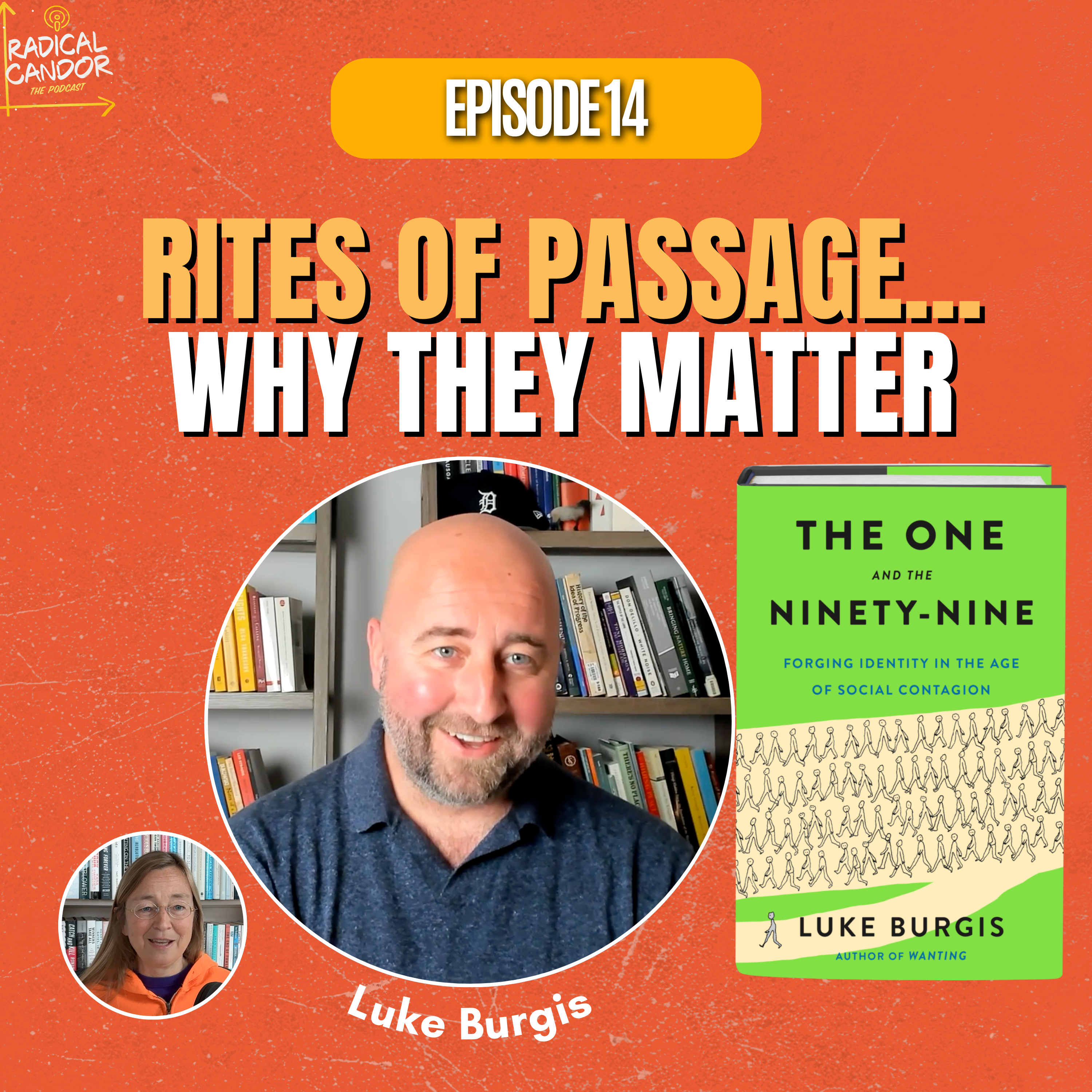
Table of Contents
While the podcast team is taking a Radical Sabbatical, Kim is interviewing authors of the books that have had a big impact on her in the past two years.
On this episode of the Radical Candor Podcast, Kim talks with Luke Burgis about his new book, The One and the Ninety-Nine, Forging Identity in the Age of Social Contagion. Through stories ranging from the parable of the lost sheep to August Landmesser, the only person in a huge crowd to refuse to salute Hitler, Luke describes the missing skill that makes real community possible: learning how to remain oneself while staying connected to others. He offers practical, tactical advice for how to recognize false belonging, escape coercive dynamics, and pass through the rites of passage that produce people with integrity and courage.
Watch the episode:
The book opens with two stories that frame everything that follows. The first is the parable of the lost sheep: a shepherd who leaves 99 sheep behind to search for the one who wandered off. Burgis spent years unsettled by the parable's economics — why chase the one percent? — before realizing the point isn't efficiency but love. The shepherd would have gone after any of the 100. Caring for the individual is how you care for the whole.
The second is August Landmesser, a man in Nazi Germany who joined the party for a job, fell in love with a Jewish woman, and was eventually captured in a now-famous photograph: the only person in a shipyard crowd refusing to salute Hitler. No social media, no audience, no reward. Burgis asks the question the photo leaves hanging: what separates Landmesser from everyone else in that crowd? And could any of us do the same?
Georgetown psychologist Murray Bowen realized that individual psychology can't be separated from family dynamics. He coined two concepts that Burgis carries through the book: the solid self — the version of you that holds its convictions under pressure — and the pseudo self, which adapts instantly to whatever others expect. Bowen ran an experiment on his own family, arriving at a holiday gathering determined to speak honestly instead of shutting down. The result was friction, then transformation. When he returned to his Georgetown office afterward, the workplace gossip that used to consume him simply stopped working on him. Kim connects this directly to what she calls Ruinous Empathy: the family-origin pattern of keeping the peace at the cost of telling the truth.
Burgis, a professor at Catholic University, argues that graduating from college no longer feels like a rite of passage. A genuine rite of passage has three stages: separation, a liminal space of discomfort, and reintegration as a changed person. Modern education has flattened all three. Drawing on Marshall McLuhan, Burgis suggests that technology has dulled our senses — the ability to detect truth, read a room, or sense when something is off — and that the best thing we can give students is the restoration of those senses. Kim adds that failure is in short supply in our educational system, and so is independence. Real education, Burgis argues, should feel dangerous. Without genuine ownership and real consequences, students default to the path of least resistance — which is almost always the mimetic one.
Building on his earlier book Wanting and the work of René Girard, Burgis explains how we unconsciously imitate others' desires — especially under uncertainty. At NYU, he abandoned pre-med for finance because the most confident students around him were doing it. He chased Wall Street jobs he didn't want simply because they carried the most social approval. It took a company failure in his late twenties to trigger the rite of passage that education never provided.
The conversation turns to politics, where Burgis traces how our political selves are formed mimetically from early childhood — grandparents' offhand remarks, family dinner-table dynamics — and how returning from three years of reading philosophy on a hill in Rome made American political polarization visible to him in a way it hadn't been before. The antidote isn't to reject tension but to sit with it. As Girard warned, the belief that you can drive out violence with violence — whether through scapegoating or an AI arms race — is the fundamental lie. The solid self emerges not from comfort, but from learning to hold contradictions without fleeing.
[00:05] Kim Scott: Hello everybody and welcome to the Radical sabbatical. The rest of the Radical Candor team is taking a sabbatical, including me. The thing I love to do more than anything else is to read great books. And recently I read the one and the 99 by Luke Burgis and we are lucky to be in conversation here today. Welcome Luke.
[00:28] Luke Burgis: Thanks so much, Kim. It's good to be with you. My first contact with you came, maybe the audience should know, we share the same amazing editor, Tim, is, shout out to Tim, who is humble, great at his job, but he's not a poster, doesn't post a lot. And I happened to see on his Instagram a photo of Tim and you in some idyllic, like cabin, editing one of your books.
[00:37] Kim Scott: Yeah, shout out to Tim Bartlett, who is wonderful. Yes.
[00:55] Luke Burgis: And I called Tim and I was like, Tim, where do we get to the part of the editing process where we're sitting in a place together going through my book? And he's like, well, that was a bit of a special situation.
[01:06] Kim Scott: you know, I have this, I have this she shed in the backyard, which you all are welcome to use. It's basically three sliding glass doors and one big window. And it's a great place to write and think. yeah, yeah. Well, thank you. I'm so excited to talk to you about this book. As our listeners know, there's in radical candor, there's sort of
[01:19] Luke Burgis: It looked beautiful. Yeah, well, thanks for having me on.
[01:31] Kim Scott: a picture of what it means to be a leader. And you are at the center, and then there's your relationships, and then there's your responsibilities. And from the way that you conduct your relationships and your responsibilities, your culture emerges. So I can't think of a better book to interrogate all the parts, but in particularly the you part of that diagram. than the one in the 99. Why don't we start with the title? Why did you call this book the one in the 99? It's the parable, which has always puzzled me and you helped elucidate it. So thank you.
[02:09] Luke Burgis: Thanks. Well, it's always interesting to ask what the original title of a book might've been. We knocked around a lot of ideas. One of mine was the things we have to do alone or something like that. Like, know, when we have to do things alone.
[02:15] Kim Scott: yeah, what might it have been? That's a good question, which I didn't ask. Thank you for the problem. huh. Yeah.
[02:30] Luke Burgis: And because I was wrestling with this tension between the self and the crowd, the individual and groups and the way that we shape groups and groups shape us. And I thought, you know, a lot of the difficult and important things that I've had to do in life, the things that I would call rites of passage, right. I grow up, I mature, I realize things about myself. They were things that I kind of felt at the time, like I was going through them alone. And then I realized that, that's, that's not really
[02:46] Kim Scott: Yeah.
[02:57] Luke Burgis: what the book is about because I'm trying to get to a place where once we've gone through one of those experiences, we come out the other side being in a more mature, healthier relationship with a community, whether that's your family or a group, your workplace or whatever. So like, I'm keep it as the one and of the 99, the most important word in the whole title being the word and actually.
[03:12] Kim Scott: Yeah, yeah. Yes.
[03:24] Luke Burgis: So that it's not just the one, because my message is not like radical individualism or something like that. And then, yeah, and I was inspired by this parable of the lost sheep, which was, if you don't know it, it's this kind of bizarre biblical parable where a shepherd leaves 99 sheep to go in search of the one who wandered off, who was lost.
[03:29] Kim Scott: Yeah, yeah, it's so good. Who wandered off?
[03:49] Luke Burgis: And that parable has unsettled me my entire life. Like it's like, yeah, from an economic standpoint, like, do you really just kind of chase the 1 %? Like who operates like that? And then I was like, you know, but we...
[03:53] Kim Scott: Me too. Yeah. Yeah. And what about all those poor 99 sheep? What like?
[04:05] Luke Burgis: Does the shepherd not care about them? And I've heard a lot of theological high-minded explanations for it and I got to thinking I think this is actually a really interesting kind of parable about sociological dynamics Workplace dynamics what happened to the sheep while it was missing before the shepherd found it did it come back? Why did it go wandering off in the first place? Did it come back different than when it left?
[04:07] Kim Scott: Yeah. Why'd it go wandering off? Yes. Yeah.
[04:31] Luke Burgis: You know, so was like, maybe I can get inside the mind of that sheep a little bit, because I felt like I have been that sheep at various times in my life and, well, story. Yeah, I think so.
[04:36] Kim Scott: Yeah, we all have. That's why the parable resonates, I think. We all feel like it. And one of the things you said that really helped me understand the parable in a new way is that the reason for the parable is that it shows that the shepherd loved all the sheep. Like, he loved, if any one of the 100 sheep had wandered off, he would have gone in search of it. And so caring for the one is how you care for the whole.
[05:04] Luke Burgis: Yeah, and the other kind of precondition of the whole thing is that, is the precondition of freedom where like, it seems like the sheep was allowed to wander off. And if it hadn't been, then you'd be dealing with an issue of like extreme authoritarianism or something like that. That's not the shepherd. No.
[05:12] Kim Scott: Yeah. Wander off. Yeah. Yeah. Yes, there was no vents. And you know what a vent is? A vent is a virtual fence. And now shepherds use vents. put like a collars on all the sheep. And if the sheep wanders too close out of bounds, it gets shocked. There was no vents in this store.
[05:31] Luke Burgis: I had never heard that. don't have a dog as you could tell anymore. But no, there were no vents for sure.
[05:44] Kim Scott: Yes, yes, yes. And then you also pair the story with the parable with the story of August Landmesser, I don't know if I'm saying his name right, who refused to salute. So talk about that and how that ties in with the parable of the sheep.
[06:05] Luke Burgis: Mm-hmm August landmesser is a guy who? By all accounts joined the Nazi Party early in its formation Because he was looking for work and they were the only ones offering jobs and as he
[06:19] Kim Scott: Mm-hmm. Mm-hmm. By the way, let's just, can we just pause on that for a moment? I've get a lot of notes from a lot of people who feel like I'm about to join this company. I think this company is doing evil things, but I need a job. So I think there's a lot of people out there who might connect, even though this is an extreme story, who might connect with it.
[06:45] Luke Burgis: I think so. mean, because most of us, who knows what was going inside his mind at the time. Maybe he thought, I'll just join for a year and then I'm out and I'll get a job and maybe not realizing exactly what he was getting himself into. So yeah, I think it's very relevant to all of us, even though it's a story about Nazi Germany. He joined the party, he was a couple of years in and he met and fell in love with a Jewish woman.
[06:50] Kim Scott: Yeah. Yeah. Mm-hmm.
[07:12] Luke Burgis: and was continually harassed and given a hard time and told, he got engaged to her and he was threatened with imprisonment, he was fined and he realized the tension between this love of his life and the party and he eventually got completely disillusioned with him. The reason that we know his name today is that he was captured in a famous, a now pretty famous photo, you may have seen it where.
[07:27] Kim Scott: Mm-hmm. Yeah. Yeah.
[07:40] Luke Burgis: He's at a rally in a shipyard, Hitler is there, and little did he know that some photographer was up in the stands taking this photograph. And everybody in the crowd is saluting Hitler, and he's standing there with his arms crossed, except him like this. And when I saw that for the first time, because he'd had enough at that point, he just seemed like he just didn't care what the consequences were. When I saw that, I thought, wow.
[07:53] Kim Scott: Accept him. Yeah.
[08:08] Luke Burgis: there was no social media back then. So he certainly didn't do it so that he could be seen and praised for his actions. He probably had no idea that there was a photographer taking that picture in the first place. You know, but but he did it anyway. And he had to be the one quite almost literally, there's probably hundreds of men in that picture. But he had to be the one in the 99. And I was, I don't know, first, I was troubled. I was like, would I have done that? First of all, if I'm honest with myself.
[08:14] Kim Scott: Yeah. Yeah, yeah. Yeah. Yeah.
[08:35] Luke Burgis: what I have done that, knowing what the consequences could actually be. And then what leads a person to be able to do that? I doubt he just woke up and spontaneously was the kind of person with the character that would do that. What separated him from everybody else in that crowd? And I wanted to sort of understand, psychologically, what was going on there. So that kind of opens the entire book as... you know, question that I needed to answer. Like a book kind of always starts with a burning question that you need to figure out for yourself.
[09:03] Kim Scott: Yeah. Yeah. Yeah. And I think it's, that is a lot of people wonder what I have had, what I have had. And even if the consequences, even if there hadn't been consequences, like it's very hard to be the only one in a room of any sort doing anything. Like I just went back for my 40th high school reunion and, and we all had the same haircut. were looking at the yearbook like, Why do we all have to sit like, why did nobody dare to have a different haircut? So I mean, silly example, but it's really hard to, even if there are dire consequences in the situation, and even if it doesn't matter as much, maybe if there are dire consequences and it does matter, it's easier to stand up or harder, I don't know. But I think your book explores all those questions and helps us come out of reading the book with some
[09:57] Luke Burgis: Yeah.
[10:02] Kim Scott: greater confidence that we could be the August landmesser of that time. So thank you for writing it.
[10:10] Luke Burgis: I hope so, because I hope that none of us ever find ourselves in a situation where the consequences could be that severe. you know, on a daily basis, I I find myself getting caught up in stupid things like gossip, right? Or it's just like, you know, I need to, you know, and I go home at the end of it and I'm like, I wasn't particularly proud of myself for just sort of like, you know, passively letting myself get caught up on the stream. So, you know, and when it happens every day, eventually, you know, after a thousand times, it does actually change your character. So I think sometimes we need the extreme examples to see the way
[10:25] Kim Scott: Yeah. Yeah. Yeah.
[10:48] Luke Burgis: that were subtly affected on a daily basis.
[10:50] Kim Scott: Yeah, and also how to figure out when not to pay attention to things. Like when is the right thing not to read that article? Because you're getting pulled into some sort of anyway. Well, let's start where you start, which is the family and the self, which was such an interesting chapter, because certainly I feel like my family is such a part of such a source of strength and support. And at the same time, It was important for me to leave home in order to become myself. So talk a little bit about the experiment that you described that Murray Bowen, was that his name? The Murray Bowen experiment? Bowen.
[11:31] Luke Burgis: Yeah, Murray Bowen was a Georgetown psychologist who is known for applying systems theory to the family for the first time. So he realized in his practice that if an individual comes to him complaining about some struggle they're having in the family, that it was impossible to fully diagnose what was going on without understanding the whole family system.
[11:41] Kim Scott: Yeah. Yeah.
[11:58] Luke Burgis: What shocking like he you know, he had to come to this realization and that was in 60s But and it seems relatively obvious, but everybody had sort of treated it as individual psychology So he was a little bit of a counter to to Freud in a certain sense
[12:02] Kim Scott: Yeah. Yeah.
[12:13] Luke Burgis: So he would ask, well, tell me where are you in the family system? Let's talk about the family dynamics. Do you have siblings? And he realized that in every family, there's an emotional sort of system that because we're part of it from such a young age, we learn certain ways of existing in that system.
[12:19] Kim Scott: Mm-hmm. Mm-hmm. Mm-hmm.
[12:33] Luke Burgis: often to maintain equilibrium and in moments that could create anxiety to sort of lower the anxiety. And in order to do that, we often have to adapt ourselves, right, to what the expectations are of us. know, Bowen tells this story about how he had a work problem in his Georgetown office where
[12:49] Kim Scott: Yeah.
[12:56] Luke Burgis: I use the example of gossip in my life, because I work in a university, it happens quite a bit, happens in every workplace. And he noticed that this was happening in his office. And then he would drive home, about a half hour home at the end of the day, and about halfway through his drive, he would realize that he had sort of completely become somebody else while he was in the workplace. He would participate in it in a way that he wasn't particularly happy of. And as soon as he had a little bit of distance, He realized how silly it all seemed and a lot of the you know, he's all worked up about it when he was in the office and on his drive home he would chill out and He tried to fix that problem and he came to the realization that you know He was working and inventing family systems theory at the same time and he said to himself, you know Maybe I don't have a work problem
[13:30] Kim Scott: Yeah.
[13:50] Luke Burgis: Maybe I have a family origin problem and maybe if I can solve the problem in my own family, I will solve the problem at work. And the problem being his ability or inability not to just melt into some kind of a, you know.
[13:51] Kim Scott: Family. Wow. a dynamic that wasn't expressing who he really wanted to be. Yeah.
[14:12] Luke Burgis: and even what he truly felt, his own convictions. He couldn't even tell the truth, right? So he did an experiment where there was some drama in the family and there was going to be an opportunity where the family was gonna be at the same house. And up until that point, he had sort of operated like the person that's about to go home for Thanksgiving. I don't know what true Thanksgiving's are like, but who sort of is like, this is not gonna be fun, especially after the election or whatever.
[14:31] Kim Scott: Yeah. Yeah. Yeah. Yeah.
[14:41] Luke Burgis: And you know, I'm just gonna kind of shut down. I'm just gonna like emotionally shut off. I'm just gonna shut off my brain. I'm gonna shut off everything. I'm just gonna sit there. I'm gonna eat my turkey. I'm gonna get through it. Maybe have a third glass of wine and then I'm go home. And he realized that he had sort of been, or I'm just gonna say whatever I need to say to make Uncle Jim happy.
[14:50] Kim Scott: Maybe have a third glass of wine.
[15:02] Luke Burgis: and to just stop talking about that. And he realized that he'd been doing that his entire life and the pressures in his particular family were very, very sort of strong. And he said, you know, this time I'm going to go into that reunion as what he calls a solid self, right? I'm gonna try to stay a solid self as opposed to melting into what he calls the pseudo self, which is.
[15:11] Kim Scott: Yeah.
[15:27] Luke Burgis: the version of ourself that will just instantly change and adapt to whatever somebody else expects. He said, if I can do it once in my family, I know that it will probably cause friction and tension, but I have to do it. It's like a healthy tension and friction. I need to be the one to do it. I don't think anybody else is going to do it. And he did it. had a very particular strategy for doing it, which I walked through in the book.
[15:30] Kim Scott: Yeah. Yeah. Yeah. Mm-hmm.
[15:52] Luke Burgis: And after he did it, he said he was able to actually go into his Georgetown office as more of a solid self that didn't get swept up in the current of gossip. So, you know, there's this whole debate about taking your whole self to work, which I know you've written about and spoken about. And I think what I learned from Murray Bowen was like, well, maybe we don't have to take our whole self to work. It's probably not always a good idea. But I think that I should take my solid self to work, which is...
[16:09] Kim Scott: Yeah. Yeah, you want your best self, maybe even. Yeah, yeah, yeah, not your worst. Yeah, and I think it's so true that this, I mean, it's true at work, but it's also probably more true in family dynamics where there's this notion of false harmony or what I call ruinous empathy that kind of gives way over time to what I call manipulative insincerity and radical candor. And I think that that
[16:22] Luke Burgis: Which is different. Yeah. Yeah. Yes. My best self.
[16:51] Kim Scott: I don't think I would have managed to get married if I hadn't used what I was learning about management at work to get out of a bad romance and into a happy marriage, you know? Because it's very hard when you're used to, like my role in my family, I was the peacemaker. And that meant I didn't always tell the truth, but I didn't always say what I really thought. And I had to learn how, and not, There was nobody explicitly saying, I don't want to hear what you really think, Kim, but it was like a version of self-censorship.
[17:26] Luke Burgis: Yeah, yeah. And I mean, I'm an only child too. So I think, you know, the way that Bowen would see that is like an only child that has a very, he's really enmeshed, because it's just the three of you, right? Like really, really enmeshed in the parental dynamic, right? You are the triangle, right? I mean, and then when there's one sibling, his whole theory kind of is founded on the idea that we're in emotional triangles usually, right? Like there's always a third person.
[17:39] Kim Scott: Yeah. Yeah, yeah, yeah. There's a triangle. Yeah. Yeah. Yeah.
[17:55] Luke Burgis: Involved right like whenever there's something going on between two people we draw in a third person in order to resolve the tension And isn't that exactly what gossip is? It's like if two people can't talk to each other. They instinctively have to go talk about something else you can
[17:57] Kim Scott: Yeah. Yes, yeah, yeah. They talk about the person. Yeah, not to, but about, yeah, yeah, yeah. so I love, there's another, I wonder what you think about this. I recently talked to Tom Rath about his new book, What's the Point? And he said that one of the dangers in embarking on a new career as a young person kind of starting out is that you're familiar with what your parents did and maybe a few friends of your parents. So you're familiar with like, six jobs, but there's lots of different career paths. And because you don't break free of that family system and like explore the big world, you limit yourself. To what extent is that part of this breaking free of the family in order to become a robust self?
[18:57] Luke Burgis: I mean, it's huge. One of the many hats that I wear is as a... college professor at a university. And I have a lot of freshmen and I have 30 students that I advise in any given semester. And the number one thing we talk about are jobs and career paths. And it is shocking how much parental expectations come up. And they really just know the one or two jobs that they see in their family of origin. It really kind of forms their universe of what
[19:02] Kim Scott: Right.
[19:30] Luke Burgis: they actually seen. And I sort of tell the students like, you know, there's a lot of jobs out there, even though everything's changing a little bit right now in particular, it's kind of a scary time.
[19:30] Kim Scott: Yeah. Yeah. Maybe it's a liberating time. Like you don't have to get on some path you don't want to be on because it may be worth worthless. This is what I tell my kids anyway. So you may as well do what you enjoy because who knows if what you don't enjoy is going to have any value.
[19:53] Luke Burgis: Yeah. Yeah. And one of the exercises that I will often give them is do something that you enjoy. And if you're trying to decide between two or three different things, it's not the most pleasant experiment. if neither one of them really worked out, let's say it didn't become your career. Let's say they were both complete failures, the kind of thing you didn't even want to put on your resume or something like that. Which one would actually contribute the most to you growing as a person, right? If the professional metrics were like zero, like let's just set that to zero, not that we want that to happen. And it's actually like a really helpful kind of like Occam's racer for making decisions if all else is equal.
[20:26] Kim Scott: Yeah. Yeah. Yeah. Yeah, you're actually describing my career because for the for the longest time, the thing I most love to do was to write novels. And I had a big fat stack of rejection. So it was contributing zero to my ability to earn a living. You know, I just had nothing but a set of a bunch of failures from that. But I kept doing it because I love doing it. And
[21:03] Luke Burgis: At age in your career were you writing these novels?
[21:06] Kim Scott: I started early. In fact, I think I wrote my first one in 1999, so a while ago. And I decided 1999 was going to be the year of my fantasy when I did only what I wanted to do. And so I quit my job and the economy's chugging along and people are like, what are you doing writing a novel in this economy? But anyway, I did. And I'm glad I did because it... even though it eventually led me where I wanted to go. So I had this, on the one hand, this thing I was doing all the time. While I was working at Google, I was writing a novel. I was always writing a novel. And I always felt like that it was 100 % intrinsic validation and 0 % extrinsic validation. And I wouldn't say my, I mean, I did like. working at Google. So I wouldn't say it was exactly the opposite. It wasn't 0 % intrinsic validation, but there was a lot more extrinsic validation than intrinsic in my, in my, in my career, for much of my career until Radical Keener came out.
[22:12] Luke Burgis: Yeah, I mean, I'm so inspired to hear that, especially that you did that while at Google. I've always wanted to write a novel and I've never had the courage to publish. I've got like a bunch of drafts and now I've made the mistake of writing a couple serious nonfiction books, which I think is like to go, now I got to go from that into getting back into that like youthful imaginative. There's probably a reason why many novelists are on the air, but there's still a chance, still a chance.
[22:32] Kim Scott: Yeah. Yeah, no, absolutely. There's still a chance. And maybe you'll pull one of those old ones out of the drawer and get it published. I'll certainly read it. I love your writing. So that's exciting. All so now let's talk about education and the self. My kids are juniors in high school. This chapter really resonated for me because my kids are juniors in high school. I think I was never more stressed than when I was a junior and senior in high school.
[22:44] Luke Burgis: Yeah. Thank you. Appreciate it.
[23:04] Kim Scott: And it's worse now, way worse now than was then. And so I've been thinking a lot about the ways in which our education system and the pressures that the whole college situation puts on kids. It makes it really hard for them to become themselves. And the other day I was watching The Val, which is this Netflix documentary about a cult, the sex cult in ex IBM or something.
[23:33] Luke Burgis: yeah, yeah, yeah.
[23:34] Kim Scott: it has, it's, I can't pronounce it, anyway, part, yeah, yeah. the part of the cult leaders strategy for control was to keep people so busy that they didn't have time to think for themselves. And there's this one scene in, in the show where they're, they're playing volleyball. mean, it seems kind of innocuous, but this volleyball game was like a source of control, because.
[23:37] Luke Burgis: that's the end or something.
[24:03] Kim Scott: they were doing that instead of sleeping. They had to play volleyball at like 2 a.m. But I feel like we're kind of doing that to our kids with, I know this isn't exactly what you were writing about with education, but I feel like one of the problems with our education system is that it doesn't give kids time to, as my grandmother would say, rusticate. Children need time to be themselves.
[24:26] Luke Burgis: Yeah, you know, as one who struggled in school my whole life, I got kicked out of one of my high schools. I was bored out of my mind.
[24:36] Kim Scott: Okay.
[24:40] Luke Burgis: And now I'm a professor and I'm part of a university. I think about this question all the time. And I've been, as you know, from reading the chapter, I have been influenced by Marshall McLuhan quite a bit, who says, you know, the medium is the message and.
[24:44] Kim Scott: Yeah. Mm-hmm. Yeah. Boy, that is never has that been more true than today.
[25:00] Luke Burgis: Yes. And, you know, he wrote quite a bit about education in a digital world and tells this interesting story that I can't get out of my mind about how some kids in Southern California were dropped out of school. I think they were in Watts and they were interviewed and they sort of explained their
[25:06] Kim Scott: Yeah.
[25:23] Luke Burgis: reason for doing it. It wasn't like a rejection of the school. was like we were letting our education get in the way of our education and we're learning a lot more out here in the world where every day feels like an adventure. And I don't think we should discount that.
[25:37] Kim Scott: Yeah. Yeah.
[25:47] Luke Burgis: in the world that we're in, I I think like the internet caused massive problems to traditional forms of education because, you when the kids are on the phone or they're tempted to be on the phone in the back of the classroom, it actually is for a relatively good reason. And that's that, first of all, like the lecture might suck, but you know, this thing that we have in our pockets actually does give us access to a lot of fascinating like information out there and we can go on and choose your own adventure.
[26:17] Kim Scott: Yeah.
[26:17] Luke Burgis: where we can go learn about anything that we want. we can, you you've got 12 year olds becoming entrepreneurs. I mean, that is really, really exciting. And that quite frankly is what our education system is competing with, you know, it's competing against that. you know, the book is kind of about, you know, we're, how can we have a healthy posture against some of the homogenizing forces in the world?
[26:29] Kim Scott: Yes, yeah, yeah, yeah.
[26:43] Luke Burgis: And I think like one of the ways, especially in a technological environment that we're all in, McLuhan is saying that, know, we need to, technology always sort of dulls one particular sort of sense. when we're using it and we sort of need to Reacquire like a sensory perception we need to train our senses so that we can make sense of the way that our of the environments that we're moving in and out of the way in which they're affecting us and If we're just talking about facts and information all the time if that's all education is and we're not training people to perceive the way that they are being affected or the environments that we're in, we're not actually educating students for an uncertain future. Like the best thing that I could give my two daughters is the ability to sort of sense the world around them and what's going on and not have their senses dulled. And for me, that's the impetus behind the bad unhealthy uses of smartphones in the classroom. Like to the extent that it's dulling the senses, it's bad.
[27:49] Kim Scott: Yeah. Yeah, there's no smell. There's no, there's, there's no like natural sounds. There's no bugs and birds. I mean, unless you go to one of those sites that gives you bird song, but you're not getting the kinds of senses that our minds and bodies evolved to need.
[28:00] Luke Burgis: There's yes. And even the sense of discerning what's true. So if you look at a social media platform like Twitter, I still call it that, The way, yeah, X is a stupid name. Such a dumb rebranding. We see this information. Yes, Twitter, in peace. The way that...
[28:28] Kim Scott: Twitter. Let's call it Twitter. Let's rebel. Yeah. We'll call it Twitter R.I.P.
[28:44] Luke Burgis: even truth is evaluated on that platform is totally different than the way that it was for centuries, right? It doesn't seem like it is most of the time, but that's also like people would look into another person's eyes and they would sort of evaluate their, like we've just sort of in a scrolling kind of feed like environment, even the sort of, not even just the physical senses, but sort of like the,
[28:52] Kim Scott: Is it evaluated on that platform? No, I think it's not evaluated. Yeah.
[29:13] Luke Burgis: the more holistic, like sensing the truth, like even those things, like all of the little subtle cues that we pick up on are really missing.
[29:19] Kim Scott: Yeah. They're gone, yeah. Because it comes up to a thumbs up or thumbs down or hard or not hard or whatever, very simple. And it turns out that when you think about the difference between writing something on Twitter and saying something at a dinner party. So if you're at a dinner party and you say something sort of ridiculous and extreme. You're going to get a lot of eye rolls and you're going to notice those people are going to, you're going to sense it. Like not only are you going to notice the eye rolls, but you're going to sense the disapproval in the room. Whereas on Twitter, all you get is the one person who's like, Whoa, I got to pay attention to that. it's six, which is why it moves us towards extremism.
[30:10] Luke Burgis: Yeah, absolutely. And it's just a day after day where we're not exercising that. John Henry Newman used to call it the illative sense where, you know, it's like, can't explain why you know something is bullshit or why you know it's true because it's like, it's like fit 40 or 50 small signals are all converging on this one thing, you know, and that's that that's what I'm worried we're losing. education somehow has to kind of restore that. And that is that is something that is kind of.
[30:23] Kim Scott: Yeah. Yeah. Yeah. Yeah. Yeah.
[30:38] Luke Burgis: And if our education system is not giving it to students, we need to find ways to give it to them. I think it's probably why homeschooling is on the rise, right? Like exposing students to one of the reasons, yes. Yeah.
[30:44] Kim Scott: Yeah. Well, that, that, that's one of the reasons. not the only reason. I think also when, at least when I started at Google back in 2004 and I was leading AdSense, an AdSense team. And so for folks who don't know AdSense is where you put Google put ads on other people's websites. And I really believed at the time in the the long tail, which has since been disproved. I didn't understand that the internet and social media, well, social media didn't even exist then, but it was about to exist. But all of these things have a rich get richer algorithm. And I thought there was a long tail and more people were going to go find what they really wanted. And instead, these platforms have made us all want the same thing, going back to your previous book, Wanting.
[31:37] Luke Burgis: Yeah, and I gave Google AdSense a lot of my money in 2004 and five, which is when I was launching an e-commerce company and that was the way to grow at the time. It worked until it didn't too, until it got very expensive.
[31:42] Kim Scott: Ha! Yeah. Yeah, yeah, yeah. It worked. I mean, it worked for one thing, but it didn't. Yeah, yeah, yeah, yeah. So you talk about three sort of antidotes to the problems of education. There's sort of rites of passage, replacing a quest for more knowledge with sort of space and time to think deeply, and leisure time, I'll call it. So explain what you meant by those antidotes to our educational system, which is sort of failing us.
[32:25] Luke Burgis: You know, I think that rites of passage, let me just focus on that one because I think that this most important one
[32:29] Kim Scott: Okay.
[32:32] Luke Burgis: know, graduating from college for me and I think for a lot of my students, does no longer feels like a rite of passage. And I'm a little clear on when it stopped being one, I think when it just sort of became a certificate. And, you know, a rite of passage has three stages. The first stage you sort of have to separate.
[32:39] Kim Scott: Mm-hmm. Mm-hmm.
[32:56] Luke Burgis: and enter what's called a liminal stage where you sort of feel alone. And this is why initially it's sort of the book is gonna be the things that you must do alone before you are sort of reintegrated back into a group. And I think like the rites of passage, and I don't mean rites of passage like going from third grade to fourth grade or fourth grade to fifth grade.
[32:59] Kim Scott: Yeah. Yeah. Yeah. It's becoming an adult. like a, used to be almost what Bar Mitzvah is and, you know, except five years later.
[33:31] Luke Burgis: Yeah, yeah, totally. the rites of passage in, we're losing rites of passage not only in education, but in a lot of parts of our society. One of the ways that I think a rite of passage shows up or should show up in education is that we try to, this is why think entrepreneurship is a really important part of education or why.
[34:01] Kim Scott: Mm-hmm.
[34:02] Luke Burgis: you're seeing or we're seeing a lot of sort entrepreneurial schools because somebody is sort of doing applied knowledge applied to a problem that they see in the world, learning as much as they can to sort of like tackling it as a mission and trying to build a real thing so they're invested in it and either succeeding or failing. And the process of going through that, like getting invested, having skin in the game.
[34:07] Kim Scott: Mm-hmm. Mm-hmm.
[34:30] Luke Burgis: trying to solve like a real problem and sort of having the education be context-dependent is a kind of rite of passage that sort of enforces the student to enter a place where they are taking ownership of something, like complete ownership of something. And I think like one of the problems with education and one of the reasons why I was so bored is like, I didn't feel like I had ownership of anything. you know, if I, it sucks to feel like, you know, if I don't, if I don't show up for a week, you know, nobody's going to miss me and nothing will change whatsoever. Right. So, and that's, so I think like there's, there's ways to integrate these little rites of passage where there is kind of the separation, the liminal state.
[34:51] Kim Scott: Yeah. Yeah. Yeah.
[35:18] Luke Burgis: and then the maturation at the end of it, little by little. mean, I don't know, week by week, month by month, or whatever, where people are sort of taking a risk, they're taking ownership. It's scary. Education should be scary. It should feel dangerous. And that's kind of what I'm trying to say. We need to find ways to make it actually feel dangerous again, because if it doesn't feel dangerous, eventually you're not learning and you're not gonna continue.
[35:34] Kim Scott: Yeah, it should be. Yeah, yeah. You're not learning anything, Yeah, yeah, yeah. And you're not you're never going to succeed. Like if you're guaranteed like I think that failure is in short supply in our educational system. And so is independence. I mean, for me, think graduating from college meant that I needed to figure out how to earn a living like that. That's what it meant. I was not. And the economy was such that it wasn't unreasonable for my parents to say, you're not coming back home. You you've got to go figure out how to pay the rent. I'm not sure I'm going to be able to, you know, I don't know. I don't know if it's going to be possible. And so then what does it mean? Yeah.
[36:28] Luke Burgis: I mean, at times of uncertainty, we become hypermimetic. it's like mimesis, and this is, wrote my first book called Wanting, which is about mimetic desire, the way that we usually unconsciously imitate the desires of other people. And when we're feeling uncertain or a little scared, we default to imitating what other people are doing, right? So like for me, what that looked like was entering college and majoring in what,
[36:48] Kim Scott: Yeah. Yeah.
[36:57] Luke Burgis: the most confident students around me were majoring in. It was finance. So I went to NYU undergrad business school, but I applied for college as a pre-med major. And I got there and the mimesis was so strong that I immediately changed. I competed for the best jobs on Wall Street. I got one because I was
[37:02] Kim Scott: And what was that? Uh huh. Okay. Yeah. wow. Mm-hmm. Uh-huh.
[37:25] Luke Burgis: I'm because I'm fiercely competitive and I'm pretty good at math. but I really, really hated my job. So I was like chasing all of these because I think things that I didn't really want. when, when there are, when we lack those kinds of dangerous rites of passage where people can take real on it, we just default.
[37:28] Kim Scott: Yeah. Yeah. Yeah. Things you didn't really want. Yeah.
[37:45] Luke Burgis: to doing the easy thing, which is often the mimetic thing. And it usually takes something that happens to us. I mean, for me, it was in my late twenties that kind of wakes us up and makes us realize like, you know, I was just kind of coasting and doing what I had sort of the most approval to do up until now. And that's kind of when I actually, my education started when I was 28, 29 years old and I had a company fail. But I wish it would have happened like 15 years earlier.
[37:47] Kim Scott: Yeah. Yeah. Yeah, yeah, yeah. And I think you also said that to a certain extent, becoming an entrepreneur was a bit of a memetic thing. Like at a certain point you had to leave it also.
[38:26] Luke Burgis: It was, you know, and part of, you know, what Renee Girard says about memetic desires, we have an idea that we have authentic desires and it's radical message is that. We're social creatures and we learn through imitation and we even acquire our very desires through contagion sometimes, good or bad, by the way, right? And this idea of the authentic self or the authentic desires.
[38:39] Kim Scott: We don't know it, yeah. Yeah. Yeah. Yeah. Yeah. Not always bad.
[38:57] Luke Burgis: Um, is, is itself, um, you know, often, often an illusion and there's nothing wrong with that, right? With, with like owning that, that fact, right? So yes, I mean, when I looked back at it, I left my job, uh, in investment banking to go to a startup, which in 2005, it wasn't really that cool, especially because mine was a healthy vending machine company. So there's nothing, nothing cool about that. My, my managing director boss was like, you're out of your mind. You'll never work on wall street again. And I was like, I think this is gonna, it's what I gotta do. I was like, fine.
[39:03] Kim Scott: Yeah. Yeah. Awesome. Yeah.
[39:27] Luke Burgis: But, and I didn't realize this until years later, that the reason that I did it was because somebody else in my group had left to start a company before I did. And I couldn't even, and it was massively influential on me. Like I don't know if I would have done it or had the courage to do it if that person hadn't done it first. And I don't even know if the thought had really crossed my mind until they had done it.
[39:38] Kim Scott: Yeah. Yeah, yeah, it's really interesting. thought I was doing so I my first startup was in 1999, a little older. And I thought that I was really, you know, bucking and but I of course was jumping on a bandwagon. But I thought I was bucking a trend, you know. And that is often true. And I'm glad I did. But, you know, it's also useful to realize. When we think we're doing something so new, it may not be so new after all. And you talk a lot about mimesis when you talk about politics of the self, which is where it probably shows up right now more acutely than anywhere. So talk about how to break free of political mimesis.
[40:44] Luke Burgis: I think that I don't don't you know, there's not an easy answer to that question What what I what I'm trying to do is show Maybe the way that the political self can can be formed in the first place And if we can become aware of that a little bit Sometimes we just have a little more self-awareness about our political self and people have
[40:49] Kim Scott: No, no, there's not, but you do wrestle with it. Mm-hmm.
[41:11] Luke Burgis: greater or lesser sort of senses of self that are tied specifically to politics. And, you I'd be lying if I said it wasn't part of the reason that I wrote the book, right? I I lived in Italy from 2013 to 2016.
[41:21] Kim Scott: Yeah. You came back to a country that probably felt unrecognizable.
[41:28] Luke Burgis: I lived on a hill in Rome reading philosophy every day for three years. I wasn't online. I wasn't really on social media. And I came back to the States in June, 2016. And I felt like I was like a fish out of water. was like a very bizarre experience for me. And I did notice that everything was politics all the time. In a span of three or four years, something had actually changed.
[41:30] Kim Scott: Yeah, yeah, yeah. Wow. Yeah. Yeah.
[41:55] Luke Burgis: And that even friends that I had, their self was more bound up with politics than ever before. know, Burgis, like you need to get way more invested in this, you know. And let me figure out what's going on. And I think like in the last 10 years, probably even worse. So, you know, in the book, I sort of traced this concept of the pseudo self and the solid self that we talked about earlier, that, you know, from Murray Bowman's Family Systems. Like, how does that play out in politics, right?
[42:07] Kim Scott: Yeah. Yeah. Yeah. Yeah.
[42:27] Luke Burgis: And is there, Eric Hoffer wrote a great book in the 1950s called The True Believer. you know, yes, it was super influential on me. And he says, oftentimes people join mass movements.
[42:36] Kim Scott: Yes, that is really, it's a remarkable book.
[42:45] Luke Burgis: To flee an unwanted self and when I read that I thought huh, I was like, I wonder if there's some connection between the pseudo self and sort of like attraction Right to strong men or to you know to certain political movements or something like that and then I thought back to you know mimesis and mimetic desire and It is true. Girard is correct
[43:01] Kim Scott: Yeah.
[43:10] Luke Burgis: We are subtly formed, our desires are subtly formed from a very early age. Our ideas are formed through all these different forces and people that we usually can never name. there's a certain sense of political self that is formed from a young age, largely through mimesis. I have very early memories of just like being at my grandmother's house and little things that she would say would sort of... definitely contributed to because I was so young, right? Like this is very impressionable on me when I would hear the parents say things. And then, you know, we sort of get to a point most of us in our lives where we are either start reading, where we go into a different environment, maybe it's college, maybe it's our first workplace, and we start to encounter people that
[43:54] Kim Scott: Mm-hmm. Mm-hmm.
[43:59] Luke Burgis: grew up in very different situations than us. And I sort of say, you know, in the book that any of these things, this is not a politically coded thing at all, sort of goes just back to the matrix. Like there are these sort of like red pills that just, they're just the things that.
[44:13] Kim Scott: we should call them like green pills and orange pills or something. Because the black pill, yeah, yeah, yeah. But it's not nothing about Democrat or Republican.
[44:16] Luke Burgis: Well, now there's like, the internet has like 15 different kinds of bills, right? So we, it's nothing about it doesn't mean, it doesn't mean conservative or Republican. A red pill in the matrix is just a thing that you encounter that makes you question like everything that you thought you knew, all these assumptions that you have. It's like, yeah. And it is kind of like an anti-mimetic thing that happens where it's like, now I have to like sort of wrestle or confront this new,
[44:30] Kim Scott: Yeah. It's like waking up from the dream that you've been.
[44:46] Luke Burgis: great book that I read, right? For many people, it's like they read, I don't know, Dante or whatever, something for the first time. And it's like, then you somehow have to reconcile that with the kind of mimetic, mimetically formed things and you have a decision to make, right? And then you have to figure out how to integrate that or you will feel very disintegrated. And there are a couple of ways to deal with that weird feeling of encountering these new things. One, you can just reject them completely.
[44:47] Kim Scott: Yeah. Yeah. Mm-hmm. Yeah.
[45:15] Luke Burgis: or you can sort of actually sit with the tension and find a way to sort of be with other people and in society in a productive way without running or something like that.
[45:28] Kim Scott: Yeah. Yeah. Yeah. Yeah.
[45:31] Luke Burgis: And if there's one thing that I've was that the core of everything that I'm writing about is that we often flee tension at the very first stages of it. Like we flee tension in politics. We flee tension in religion. We flee tension in the workplace. We don't like tension and anxiety. That's normal, right? But if we're able to do a little bit more of that as individuals and frankly, as a society, we can sit in the tension and don't let the algorithm sort us into these fantasy land. where we just listen to things that we want to hear, we will be better for it. Like that is how the solid self emerges. And I was like, I can't write this book without having a chapter on politics, or I would be like, honestly, everybody would be like, what's up, Burgis? Like, you don't want to touch that? So I tried to do it in a way that was a little bit more.
[46:11] Kim Scott: Yeah, yeah. Yeah. Yeah. That was inviting, that was inclusive of everyone, no matter what they might believe. yeah. Can I ask you a question about Girard and Peter Thiel? Maybe to veer into a place where maybe not everyone will agree. But it seems to me, I'll just share my opinion. It seems to me like Girard, if I understand his writing, there were two things that were very dangerous that he warned about. One was mimetic desire, and two was violence.
[46:23] Luke Burgis: of everybody.
[46:48] Kim Scott: And mimetic desire is often a way to avoid violence, but it creates a whole other set of potentially worse and more devastating problems. that, did I get your art right or am I totally wrong?
[47:00] Luke Burgis: Um, he, he, he sort of drew a connection between mimetic desire leading to rivalry, um, which then spread in larger conflicts, which was resolved, right? By some violence against a scapegoat. Yeah.
[47:08] Kim Scott: And then we used the scapegoat. Yeah. Right. So I'll just, again, at the risk of totally misinterpreting but simplifying. Two bad things, mimetic desire and violence in his writing. Is that more or less fair?
[47:30] Luke Burgis: I think mimetic does have that. Sure, let's run with that. Yeah, that's fair enough.
[47:33] Kim Scott: Mimetic desire is dangerous. It's inevitable, but you also need to be aware of it if you're not going to be entrapped by it.
[47:37] Luke Burgis: Thanks. Yes, think, mimetic desire is dangerous is a totally fair statement because especially if we're not aware of it, it almost always ends up in conflict.
[47:50] Kim Scott: Yeah. And it's also sort of what Robertson, there's a great quote from Robertson Davies, one of my favorite novelists who said, if you're not consciously aware of your beliefs, you can be sure that some not very creditable belief will seize you, you know? And I think that's the danger of mimetic desire and also mimetic politics is. So why is it that
[48:07] Luke Burgis: Yeah. Yes.
[48:18] Kim Scott: that his most famous acolyte, Peter Thiel, is investing in violent and mimetic desire. Between Palantir and Metta. What's up? It seems like Jard was warning these things are bad, and then Peter Thiel is doubling down on them. What's going on?
[48:31] Luke Burgis: Yeah. I mean, I'm not in Peter Thiel's head. think like Metta was an investment in memetic desire as a profitable, like, you know, this is a platform that sort of.
[48:50] Kim Scott: Yeah.
[48:54] Luke Burgis: Potentially makes them medic desire very profitable and maybe right. I'm just just pure speculation like mimetic desire just is You know, we can't you know, we can't really make it go away. We're memetic creatures. We always will be here's a business that That gives it an outlet to sort of live online and you know, that maybe was more of like a pure, it's going to work because it amplifies Mimesis. Therefore it's going to work and you know, with my VC head on this will, this potentially would be a very profitable investment. The Palantir question is a very different one because it's just a very different company than Meta is, right? It's literally engaged in intelligence to support war efforts and...
[49:32] Kim Scott: Yeah. Yeah.
[49:49] Luke Burgis: It's very mysterious. mean, I...
[49:52] Kim Scott: It's hard to reconcile with an acolyte of Girard to me.
[49:58] Luke Burgis: I mean, I have asked myself like if Girard were alive today, like what would he?
[50:02] Kim Scott: he'd be screaming and yelling and pulling his hair out and saying he'd be I think but maybe I believe what I want to believe.
[50:08] Luke Burgis: I, yeah, no, I don't think so. I mean, I think it's very fair because the lie for Girard was always that you can prevent or solve the problem of violence with violence. That is what the scapegoat mechanism is, quite literally. It's like if we just kill this one person, we can bring peace to the society. So it's.
[50:24] Kim Scott: Yeah, yeah, yeah. yeah. Well, yeah, the rest of us can get along.
[50:35] Luke Burgis: So it's very curious that the way to, my understanding is we're sort of in a new arms race now and instead of nuclear weapons, it's AI instead, right? And if we just sort of out AI China, then the world would be safer. I don't think that that's true. And I think that it does sort of fundamentally...
[50:46] Kim Scott: yeah. Yeah, yeah. I agree.
[51:02] Luke Burgis: push against with like one of Girard's fundamental things is that the satanic lie literally says it's satanic is that you cannot drive out violence.
[51:08] Kim Scott: Yeah. Yeah, yeah, yeah. Anyway, well, we could talk for another two hours about that. I want to read sort of the last line of your book, because it's so beautiful. And I think that it sort of helps people know where all of this leads. You're describing your father who's moved into, an assisted living facility and he's not happy about it, which is I think an experience that so many listeners can share. and he says, well, maybe it's not supposed to be comfortable in life. These things take work. And I think that that's such a beautiful way to end the book because it does take work and it is profoundly uncomfortable to become yourself, but it's worth it.
[52:10] Luke Burgis: Yeah, thank you. Yeah, there's a story of my relationship with my dad that runs throughout the book, which I wasn't expecting when I started to write it. It's not even in the book proposal, you know? Like none of the stuff about my dad was in the book proposal in any way. And then this weird thing happened when I started to write it. And I realized that my dad, my becoming the full-time caregiver for my father,
[52:15] Kim Scott: Yeah. Wow, that's amazing.
[52:36] Luke Burgis: Um has taught me more in the last few years. It's been my own rite of passage. First of all, um, uh, has forced me to be in a liminal space of my own. And my dad is very weird, curious thing where I had to move my dad has been very independent his whole life into an assisted facility home. He's now at a VA, um, facility and he, he was just thrust into a community with a bunch of strangers, you know, in his, in his late seventies, right? It's incredibly
[52:41] Kim Scott: Yeah, yeah. Yeah. Yeah.
[53:06] Luke Burgis: jarring. And this all happened after I'd conceived the book. And I was like, wow, like, in my very life right now, like, my dad is like living the very tension that I am trying to like figure out for myself and in the world. And, and he made me realize like,
[53:18] Kim Scott: Yeah.
[53:28] Luke Burgis: If we're looking for a perfect home or a perfect community or a perfect workplace that is free of tension and friction where we get along with everybody, it just doesn't exist. You're going to be severely, severely disappointed. But if you begin to sort of see that very kind of tension as an opportunity to develop thicker, deeper relationships, I can tell so many stories about my dad's facility and like the... ate lunch there like every day for a few months. I spent a lot of time there. And just to sort of like see the way that he has changed from when he first got in there, is now friends with these guys that he, you know, like who is this guy, you know, when he first got in there. And despite his advanced Alzheimer's, you know, I'm seeing something play out in his relationships and his ability to sort of be there. He doesn't really have a choice, you know, his ability to be there.
[54:01] Kim Scott: Yeah. Yeah. Yeah.
[54:25] Luke Burgis: which is quite beautiful and profound. And quite frankly, I've learned a lot from it, which I tried to end the book with a bit of tension, right? Because that's the whole point of the book is that this is part of what we have to learn to do if we want to belong without losing ourselves. We need to get used to the feeling that other people are different from us. We need to learn to be in relationship with them. And communion is a really hard.
[54:34] Kim Scott: Yeah. Yeah.
[54:54] Luke Burgis: to get to, but the work is really worth it.
[54:56] Kim Scott: Yeah, absolutely. I think it's a little bit like at the risk, I'm going to take a risk. I'm going to quote Rudyard Kipling, who someone said, you can't quote Rudyard Kipling anymore. And Rudyard Kipling got a lot of things wrong because despite his many efforts, he was never quite able to break free from his thinking about the tyranny of empire. But he did try. And one of the things he said was, the strength of the pack is the wolf and the strength of the wolf is the pack. And there's a lot of tension in that statement. sort of living with that tension and allowing that friction to create a pearl of great price rather than just a blister on your toe is what it's all about. And sometimes you might have to get that blister on your toe in order to get to that pearl of great price. Well, Luke, thank you so much for the conversation. Where can people find you? And when can they buy your book?
[55:46] Luke Burgis: Absolutely. Thanks so much for having me Kim book is out June 16th in the US and the UK and you can find me at Luke Burgis comm
[56:06] Kim Scott: Amazing. Thanks so much. Take care.
[56:07] Luke Burgis: Awesome. Thanks so much.
The parable describes a shepherd who leaves 99 sheep to search for the one who wandered off. Luke Burgis uses it to illustrate that caring for the individual is how you care for the whole community — and that real belonging requires the freedom to wander and return changed.
Murray Bowen's concept distinguishes the solid self — the version of you that holds its convictions even under social pressure — from the pseudo self, which instantly adapts to whatever others expect. Burgis argues that developing a solid self starts in the family system and carries into every workplace and political context.
Burgis describes how, at NYU, he abandoned pre-med for finance simply because the most confident students around him were doing it. We unconsciously imitate others' desires, especially under uncertainty, and often don't realize it until years later when a failure forces self-examination.
Rites of passage — separation, a liminal stage of discomfort, and reintegration as a changed person — have been flattened in modern education. Without them, people default to mimetic choices and never develop the ownership and resilience that come from real risk and real failure.
Girard showed that mimetic desire leads to rivalry, which escalates into conflict, which societies historically resolve through violence against a scapegoat. Burgis applies this lens to modern politics and technology, arguing that the belief you can drive out violence with violence is the fundamental lie Girard warned against.
Three ways to put this into practice.

Holiday communication with your family can be rife with stress. And while you love your family, let’s be frank, family togetherness during the...
While the podcast team is taking a Radical Sabbatical, Kim is interviewing authors of the books that have had a big impact on her over the past two...

On this episode of the Radical Candor podcast, Kim, Jason and Amy discuss how the fundamental attribution error makes us more likely to use...
Share your perspective
Leave a comment below.